Consulting the Oracle

sfo01.jpg

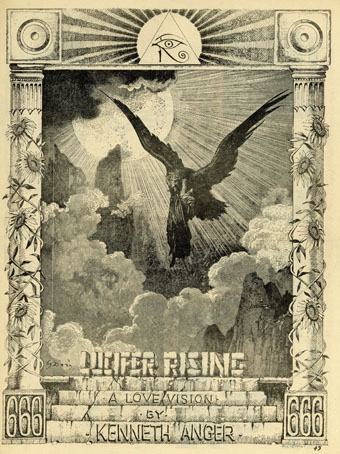
Good to find such a pristine reproduction of this Rick Griffin poster. Kenneth Anger commissioned the design in 1967 when he was putting together a package of promotional items to stimulate the interest of potential investors in his new film. Bill Landis in the unofficial Anger biography says the ploy was a successful one, investors were forthcoming although it would be several years before Anger had enough footage for the ill-fated first version of Lucifer Rising to appear in public. While we’re on the subject, I’ll note again that the Gustave Doré engraving used here is from the Purgatorio section of The Divine Comedy, not Paradise Lost as some people continue to claim. Milton’s Lucifer had wings of his own, as well as god-like powers, he didn’t need to be ferried around by a giant bird.

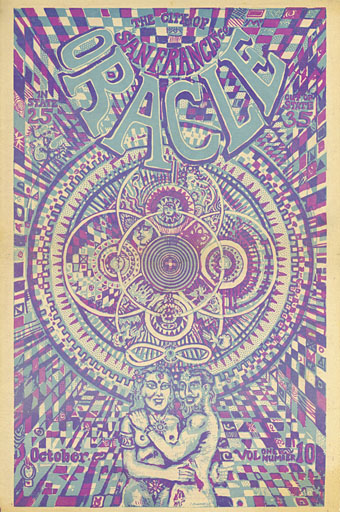
This copy of Griffin’s poster is from issue 7 of the Oracle, or the San Francisco Oracle as it was later titled and known outside the city, an underground newspaper, and one of the best where graphics are concerned.

sfo02.jpg

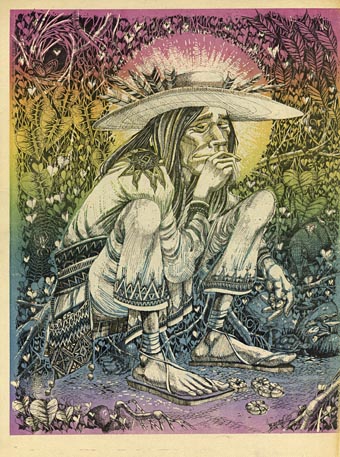
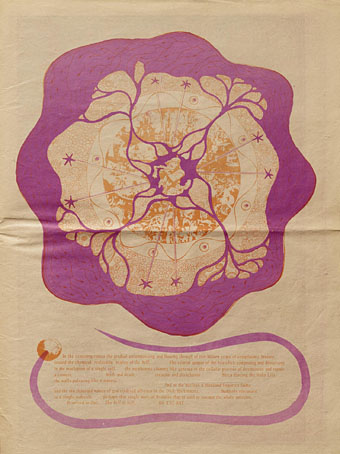
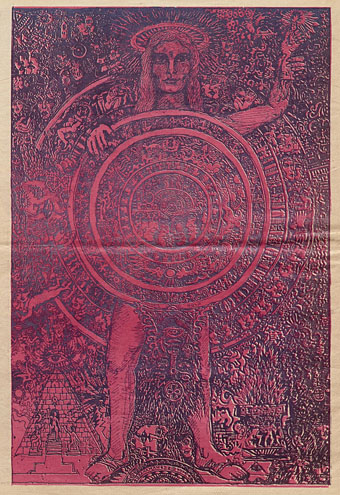
Underground papers and magazines of the late 1960s often followed the form of other amateur or semi-professional publications, with attractive cover art wrapped around more prosaic interiors. The Oracle ran for 12 issues, from 1966 to 1968, and in its later issues gave as much attention to the appearance of its inner pages as its covers, assisted by artists like Griffin and Bruce Conner. Being based in the city that gave the world so many exceptional concert posters was an obvious advantage.

sfo03.jpg

I was hoping the Internet Archive might have a complete run of the Oracle but only four of the highly-decorated issues are currently available. There’s no Wilfried Sätty artwork in evidence either, although I’m not sure he ever worked for the undergrounds despite there being many titles to choose from in the Bay area. Of note in one of the later issues is a full-page announcement for the forthcoming march on the Pentagon, an anti-war protest that took place in October 1967. Kenneth Anger attended the event although the exact nature of his involvement, like so many other Anger stories, varies according to the reporter.

San Francisco Oracle – Vol 1, No 7
San Francisco Oracle – Vol 1, No 9
San Francisco Oracle – Vol 1, No 10
San Francisco Oracle – Vol 1, No 12

sfo04.jpg

sfo05.jpg

Continue reading “Consulting the Oracle”

The Purloined Eidolon

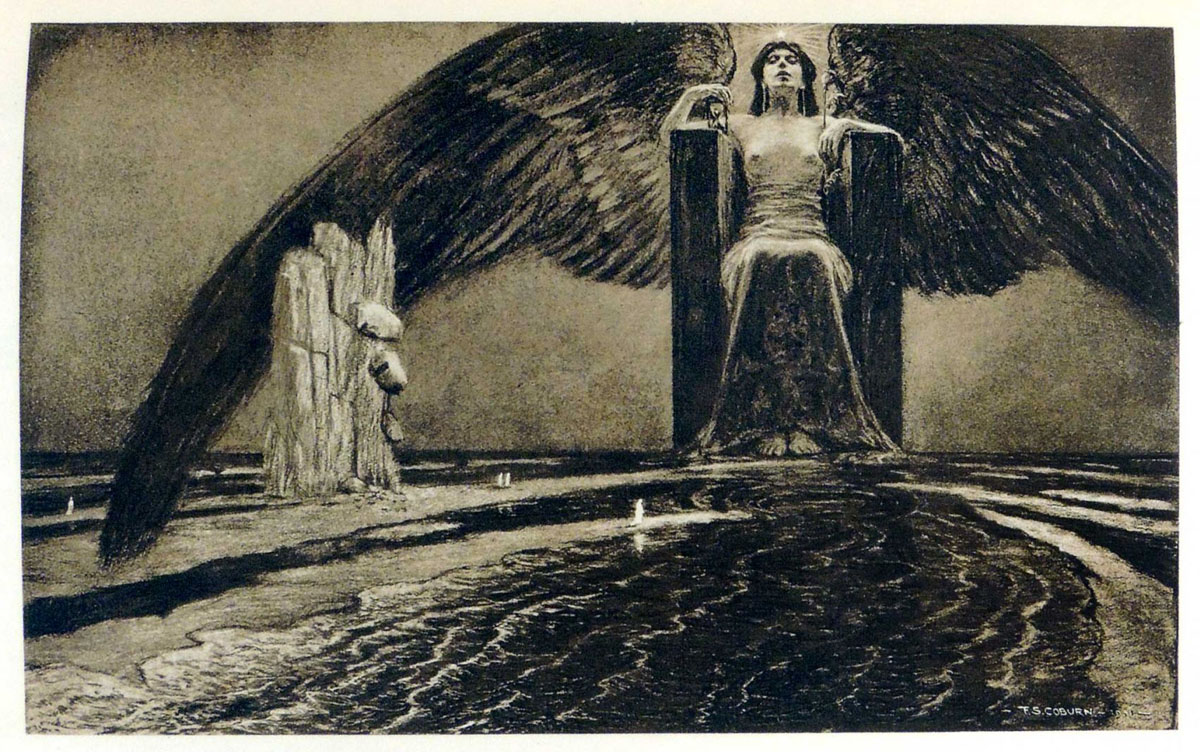
coburn.jpg

Dreamland by Frederick Simpson Coburn.

By a route obscure and lonely,
Haunted by ill angels only,
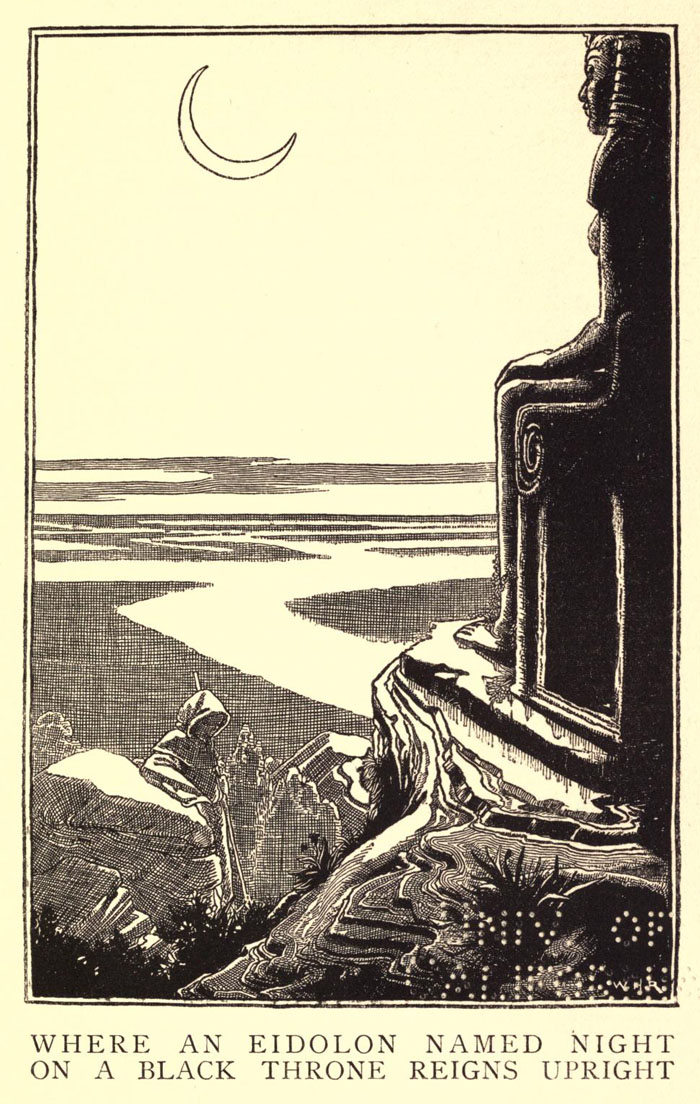
Where an Eidolon, named NIGHT,
On a black throne reigns upright,
I have reached these lands but newly
From an ultimate dim Thule—
From a wild weird clime that lieth, sublime,
Out of SPACE—Out of TIME.

Dreamland by Edgar Allan Poe

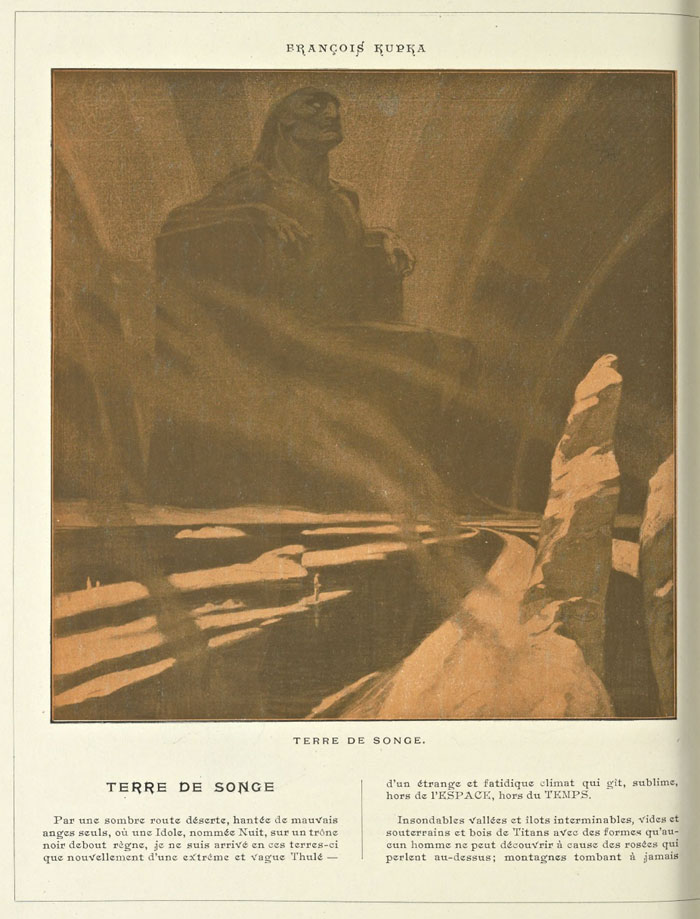
There’s always more Poe. Frederick Simpson Coburn was a Canadian artist who illustrated a 10-volume set of Edgar Allan Poe’s complete works in 1902, the collection being edited by Charles F. Richardson, and published in special editions with Poe-esque names such as “Arnheim” and “Eldorado”. Coburn was more of a painter than an illustrator so his full-page pieces tend to be stolidly professional in a manner that doesn’t really suit Poe’s fervid imagination. One exception is his illustration for Dreamland (aka Dream-Land) which would be more impressive if it hadn’t been so heavily “inspired” by a similar picture, The Black Idol or Resistance by František Kupka. Kupka’s picture dates from 1903 so it might seem at first that any suggestion of creative purloining should be dismissed (or even reversed) unless you know that The Black Idol was a slightly reworked version of a similar piece which appeared in a French magazine, Cocorico, in December 1900.

kupka.jpg

The suspicion of appropriation is reinforced if you also know that Kupka’s earlier work was one of two Poe-derived pieces published in the same magazine, and was itself an illustration for Dreamland, with the first few lines of the poem in the Mallarmé translation being printed underneath the drawing. Coburn grew up in Quebec and moved to Paris in 1896 to study art; he was still there in 1900. Circumstantial evidence this may be but we don’t need the services of Auguste Dupin to suppose that Coburn might have remembered an illustration from a French magazine when the Poe commission arrived a year or so later.

robinson.jpg

I’m not here to cast aspersions, the pressure of deadlines compelled me to swipe a chunk of Gustave Doré when I illustrated Poe myself a few years ago. I enjoy finding minor artistic connections like these, and the links between Coburn and Kupka are obscure enough that they probably haven’t been remarked on very much or even noticed until now. While we’re on the subject of dark eidolons, Dreamland was illustrated by William Heath Robinson in his own Poe edition in 1900. Robinson isn’t as sublimely grandiose as Kupka and Coburn but he also portrays Night as a literal figure. See the rest of his book here.

Previously on { feuilleton }
Martin van Maële’s illustrated Poe
Narraciones extraordinarias by Edgar Allan Poe
Fritz Eichenberg’s illustrated Poe
The Pendulum, the Pit and Hope
Hugo Steiner-Prag’s illustrated Poe
Burt Shonberg’s Poe paintings
Illustrating Poe #5: Among the others
Illustrating Poe #4: Wilfried Sätty
Illustrating Poe #3: Harry Clarke
Illustrating Poe #2: William Heath Robinson
Illustrating Poe #1: Aubrey Beardsley
Poe at 200
The Tell-Tale Heart from UPA
William Heath Robinson’s illustrated Poe

Weekend links 582

dore.jpg

Illustration by Gustave Doré from L’Espagne (1874) by Jean Charles Davillier.

• Warp Records has announced the forthcoming publication of Atmospherics by Jon Hassell, a short book collecting the diary extracts, composition notes and other ephemera that Jon compiled as an evolving appendix for his website. I was involved with the first iteration of the Atmospherics when we were working on his site in 2004, and for me this section was always the most interesting part of the project, comprising unique, personal material. The book will be published in October.

• “Almost everything in his book would be dismissed by today’s streaming behemoths as ‘too quirky, too local, too slow, too dry, too difficult, too weird’.” Sukhdev Sandhu reviewing The Magic Box, a history of British TV from the 1950s to the 1980s by Rob Young.

• New music: Cobalt Desert Oasis by Marco Shuttle, Angel’s Flight (AD 93) by Biosphere, and The Shildam Hall Tapes: The Falling Reverse by Stephen Prince, a sequel to an earlier release by A Year In The Country which includes an accompanying novella.

• Mix of the week, month and year: Sentimental Ornament: A Broadcast Rarities Mix by Aquarium Drunkard. First posted almost a year ago, I only discovered it last week; Aquarium Drunkard is now added to my RSS feed to avoid further neglect.

• I didn’t post anything for Bloomsday this year but if I’d seen these caricatures by Craig Morriss back in June I would have linked to them at the time.

• At Unquiet Things: The Eerie Moods and Pulpy Frights of Henri Lievens.

• Whole lotta rarities: the strangest Led Zeppelin artwork.

• Old music: A Willow Swept By Train by Janet Beat.

Instant Lettering Database

Atmospheres (1967) by Wimple Winch | Atmospheric Lightness (2018) by Brian Eno | Ligeti: Atmosphères (2019) by Orchestre Philharmonique de Radio France; Alan Gilbert

Dessinateurs et humoristes: George Barbier

barbier05.jpg

The haute couture of the 1920s has been the subject of my latest work-related research so I’ve been going through back issues of Gazette du Bon Ton, an expensive French fashion magazine which used pochoir prints of drawings by a variety of illustrators to depict the latest dress designs from Paris. One of the regular Bon Ton contributors was George Barbier (1882–1932), an artist whose work has appeared in several posts here, and who I look for now and then when browsing library archives. Searching for new Barbier may be at an end, however, since the more recent uploads at Gallica include almost all of the books that he illustrated. It’s no surprise that these have turned up eventually—it was only a matter of time—but among the cache there’s a unique item that I’d never have expected to see.

barbier03.jpg

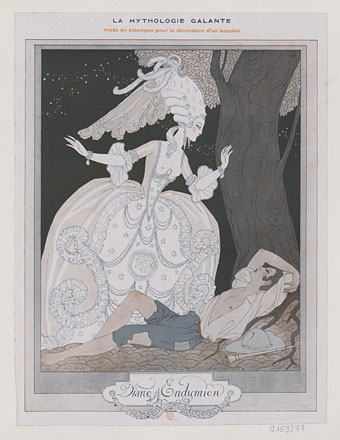
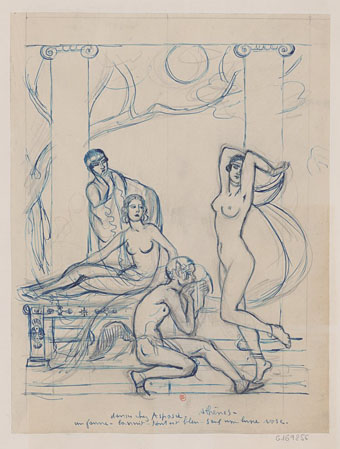
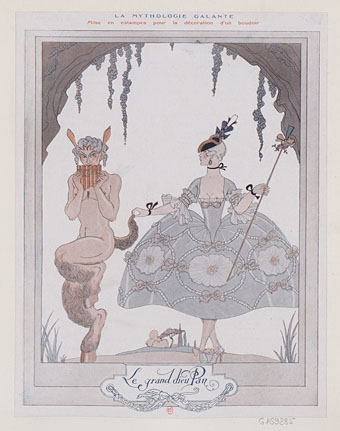
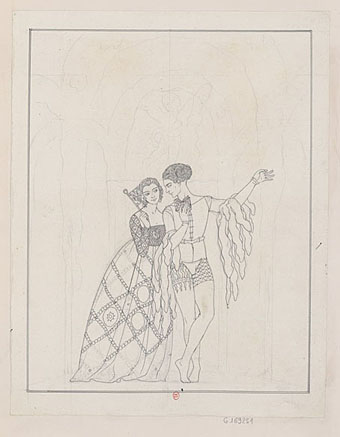
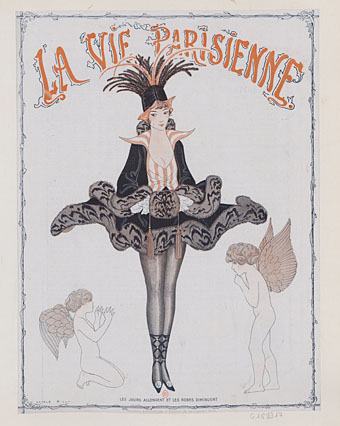
Dessinateurs et humoristes is a scrapbook of odds and ends covering Barbier’s career from 1912 to 1924, mostly humorous illustrations for magazines such as La Vie Parisienne, but the collection also includes handwritten material together with many sketches and drafts for unfinished drawings. This is part of Gallica’s “Collection Jaquet”, 113 scrapbooks collecting magazine work by French illustrators. I’ve not had the time to go through the rest of the collection but there are many familiar names in the list, each with books of their own: Albert Robida, Théophile Steinlen, two volumes dedicated to the prolific Gustave Doré, etc. Gallica’s information about these items is minimal so for now the identity of “Jaquet” remains a mystery. As for the Barbier scrapbook, if you like the artist’s drawings this is a delight to look through, a cornucopia of camp frivolity replete with all the usual crinolined ladies, powdered wigs, mischievous Cupids, tiny dogs, and almost as many nude males as there are females. There’s also a picture bearing the title “The Great God Pan” although as a representation of the deity it’s closer to Aubrey Beardsley than anything from Arthur Machen.

barbier06.jpg

barbier01.jpg

barbier07.jpg

Continue reading “Dessinateurs et humoristes: George Barbier”

Kenneth Anger’s Maldoror

teske.jpg

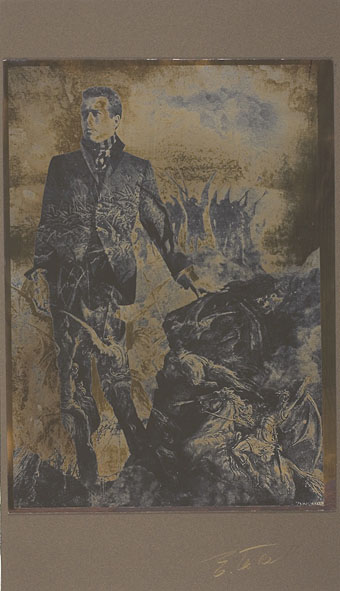
Kenneth Anger, Topanga Canyon, Composite with Gustave Doré Engraving (1954) by Edmund Teske.

Les Chants de Maldoror, 1951–1952.
16mm; black and white; filmed in Paris and Deauville.

With a hand-held 16mm camera I shot my first series of short haiku. This was my apprenticeship in the marvels that surround us, waiting to be discovered, awake to knowledge and life and whose magical essence is revealed by selection. At 17, I composed my first long poem, a 15 minute suite of images, my black tanka: Fireworks.

I had seen this drama entirely on the screen of my dreams. This vision was uniquely amenable to the instrument that awaited it. With three lights, a black cloth as décor, the greatest economy of means and enormous inner concentration, Fireworks was made in three days.

An example of the direct transfer of a spontaneous inspiration, this film reveals the possibilities of automatic writing on the screen, of a new language that reveals thought; it allows the triumph of the dream.

The wholly intellectual belief of the “icy masters” of cinema in the supremacy of technique recalls, on the literary level, the analytical essays of a Poe or the methods of a Valéry, who said: “I only write to order. Poetry is an assignment.”

At the opposite pole to these creative systems there is the divine inspiration of a Rimbaud or a Lautréamont, prophets of thought. The cinema has explored the northern regions of impersonal stylization; it should now discover the southern regions of personal lyricism; it should have its prophets.

These prophets will restore faith in a “pure cinema” of sensual revelation. They will re-establish the primacy of the image. They will teach us the principles of their faith: that we participate before evaluating. We will give back to the dream its first state of veneration. We will recall primitive mysteries. The future of film is in the hands of the poet and his camera. Hidden away are the followers of a faith in “pure cinema.” even in this unlikely age. They make their modest “fireworks” in secret, showing them from time to time, they pass unnoticed in the glare of the “silver rain” of the commercial cinema. Maybe one of these sparks will liberate the cinema….

Angels exist. Nature provides “the inexhaustible flow of visions of beauty.” It is for the poet, with his personal vision, to “capture” them.

Kenneth Anger—Modesty and the Art of Film, Cahiers du Cinéma no. 5, September 1951

* * *

Little is known about Anger’s activities during the mid-1950s. By 1958 he still had not been able to complete any films in Paris. He held on to his hope of completing Maldoror. His stack of preproduction notes and sketches had grown larger and he had plans to photograph nudes in a graveyard. Several Parisian Surrealists threatened to hand Anger’s head to him if he shot Maldoror. The book’s fluid, dreamlike imagery had been one of the trailblazers of Surrealism, and his detractors felt that a gauche American with a reputation for pop iconography and bold homosexual statement would debase a sacred text.

Bill Landis—Anger: The Unauthorized Biography of Kenneth Anger, 1995

* * *

I discovered the book when I was quite young. I loved it, put a lot of passion into it. I found people to play the parts. I found settings, gaslit corners, places still had the romantic look of a Second Empire. It was a terrific ambition to make this epic film-poem. I found ways to translate the text’s extraordinary images. I planned to film a mid-nineteenth century story taking place in twentieth century Paris. I filmed “the hymn to the ocean” on the beach at Deauville, with Hightower and members of the Marquis de Cuevas Ballet. They danced in the sea; tables were placed beneath the water line so the dancers could stand on their points. It looked as though they were standing on waves. The people who called themselves “Surrealists” were furious—this group of punks threatened me—they didn’t want a Yank messing round with their sacred text. I just told them to go to hell! I also managed to film the war of the flies and pins. I put bags of pins and dozens of flies into a glass container; revolved the container and filmed in close-up. As the pins dropped the flies zigzagged to escape. In slow motion an impressive image.

Kenneth Anger—Into the Pleasure Dome: The Films of Kenneth Anger, edited by Jayne Pilling & Michael O’Pray, 1989

* * *

The sections of the film that were completed [are] stored in the Cinémathèque Française, but [their] exact whereabouts in the archive is unknown, with no images from the film being currently available for reproduction.

Alice L. Hutchinson—Kenneth Anger, 2004

Previously on { feuilleton }
Donald Cammell and Kenneth Anger, 1972
My Surfing Lucifer by Kenneth Anger
Inauguration of the Pleasure Dome: The Eldorado Edition
Brush of Baphomet by Kenneth Anger
Anger Sees Red
Kenneth Anger’s Hollywood Babylon
Lucifer Rising posters
Missoni by Kenneth Anger
Anger in London
Arabesque for Kenneth Anger by Marie Menken
Edmund Teske
Kenneth Anger on DVD again
Mouse Heaven by Kenneth Anger
The Man We Want to Hang by Kenneth Anger
Relighting the Magick Lantern
Kenneth Anger on DVD…finally