Six Into One: The Prisoner File

prisoner1.jpg

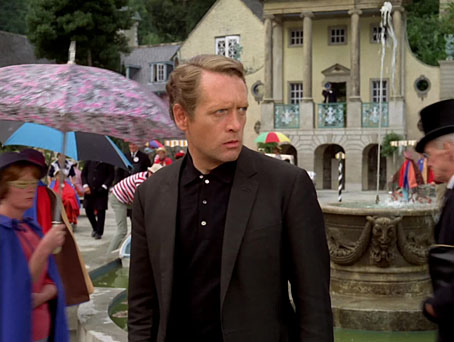
Patrick McGoohan.

Network DVD had a sale recently so I finally capitulated and bought the blu-ray set of The Prisoner which I finished watching this weekend. The picture quality is so outstanding it might have been made yesterday, and many of the extras are also essential for Prisoner obsessives, not least a restored print of the original cut of the first episode, something that was believed lost for years.
prisoner2.jpg

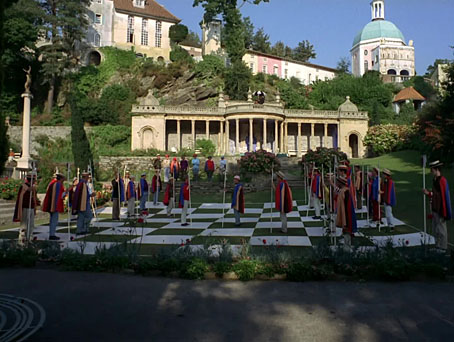
Episode 9: Checkmate.

There’s no need to enthuse about the series when I’ve done so already; this time round I’ll note that while the Cold War background is thoroughly outmoded some of the themes of particular episodes seem more relevant than ever. The model of total surveillance seen in the Village has for some time seemed to be one that Western governments and tech corporations would love to emulate. (“The whole world as the Village?” asks The Prisoner. “That’s my hope,” says Number 2.) The Prisoner isn’t the only drama to deal with authoritarian control, of course, but it also deals with the soft tyranny of closed communities, ideology and group-think. Episode 12, A Change of Mind, concerns a process whereby disobedient Villagers are confronted by their peers, declared “unmutual” then bundled off for corrective therapy; when they return they repent their antisocial crimes in public. In 1967 such a scenario would have seemed reminiscent either of McCarthyite America, or Soviet Russia and Maoist China; in 2015 you can be declared “unmutual” for minor infractions every day on the internet, and find yourself rounded upon by a sanctimonious horde.
prisoner5.jpg

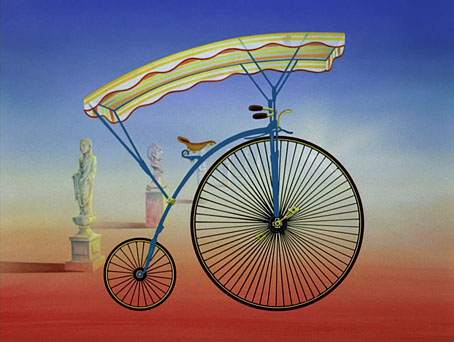
The allegorical and symbolic qualities of The Prisoner have kept the series fresh for almost 50 years while the character who launched the genre that gave rise to series—James Bond—has required several overhauls in order to keep up with changing times. Bond may bicker with his superiors but he’s always been a tool of the status quo, an agent of the Control virus in Burroughsian terms. In episode 8, The Dance of the Dead, The Prisoner is lectured by a judge in a kangaroo court on the importance of “the rules”. “Without rules, we have anarchy,” she says. The Prisoner, who happens to be dressed in a Bondian dinner jacket, replies “Hear, hear.”
Continue reading “Six Into One: The Prisoner File”

More Spare things

spare.jpg

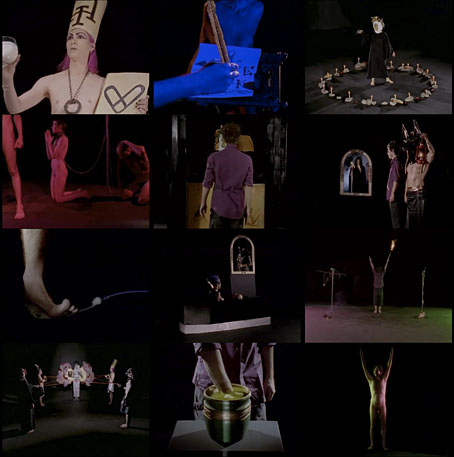
A couple of Austin Spare-related news items arrive in the same week so it’s worth linking again to Earth: Inferno (2003), a short film by Mor Navón & Julián Moguillansky based on the book by Austin Osman Spare. This is a production I have to damn with faint praise by being pleased that Spare is the focus of the work while being disappointed in the film as a whole. Despite the elaborate costumes, careful tableaux and copious nudity, Earth: Inferno confirms that an occult film needs to be more than a record of people dressing up and gesturing hieratically. If nothing else, occult rituals transform the perceptions of those involved, and this quality should be represented or implied in any film dealing with magical operations. The films of Kenneth Anger and Derek Jarman show different approaches, with the raw image transformed by superimposition, exaggerated grain, accelerated/decelerated motion, and so on. Inauguration of the Pleasure Dome and In the Shadow of the Sun are examples to follow. And now the news:

Lost Envoy: The Tarot Deck of Austin Osman Spare, edited by Jonathan Allen & Mark Pilkington. Out later this year from the fabulous Strange Attractor.

Surrealism, Austin Osman Spare and the Occult Underground of 1890s and 1990s London:

Nadia Choucha discusses the context and evolution of her ground-breaking book, Surrealism and the Occult, first published in 1991. The book traces the evolution of Surrealist ideas and situates them within the occult currents of fin-de-siècle European culture, revealing how these currents infused the work of various thinkers and artists in their quest for the ‘marvellous’. The work of Austin Osman Spare is also discussed as a way of comparing and contrasting his methods and techniques with those of the Surrealists. With the 25th anniversary of the publication of the book approaching, this evening will also present an analysis of the work as occurring within a unique historical and cultural moment.

Jun 23rd, 6:30 pm–8:00 pm at the Last Tuesday Society, London.

Previously on { feuilleton }
A Book of Satyrs by Austin Osman Spare
Spare things
Dreaming Out of Space: Kenneth Grant on HP Lovecraft
MMM in IT
Abrahadabra
Murmur Become Ceaseless and Myriad
New Austin Spare grimoires
Austin Spare absinthe
Austin Spare’s Behind the Veil
Austin Osman Spare

Weekend links 238

hinrichsen.jpg

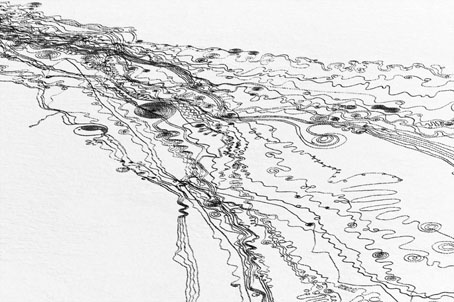
We Are The Water – Snow Drawings Project, Colorado (2014) by Sonja Hinrichsen with 50 volunteers.

• I don’t do end-of-year lists but Dennis Cooper does. My thanks to Dennis once more for including this blog among his selections. Also there is Jonathan Glazer’s film of Under the Skin, an adaptation of Michel Faber’s novel that impressed me as the most insidiously disturbing thing I’ve seen since Mulholland Drive. The Guardian‘s film critics agreed, making it their film of the year. I’d add to Peter Bradshaw’s appraisal by noting the superb score by Mica Levi, the refusal to spoon-feed the audience with explanations, and a refreshing absence of Hollywood gloss. Glazer’s film, like Kill List before it, shows that mundane British streets and interiors can still be a setting for serious horror.

• Related to the above: “I like Caravan, Coil—it’s very sad that they’re both dead now. In fact, Peter Christopherson, who was leader of Coil, contributed a song to a CD which I made for my wife for what we believed would be her last birthday.” Michel Faber talks to Hope Whitmore about Under the Skin and his new novel, The Book of Strange New Things. M. John Harrison recommends the latter on his own end-of-year list. In January Black Mass Rising will release a recording of The Art of Mirrors, Peter Christopherson’s homage to Derek Jarman from 2004.

David Bowie and band live on Musikladen in 1978: 40 minutes with Adrian Belew on squealing lead guitar, some Kurt Weill and an outstanding performance of “Heroes”.

• “Realism is a literary convention – no more, no less – and is therefore as laden with artifice as any other literary convention.” Tom McCarthy on realism and the real.

• Mixes of the week: The Best of the Best of the Best by TheCuriosityPipe, and Secret Thirteen Mix 138, a medley of post punk from Psyche.

• “We spent two weeks making the penises.” Livin’ Thing: An Oral History of Boogie Nights by Alex French and Howie Kahn.

• At Dangerous Minds: Seeing The Man Who Fell to Earth was one of the greatest experiences of Philip K. Dick’s life.

• Giving Voice to Our Pagan Past and Present: Pam Grossman on Witches, Women and Pop Occulture.

• Neglected last week (and linked everywhere but still a good one): The typography of Alien.

William Mortensen, the photographer who Ansel Adams called the Anti-Christ.

• Hear a track from analogue synthesizer virtuoso Kaitlyn Aurelia Smith.

Rick Poynor on illustrations by Bohumil Stepan for Crazy Fairy Tales.

12 excellent features from directors who never made another feature.

Werner Herzog Inspirationals

The Devil in the Hedgerow

New Warm Skin (1980) by Simple Minds | Rapture Of The Skin (1996) by Paul Schütze | Take Me Into Your Skin (2007) by Trentemøller

Weekend links 237

trouille.jpg

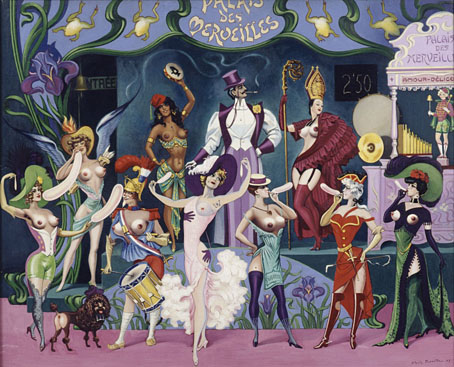
Le Palais des Merveilles, 1907 – 1927 – 1960 by Clovis Trouille.

• “Why is it OK to show a male ejaculation but not a female one? What are the qualifications of those who cobble together these rules?” Suzanne Moore on the latest batch of discriminatory restrictions against porn production in the UK. Porn laws in Britain have long been like the drug laws, sprouting fresh Hydra-heads of unwarranted bans and crackdowns after the previous bans and crackdowns have been discredited. Last month Zoe Williams talked to women who make niche porn for other women. This week she discovered that some of those she interviewed now find their work is illegal under the latest restrictions.

• “[Derek Jarman] considered In the Shadow of the Sun to be just as important as any of the feature films that he made in the 1970s.” Film producer and archivist James Mackay talking to Beatrix Rux about Derek Jarman’s Super-8 films. Related: Tilda Swinton is GQ’s Woman of the Year.

The Art of Big O by Michael Fishel (author) and Nigel Suckling (editor), a collection of the fantastic and psychedelic poster art published by Peter Ledeboer’s company in the 1970s. Good to see but at $67 (really?) I’d expect a better cover design.

• New electronica: More “confusing English electronic music” from Moon Wiring Club; Shut-Eyed Stories, an album by Jim Cheff; and Shapwick by Jon Brooks, previously vinyl-only and out-of-print, now has a digital edition.

JK Potter Mutates the Story: Christopher Burke & David Davis talk to the horror illustrator about his photographic work.

• Beth Maiden on The Fascinating Life of Pamela Colman Smith, artist of the Rider-Waite-Smith Tarot deck.

• Under the Influence: The Sexy, Sordid Surrealism of Clovis Trouille by Kirsten Anderson.

Geoff Manaugh on The Fiery Underground Oil Pit Eating LA.

• Mix of the week: Secret Thirteen Mix 137 by Teste.

The Wild Horny Goat

The Young People (2010) by Belbury Poly & Moon Wiring Club | Goat Foot (2012) by Belbury Poly | Walking Through Me (2014) by Moon Wiring Club

Weekend links 234

dezso.jpg

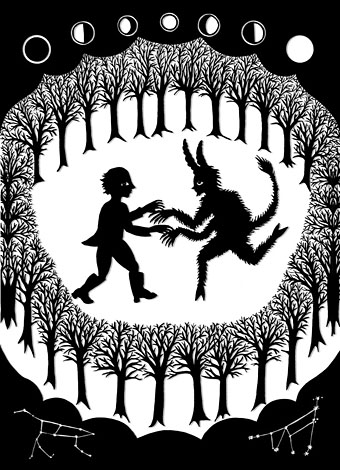
The Devil in the Green Coat by Andrea Dezsö, an illustration for a new, uncensored edition of the Grimm Brothers’ Fairy Tales.

• That { feuilleton } object of cult attention, Penda’s Fen, a 1974 television film by David Rudkin directed by Alan Clarke, continues its long journey out of the shadows. To coincide with a screening in London of a 16mm print, Sukhdev Sandhu looks back at a unique drama, and examines its connections to other British films of the period. There’s still no sign of a DVD release although rumours persist. Related: Penda’s Fen at A Year In The Country.

• “One of the reasons I’m sure I found the horror genre congenial is that it’s almost always focused on the body. The body is the center of all horror films.” David Cronenberg talking to Calum Marsh about his novel, Consumed.

• Mix of the week: Antony Hegarty’s Future Feminist Playlist, and Secret Thirteen Mix 134 by James Ginzburg & Yair Elazar Glotman. Related: Nimbes by Joaniele Mercier & James Ginzburg.

• Another week, another Kickstarter: Suzanne Ciani: A Life in Waves is a planned feature-length documentary about the American synthesist and composer.

• “[Marjorie] Cameron’s connections to Scientology and powerful men once drew headlines, but now her art is getting its due,” says Tanja M. Laden.

Jay Babcock found a Hawkwind Tarot spread in International Times for 1971. Is this an overlooked Barney Bubbles design?

• “Tempered in the flames of hell”: Helen Grant on the precursors of Robert Louis Stevenson’s The Bottle Imp.

Hawthonn: Phil and Layla Legard (and others) remember John Balance with a special musical project.

Derek Jarman Super 8 by James Mackay, a book of stills from Derek Jarman’s Super 8 films.

• “Coltrane’s free jazz wasn’t just ‘a lot of noise’,” says Richard Brody.

This might be the world’s first book on colour palettes.

Paris 1971 (1971) by Suzanne Ciani | The Fifth Wave: Water Lullaby (1982) by Suzanne Ciani | Blue Amiga (2014) by NeoTantrik & Suzanne Ciani