Weekend links 298

liu-wong.jpg

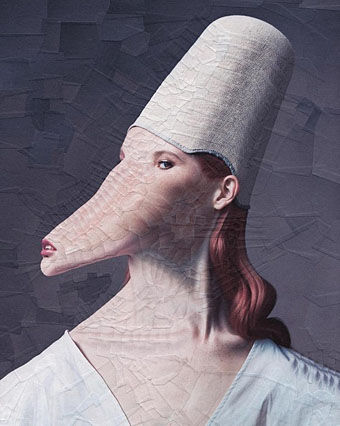
The Gathering (2015) by Kristen Liu-Wong.

• Tom of Finland’s house in Echo Park, Los Angeles, “is a trove of homoerotic masterpieces“. The house and its former owner are celebrated in Tom House, a book by Michael Reynolds with photos by Martyn Thompson. Related: Tom House exposed by Rizzoli.

• “Underlying the heightened nature of the films was a deep, questioning soulfulness related to literary antecedents coupled with a vision of cinema open to shifting levels of perception and fantasy.” David Thompson on Andrzej Żuławski.

• Memories of the Space Age: Photos by Roland Miller of the ruins of NASA’s old launch pads, bunkhouses and research facilities. A British equivalent (and a much more modest affair) is the Highdown Rocket Site on the Isle of Wight.

• Statues allegedly made for the John Huston film of The Maltese Falcon are among the most expensive props in cinema history even though there’s still dispute about their authenticity. Bryan Burrough investigates.

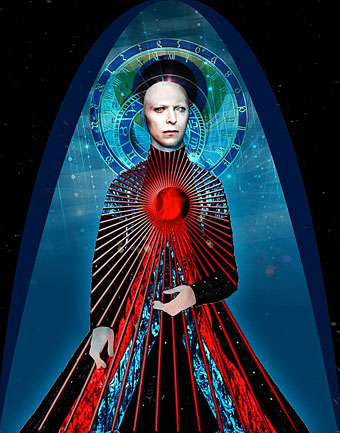
• Mixes of the week: The Solar Gate: Female Private Press New-Age Music – Vol.1 by Michael Tanner, and an “alchemical” Bowie selection by The Ephemeral Man.

• “What Does It Take To Be A ‘Bestselling Author’? $3 and 5 Minutes.” Brent Underwood on why Amazon ratings can’t be trusted.

Edward Gorey/Derek Lamb title sequences from the PBS/WGBH show Mystery! (1981).

• A Painter Possessed: Kate Kellaway on the occult abstractions of Hilma af Klint.

Invertebrate Harmonics: a new composition by Chris Watson.

• Frozen in time: Inside Bangkok’s first ever department store.

Roly Porter’s Favourite Space Records

• Space-Age Couple (1970) by Captain Beefheart & His Magic Band | Space Age Batchelor Pad Music (Mellow) (1993) by Stereolab | Space Age Ballad (2001) by Acid Mothers Temple & The Melting Paraiso U.F.O.

Weekend links 295

dupre.jpg

Untitled (2014) by Lola Dupré. Via.

Announcement of the week (if not the month/year) is the news that the BFI will be releasing all of the BBC dramas directed by Alan Clarke on DVD/Blu-ray in May. In addition to the long-awaited appearance on disc of Penda’s Fen (1974) we can expect a previously unseen director’s cut of Clarke’s last TV film, The Firm (1989), the DVD premier of Baal (1982) with David Bowie, plus many other works including some from the 1960s that were believed lost. (And it should be noted that this isn’t everything of Clarke’s; he also worked occasionally for ITV and later directed feature films for Channel 4.)

The BFI attention is a tribute to an exceptional director that’s overdue. Clarke has long been a cult figure among the British actors who worked with him, and among directors such as Harmony Korine and Gaspar Noé, but the tendency of TV to give one-off dramas a single screening has meant that much of his best work has been unavailable for years outside old VHS tapes. Clarke is important for having persistently chosen difficult subjects which he directed with a flair and intensity usually only found in cinema. When he died in 1990 the BBC repeated a handful of his films but the only ones given repeated DVD release have been the violent dramas with the big names attached: Scum (1979, with Ray Winstone), Made in Britain (1982, with Tim Roth), and The Firm (with Gary Oldman). Clarke’s oeuvre is much more than a parade of nihilistic villains, as will become evident later this year.

• A psychedelic video directed by Peter Strickland for Liquid Gate (ft. Bradford Cox) by Cavern of Anti-Matter. The debut album from Cavern of Anti-Matter, Void Beats/Invocation Trex, will be out later this month.

Celebrating Dusseldorf, the city that birthed Krautrock. (Article loses points for not mentioning producer Conny Plank.)

All Rivette’s features might be regarded as different kinds of horror films; Céline et Julie vont en bateau is his first horror comedy. The anxiety and despair of Paris Nous Appartient and La Religieuse, L’Amour Fou and Spectre seem relatively absent, yet they perpetually hover just beyond the edges of the frames. We still have no privileged base of ‘reality’ to set against the fictions, each of which is as outrageous as the other; and along with Borges, we can’t really say whether it’s a man dreaming he’s a butterfly or a butterfly dreaming he’s a man—although we may feel, in either case, that he and we are just on the verge of waking.

Jonathan Rosenbaum on work and play in the house of fiction: Jacques Rivette’s Out 1 and Céline and Julie Go Boating

• Mixes of the week: Finders Keepers Radio Show Krautrock Special, and The Ivy-Strangled Path Vol. XV by David Colohan.

• At Dangerous Minds: Super strange sculptures (by Shary Boyle) only the dark and demented could love.

• Beautiful Brutalites: S. Elizabeth questions Arabella Proffer about her paintings.

KTL is a musical collaboration between Peter Rehberg and Stephen O’Malley.

• Why study art when you can make it? The strange world of…This Heat.

Sarah Galo on the explicitly sexual female artists that feminism forgot.

Irmin Schmidt‘s favourite music (this week).

• LSD: My life-saving drug by Eric Perry.

The Occult Activity Book

Twenty Tiny Cities

Der LSD-Marsch (1970) by Guru Guru | Krautrock (1973) by Faust | Düsseldorf (1976) by La Düsseldorf

Pierrot in Turquoise, or The Looking Glass Murders

pierrot.jpg

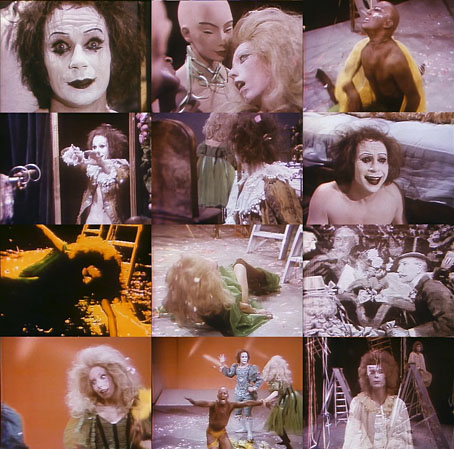
A final Bowie post included here as much for its connections to Derek Jarman. Pierrot in Turquoise was a pantomime by Lindsay Kemp based on the characters of the Commedia dell’arte, and broadcast by Scottish Television in 1970. David Bowie is “Cloud”, a non-commedia character who provides songs while perched atop a step-ladder. The smaller independent TV stations like Scottish often used to fill out their end-of-day programming with oddities such as this, the kind of thing that would have been screened once to a bewildered audience then forgotten.

Kemp’s production reverses some of the commedia traditions by having his Pierrot challenge Jack Birkett’s Harlequin, the exchange of roles taking place after a Cocteau-like journey through a mirror. Pierrot lacks a hat but otherwise his costume resembles the one that Bowie wore in the Ashes to Ashes video. Two years and a gulf of reinvention separate this little pantomime from Kemp and Bowie’s next encounter in Mick Rock’s video for John, I’m Only Dancing, a film the BBC found too weird and/or queer, and refused to show.

Previously on { feuilleton }
Flowers: A Pantomime for Jean Genet
Lindsay Kemp’s Salomé again

Weekend links 292

splendor.jpg

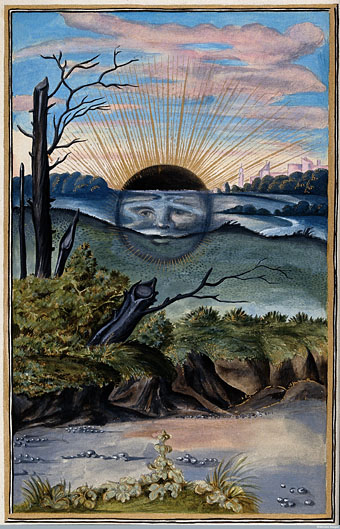
The Black Sun from Splendor Solis (1582) “attributed to the legendary figure Salomon Trismosin”.

Topic B predominates this week. The Black Sun of alchemy was the first thing I thought of when the title of David Bowie’s final album was announced late last year. The Black Sun symbolises the nigredo stage of the alchemical process when putrefaction or decomposition takes place; Carl Jung in Psychology and Alchemy equates the nigredo with the dark night of the soul. At the time I didn’t seriously think that the Bowie of 2015 would have had this in mind as a primary reference even though the Bowie of the early 1970s was immersed in Golden Dawn occultism, the Kabbalah, and a reader of Pauwels & Bergier’s The Morning of the Magicians, a book that informs the lyrics of the Hunky Dory album, and which contains a great deal of discussion about alchemy and other esoteric matters. And yet… Of all the outfits that Bowie might have worn in his final video the one that he chose for Lazarus is a match for the one he wore during the Station To Station Kabbalah-drawing photo session. At Sol Ascendans Alex Sumner and his commenters explored this twilight zone.

Back in the sublunary world, Jonathan Barnbrook’s cut-out sleeve design for the Blackstar album gained additional resonance this week: the black star as the hole that’s left when a more familiar star has been removed from its setting. Hindsight also makes poignant the observation that this was the only album without a picture of the artist on the cover. Elsewhere there were speculations about the title being a reference to Black Star by Elvis Presley (who shared a birthday with Bowie) or a term from oncology, two suggestions that fit so well they’re hard to ignore.

He began to develop a science fiction sensibility, drawing on the New Wave SF movement of Michael Moorcock and JG Ballard, other writers who used the genre such as Anthony Burgess and William S Burroughs, and an older fantasy tradition found in HP Lovecraft and Edward Bulwer-Lytton (whose The Coming Race is name-checked in Oh! You Pretty Things, 1971).

Jake Arnott on David Bowie’s literary influences

• In something-else-also-happened-this-week news, 2016 may see the long-awaited release of Andrei Tarkovsky’s films on Region B Blu-ray. Fingers crossed.

• International posters for The Man Who Fell To Earth. More Nicolas Roeg (and more shiny discs): Eureka (1983) will receive a Blu-ray release in March.

• Cracking the codes of Leena Krohn: Peter Bebergal on the Finnish writer of strange stories.

• Anthems for the Moon: Jason Heller examines David Bowie’s connections to science fiction.

• From 2013: Jon Savage on Bowie’s first meeting with William Burroughs in 1974.

• Mixes of the week: Bowie-esque Vol 1 and Bowie-esque Vol 2 by Abigail Ward.

David Bowie Doing Shit: a Tumblr

“Heroes” (1978) by Blondie & Robert Fripp | “Heroes” (2003) by King Crimson | “Helden” (2007) by Apocalyptica ft. Till Lindemann

The Image, a film by Michael Armstrong

image.jpg

The image in question is a certain David Bowie making his first (non-speaking) film appearance as “The Boy”, a figure from a painting come to life. The only other character is an artist played by a young Michael Byrne, later a familiar face in many British film and TV productions. Bowie was 20 at the time, and Michael Armstrong’s short was made in 1967, the same year that David Bowie’s debut album was released to little acclaim. The film may be a little rough—it was obviously made with sound added later—but hindsight lends it multiple resonances: Bowie as an artwork come to life, the art theme in general (many of the paintings Bowie made public were self-portraits), a slight homoerotic subtext, and so on. There’s also a moment at the beginning where Bowie presses his face to the window, and his flattened nose looks the way it does on the cover of Lodger. A mere 12 years separates that album and this small film with a mountain range of tumultuous creativity in between. Watch The Image here.

Previously on { feuilleton }
Cracked Actor
Strange fascination