Frederic Leighton’s sculptures

leighton1.jpg

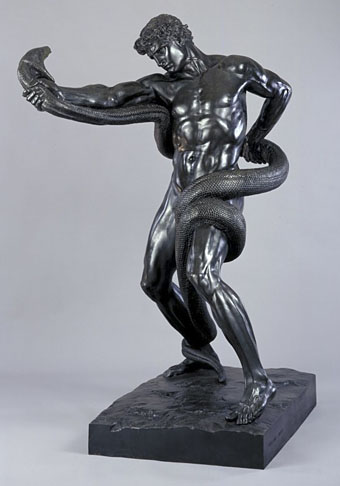
An Athlete Wrestling with a Python (1877).

The python wrestler by Frederic Leighton (1830–1896) has appeared here before, and it’s one sculpture that always catches my eye for having appeared in my adaptation of The Call of Cthulhu in 1988. It’s now one of the Leighton works available for close viewing at the Google Art Project although only from a single angle, something that seems a flaw in web presentation of three-dimensional art.

leighton2.jpg

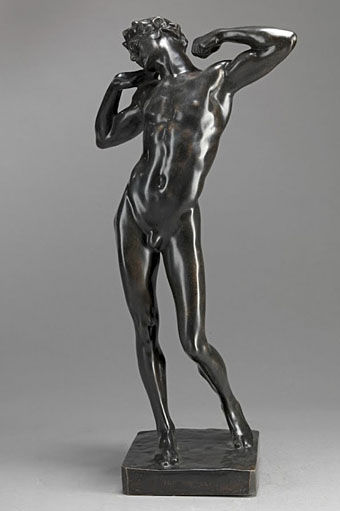
The Sluggard (c. 1895).

In the same collection is a copy of Leighton’s The Sluggard from the Yale Center for British Art. What’s notable about this piece is that it’s generally offered as Exhibit A for the homo-prosecution during discussion of the artist’s sexuality. The Sluggard to which most people refer is the life-size bronze which is a lot more robust and muscular than this lithe and twinky specimen. According to a note at the V&A Yale’s copy is one of many cast from the clay model for the life-size version. What was excused at the time as a late Victorian exercise in contrapossto looks even more camp—in the Philip Core definition—than the finished piece which makes me wonder whether Leighton beefed up the original to disguise something. Core defined camp as “the lie that tells the truth”; camp art always pretends to be one thing whilst simultaneously telegraphing a very different message about its creator. Leighton’s sexuality is a source of continual speculation which means it’s unlikely now to be resolved in any direction, and the artist himself would loathe our prurience, but it’s only by reappraising works in this way that we’re able to show that gay people didn’t magically erupt via some process of spontaneous generation in 1967. If Leighton had any dalliances whilst holidaying in the gay resort of Capri then he was perfectly circumspect. Back at home, as a President of the Royal Academy he had a rather pompous and remote reputation, being memorably described by Violet Paget as “something between an Olympian Jove and a head waiter.” For more camp, see The Narcissus Hall in the artist’s incredibly lavish home, Leighton House in London, where 1st Baron Leighton, PRA, lived splendidly alone.

Previously on { feuilleton }
Angelo Colarossi and son
Men with snakes

Heavy Metal, October 1979: the Lovecraft special

hm1.jpg

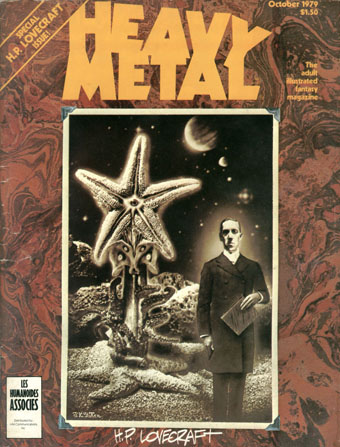
Mr Lovecraft by JK Potter.

HP Lovecraft died seventy-five years ago on 15th March, 1937. Twenty-five years ago I was halfway through drawing my comic strip adaptation of The Call of Cthulhu, conscious at the time that, yes, it was fifty years ago today… I mentioned at the weekend the special Lovecraft edition of Heavy Metal that was published in October 1979; of the many stimuli that led to the drawing of CoC, this magazine was by far the most important. Given the date, now seems as good a time as any to say something about it.

hm2.jpg

Illustration for the contents page by Stephen R. Bissette.

Heavy Metal was the US offshoot of Métal Hurlant, the sf/fantasy comics magazine founded by Jean Giraud (Moebius), Philippe Druillet and Jean-Pierre Dionnet in 1974. Copies of Métal Hurlant could be found in London but none ever made it further north. The advent of Heavy Metal provided an invaluable introduction to a generation of European artists whose work was otherwise difficult to find. Even better: their stories were being translated into English for the first time. The late 70s was a dizzying period for a Lovecraft reader: HR Giger appeared apparently out of nowhere in 1977 when Big O published the first UK collection of his art (which I couldn’t afford at the time), a book with Necronomicon in the title; a year later Thames & Hudson published Franz Rottensteiner‘s The Fantasy Book, an overview of the genre that devoted eight pages to Lovecraft and Arkham House, and which included many illustrations I’d never seen before; in 1979 Giger was all over the newspapers and magazines thanks to Alien; then in October the Lovecraft special dropped onto the shelves. I was stunned: this was that rare occasion when someone creates exactly the thing you want to see at precisely the right moment.

hm3.jpg

The Dunwich Horror by Alberto Breccia. A superb adaptation.

Looking back, the issue isn’t quite as good as it seemed at the time: many of the stories are slight, a couple have nothing whatever to do with Lovecraft, and, Breccia aside, none of the artists tackle the major works. What counted in the end was the idea of the issue, the implication that Lovecraft’s imagery was there to be seized and reworked in visual form. There were better issues of the magazine, before and after, but for the next six years this one remained for me a tantalising possibility. They hadn’t got it quite right…what if someone else did? After searching comic shop shelves in vain I eventually decided to have a go myself.

Continue reading “Heavy Metal, October 1979: the Lovecraft special”

Philippe Druillet album covers

druillet1.jpg

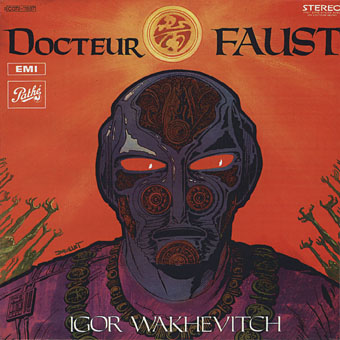
Docteur Faust (1971) by Igor Wakhévitch.

Philippe Druillet: album cover artist. As with John Martin, I’m surprised there aren’t more examples. Once again, Discogs.com proves incomplete so I’ve added a couple more including the first on this list, Docteur Faust. If you know of any others, please leave a comment.

Igor Wakhévitch’s berserk masterpiece is a cult item in this house, and something I’ve written about already. The cover art is the icing on an unclassifiable cake.

druillet10.jpg

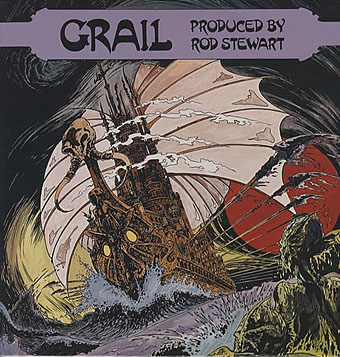
Grail (1970) by Grail.

The cover is the opening page of The Wild Wind Isles, one of Druillet’s Lone Sloane stories. Produced by Rod Stewart; did you notice? “We are sailing…”

druillet4.jpg

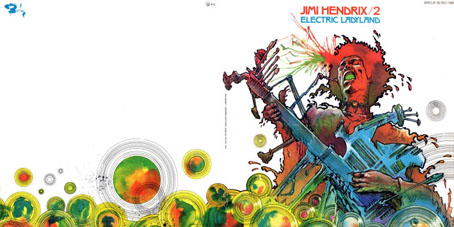
Electric Ladyland (1975) by The Jimi Hendrix Experience.

A gatefold sleeve for a series of four Hendrix reissues on the Barclay label. The other covers were provided by Moebius, Jean Solé and an artist unidentified on the link above but it looks to me like the work of Philippe Caza.

druillet3.jpg

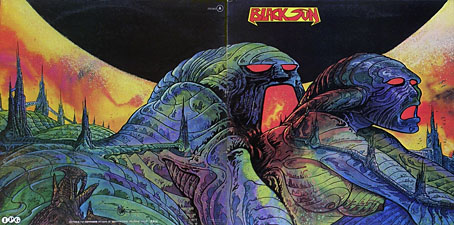
Black Sun (1978) by Black Sun.

Black suns are a regular feature of Druillet’s work (and mine, ahem) so the artist at least suits the title. The debut album of a short-lived French funk/soul group.

East/West (1980) by Richard Pinhas.

The French equivalent of Krautrock doesn’t have a name but Richard Pinhas is one of its leading practitioners. This is still my favourite among his solo works, not least because it’s more successfully musical than other albums which feature great slabs of guitar or synth doodling. In addition to a cover of David Bowie’s Sense Of Doubt there’s also science fiction author Norman Spinrad ranting through a vocoder on the opening and closing tracks. The great cover art is a page from Druillet’s 1980 adaptation of Flaubert’s Salammbô.

Continue reading “Philippe Druillet album covers”

Weekend links 99

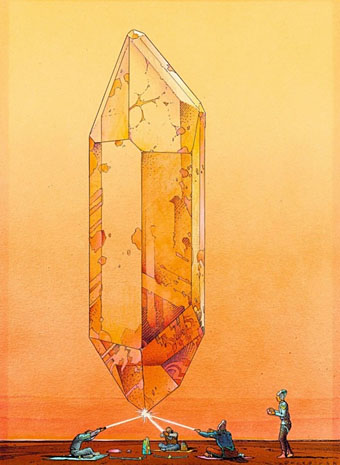
moebius.jpg

From the Crystal Saga portfolio (1986) by Moebius. Via Quenched Consciousness.

Moebius: A while ago, [science fiction] was filled with monstrous rocket ships and planets; it was a naive and materialistic vision, which confused external space with internal space, which saw the future as an extrapolation of the present. It was a victim of an illusion of a technological sort, of a progression without stopping towards a consummation of energy. But we’ve completely changed that vision. It’s been a sharp, radical change, and somewhat brutal.
HM: Why brutal?
Moebius: Because all those beautiful projects we believed in are gone. But the real sense of science fiction is the discovery that the voyage is interior, and the real energy, the rockets of the past, is what is contained in people’s spirits.
HM: One doesn’t have to read other people’s visions then, one can make the discovery oneself?
Moebius: Well, that, and also the fact that the “new planet” of old science fiction is right here: it’s the Earth.

The Moebius Interview by Diana K. Bletter, Heavy Metal, August 1980.

RIP Jean Giraud, aka Moebius, one of the great artists of the 20th century. My approach to drawing comics was almost wholly derived from the illustrational style of the French, Belgian and other artists being published in Heavy Metal magazine in the late 1970s/early 1980s. Many of the stories were appearing in English for the first time, and for me they revitalised a medium in which (undergrounds aside) I’d lost all interest. It wasn’t only the exceptional artwork that was attractive. The narratives of Moebius, Druillet, Bilal and co. presented a more sophisticated approach to science fiction and fantasy than the simple-minded fare filling the superhero titles or the pages of 2000 AD. Moebius’s work was wittier, sexier and far more imaginative than any American comics I’d seen up to that time. Some of the stories read like graphic equivalents of New Worlds-era science fiction so it came as no surprise to find Moebius drawing a strip called The Airtight Garage of Jerry Cornelius (the title was later amended at Moorcock’s request) while Druillet in his September 1980 Heavy Metal interview mentioned enjoying books by William Burroughs, Michael Moorcock and Thomas Disch, and singled-out Ballard’s Crash as a favourite novel. Without the examples of Druillet and Moebius (and the intoxicating inspiration of the October 1979 issue of Heavy Metal) I wouldn’t have spent 17 months adapting The Call of Cthulhu as a comic strip.

Hasko Baumann’s 2007 documentary, Moebius Redux: A Life in Pictures (some of which can be seen on YouTube) is a good place to start when trying to appraise Jean Giraud’s extensive career. The film is now available on DVD.

Update:
The hour-long cut of Moebius Redux has been posted to Vimeo
An obituary by Kim Thompson at The Comics Journal
The Moebius posts at But Does It Float
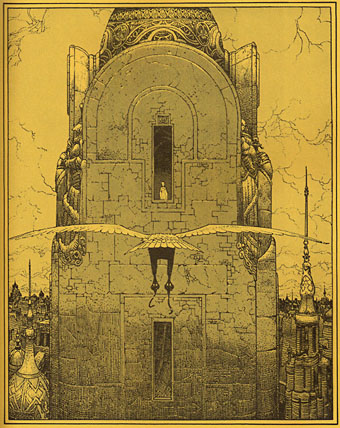
moebius2.jpg

From Les Yeux du Chat (1978) by Jodorowsky & Moebius. Via Quenched Consciousness.

• “Naked Lunch,” Ballard wrote later, “was a grenade tossed into the sherry party of English fiction.” The criss-crossing careers of JG Ballard and William Burroughs are examined in detail at RealityStudio. Related: The Discipline of D.E. (1982) by Gus Van Sant and The Unlimited Dream Company (1983) by Sam Scoggins.

• Dr John’s forthcoming album, Locked Down, has been produced by The Black Keys‘ Dan Auerbach. Those of us who favour the Doctor’s voodoo-inflected early albums are hoping this might mean he gets groove back after wandering for years in an MOR swamp. One of the new recordings, Revolution, sounds promising.

I don’t think sexuality is fixed anymore. I think more from the gay male side than the lesbian side, there is often a wish for things to be fixed. I heard Lady Gaga’s Born This Way and I don’t know why they like it. Maybe, they need more certainty than girls do. For me, it’s like why do you care anyway? Maybe you were, maybe you weren’t. What’s the big deal? I can’t connect to that emotionally, so it baffles me.

Jeanette Winterson talks to Sassafras Lowrey.

• “In [Jacob’s Room], [Virginia] Woolf makes the subject matter not Jacob himself but the ways in which we know and don’t know each other – the gaps in our knowledge.” Alexandra Harris on Modernism in art and literature.

• The Northwest Film Forum in Seattle hosts Magick in Cinema on 5th April, an evening of occult-themed short films which includes a rare screening of Curtis Harrington’s Wormwood Star.

• John Bertram’s Lolita cover competition from 2009 is due to appear in June as a book-length study entitled Recovering Lolita. Bertram previews the contents here.

• “Erotic fiction is having a steamy renaissance and its hottest authors are women.”

LSD helps to treat alcoholism.

• The other Moebius (Dieter): News (1980) by Moebius & Plank | Tollkühn (1981) by Moebius & Plank | Conditionierer (1981) by Moebius & Plank.

Cthulhoid and Artflakes

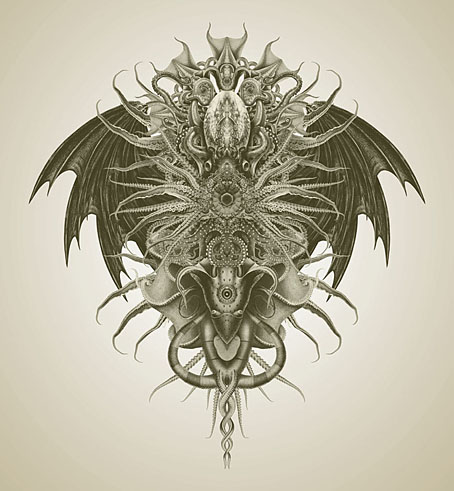
cthulhoid.jpg

Cthulhoid (2012).

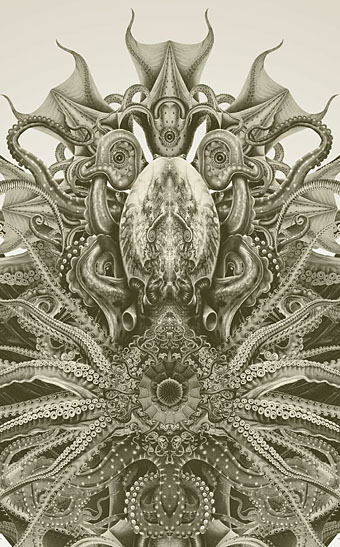
Hot on the scaly heels of my recent Cthulhu God comes a new collage work I was messing with over Christmas. This was done in part as a reaction to the earlier picture which I’m very happy with but which looks cleaner and flatter than I prefer for Lovecraft-related things. I’d also found some new books of copyright-free cephalopoda that I wanted to try playing with. There are trace elements here of Haeckel’s Kunstformen der Natur but I’ve plundered Haeckel so much in the past it’s better to search elsewhere for source material.

cthulhoid-detail.jpg

I’ve been selling reproductions of works such as this at CafePress but now have an additional outlet with a new print venture, Artflakes, who asked me late last year to contribute to their site. Artflakes is a German company operating as CafePress does: artists upload their pictures which can then be sold on a variety of products. The product range is smaller than their rivals but they do canvas prints which CafePress don’t. These are costly items but canvas prints tend to be expensive anyway, even at a high street copy shop. On the plus side, being based in Germany means the shipping costs will be slightly cheaper inside Europe. I’ve not uploaded much at the moment but this new piece is there together with six other works. More will be added in the next couple of months.

Elsewhere on { feuilleton }
The Lovecraft archive