Spare things

spare-cthulhu.jpg

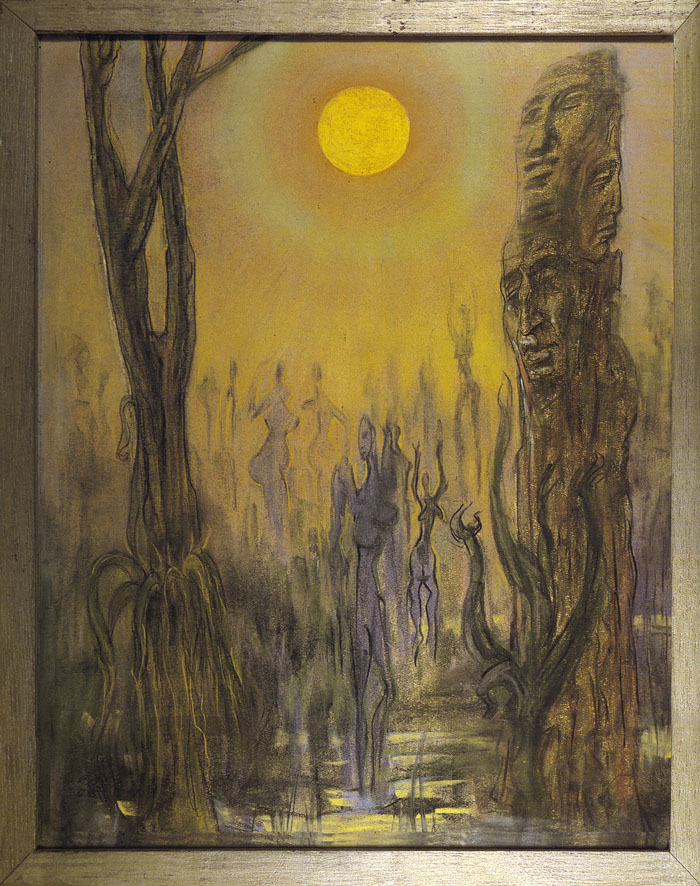
Cthulhu Cultus: The Sun is Sick (no date) by Austin Osman Spare.

I’ve been telling people about this drawing for years but I’ve not posted it here before. Spare produced this piece after Kenneth Grant gave him some of HP Lovecraft’s stories to read. I’ve never seen it dated but it’s probably from the mid-50s when Kenneth and Steffi Grant were corresponding with Spare and commissioning new artworks. What’s notable for me is that this is probably the first Lovecraft-derived drawing that wasn’t either a magazine or book illustration, or something done for one of the horror fanzines.

coc.jpg

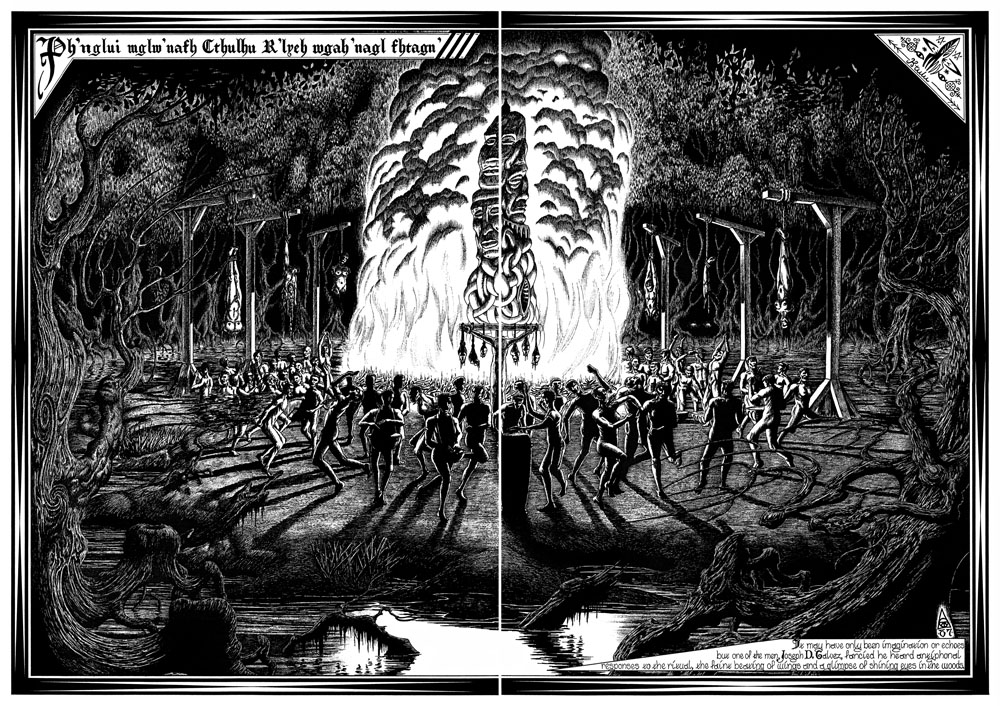
The Call of Cthulhu (1987) by John Coulthart.

Lovecraft aficionados have never seemed aware of Spare’s drawing since Lovecraft studies tended until very recently to remain fixed on popular media and the often parochial world of genre fandom. When I came to draw the swamp scene for The Call of Cthulhu in 1987 I borrowed the faces from Spare’s pillar for the column in the centre of the picture.

bulldogbreed.jpg

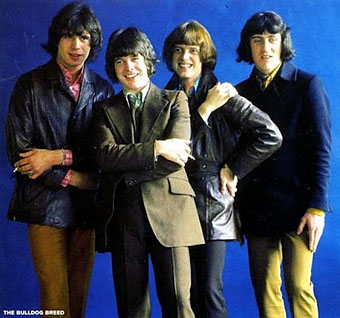
Bulldog Breed.

While we’re on the subject, and in the spirit of showing how all the obsessions here connect in one way or another, Phil Baker’s excellent biography of Austin Spare notes a surprising reference to the artist that predates Man, Myth and Magic via the psychedelic music scene. Bulldog Breed were a short-lived London group, one of many being promoted by the Deram label in the late 1960s. The group’s one-and-only album, Made In England, was released in 1969. The cover art is dreadful but the final song is a number entitled Austin Osmanspare [sic], a paean to the artist that turns AOS into a typical character from British psychedelia: an eccentric, oddly named, Victorian type with a sinister and mysterious glamour. According to Baker one of the band members had an aunt who knew Spare. It’s not a bad song, and the choice of magus gave them an edge over the Beatles who went for the more obvious Aleister Crowley. “They said he was before his time…”

Previously on { feuilleton }
Dreaming Out of Space: Kenneth Grant on HP Lovecraft
MMM in IT
Intertextuality
Abrahadabra
The Occult Explosion
Murmur Become Ceaseless and Myriad
Kenneth Grant, 1924–2011
New Austin Spare grimoires
Austin Spare absinthe
Austin Spare’s Behind the Veil
Austin Osman Spare

Dreaming Out of Space: Kenneth Grant on HP Lovecraft

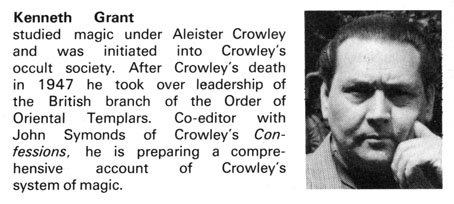
grant.jpg

Going through some of my loose copies of Man, Myth and Magic recently turned up this article by Kenneth Grant that I’d forgotten about. I have two separate sets of Man, Myth and Magic: a complete edition in binders, and a partial collection of loose copies of the weekly “illustrated encyclopedia of the supernatural”. The partial collection is worth keeping for the unique articles that ran across the last two pages of every issue, all of which are absent (along with the magazine covers) from the bound edition. These articles formed the Frontiers of Belief series, a collection of essays of the kind one might find in magazines today such as Fate or Fortean Times. An earlier essay about Wilfried Sätty, Artist of the Occult, was reproduced here a few years ago; none of these pieces have ever been reprinted so it seems worthwhile putting another of the more interesting pieces online.

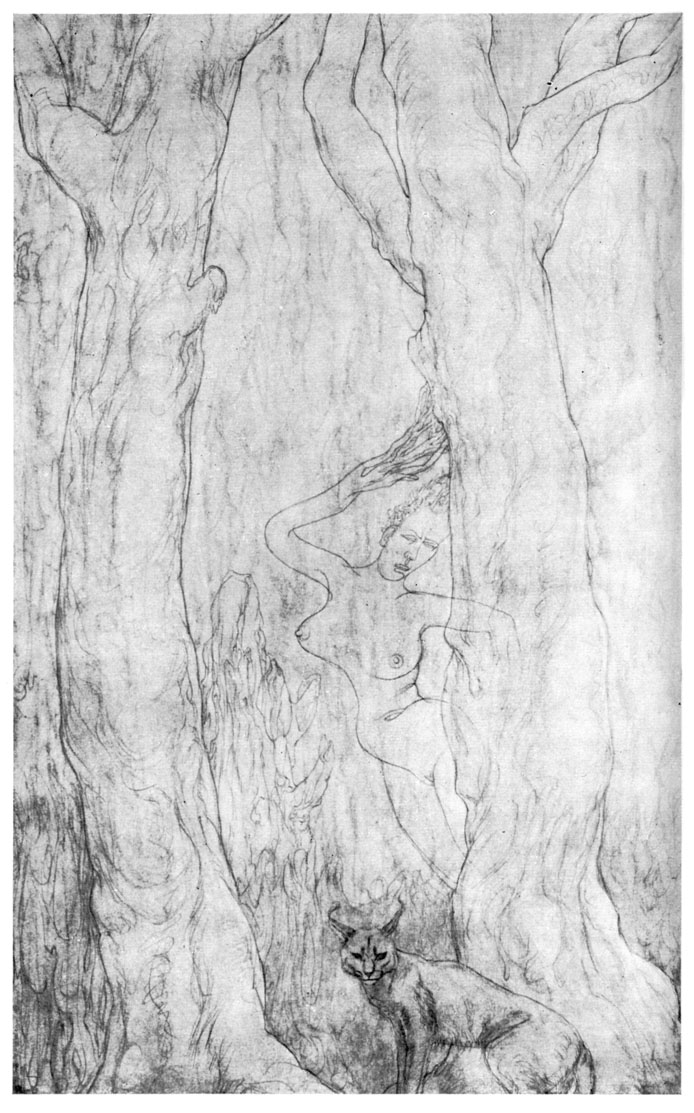
Kenneth Grant was the only active occultist among Man, Myth and Magic‘s roster of very serious and well-regarded writers and experts. Grant wrote several of the encyclopedia entries although not the one about Aleister Crowley, as you might expect, that entry going to Crowley’s executor and biographer, John Symonds. Grant was also a lifelong champion of HP Lovecraft’s fiction which explains this article; many of Grant’s later occult texts have a distinctly Lovecraftian flavour, and they often refer to Lovecraft and Arthur Machen as being the unconscious recipients of actual occult emanations or presences. Grant’s belief that the authors channelled these emanations into their fiction is central to this piece, a belief that Lovecraft would have dismissed even though several of his stories (not least The Call of Cthulhu) concern exactly this process. Grant connects Lovecraft with another artist whose work he championed throughout his life, Austin Osman Spare. It was Grant’s involvement with Man, Myth and Magic that put one of Spare’s drawings on the cover of the first issue, and further drawings inside the magazine, introducing the artist’s work to a new, highly receptive audience. The drawing below (Were-Lynx) appears in the magazine behind Grant’s text so I’ve scanned a text-free copy from Grant’s Cults of the Shadow (1975).

DREAMING OUT OF SPACE by Kenneth Grant

Malevolent powers are lurking in wait to project themselves into the sleeping minds of men: this terrifying idea is a recurring theme in the stories of Howard Phillips Lovecraft, who claimed that they came to him in nightmares. But were they simply bad dreams, or was he in fact receiving communications from an unknown source, as Kenneth Grant here suggests?
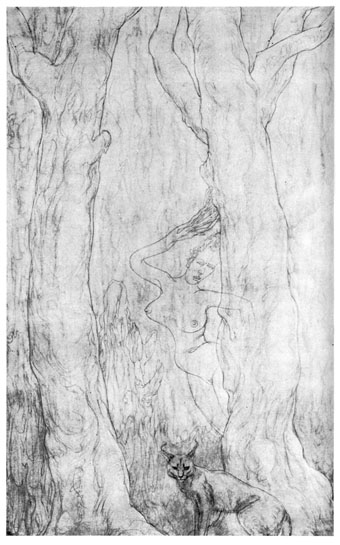
spare.jpg

“I have watched for dryads and satyrs in the woods and fields at dusk”; illustration by Austin Osman Spare, who sensed the forces looming behind Lovecraft’s work, and was inspired to illustrate these presences.

Howard Phillips Lovecraft died in 1937; but the myth-cycle which he initiated in unrivalled tales of cosmic horror now raises the question whether it was a mere fiction engendered in the haunted mind of an obscure New England writer, or whether it foreshadowed a particularly sinister kind of occult invasion.

According to a well-known occult tradition, when Atlantis was submerged, not all perished. Some took refuge on other worlds, in other dimensions; others “slept” a willed and unnatural sleep through untold aeons of time. These awakened; they lurk now in unknown gulfs of space, the physical mechanism of human consciousness being unable to pick up their infinitely subtle vibrations. They lurk, waiting to return and rule the whole earth, as was their aim before the catastrophe that destroyed their corrupt civilization.

This tradition was a major theme in Lovecraft’s work. Until quite recently people read his stories and shuddered (if sufficiently honest and sensitive enough to admit their uncanny impact), not suspecting for a moment that such things could be.

Few know that Lovecraft dreamed most of his tales. And he sometimes thought that these dreams, or rather, nightmares, were caused by misdeeds in remotely distant incarnations when, perhaps, he had aimed at acquiring magical powers. These dreams were memories of the past and prophecies of the future, for he said that “nightmares are the punishment meted out to the soul for sins committed in previous incarnations—perhaps millions of years ago!”

In his life as Howard Phillips Lovecraft he tried again and again to bring himself to face squarely the ordeal through which he knew he would have to pass, if he were finally to resolve his spiritual difficulties. The issue is brought to the surface perhaps more clearly and urgently in his poems than in his stories. He is on the brink of making the critical discovery, of surprising the secret of his inner life, and he is forced back repeatedly by the dread, the stark soul-searing fear which he bottles up in his work and which he communicates so successfully—in neat doses—to his readers.

One of Lovecraft’s most vivid creations is the ancient book of hideous spells composed to facilitate traffic with creatures of unseen worlds. He ascribed its authorship to Abdul Alhazred, a mad Arab who flourished in Damascus about 700 AD. This grimoire, during the course of its mysterious career, is supposed to have been translated by the Elizabethan scholar Dr John Dee, into Greek, under the title of Necronomicon. It contains the Keys or Calls that unseal forbidden spaces of cosmic sleep, inhabited by elder forces that once infested the earth. The Keys are in a wild, unearthly tongue reminiscent of the Calls of Chanokh, or Enoch, which Dr Dee actually obtained through contact with non-terrestrial entities during his work with the magician, Sir Edward Kelley, whom Aleister Crowley claimed to have been in a previous life. It is possible that the “evil and abhorred Necronomicon” was suggested by the clavicles or Keys of Enoch, which Dee and Kelley discovered, and which Crowley later used to gain access to unknown dimensions.

Continue reading “Dreaming Out of Space: Kenneth Grant on HP Lovecraft”

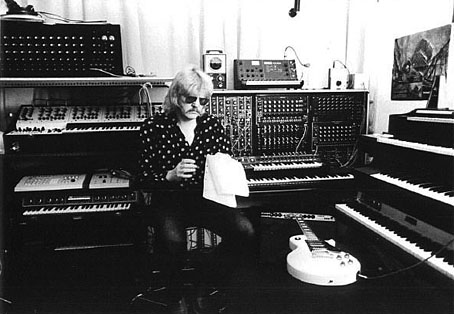
Edgar Froese, 1944–2015

froese.jpg

“I was a big fan of Kraftwerk, Cluster and Harmonia, and I thought the first Neu! album, in particular, was just gigantically wonderful,” admits Bowie. “Looking at that against punk, I had absolutely no doubts where the future of music was going, and for me it was coming out of Germany at that time. I also liked some of the later Can things, and there was an album that I loved by Edgar Froese, Epsilon In Malaysian Pale; it’s the most beautiful, enchanting, poignant work, quite lovely. That used to be the background music to my life when I was living in Berlin.”

David Bowie, Mojo magazine, April 1997

Epsilon In Malaysian Pale was Froese’s second solo album released in September 1975. That month David Bowie was in Los Angeles recording his Station To Station album, the opening of which features phased train sounds that are strikingly similar to those that run through the first side of the Froese album. I’ve never seen this similarity mentioned by Bowie scholars but if there was an influence it’s a good example of the degree to which Tangerine Dream infiltrated the wider culture as much as Can and Neu! (Kraftwerk remain in a league of their own.)

zeit.jpg

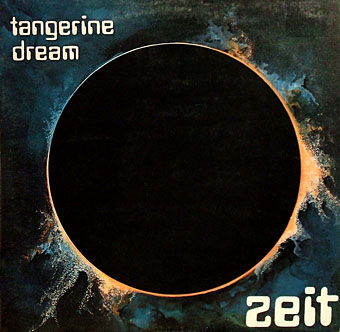
All you need is Zeit. Cover painting by Edgar Froese.

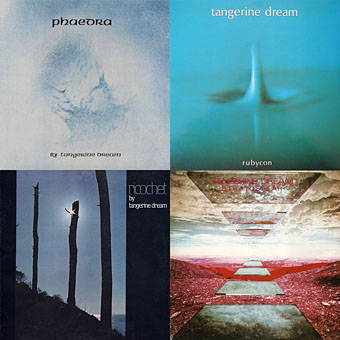
The influence of Tangerine Dream’s albums on the Ohr and Virgin labels is now so widespread that it’s difficult to compile a definitive list of those who’ve either paid homage or copied the group’s trademark style of extended sequencer runs and phased chords. Offhand I could mention the Ricochet-like tracks on Coil’s Musick To Play In The Dark Volumes 1 & 2; the many moments on the early Ghost Box albums, one of which samples from Alpha Centauri; and some of Julian Cope’s more out-there recordings from the late 1990s. There’s also all the releases by a group of loosely affiliated musicians dedicated to maintaining the 70s sound of Mellotrons and bouncing sequencers; many of these I’ve yet to hear but I’ve enjoyed the albums by Node and Redshift.

td.jpg

Tangerine Dream have been a continual fixture in my music listening since I was a teenager; I drew most of The Call of Cthulhu to a soundtrack of Rubycon and Jon Hassell’s Aka/Darbari/Java album. I kept up with them after they departed from Virgin then jumped ship in 1986 after Johannes Schmoelling left the group. The albums continued to proliferate in recent years to an extent that even the Freeman brothers only follow the discography (with some exasperation) up to 1990 in their redoubtable Krautrock tome The Crack in the Cosmic Egg. Navigating a late career is a tricky business for a popular musician so you can’t blame Froese for carrying on the project. Those early recordings are the important ones, and he was a crucial component in their creation.

There’s a lot of Froese and TD on YouTube. If you like the early material these are some of the better moments:

Bath Tube Session, 1969: TD in psych-freakout mode. Klaus Schulze on drums, and lots of German heads looking bemused/bored.
Ossiach Lake, 1971: Playing outdoors for the TV cameras.
Paris, 1973: Footage of the group improvising in the manner of the Atem album.
Coventry Cathedral, 1975: Tony Palmer’s film of one of the cathedral concerts which caused them to be banned by the Pope from playing in churches. The original sound on this one is lost so the YT version has edits of the Ricochet album as the soundtrack.
London, 1976: Great film of the Ricochet period. Total synth porn.
Thief, 1981: The opening scene to Michael Mann’s thriller, and one of their best soundtrack moments. In The Wire this month John Carpenter enthuses about the TD score for Sorcerer but I’ve always felt Mann’s crime drama was a better match for their sound.
Warsaw, 1983: A Polish TV recording of the concert documented on the Poland (1984) album.

Previously on { feuilleton }
Synthesizing
Tangerine Dream in Poland

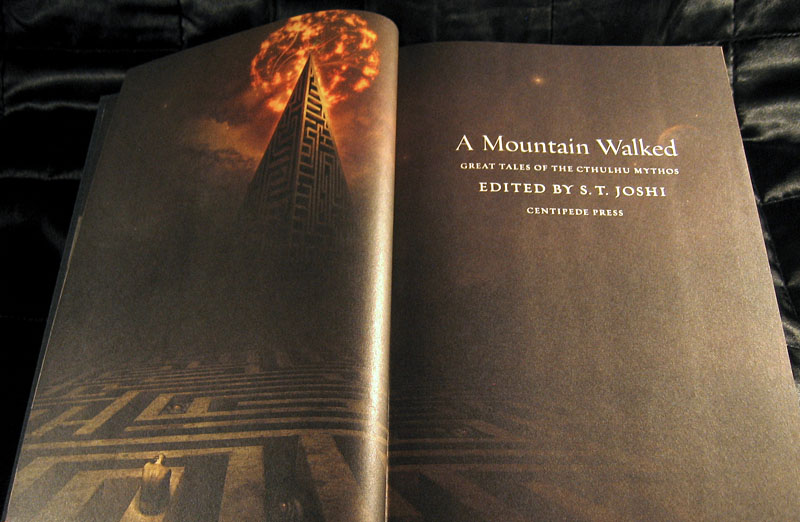
A Mountain Walked

mountain01.jpg

Art by David Ho.

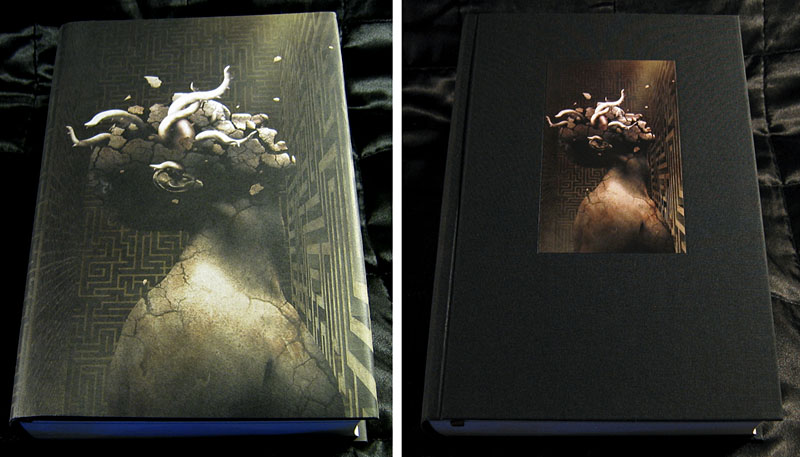
This may be a frustrating post for some since it concerns a limited edition anthology that sold out almost as soon as it was announced a year or so ago. Even though the book was published last year it’s taken a few months for my copies to arrive. A Mountain Walked is a collection of Cthulhu Mythos stories compiled by leading Lovecraft scholar ST Joshi, and published in the US by Centipede Press. Anyone familiar with Centipede’s more luxurious volumes will know that they don’t do things by halves, and this weighty tome is no exception: a large-format hardback (the signed edition is also cased), with heavy paper stock, colour printing, tinted sheets and a bulk that runs to almost 700 pages.

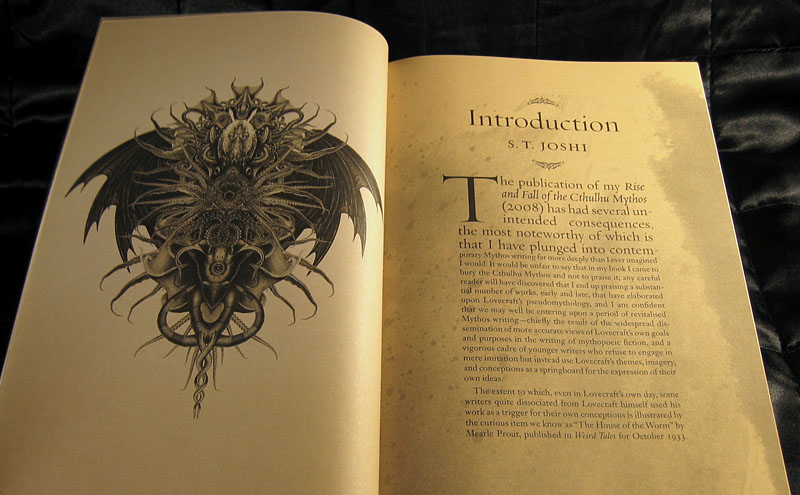
mountain02.jpg

Art by David Ho.

Many of the stories are reprints but there’s also new material from contributors including Thomas Ligotti, Neil Gaiman, Caitlín R. Kiernan, Laird Barron, the late Michael Shea (to whom the book is dedicated), Patrick McGrath, TED Klein, Gemma Files, Ramsey Campbell and many others. The artwork also ranges widely; I’d not seen anything by David Ho before but he’s very good, hence the samples shown here. But there’s also a variety of other work, even a Lovecraftian Peanuts comic strip by Julien Baznet. I was pleased that my Cthulhoid picture was placed with the introduction, it makes up for my never having responded to Mr Joshi when he wrote to me years ago asking if I’d be interested in contributing something to Necronomicon Press.

Since the book was so successful there’s been talk of doing a cheaper reprint. In the meantime, bloated Lovecraftian plutocrats (Yuggothcrats?) will find very expensive copies for sale on eBay. A few more page samples follow.

mountain03.jpg

Continue reading “A Mountain Walked”

Weekend links 236

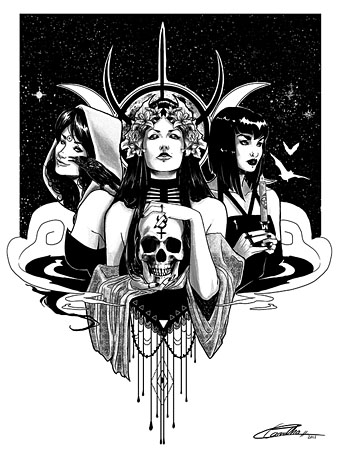
carvalho.jpg

The Three Witches (2014) by Lorena Carvalho.

Immersion, a new album by Grey Frequency, “…is a recording of the broken signals, wraiths in the ether from lost futures and utopias which were once promised…”. Box Of Secrets (1999) is an album of electronica by Ian Boddy that’s a free download until the end of December.

• “Hothouse flowers, Egyptian statuary, jewels, Nubian servants, crystal balls, cocaine, opium and champagne were just some of the things she spent her money on…” Lucy Davies explores the riotous world of Marchesa Luisa Casati.

• “London is a network of complete nexuses, coincidences, overlaps, references…” Stephanie Boland talks to Iain Sinclair about his new book 70×70: Unlicensed Preaching: A Life Unpacked in 70 Films.

My Women’s Studies professors would say: “You don’t know how hard we fought for you.” And yet, when they told me my sexuality was not correct, I felt embarrassed. I knew I had longings that didn’t line up with the politics, but I refused to repress them, particularly in my writing. I fought to unravel a political correctness that was censoring desire.

Screenwriter Erin Cressida Wilson on sex, cinema and secrets

Cthulhu, Fiction and Real Magic, a lecture by Ian ‘Cat’ Vincent at Treadwell’s, London, on December 3rd. For those who can’t attend, Erik Davis has just posted his essay about Lovecraft and contemporary occultism.

• “John Gielgud was obsessed with trousers, loved corduroy and leather. And so he wrote a film set in a menswear shop.” Gielgud’s unfilmed screenplay for gay porn director Peter de Rome may now be filmed.

• “The stories are even more fantastic and full of marvels than those in the Arabian Nights.” Robert Irwin on the newly-translated Tales of the Marvellous.

• Mixes of the week: The Advisory Circle present Winter From Out Here; Fall by The Ephemeral Man; Secret Thirteen Mix 136 by Cosmin TRG.

Danny Cooke‘s drone views of Pripyat, Chernobyl. Related: Into the Zone: Gasworks Park (Seattle, WA) by Christina Scholz.

• Watch Dragnet’s 1967 LSD episode. More psychedelics: “Magic mushrooms change brain connections“.

• Earth Magic: Peter Bebergal on photography of witches at play and at ritual.

• Düsseldorf 1970: The crucible of Krautrock by those who were there.

• It’s Alright Ma, It’s Only Witchcraft (1968) by Fairport Convention | Witch’s Will (1973) by Wilburn Burchette | Witches’ Multiplication Table (1982) by Holger Czukay