Polypodes

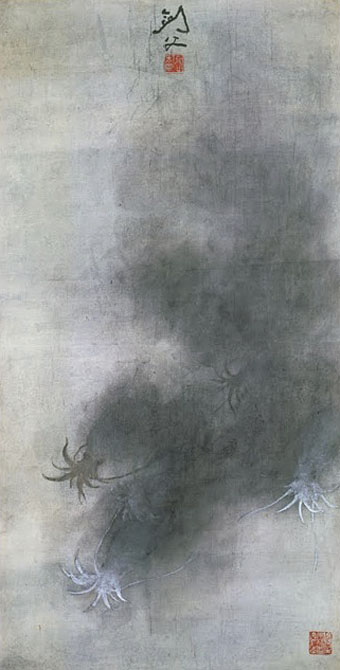
jianfu.jpg

Sepia (no date) by Gao Jianfu.

Quelquefois, dans une nuit d’orage, pendant que des légions de poulpes ailés, ressemblant de loin à des corbeaux, planent au-dessus des nuages, en se dirigeant d’une rame raide vers les cités des humains, avec la mission de les avertir de changer de conduite, le caillou, à l’œil sombre, voit deux êtres passer à la lueur de l’éclair, l’un derrière l’autre; et, essuyant une furtive larme de compassion, qui coule de sa paupière glacée, il s’écrie: «Certes, il le mérite; et ce n’est que justice.» Après avoir dit cela, il se replace dans son attitude farouche, et continue de regarder, avec un tremblement nerveux, la chasse à l’homme, et les grandes lèvres du vagin d’ombre, d’où découlent, sans cesse, comme un fleuve, d’immenses spermatozoïdes ténébreux qui prennent leur essor dans l’éther lugubre, en cachant, avec le vaste déploiement de leurs ailes de chauve-souris, la nature entière, et les légions solitaires de poulpes, devenues mornes à l’aspect de ces fulgurations sourdes et inexprimables.

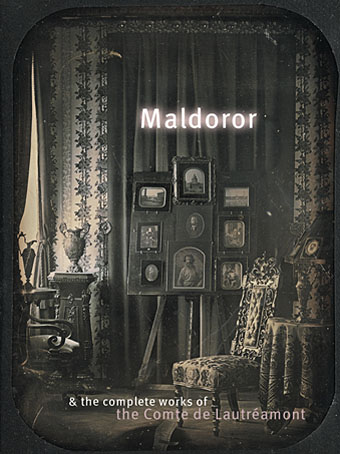
Les Chants de Maldoror (1869) by the Comte de Lautréamont

maldoror.jpg

Sometimes on a stormy night while legions of winged squids (at a distance resembling crows) float above the clouds and scud stiffly towards the cities of the humans, their mission to warn men to change their ways—the gloomy-eyed pebble perceives amid flashes of lightning two beings pass by, one behind the other, and, wiping away a furtive tear of compassion that trickles from its frozen eye, cries: “Certainly he deserves it; it’s only justice.” Having spoken thus it reverts to its timid pose and trembling nervously, continues to watch the manhunt and the vast lips of the vagina of darkness whence flow incessantly, like a river, immense shadowy spermatozoa that take flight into the dismal aether, the vast spread of their bat’s wings obscuring the whole of nature and the lonely legions of squids—grown downcast viewing these ineffable and muffled fulgurations.

Translation by Alexis Lykiard, 1970

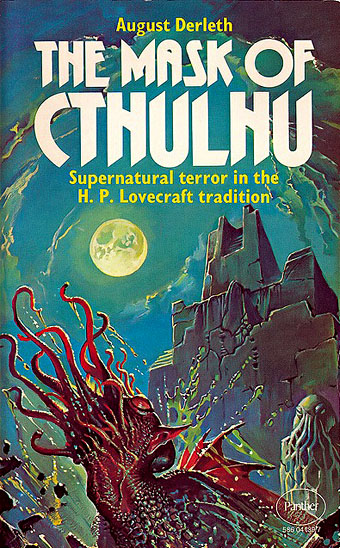
pennington-cthulhu.jpg

The Mask of Cthulhu, 1976 paperback reprint. Cover art by Bruce Pennington.

Above these apparent hieroglyphics was a figure of evidently pictorial intent, though its impressionistic execution forbade a very clear idea of its nature. It seemed to be a sort of monster, or symbol representing a monster, of a form which only a diseased fancy could conceive. If I say that my somewhat extravagant imagination yielded simultaneous pictures of an octopus, a dragon, and a human caricature, I shall not be unfaithful to the spirit of the thing. A pulpy, tentacled head surmounted a grotesque and scaly body with rudimentary wings; but it was the general outline of the whole which made it most shockingly frightful. Behind the figure was a vague suggestion of a Cyclopean architectural background.

The Call of Cthulhu (1928) by HP Lovecraft

Previously on { feuilleton }
Ulysses versus Maldoror
Maldoror
Vampyroteuthis Infernalis by Vilém Flusser
Books of blood
Magritte’s Maldoror
Frans De Geetere’s illustrated Maldoror
Maldoror illustrated

Covering Viriconium

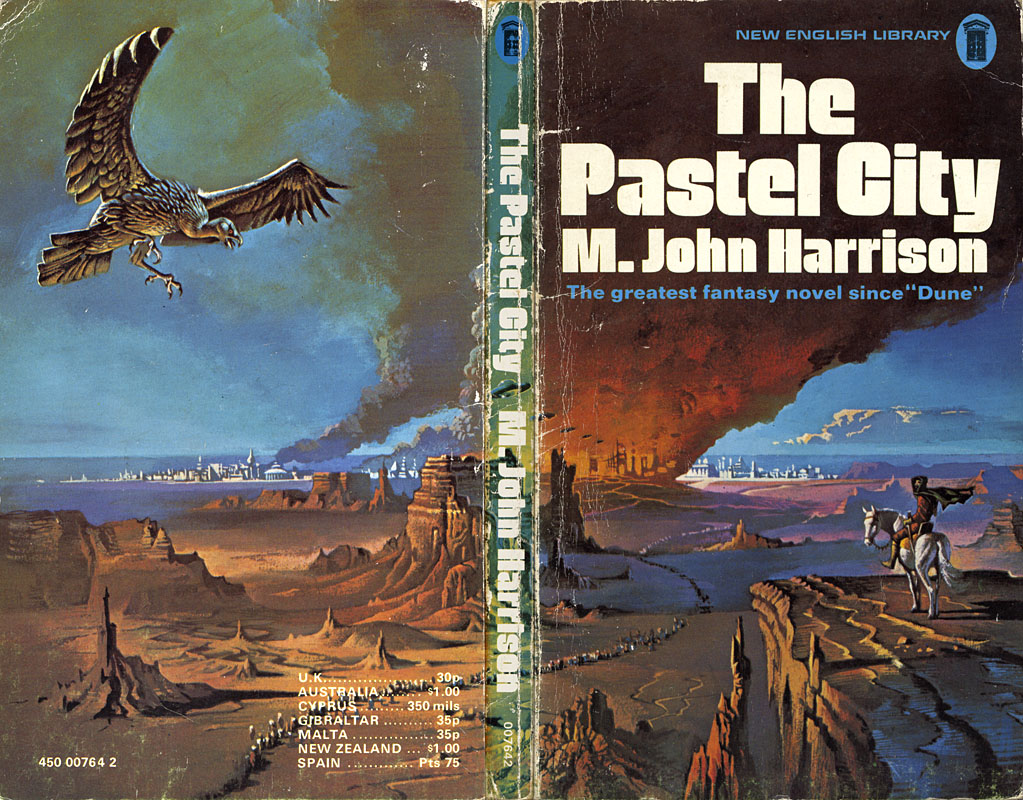
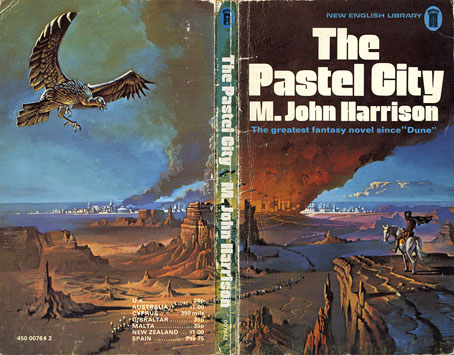
pennington-pastel.jpg

The Pastel City (New English Library, 1971). Illustration by Bruce Pennington.

There are writers’ writers, of course, and M. John Harrison is one of those. He moves elegantly, passionately, from genre to genre, his prose lucent and wise, his stories published as sf or as fantasy, as horror or as mainstream fiction. […] His prose is deceptively simple, each word considered and placed where it can sink deepest and do the most damage.

Neil Gaiman in the introduction to the Bantam/Spectra edition of Viriconium (2005)

This is a lengthy post of potentially minority interest for which I make no apologies. It’s often been a function of the writing here to think aloud while communicating an enthusiasm; as enthusiasms go this one runs deeper than usual. I love these books indecently. If they were people I’d want to sleep with them even though doing so might mean contracting some debilitating illness. When you’re employed as a book designer and illustrator it’s impossible to avoid taking a professional interest in the packaging of your favourite books. M. John Harrison‘s Viriconium books—three novels and a collection of short stories—present challenges that the illustrators and art directors of the past have invariably failed to meet. This post looks at prior cover designs while a subsequent post will suggest some solutions to the challenges. But first it’s necessary to say something about Viriconium itself.

In the distant future of the Earth, when the human race has flourished then lapsed into a state of terminal decay, only one city of note remains: Viriconium, the Pastel City, surrounded by the wastes and fens of a ruined world. Or so we’re told in the first book of a series which begins as outright fantasy and moves by an astonishing feat of authorial dexterity closer to our world and our time. (A shorthand description might describe a series that starts out reading like Jack Vance and ends up closer to Bruno Schulz.) It becomes apparent that Viriconium stands for all the cities that have ever been, and with its avenues, rues and strasses often seems to be a composite of them all. Aside from the unspecified future its fixture in time is indeterminate: one story may concern events which are in the distant past of another while the streets and quarters never remain anchored enough for any kind of map to be drawn. Areas of continuity rise like towers from a sea of vapour. Even the city’s name slips its mooring: the origin is Viroconium Cornoviorum, a Roman town in Shropshire, and Viroconium, a poem by Mary Webb. In the later books we’re told the city is also called Uriconium or Vriko but whether these variants lie in the past or future of Viriconium is unclear. The indeterminacy was deliberate, a riposte to what Harrison calls “fauxthenticity”, and the tendency of genre readers to reduce the subtleties of fiction to the schematics of role-playing games, spaceship diagrams and books with titles like The Science of Middle-Earth. It’s this indeterminacy and a refusal to offer neat resolutions (or that awful term “closure”) that no doubt explains why Harrison’s books often seem to attract more praise than actual readers.

The most remarkable aspect of the books presents the greatest problems in design terms. In the fourteen years that Harrison worked on his series he used its mutable qualities to pull the entire project to pieces without actually destroying it or turning the whole thing into a self-regarding postmodern game. The early books critique the lazy assumptions of the fantasy genre while the later books recast the earlier stories as myths or half-remembered dreams. The first two books may use the apparatus of the fantasy genre but that doesn’t mean the tired imagery of fantasy illustration necessarily suits their covers. The very last story, A Young Man’s Journey to Viriconium, is set in the north of England in our own time. Changing the name Viriconium to London throughout the text, which Harrison has done when the story has been published elsewhere, dissolves the remaining genre trappings. The process is akin to watching those Buddhist monks who construct elaborate mandalas of coloured sand only to sweep them away when the work is finished. All this makes the Viriconium books unique, it’s one of many reasons why I hold them in such high regard and it’s also why they frequently irritate those who want simpler fare. The problem of appealing to a reactionary readership may explain why many of the following covers have failed to honour the content of the books.
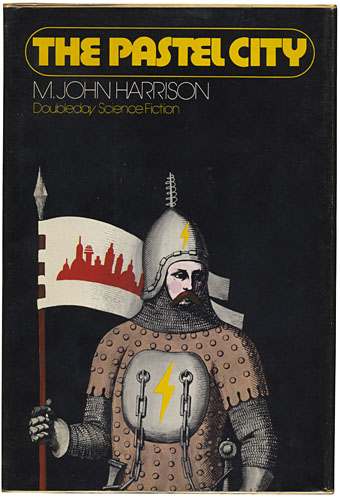
pastel-minor.jpg

The Pastel City (Doubleday, 1972) Illustration by Wendell Minor.

Dustjacket summaries do none of the books any favours but for the unacquainted they help give a flavour of each volume. They also show how the presentation gradually shifts emphasis. Here’s the Doubleday edition:

An intriguing fantasy in which past and future blend uniquely on an Earth far different from any known to man.

There, in the Empire of Viriconium, a world of chivalry, of magic and strange powers, two Queens clash in bloody warfare for control of the Pastel City and all of its domains. The armies of the defender, Queen Methvet, are led by Lord tegeus-Cromis and the rest of a legendary band of knights, while their attackers are the vicious and cunning Northmen who serve the rival Queen Moidart.

More is involved than a struggle for a throne however, for in their lust for victory the forces of Queen Moidart have unleashed creatures from Earth’s dim past whose terrible potential they little realize until too late. And as Lord Cromis and the rest of his band seek to meet the challenge of these nightmare apparitions, their quest leads them on a perilous journey across many weird lands to a deadly climax in a buried city where a solution is revealed that is as old as time itself.

It’s apposite that a series about an indeterminate city begins with some confusion evident from the outset. The Pastel City in its first UK printing was described on the cover as a fantasy yet compared to Dune which is generally regarded as science fiction; the Doubleday edition is labelled science fiction yet the cover illustration shows a mailed and armoured warrior; the narrative is situated somewhere between the genres in what used to be called science fantasy. While the story concerns the distant future many of the props are the familiar material of heroic fantasy: horses, swords, feuding queens, an axe-wielding dwarf. What technology remains is either defunct or barely functioning. The ruin and decay of Harrison’s world is part of the pleasure, as is the vacillating and ambivalent nature of the characters, a quality which increases as the series develops. None of the publishers dare to reflect this ambivalence in the cover art. Unaware readers would be led to believe from subsequent editions that these books contain the determined and super-efficient heroes they’d find in other books. Compared to what follows the first two covers aren’t so bad; Bruce Pennington gives us one of his flying saucer apocalypses while Wendell Minor’s avoidance of a genre scene is an approach that might have been deployed a lot more often later on.

Continue reading “Covering Viriconium”

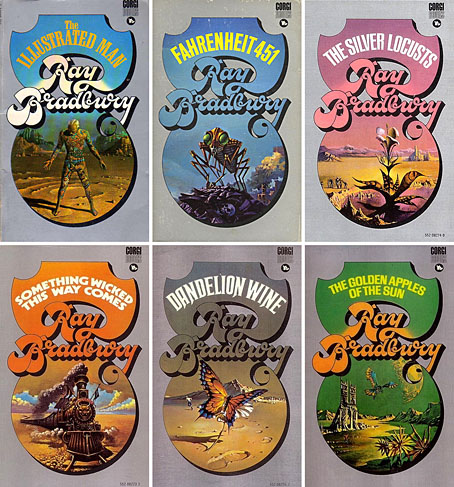
Ray Bradbury, 1920–2012

bradbury.jpg

I always liked these paperback covers, a very of-their-time series published by Corgi Books in the UK from 1969 to 1970. A sea of metallic silver ink surrounded the paintings by Bruce Pennington. Seeing them together makes me wish I had the full set.

Mr. Electrico was a beautiful man, see, because he knew that he had a little weird kid there who was twelve years old and wanted lots of things. We walked along the shore of Lake Michigan and he treated me like a grown-up. I talked my big philosophies and he talked his little ones. Then we went out and sat on the dunes near the lake and all of a sudden he leaned over and said, I’m glad you’re back in my life. I said, What do you mean? I don’t know you. He said, You were my best friend outside of Paris in 1918. You were wounded in the Ardennes and you died in my arms there. I’m glad you’re back in the world. You have a different face, a different name, but the soul shining out of your face is the same as my friend. Welcome back.

Ray Bradbury’s life was like a Ray Bradbury novel. From an amazing interview at the Paris Review.

Some memorial links:
The New Yorker unlocked two Ray Bradbury stories.
• Evan says “Loves, did you know Bradbury was a poet? Now you do.”
A man who won’t forget Ray Bradbury by Neil Gaiman.

Elsewhere on { feuilleton }
The book covers archive

Previously on { feuilleton }
The fantastic and apocalyptic art of Bruce Pennington

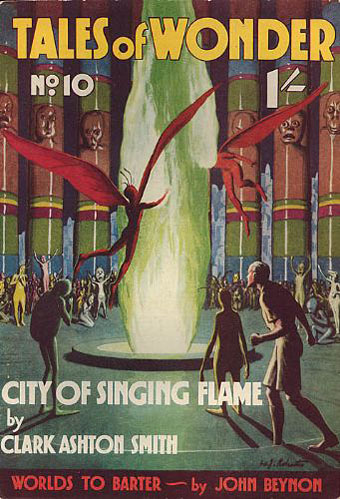
The City of the Singing Flame

cas1.jpg

Wonder Stories, July 1931. Illustration by Frank R. Paul.

Looking over Bruce Pennington’s artwork this week sent me back to some of my Clark Ashton Smith paperbacks, many of which sport Pennington covers. One of my favourite Smith stories, The City of the Singing Flame, is also one of his finest pieces, and a story that Harlan Ellison has often referred to as his favourite work of imaginative fiction.

cas2.jpg

Tales of Wonder, Spring 1940. Illustration by WJ Roberts.

The story as it’s known today was originally a shorter piece, The City of the Singing Flame, followed by a sequel, Beyond the Singing Flame; both stories were published in Wonder Stories magazine in July and November of 1931, then as one in Arkham House’s CAS collection Out of Space and Time in 1942. The two-in-one story is now the definitive version.

Smith’s tale concerns the discovery of a dimensional portal somewhere in the Sierras. Beyond this there lies a path leading through an otherworldly landscape to a colossal city peopled by a race of mute giants. A temple at the heart of the city protects the prodigious green flame of the title, an eerie and alluring presence whose siren call draws creatures from adjacent worlds who prostrate themselves before the flame before immolating themselves in its fire. A narrator, Philip Hastane, give us details of diary entries from a friend who discovered the portal, and who subsequently has to decide whether to resist the lure of the mysterious flame or follow the other creatures into the fire. More than this would be unfair to divulge if you’ve never read Smith’s remarkable piece of fiction.

Continue reading “The City of the Singing Flame”

The fantastic and apocalyptic art of Bruce Pennington

pennington-pastel.jpg

The Pastel City (1971), the first in M. John Harrison’s peerless series of Viriconium books.

Today’s post is another guest entry over at Tor.com. I’d been intending on writing something about Bruce Pennington‘s art for some time, having already covered the work of Ian Miller, my other favourite genre cover artist of the 1970s. (By coincidence both artists have illustrated the work of M. John Harrison and HP Lovecraft.) My hand was forced this month by the news of the first ever exhibition of Pennington’s paintings which is being held at Britain’s foremost occult book emporium, the Atlantis Bookshop in Museum Street, London. There’s a catalogue of the works on display here, many of which will be for sale. If I had the cash I’d consider buying one, Pennington’s work made a big impression on my imagination when I was reading many of the titles he’d illustrated for the first time. His art was unique for me in its occasionally Surrealist overtones, and as a cover artist he was unusual in working across a range of genres. Like Frank Frazetta his imagination and technique were able to suggest a great deal with a minimum of brush strokes.

pennington-cthulhu.jpg

The Mask of Cthulhu (1976).

This post can be taken as an appendix to the Tor one which I didn’t want to overburden with pictures. The Derleth cover is purloined from Jovike’s excellent Flickr collection which includes several Pennington covers. Below are some pages from Pennington’s first book, Eschatus, a large-format collection of paintings interpreting the prophecies of Nostradamus as an apocalyptic science fiction narrative taking place in the 24th century.

Pennington has many examples of his work on his website, and there’s also a feature about his paintings in this month’s Fortean Times. The Atlantis exhibition runs to August 27th.

pennington-eschatus1.jpg

Eschatus (1976).

Continue reading “The fantastic and apocalyptic art of Bruce Pennington”