Pogány’s Turkish fairy tales

pogany05.jpg

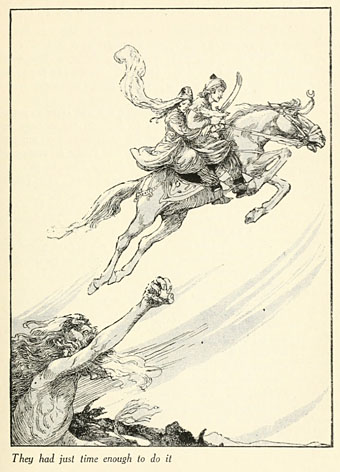
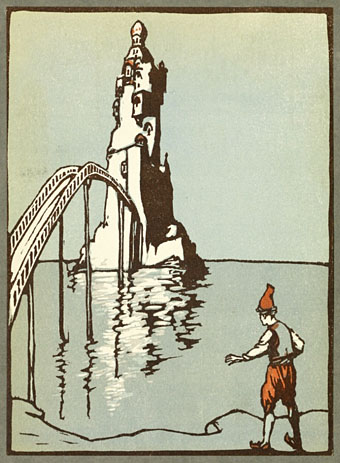
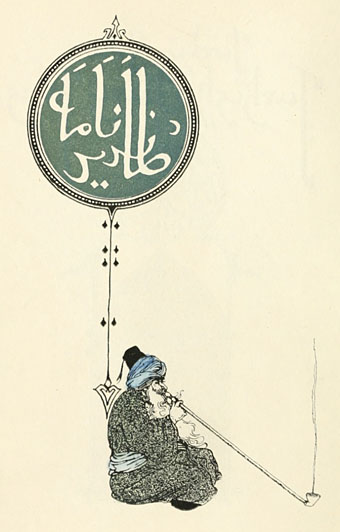
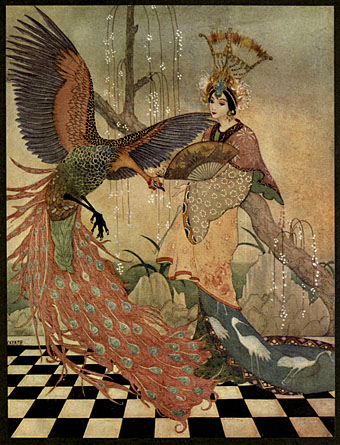
The illustrations are by Willy Pogány, the forty-four fairy tales were collected and translated by Ignácz Kunos. This wasn’t the first edition of Kunos’s book which dates back to 1889, but Pogány’s edition must be one of the most heavily illustrated, with drawings in a variety of styles throughout. The tipped-in plates look like woodcuts which is a style I’ve not seen from Pogány before. Elsewhere there are many comic demons and monsters rather like the kinds of things Sidney Sime used to enjoy inventing. And many Orientalist motifs, of course The Internet Archive copy isn’t dated but other sites give a date of 1913. This copy is also poorly hand-painted in places. Sacred Texts has the illustrations sans daubings.

pogany01.jpg

pogany02.jpg

Continue reading “Pogány’s Turkish fairy tales”

Weekend links 84

enok.jpg

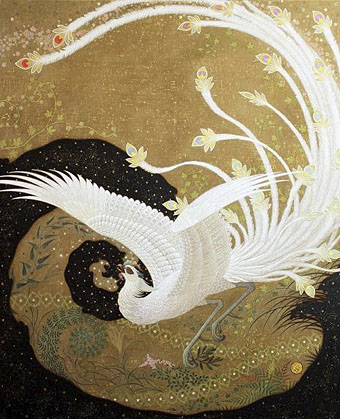
Regeneration (2011) by Toshiyuki Enoki. Via.

HIDE/SEEK: Difference and Desire in American Portraiture, the art exhibition that caused such a fuss last year at the Smithsonian Institution, opens at the Brooklyn Museum, NYC, on November 18th. Among the events associated with the show is a screening of James Bidgood’s lusciously erotic Pink Narcissus. David Wojnarowicz’s video piece, A Fire in My Belly, is still a part of the exhibition so the New York Daily News reached for the outrage stick to prod some reaction from people who’d never heard of the artist or his work before. Will history repeat itself? Does the Pope shit in the woods? Watch this space…

Magic is not simply a matter of the occult arts, but a whole way of thinking, of dreaming the impossible. As such it has tremendous force in opening the mind to new realms of achievement: imagination precedes the fact. It used to be associated with wisdom, understanding the powers of nature, and with technical ingenuity that could let men do things they had never dreamed of before. The supreme fiction of this magical thinking is The Arabian Nights, with its flying carpets, hidden treasure and sudden revelations…

Marina Warner, whose new book, Stranger Magic: Charmed States and the Arabian Nights, is reviewed here and here.

• Those Americans who adore big business but loathe the idea of gay marriage will be dizzy with cognitive dissonance at the news that 70 major US companies—including CBS, Google, Microsoft and Starbucks—have signed a statement saying the Defense of Marriage Act (DOMA) is bad for business. Mark Morford at SFGate says this now means that real homophobes don’t Google.

Divining with shadows and dreams, tears and blood: S. Elizabeth talks to JL Schnabel of BloodMilk about her “supernatural jewels for surrealist darlings“.

Earth: Inferno (2003), a short film by Mor Navón & Julián Moguillansky based on the book by Austin Osman Spare. Via form is void.

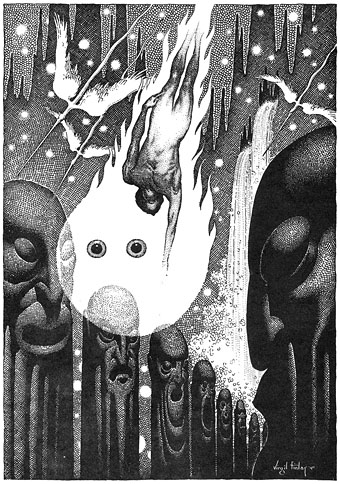
finlay.jpg

Illustration by Virgil Finlay for A. Merritt’s The Face in the Abyss. From a 1942 Finlay portfolio at Golden Age Comic Book Stories.

The Mute Synth as created by Dirty Electronics & designed by Adrian Shaughnessy.

Phil Baker reviews two new Aleister Crowley biographies at the TLS.

A Brief Rant on the Future of Interaction Design

The Most Amazing Room In Queens, NYC.

Brian Eno on composers as gardeners.

Alan Turing is Alan Garner’s hero.

• Paintings by Guy Denning.

Static (1998) by Redshift | The Owl Service (2000) by Pram | Lover’s Ghost (2010) by The Owl Service.

Maxfield Parrish’s Arabian Nights

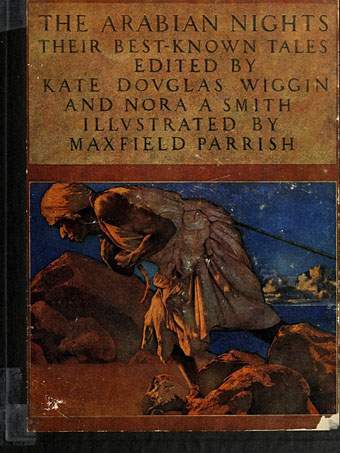
parrish01.jpg

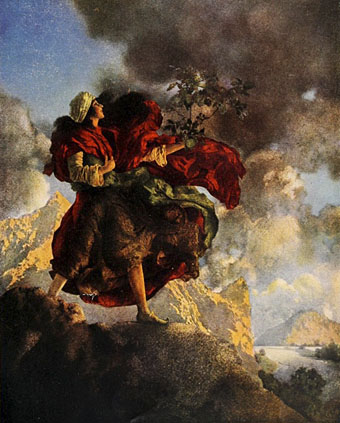
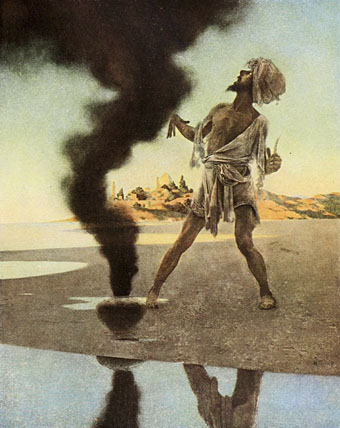
Despite spending years tracking down the work of various illustrators I’ve never been as familiar with the major works of Maxfield Parrish as I might. I’ve seen a couple of the plates from this 1909 edition before but the majority are new discoveries. They’re as lucious as you’d expect from Parrish, and for once the paper and inks haven’t been spoiled by age. See all the pages or download the entire book here.

parrish02.jpg

parrish03.jpg

Continue reading “Maxfield Parrish’s Arabian Nights”

Thomas Mackenzie’s Aladdin

aladdin1.jpg

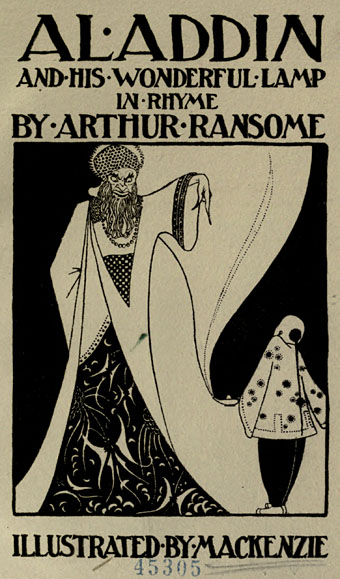
The tip for this one came via Beautiful Century. Thomas Mackenzie (1887–1944) was a minor British illustrator whose work I hadn’t seen before, and if I’d seen the picture above uncredited I might have taken it for something by Kay Nielsen or Edmund Dulac. Mackenzie’s colour plates for the 1919 edition of Aladdin and His Wonderful Lamp in Rhyme by Arthur Ransome are very similar to his more famous contemporaries, while the black-and-white pieces owe a considerable debt to Aubrey Beardsley, especially the title page below. Not all the drawing is as assured as one might hope but the book as a whole is still worth a look.

aladdin2.jpg

Continue reading “Thomas Mackenzie’s Aladdin”

Weekend links 50

selski1.jpg

Invisible Light by Margo Selski.

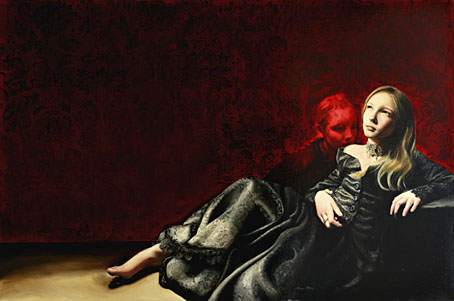
The Glass Garage Fine Art Gallery has an online collection of paintings by Margo Selski, many of which feature her cross-dressing son, Theo. Coilhouse profiled artist and model earlier in the week. Some of these paintings mix oil with beeswax which is something I’ve not come across before.

• The Periwinkle Journal‘s first issue will be available online, free, from March 22nd until mid-June, featuring work by filmmaker and artist Hans Scheirl (Dandy Dust), artwork and collages by Genesis Breyer P-Orridge, a 7-page colour comic by Mavado Charon, artwork by Timothy Cummings, artwork and installations by Cody Chritcheloe/SSION, photos by Megan Mantia, Science-Heroes by Peter Max Lawrence, an illustration portfolio by Diego Gómez, selections from the queer photography pool on Flickr, reviews and other stuff. More later.

• The Quietus wanted to remind us that this year is the 25th anniversary of the NME‘s C86 compilation tape, a collection that sought to capture a moment of ferment but which inadvertently inspired too much dreary sub-Velvet Underground pop. I’d rather celebrate the 30th anniversary of the NME‘s C81 compilation, a far more diverse collection and musically superior. If you want to judge for yourself, both tapes can be downloaded here.
selski2.jpg

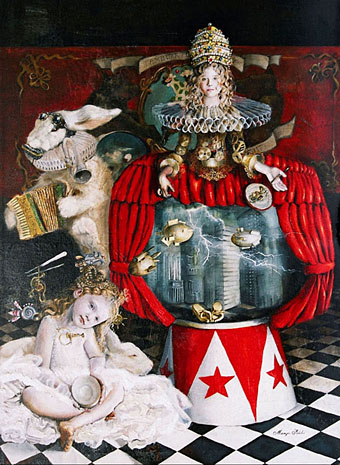
Machine in the Garden — Our Island Shall Know Abundance Without End by Margo Selski.

• Rick Poynor continues his exploration of Ballardian graphics with a piece about the paintings of Peter Klasen. Related: Where Will It End? JG Ballard interviewed by V. Vale & introduced by Michael Moorcock (Arthur No. 15/March 2005).

In his autobiography, Miracles of Life, JG Ballard suggested that illustrated versions of The Arabian Nights helped prepare him for surrealism.

Robert Irwin, author of The Arabian Nightmare, on the illustrators of The Arabian Nights.

• Another Coulthart cult movie surfaces, Jerzy Skolimowski’s Deep End (1970), out of circulation for many years but newly restored by the BFI. A re-release is scheduled for May so I’m hoping now that a DVD release will follow soon after.

Thom Ayres’ photostream at Flickr, and more long-exposure photos.

Fuck You, A Magazine of the Arts, number 5, volume 8.

Nicolas Roeg: “I don’t want to be ahead of my time.”

• MetaFilter looks at the films of René Laloux.

• The Eerie covers of Frank Frazetta.

Indie Squid Kid.

Requiem (for String Orchestra) by Toru Takemitsu.