Weekend links 11

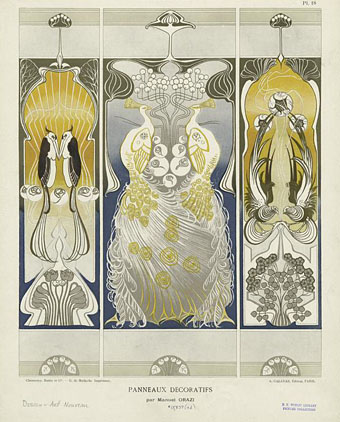
orazi4.jpg

Panneaux decoratifs (1900) by Manuel Orazi at NYPL.

Ghostsigns: “a collaborative national effort to photograph, research and archive the remaining examples of hand painted wall advertising in the UK and Ireland.”

• Golden Age Comic Book Stories posts some Alphonse Mucha.

Voyage Fantastique – An illustrated guide to the body and mind at A Journey Round My Skull.

The gallery of the International Exhibition of Calligraphy.

Trevor Wayne Pin-Up Show, a new photo collection of the tattooed Mr Wayne which includes photos and a foreword by Clive Barker.

Phallophonies, a gallery exploring the penis in religious art. Related: “Churchgoers are outraged over a crucifix in a Catholic church that they say shows an image of genitalia on Jesus.”

Hollingsville: “Expect live and unscripted wanderings around voodoo science parks, examinations of cities as battle suits and thoughts on pods, capsules and world expos.”

Phantom Circuit #33 is a Ghost Box special featuring an interview with Jim Jupp (Belbury Poly) and Julian House (The Focus Group). Related: Ghost Box films at YouTube.

Eldritchtronica and Wyrd Bliss, a mixtape by Simon Reynolds.

• Avant garde music and cinema meet at The Sound of Eye.

• Make your own newspaper with Newspaper Club.

Drawdio: A pencil that lets you draw music.

Yoko Ono collects rare books.

KittehRoulette.

• Song of the week: The Four Horsemen (1972) by Aphrodite’s Child.
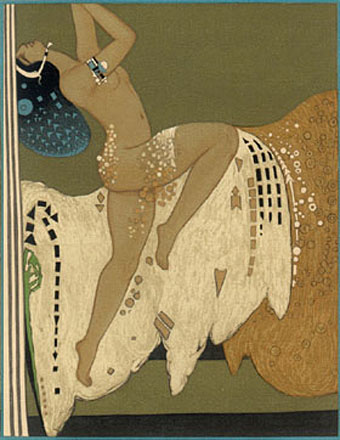
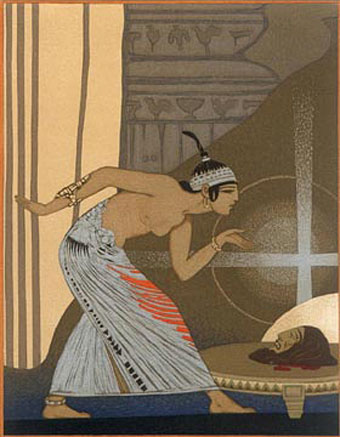
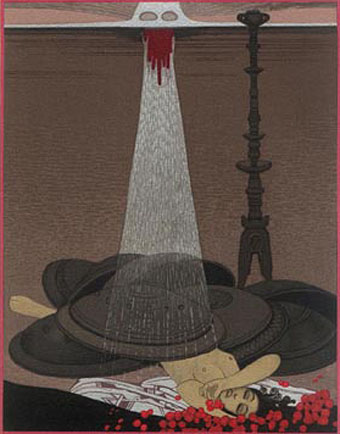
Manuel Orazi’s Salomé

orazi1.jpg

The Biblical bad girl returns in three pictures from an illustrated edition of Oscar Wilde’s play, published as a limited run in 1930. Manuel Orazi (1860–1934) was a French artist whose work has appeared here before, and no doubt will do again very soon since I’ve been finding further examples of his illustrations and designs. These drawings are closer to Gustav Klimt or George Barbier than his earlier illustrations which owed much to the stylisation of Mucha’s Art Nouveau.

orazi2.jpg

orazi3.jpg

Elsewhere on { feuilleton }
The illustrators archive
The Salomé archive

Maria Nilsdotter

nilsdotter1.jpg

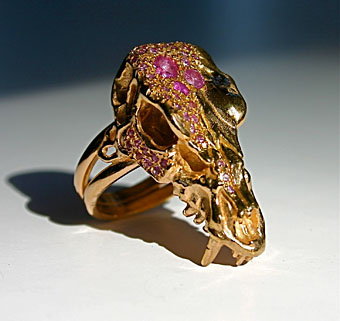
Dragon Skull Ring.

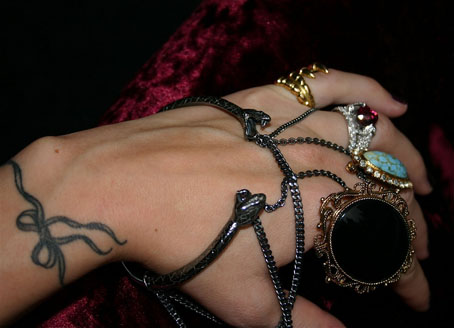
Jewellery by Swedish designer Maria Nilsdotter. Looking at her blog posts I’d guess that her snake bangle is inspired by the serpentine ring and bracelet set designed by Alphonse Mucha and Georges Fouquet for Sarah Bernhardt.

nilsdotter2.jpg

Snake bangle (blackened silver).

Previously on { feuilleton }
The Divine Sarah
Lalique’s dragonflies

The art of Henri Privat-Livemont, 1861–1936

privat3.jpg

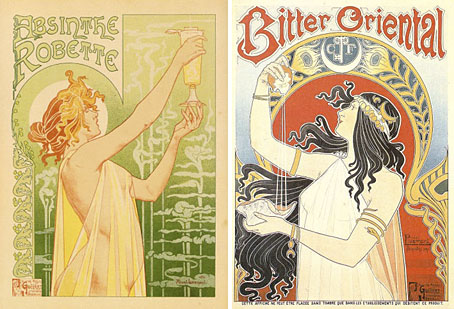
left: Absinthe Robette (1896); right: Bitter Oriental (1897).

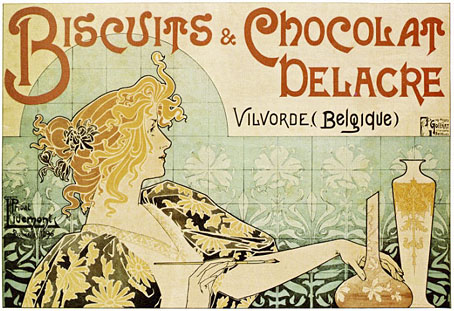
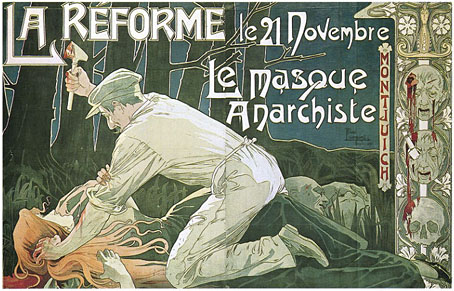
Henri Privat-Livemont, a Belgian artist and one of the best of the post-Mucha Art Nouveau stylists. I’ve featured his Absinthe Robette poster before but am including it again since it’s my favourite of the ones I’ve seen. All of these are from the Art of the Poster 1880–1918 collection at Lawrence University whose copies can be explored in extreme close-up.

privat2.jpg

Biscuits & Chocolat Delacre (1896).

privat1.jpg

Le Masque Anarchiste (1897).

Previously on { feuilleton }
Absinthe girls

The faces of Parsifal

parsifal.jpg

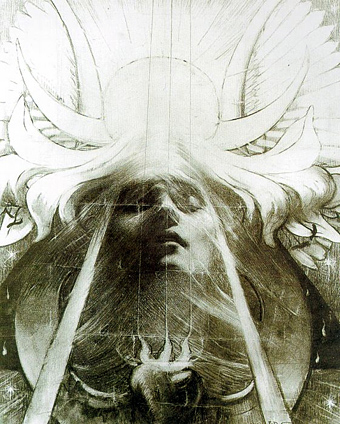
Parsifal by Jean Delville (1890).

Continuing the occasional series of posts examining the evolution of a particular design or image, this one begins with a mystical charcoal drawing by Belgian Symbolist, Jean Delville (1867–1953), our object of concern being that entranced or dreaming face.

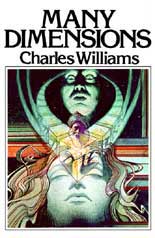
lamb.jpgMy first encounter with Delville’s image wasn’t via the original but came with this Seventies’ version produced for a Charles Williams paperback cover by illustrator Jim Lamb. (And this copy is the only one I can find, reused on a recent audiobook of Williams’ novel. If anyone has a link to a larger copy of the paperback cover then please post it in the comments.) Yes, this is tenuous but when I eventually got to see Delville’s picture it made me think immediately of Lamb’s illustration. Many Dimensions is one of my favourite books by Williams and unusually for him it deals with Islamic rather than Christian mysticism; in that case if Lamb was borrowing from Parsifal then it’s a case of the right image for the wrong book.

Jim Lamb is another illustrator from this period who now works mainly as a landscape artist.

Continue reading “The faces of Parsifal”