The art of Frieda Harris, 1877–1962

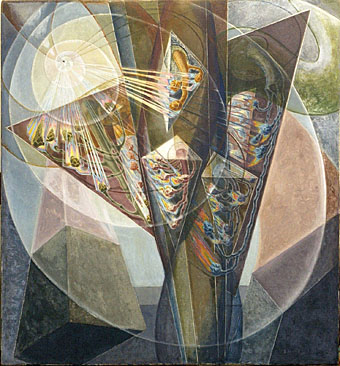
harris01.jpg

Searching around for artwork by Frieda Harris turned up a few examples I hadn’t seen before including the marvellous painting above which is unfortunately untitled and undated. Harris is very familiar to Aleister Crowley aficionados and those with an interest in the Tarot via her paintings for the Thoth Tarot deck, a project that she and Crowley worked on during the 1930s. The deck is justly celebrated for its modernising of the Tarot symbolism, and for its radical art style which wasn’t afraid to combine some of the developments in 20th-century art with Harris’s studies of Projective Synthetic Geometry.
harris05.jpg

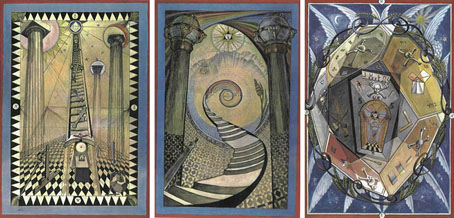
Masonic Tracing Boards.

Less familiar is her work away from the Tarot deck, some of which can be seen here. Prior to meeting Crowley, Harris was involved with Freemasonry for which she produced three designs for the Masonic teaching aids known as Tracing Boards. (See larger copies here.) I used to think these looked like outtakes from the Tarot deck but seeing them in the light of the mysterious painting above it’s evident that the Tarot style wasn’t unique to that set of cards.
harris04.jpg

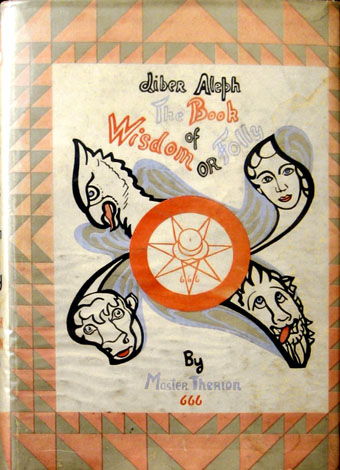
Liber Aleph vel CXI: The Book of Wisdom or Folly (1918) by Aleister Crowley.

A book cover which pre-dates the Tarot designs. The heads are the traditional embodiments of the four elements but with one change: the human figure has a feminine face rather than the usual masculine features. The same figures appear on her painting for the final Tarot Trump, The Universe (below), but in a more traditional guise.
Continue reading “The art of Frieda Harris, 1877–1962”

Konx om Pax

konx1.jpg

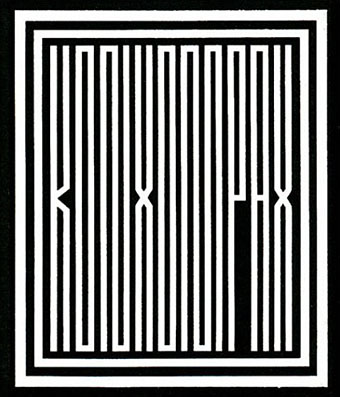
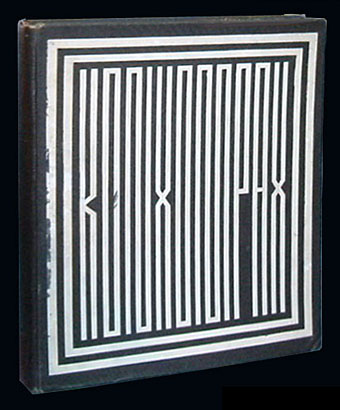
Not the musician but the book of “Essays in Light” published by Aleister Crowley in 1907. I’ve been familiar with this for years but only via the many reprints. It was only recently that I discovered the striking cover design of the first edition which, we’re told, was designed by Crowley himself during a hashish bout. I’ve not been able to find the source for this piece of information but it’s not in the chapter of his autobiography where he discusses the writing of the book. (Matters aren’t helped by Konx om Pax not being listed in the index.) If anyone has the relevant details then please leave a comment.

konx2.jpg

In design terms this cover might seem radical for 1907 but if Crowley did design it I’d guess he was thinking of a quite common geometric variation of Kufic script. Crowley travelled East as far as China, and had an abiding interest in languages of all kinds. Konx om Pax opens with a quote in Arabic from the Qur’an which is followed by a succession of quotes in different languages including Hebrew, Chinese, Ancient Greek, Sanskrit and hieroglyphic Egyptian.

konx3.jpg

Konx om Pax (2011) by Fredrik Söderberg.

Crowley’s lettering turns up much later in this painting by Fredrik Söderberg. The phrase was also referenced during the 1990s on many of Bill Laswell’s recordings, often by cryptic phrasing on CD stickers. The name forms part of one of the tracks on Laswell’s Axiom Ambient album from 1994, an album which includes a sample of Crowley’s voice. Also in the 1990s, Laswell was making frequent use of what MacGregor Mathers claimed was the English translation of the Egyptian origin of the phrase: “Khabs am Pekht” or “Light in extension”. One of Laswell’s many dub projects, Divination, released two compilation albums called Light In Extension, while the phrase “Khabs am Pekht” (which had me mystified for years) appears on the back of Material’s magnificent Hallucination Engine (1994). One of my favourite albums, which also includes a portion of a Crowley Tarot card in its James Koehnline artwork.

Previously on { feuilleton }
Burroughs at 100
Aleister Crowley: Wandering The Waste
Brush of Baphomet by Kenneth Anger
Rex Ingram’s The Magician
The Mysteries of Myra
Aleister Crowley on vinyl

Weekend links 212

non-format.jpg

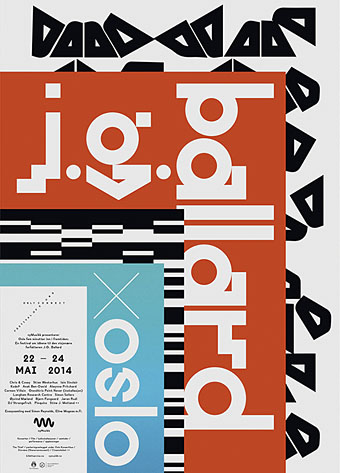
Poster for the recent Ballard-themed Only Connect Festival of Sound in Oslo. Design by Non-Format.

Bulldozer by Laird Barron was my favourite piece in Lovecraft’s Monsters, the recent Tachyon anthology edited by Ellen Datlow that I designed and illustrated. So it’s good to hear that Nic Pizzolato, writer of the justly-acclaimed HBO series True Detective, is among Barron’s readers. True Detective, of course, created a stir for referencing Robert Chambers’ weird fiction in a police procedural. The series is out now on DVD and Blu-ray, and I can’t recommend it too highly.

• Citation-obsessed Wikipedians don’t believe Hauntology is a genuine musical genre, a sentiment which will probably surprise some of its practitioners. Whatever the merits of the argument, I rather like the idea of a musical form that resists strict definition.

• “This year, in order to do things differently, I will make a conscious effort to separate the man from his writing.” Giovanna Calvino, daughter of Italo Calvino, remembers her father.

With ideology masquerading as pragmatism, profit is now the sole yardstick against which all our institutions must be measured, a policy that comes not from experience but from assumptions – false assumptions – about human nature, with greed and self-interest taken to be its only reliable attributes. In pursuit of profit, the state and all that goes with it is sold from under us who are its rightful owners and with a frenzy and dedication that call up memories of an earlier iconoclasm.

Alan Bennett delivers a sermon.

Zarina Rimbaud-Kadirbaks, aka Dutch Girl In London, reviews the Chris Marker exhibition that’s currently running at the Whitechapel Gallery, London.

• Exteriorizing the Inner Realms: Christopher Laursen talks to Phantasmaphile and Abraxas magazine‘s Pam Grossman about occult art, past and present.

• The Beast is back: Erik Davis talks to Gary Lachman about his new book, Aleister Crowley: Magick, Rock and Roll, and the Wickedest Man in the World.

• The body as factory: anatomy of a New Scientist cover image. Rick Poynor on the recurrent use of a familiar visual metaphor.

• Mix of the week without a doubt is FACT Mix 445 by Stephen O’Malley, a three-hour behemoth.

• Jennifer in paradise: Photoshop developer John Knoll on the story of the first Photoshopped image.

• The trailer for Grandfather of Gay Porn, a documentary about Peter de Rome by Ethan Reid.

Giorgio’s Theme is a new piece of electronic music by Giorgio Moroder.

Agender, a series of androgynous photo-portraits by Chloe Aftel.

• RIP Little Jimmy Scott

Evil Spirits

Chase (1978) by Giorgio Moroder | Call Me (1980) by Blondie | The Apartment (1980) by Giorgio Moroder

Weekend links 203

budich.jpg

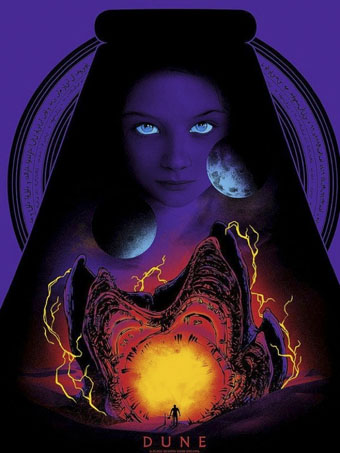
A Dune-inspired piece by Joshua Budich for In Dreams: an art show tribute to David Lynch at Spoke Art.

• “[Montague] Summers was a friend of Aleister Crowley and, like [Jacques d’Adelswärd] Fersen, conducted homoerotic black masses; whatever eldritch divinity received their entreaties was evidently propitiated by nude youths.” Strange Flowers goes in search of the Reverend Summers.

• More Jarmania: Veronica Horwell on the theatrical life of Derek Jarman, Paul Gallagher on When Derek Jarman met William Burroughs, and Scott Treleaven on Derek Jarman’s Advice to a Young Queer Artist.

Robert Henke of Monolake talks to Secret Thirteen about his electronic music. More electronica: analogue-synth group Node have recorded a new album, their first since their debut in 1995.

This hypertrophied response to decay and dilapidation is what drives the “ruin gaze”, a kind of steroidal sublime that enables us to enlarge the past because we cannot enlarge the present. When ruin-meister Giovanni Piranesi introduced human figures into his “Views of Rome”, they were always disproportionately small in relation to his colossal (and colossally inaccurate) wrecks of empire. It’s not that Piranesi, an architect, couldn’t do the maths: he wasn’t trying to document the remains so much as translate them into a grand melancholic view. As Marguerite Yourcenar put it, Piranesi was not only the interpreter but “virtually the inventor of Rome’s tragic beauty”. His “sublime dreams”, Horace Walpole said, had conjured “visions of Rome beyond what it boasted even in the meridian of its splendour”.

Frances Stonor Saunders on How ruins reveal our deepest fears and desires.

Gustave Doré. L’imaginaire au pouvoir: Four short films from the Musée d’Orsay to accompany their current exhibition, Gustave Doré (1832–1883): Master of Imagination.

• At Dangerous Minds: Remembering Cathy Berberian, the hippest—and funniest—lady of avant-garde classical music.

• “Merely a Man of Letters”: Jorge Luis Borges interviewed in 1977 by Denis Dutton & Michael Palencia-Roth.

Luke Epplin on Big as Life (1966), a science-fiction novel by EL Doctorow which the author has since disowned.

The Psychomagical Realism of Alejandro Jodorowsky: Eric Benson talks to the tireless polymath.

• A video essay by Matt Zoller Seitz for the 10th anniversary of David Milch’s Deadwood.

Eugene Brennan on Scott Walker’s The Climate of Hunter (1984).

Dune at Pinterest.

• Prophecy Theme from Dune (1984) by Brian Eno | Olivine (1995) by Node | Gobi 110 35′ south 45 58′ (1999) by Monolake

Songs for the Witch Woman

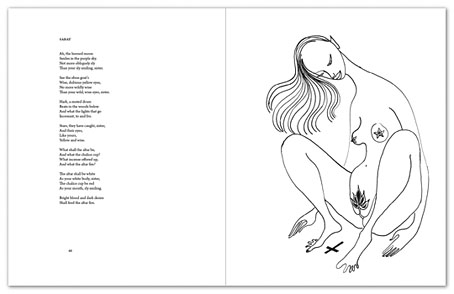
cameron1.jpg

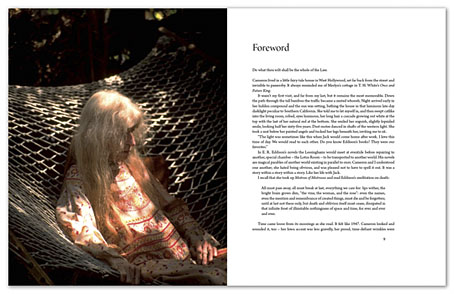
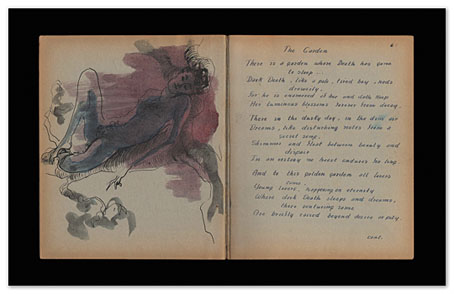
It wasn’t so very long ago that occult artist Marjorie Cameron (1922–1995) was visible only as a silent and enigmatic presence in films by Kenneth Anger and Curtis Harrington. Previous posts here have catalogued the resurrection of interest in her life and work which now includes a book of poems by husband Jack Parsons, embellished by Cameron’s drawings and paintings. This is another quality production from Fulgur Esoterica who provided me with these page layouts. Details of the book follow. See this page at Fulgur for a few more pieces of artwork.

cameron2.jpg

Songs for the Witch Woman
A Romantic Tragedy filled with Magic

‘He’ll be back some time. Laughing at you’

Fulgur Esoterica has announced today the publication of a collection of poems by rocket scientist Jack Parsons’ illustrated by his wife and magical partner Marjorie Cameron. The drawings and poetry have been gathered by Cameron after her husband’s death and are here published together for the first time. The book is the first publication to mark 100 years from Parsons’s birth (1914).

Jack Parsons was not only the most influential Californian magician of his day but was also at the heart of the US rocketry programme as one of the founder of the Jet Propulsion Laboratory before his untimely death at the early age of 37. He died in an explosion which was probably an accident but which has also been seen by some as either a result of his ‘Babalon Working’ or, by some occultists, as a direct result of tampering with dark forces.

Parsons’s wife Cameron continued to illustrate the poems he wrote for her years after his death. Cameron was an artist and actress who after Parsons’ death moved on to become one of most sought after faces in counter cultural Hollywood circles having appeared in Kenneth Anger’s Inauguration of the Pleasure Dome (1954) and Curtis Harrington’s Wormwood Star as herself and having figured on the cover of Wallace Berman’s first issue for Semina (1955).

The collaboration presented here creates a unique insight into an intense and unique romantic tragedy. As stated by Parsons’s official biographer and contributor to Songs for the Witch Woman George Pendle, “A collection of uneasy love poems, the language and meter of Songs for the Witch Woman owe a considerable debt to the Romantic poets. Keats’ “Lamia”, Byron’s Browning’s “Childe Roland to the Dark Tower Came”, Tennyson’s “Idylls of the King” are all referred to. […] But nothing is quite what it seems”. He further states that “many of the poems speak of entrapments and reversals, of women tricking or teasing men into their web to be devoured or eaten. And although a rich, pungent sensuousness overlays the poems, with datura and jasmine filling the lines with a somnolent musk, neurosis and fever, worry and sickness, never seem far away. In many ways the poems seem to act as a sort of testing ground for the emotions stirred up by the often masochistic relationship with the fiercely independent Cameron.”

The volume is complemented by critical essays and by a diary entry from Cameron’s magical diary. Some say this text constitutes the summoning of a magical entity while others looked at it as an invocation to her lost lover.

Price: Hardback £40.  Deluxe £140. Dimensions and info: large format (305mm x 240mm). 176 pages. Premium Italian Paper.

cameron3.jpg

Marjorie Cameron was born in Belle Plaine, Iowa in 1922. The fiery and uncompromising character for which she would later be known manifested from an early age. School friends and teachers alike saw her as a peculiar child who by nature looked at the world from a different angle. After the outbreak of the Second World War Cameron enrolled in the Navy and after a period of training became the cartographer for the Joints Chiefs of Staff. Discharged from the military in 1945, she joined her family in Pasadena where less than a year later she met the man who would change her life.

Cameron was twenty-four when she met Jack Parsons, a young and charismatic rocket scientist at the peak of his public career, associate founder of the Jet Propulsion Laboratory and acting master of the  ‘Agape Lodge of the Ordo Templis Orientis’. For the following seven years Cameron and Parsons worked together in magick, love and art giving birth to one of the most legendary magico-artistic partnerships of the century. Firmly believing that Cameron’s appearance in his life was the result of an intense series of magical workings carried out in the weeks preceding the encounter, Parsons famously wrote to Aleister Crowley ‘I have found my Elemental’. Be it as it may, in the first years of their relationship Cameron was not only unaware of such goings-on but also uninterested in Jack’s spiritual path, preferring art and love over the practice of magic.

But as time went by Parsons assumed another function in Cameron’s life as he quickly became her magical mentor. He renamed her Candida, recommended books, prescribed rituals and meditative practices to deal with her depressions. When Jack Parsons died in an explosion at the age of thirty-seven, Cameron was left alone, wondering whether she was human or elemental.

A very dramatic period follows for Cameron. For a time she withdraws into the desert, where she attempts to connect with the spirit of her lost lover through a series of magical workings. A few years later she comes back to Los Angeles, where in 1954 she appeared in Kenneth Anger’s landmark film Inauguration of the Pleasure Dome. She also met the director Curtis Harrington, for whom she appeared as herself in the short film Wormwood Star. In 1955 she was featured on the cover of the first issue of Wallace Berman’s artistic and literary journal Semina, so marking her firm arrival in the Hollywood artistic counter-culture.

Cameron spent the last decades of her life in West Hollywood, painting, writing and mastering the art of Thai Chi. She died of cancer in 1995 at the age of 73.

cameron4.jpg

cameron5.jpg

Previously on { feuilleton }
More Cameron
Inauguration of the Pleasure Dome: The Eldorado Edition
The Wormwood Star
Street Fair, 1959
House of Harrington
Curtis Harrington, 1926–2007
The art of Cameron, 1922–1995