Fuseli’s Nightmare

nightmare1.jpg

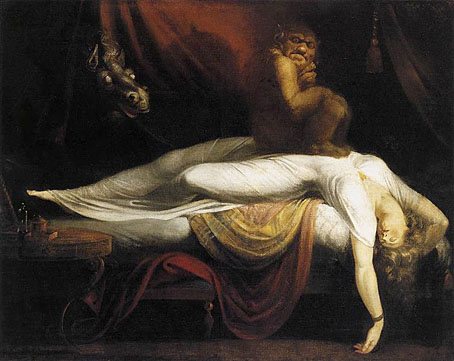
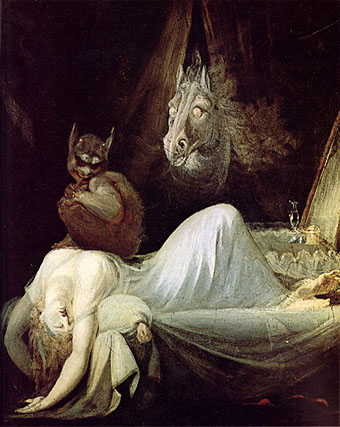
The Nightmare (1781).

Christopher Frayling’s Nightmare: The Birth of Horror (1996) opens with a prologue examining Henry Fuseli’s most celebrated painting:

Henry Fuseli, who later wrote that “one of the most unexplored regions of art are dreams”, and who was said to have supped on raw pork chops specifically to induce his nightmare, made his name with this painting. And engraved versions, produced in 1782, 1783 and 1784, distributed the image across Europe, until Fuseli’s masterpiece became the way of visualising bad dreams.

Although The Nightmare was painted just before the Romantic craze in Western Europe—which revelled in peeling back the veneer of rational civilisation to reveal the “natural” being or the raw sensations beneath, sometimes through the gateway of dreams—it was well-known to the writers and painters of the early nineteenth century. One of them wrote that “it was Fuseli who made real and visible to us the vague and insubstantial phantoms which haunt like dim dreams the oppressed imagination”.

The Nightmare was fascinating—and scary—because it operated at so many different levels at once. It was set in the present (the stool and bedside table are “contemporary” in style), and it was concerned not so much with an individual’s nightmare—the usual subject-matter of dream paintings, often involving famous individuals and their prophecies—as with nightmares in general. It was not A Nightmare, but The Nightmare; not a vision but a sensation. This gave it a direct impact, unmediated by history, which put a lot of critics off.
nightmare2.jpg

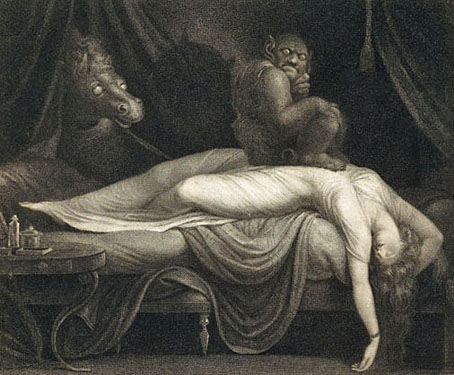
The Nightmare (1791).

Later generations of critics have had no such problems, of course, nor have the legions of artists and cartoonists who’ve plagiarised and parodied this memorable scene. I had a vague notion of collecting some of the derivations but a quick image search reveals an endless profusion of squatting figures and thrusting horse heads. Wikipedia did provide two of the engraved versions, however. Of the two paintings above I’ve always preferred the later one: the incubus, or “mara” as Frayling calls it, looks more sinister, and the horse head has become an almost unavoidable sexual symbol. No wonder that Siegmund Freud had a copy of The Nightmare on the wall of his waiting room.
nightmare3.jpg

Engraving by Thomas Burke (1783).
Continue reading “Fuseli’s Nightmare”

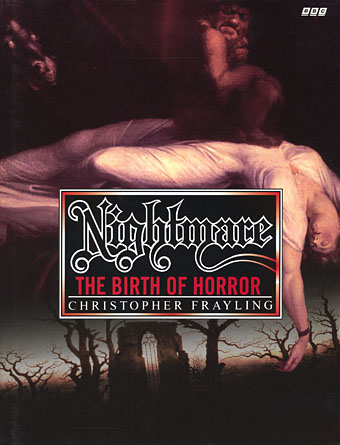
Nightmare: The Birth of Horror

frayling.jpg

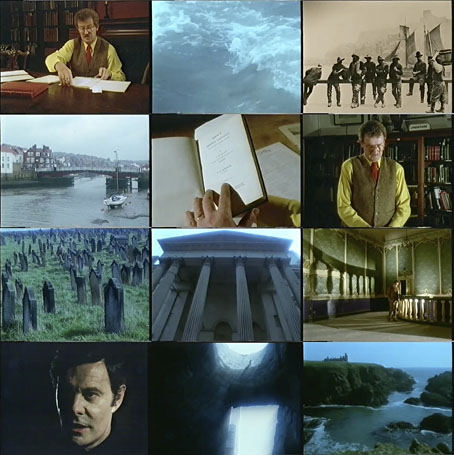
Nightmare: The Birth of Horror (1996): Dracula (and Louis Jourdan again).

Christopher Frayling, like Marina Warner, is that rare thing: a British academic with an enthusiasm for popular culture, and a talent for communicating that enthusiasm to a general audience. Both writers also have more than a passing interest in the darker areas of fiction, whether that means Gothic romance or contemporary horror films. One of Frayling’s first books was The Vampyre: Lord Ruthven To Count Dracula (1978); the same year he contributed an excellent Lovecraft essay, Dreams of Dead Names, to George Hay’s The Necronomicon: The Book of Dead Names, one of the two Necronomica published in the 1970s (three if you count Giger’s art book). Frayling’s essay, and another by Angela Carter are among the highlights in Hay’s curious volume.

frayling2.jpg

Nightmare: The Birth of Horror was both a book and a television series produced by the BBC in 1996. The year before, Frayling had written and presented Strange Landscape, an examination of the culture and philosophy of the Middle Ages. Nightmare looks at the creation of four British horror novels: Frankenstein, Dracula, The Strange Case of Dr Jekyll and Mr Hyde, and The Hound of the Baskervilles. Two of these stories—Frankenstein and Jekyll and Hyde—were famously the product of nightmares so Frayling stretches this coincidence to include the others; I’m still not sure the case is properly made for Bram Stoker but it hardly matters.

Another aspect of Frayling’s thesis is the extraordinary power of these works, all of which have had a lasting global influence. The book is naturally more detailed than the TV series, delving into the fiction for the subtexts that contribute to the power of the stories. The Dracula section is a tour-de-force of condensed information, sketching a history of fictional vampires then looking at Stoker’s career as assistant to actor Henry Irving, a man whose outsize personality was an inspiration for that of the vampiric count. There’s also some interesting speculation about Stoker’s sexuality; a letter he wrote to Walt Whitman is (to borrow a phrase from Sherlock Holmes)…suggestive. The rest of the chapter looks in detail at the slow creation of the novel. In the TV series what you lose in the literary specifics you gain in visits to some of the locations mentioned in the story, so for Dracula that means windswept Whitby on the Yorkshire coast. The same applies to the other novels: for Frankenstein there’s a visit to the Villa Diodati on the shore of Lake Geneva, a journey to Dartmoor for Hound of the Baskervilles, and so on.

I was hoping the whole series might be on YouTube but for the moment the Frankenstein episode seems to be missing. The Dracula one is the best quality, the other two look a little rough. In the meantime copies of the book may still be found at reasonable prices.

Nightmare: The Birth of HorrorDracula | Dr Jekyll & Mr Hyde | The Hound of the Baskervilles

Albin Grau’s Nosferatu

nosferatu01.jpg

For many directors a film like Nosferatu: A Symphony of Horror (1922) would have been a career peak, but Friedrich Murnau went on to make The Last Laugh (1924), Faust (1926) and Sunrise (1927). All those films improve cinematically on Nosferatu but the vampire film continues to cast the longest shadow: quoted, remade, and with even its production fictionalised in Shadow of the Vampire (2000). The lasting success of Nosferatu wasn’t all Murnau’s doing, however.

nosferatu05.jpg

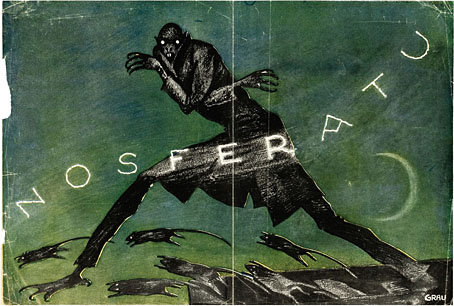
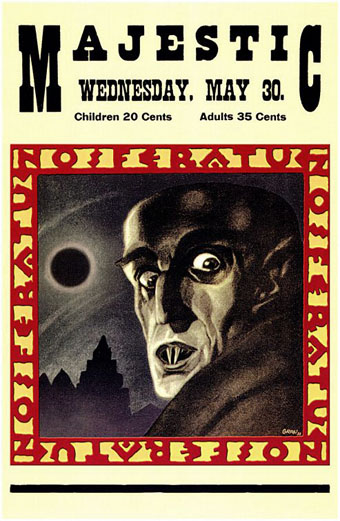
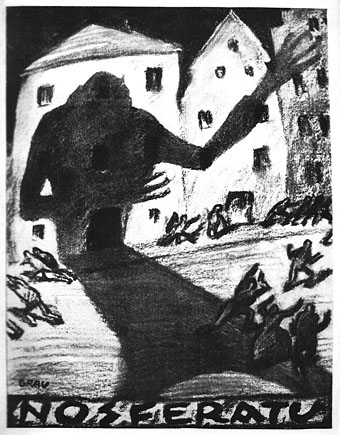
It’s arguable that without the preliminary work of production designer Albin Grau (1884–1971) the film might have been little more than a curious precursor of the Universal Dracula (1931). Grau was responsible for the set design and the extraordinary appearance of Max Schreck’s Count Orlok; Grau also created the film’s memorable poster and advertising imagery in which the vampire’s appearance hints at something even more terrible than the figure that stalks before the camera.

nosferatu03.jpg

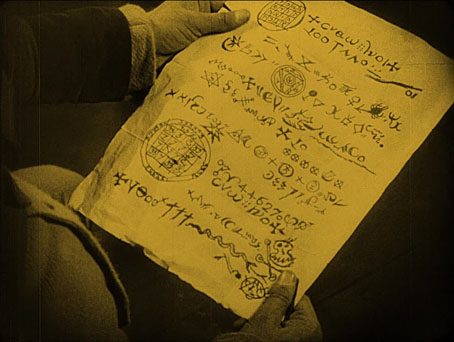
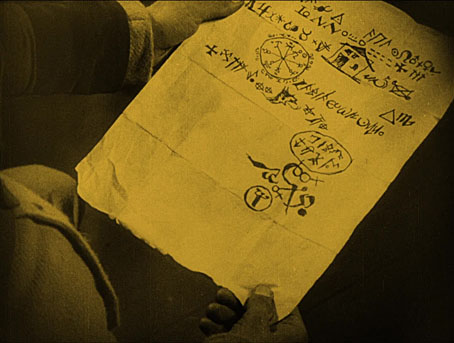
A great deal of German silent cinema is labelled “Expressionist” even if the films themselves show little in the way of overt Expressionism. Nosferatu isn’t very Expressionist at all but Albin Grau’s sketches and posters certainly tend in that direction, so much so that they make me wonder how different the film might have been if it had been as stylised as The Cabinet of Dr. Caligari (1919). In addition to his artistic pursuits, Grau was an occultist which explains the attention to detail in the bizarre contract drawn up between Knock and Count Orlok, a document that looks more like a page from a grimoire than anything used by an estate agent. There’s a quote from Grau in his occult capacity in John Symonds’ Aleister Crowley biography, The Great Beast, complaining in 1925 about Crowley’s ascension to the heights of the Ordo Templi Orientis.

nosferatu11.jpg

Nosferatu: The Knock-Orlok contract.

nosferatu12.jpg

Nosferatu comes out of the occult preoccupations, having been Grau’s project from the beginning when he formed a film company, Prana-Film, with Enrico Dieckmann. The pair announced plans for three films: Dreams of Hell, The Devil of the Swamp, and a drama about a vampire. Only Nosferatu materialised then sank the company almost as soon as it was finished: Prana-Film had spent more on publicity than on the film itself, and went deep into debt. The success of the film might have helped their finances but the death blow was struck by Florence Stoker and the British Society of Authors who won a court case against the company for filming Dracula without permission. The efforts of the Stoker estate to destroy Nosferatu are recounted in detail in David J. Skal’s fascinating Hollywood Gothic (1990). Many of Murnau’s minor films were lost through various misfortunes, and it’s a fluke that a handful of prints of Nosferatu survived. Happily for us, it’s not only vampires that manage to remain undead.

Continue reading “Albin Grau’s Nosferatu”

Count Dracula

dracula1.jpg

Vampires: if they’ve never been very scarce they didn’t used to be quite so commonplace. The fortunes of Dracula, on the other hand, seem to have diminished in recent years following a centenary peak in 1997. The surprising spike of interest in the 1970s might explain the BBC’s decision to adapt Bram Stoker’s novel for television in 1977. I often used to wonder why the corporation didn’t turn some of its costume-drama prowess to more generic material. Anthony Trollope’s The Pallisers sprawled over 26 50-minute episodes in 1974 but you’d search in vain for an adaptation of HG Wells. The closest was the yearly Ghost Story for Christmas most of which were period pieces.

dracula2.jpg

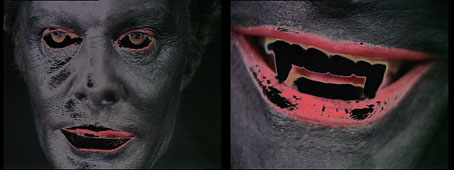
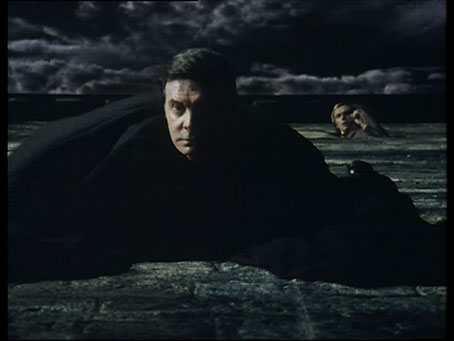
Louis Jourdan bares his fangs.

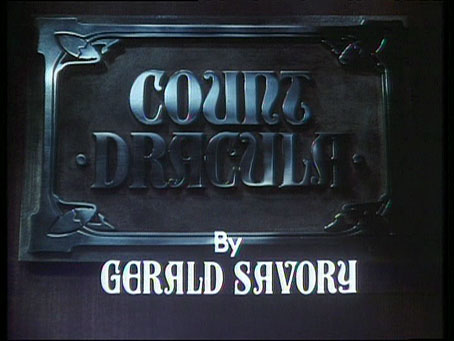
Gerald Savory’s Count Dracula, subtitled “A Gothic Romance”, was broadcast a few days before Christmas, 1977, in a single 150-minute programme. Repeat screenings broke the drama into two episodes so it’s often referred to as a mini-series. I’d read Dracula for the first time earlier that year so it was a thrill to see the story presented in such a faithful manner after all the liberties taken by feature films and derivative dramas. Count Dracula may seem primitive when compared to lavish Hollywood productions but 37 years later it’s still the adaptation that most closely adheres to Stoker’s epistolary novel.

dracula3.jpg

Louis Jourdan and Bosco Hogan (Jonathan Harker).

Continue reading “Count Dracula”

Weekend links 231

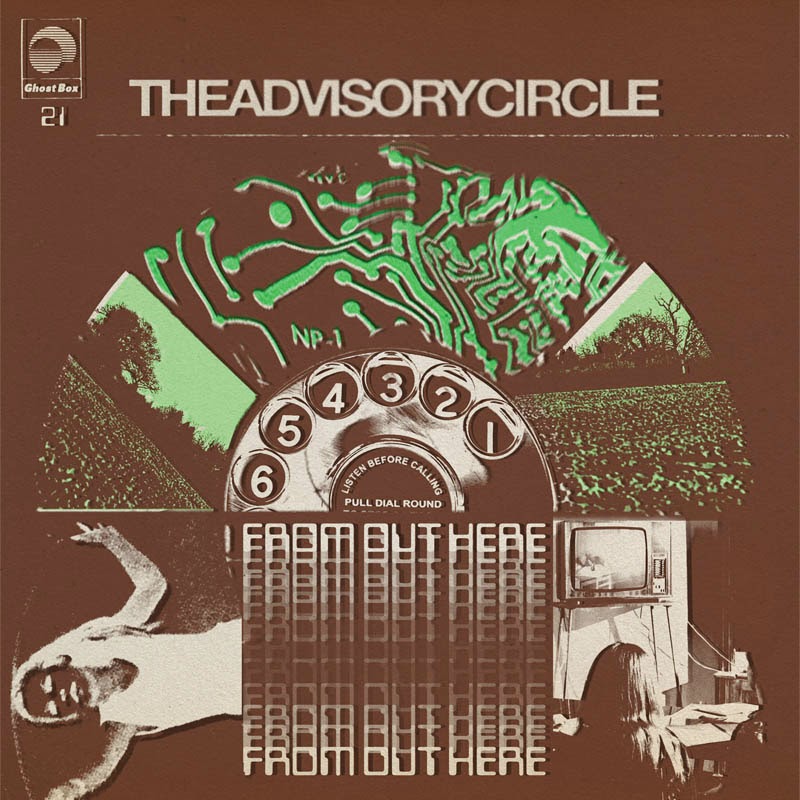
advisory.jpg

Design by Julian House.

Always good to hear of a new release on the Ghost Box label, and a new album by The Advisory Circle (due on 5th December) is especially welcome. From Out Here is described thus: “Exploring darker territory than 2012’s more pastoral As The Crow Flies, The Advisory Circle hint at a Wyndham-esque science fiction story, where bucolic English scenery is being manipulated and maybe even artificially generated by bizarre multi-dimensional computer technology.” The Belbury Parish Magazine has extracts.

• Jon Hassell’s Fourth World Music Vol. I: Possible Musics receives a long-overdue reissue next month. Possible Musics was a collaboration with Brian Eno, and Eno has some of his own albums reissued again in expanded editions. Most notable is the first official release of My Squelchy Life, an album that was withdrawn in 1991 to be replaced by Nerve Net.

• Some Halloween theatre on Friday (the 31st) at the Museum of Bath at Work with a dramatisation of Ringing the Changes by Robert Aickman. There’s a repeat performance the following week (8th November) with added spectral atmospherics from the Electric Pentangle. Free admission.

The value of these books wasn’t anything wholesome they contained, or any moral instruction they offered. Rather, it was the process of finding them, the thrill of reading them, the way the books themselves, like the men they depicted, detached you from the familiar moral landscape. They gave a name to the palpable, physical loneliness of sexual solitude, but they also greatly increased your intellectual and emotional solitude. Until very recently, the canon of literature for a gay kid was discovered entirely alone, by threads of connection that linked authors from intertwined demimondes. It was smuggling, but also scavenging. There was no internet, no “customers who bought this item also bought,” no helpful librarians steeped in the discourse of tolerance and diversity, and certainly no one in the adult world who could be trusted to give advice and advance the project of limning this still mostly forbidden body of work.

Smuggler: A Memoir of Gay Male Literature by Philip Kennicott

• Getting in before the Mixcloud Halloween rush, mix of the week is Samhain Seance 3: Better Dead Than Never by The Ephemeral Man. My Halloween mix for this year is almost finished; watch the skies.

• For those who can’t wait until December for From Out Here, there’s a new Howlround album, Torridon Gate, out this week from A Year In The Country.

• Last week, Yello’s Boris Blank was choosing favourite electronic albums, this week he runs through a list of thirteen favourite albums.

Altered Balance: A Tribute to Coil by Jeremy Reed & Karolina Urbaniak. Richard Fontenoy reviewed the book for The Quietus.

Cut-Ups: William S. Burroughs 1914–2014, an exhibition of Burroughs’ typescripts at Boo-Hooray, NYC, from 7th November.

Brando, a film by Gisèle Vienne for the song by Scott Walker & Sunn O))).

NASA has a Soundcloud page

The art of leaves

Cobra Moon (1979) by Jon Hassell | Moon On Ice (1987) by Yello feat. Billy MacKenzie | Moon’s Milk Or Under An Unquiet Skull Pt. I (1998) by Coil