Weekend links 69

evans.jpg

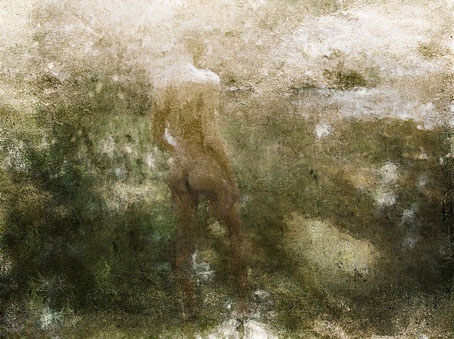
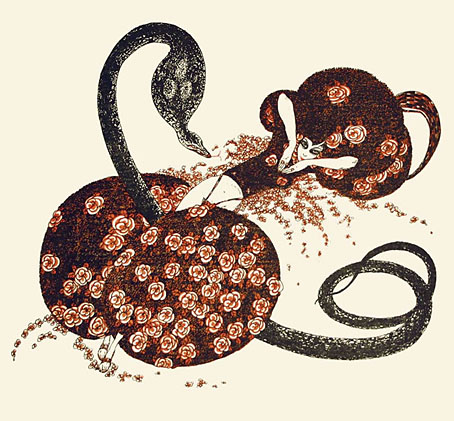
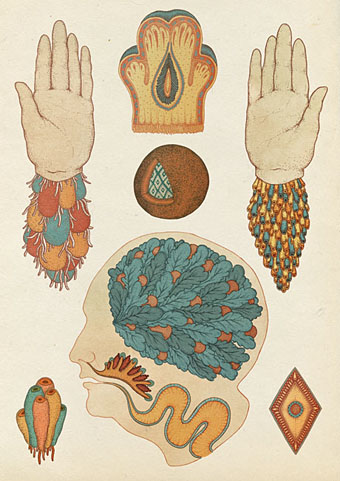
Peacock Apocalypse (detail) by Julie Evans in collaboration with Ajay Sharma.

Here at { feuilleton }, home of the curly bracket affectation, your correspondent is still surprised to find his postings the subject of a critique by Rick Poynor in the latest edition of Eye magazine, the international review of graphic design. I haven’t seen a print copy yet but you can read Mr Poynor’s appraisal here. Meanwhile, over at Design Observer this week there’s another Poynor piece about the collage illustrations of Andrzej Klimowski.

Alan Moore (yes, him again) discusses the moment when the League of Extraordinary Gentlemen gets all swinging and psychedelic. And Iain Sinclair (yes, him again) is still doing the interview rounds promoting his current book, Ghost Milk.

Ayin Acla, a short film by Anna Thew with a soundtrack by Cyclobe. The most recent Cyclobe album, Wounded Galaxies Tap at the Window, was previously vinyl-only but is now available on CD.

• Bones and beads and other things in Wren Britton’s Pure Vile clothing and accessories. Related: Patrick Veillet’s wearable bone sculptures.

Lambshead Cabinet of Curiosities Q&A: Ann & Jeff VanderMeer answer questions about their latest anthology at Fangoria.

• Being a lifelong introvert, I’m sympathetic to Four Ways Technology Can Enable Your Inner Introvert by Philip Bump.

• In an all-too-rare meeting of minds and talents, Roy Harper talks to Joanna Newsom.

Jon Macy’s Teleny and Camille is reviewed at Lambda Literary.

• Author Carol Birch tells us how best to read Finnegans Wake.

Joel Pirela’s Design Classics posters.

Each And Every Word Must Die (1999) by Cyclobe | Brightness Falls From The Air (2001) by Cyclobe | Indulge Yourselves With Our Delicious Monster (2006) by Cyclobe

John Dee’s Monas Hieroglyphica

monas1.jpg

I swear I didn’t go hunting for this. Among the various library collections at the Internet Archive one can find The Getty Alchemy Collection, a substantial gathering of very old alchemical texts scanned in a variety of formats. John Dee’s Monas Hieroglyphica caught my eye during a random search, a third edition of his treatise from 1564 in which he describes his Monas Hieroglyphica, a glyph designed to combine symbols of the Sun, the Moon, the Elements and Fire in a single figure.

monas2.jpg

The glyph also intentionally resembles a human form, and Dee relates its individual parts to various astrological and chemical symbols. I’ve mentioned before that Dee scholar Derek Jarman deliberately based Prospero on John Dee in his 1979 film of The Tempest, giving the magus a scrying wand shaped to resemble the Monas Hieroglyphica.

monas3.jpg

I produced my own variations on the glyph in 2009 when working on the cover of Jeff VanderMeer’s novel, Finch. The symbol recurs in Jeff’s fictional city of Ambergris and I seem to recall there being some discussion about including this doorway design somewhere in the book. In the end it was incorporated into the cover design in a rather subtle fashion. I think this is the first time the design alone has appeared in public.

The Internet Archive has a few other Dee-related items, including Lists of manuscripts formerly owned by Dr. John Dee; with preface and identifications (1921), a 500-page book by antiquarian and ghost story writer MR James.

Previously on { feuilleton }
Mister Jarman, Mister Moore and Doctor Dee
Alchemically Yours
Laurie Lipton’s Splendor Solis
The Arms of the Art
Splendor Solis
Amphitheatrum Sapientiae Aeternae
The Tempest illustrated
Cabala, Speculum Artis Et Naturae In Alchymia
Digital alchemy
Designs on Doctor Dee

Weekend links 68

dorosheva.jpg

Every man and every woman is a star by Sveta Dorosheva.

• Matt Taylor (illustration) with Gregg Kulick and Paul Buckley (design) provide new Penguin covers for John Le Carré. I love the look which seems inspired by Daniel Kleinman’s title sequence for Casino Royale even if it doesn’t quite suit the shabby world of George Smiley and the Circus.

[Deborah Kass] told me that when she was going to art school in the ’70s, she tripped on LSD almost every week and she said she felt it was her “moral duty as an artist to take the trip.” […] I think psychedelic experience makes you think that there are multiple realities, that there isn’t just this one normal real world to which we’re supposed to conform, but that the reality changes depending on the state of consciousness that we’re in when we’re experiencing it. So, any different kind of art kind of posits a different reality. (more)

New York Times art critic Ken Johnson discussing his new book Are You Experienced?: How Psychedelic Consciousness Transformed Modern Art.

• “That got me thinking that evolution really isn’t survival of the fittest, when it comes to these things, it is more like survival of the interesting, survival of the beautiful, survival of the weird, cool stuff that managed to evolve.” Laurie Anderson and David Rothenberg discuss music and animals.

• Laura Cumming on the late Lucian Freud. And Stephen Heller on Alex Steinweiss, the originator in 1939 of the artistic record sleeve who also died last week.

• Alan Moore says “Think Locally: Fuck ‘Globally'”. He and Queen Calluz explain how Dodgem Logic magazine puts their ideas into practice.

Adam Curtis gets interviewed while Alan Bennett returns to Armley Public Library in Leeds.

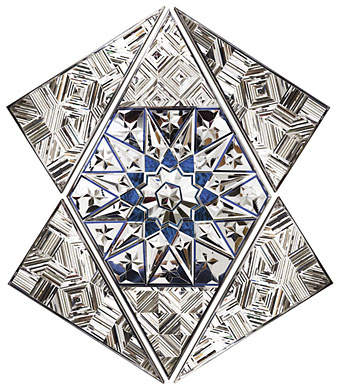
Peacock’s Garden, a celebration of pavonine splendour.

• A visit to Seher Shah’s studio in Brooklyn, New York.

• Maximum androgyny at Epicenity, a Tumblr.

Does your god have a penis?

Chrysalide (1978) is an album of “cosmic” guitar instrumentals by Michel Moulinié which sounds at times like a French equivalent of Manuel Göttsching. It’s never been released on CD but a copy can be found here.

Hello Dali!

hellodali.jpg

Russell Harty and Salvador Dalí, 1973.

This would have been a real find if the quality wasn’t so poor. Hello Dali! was a 50-minute documentary film about Salvador Dalí broadcast in the UK in 1973 as part of ITV’s Aquarius arts strand. The whole thing is on YouTube chopped into five parts and is unfortunately blighted by severe ghosting throughout. Apart from that it’s perfectly watchable.

hellodali2.jpg

Some conversations are subtitled so viewers are better able to make sense of Dalí’s English/Spanish/French dialect.

Brits who are old enough may remember Aquarius which was replaced in the late 70s by The South Bank Show, a programme using the same format of a short studio introduction followed by a self-contained film. In place of the SBS‘s Melvyn Bragg we have Humphrey Burton introducing a film directed by Bruce Gowers. Russell Harty is the front man, seen here in the days before he achieved greater fame as a gossipy chat-show host. I’d been wanting to see this for a long time, having lost a video tape of it years ago. I never saw the original broadcast but it was screened again after Dalí’s death in 1989, and I remembered it as being particularly good for showing a slightly more human side to the eccentric and occasionally annoying artist. So it is, giving us a brief portrait of Dalí in his 69th year, preoccupied at that time with the construction of his museum in Figueres. The nature of Harty and Gowers coup in getting the artist to allow a film crew into his home can be found in subsequent documentaries many of which use uncredited extracts from these interviews. It’s the brief moments of interview which make this even though they reveal little, it’s refreshing seeing Dalí talking conversationally rather than putting on a performance.

hellodali3.jpg

The early 70s saw the last flare of real interest in Dalí from the world at large. Dalí and Surrealism in general had a resurgence of popularity in the late 60s as a consequence of psychedelic culture: a number of books by or about the artist were published or reprinted, among them Peter Owen’s 1973 revival of the novel Hidden Faces which Dalí had written in 1944. About the same time Alejandro Jodorowsky was circling the Dalí camp trying to inveigle the artist into portraying the Emperor in his planned film adaptation of Dune. One detail worthy of note in the conversation with Russell Harty is mention of a golden toilet, something which Jodorowsky says Dalí wanted as his throne if he was going to be filmed. We never got to see Jodorowsky’s Dune but it’s good to find this documentary available once again. Here’s hoping a better copy turns up eventually.

Hello Dali! Pt 1 | Pt 2 | Pt 3 | Pt 4 | Pt 5

Previously on { feuilleton }
Dalí and the City
Dalí’s Elephant
Dalí in Wonderland
Alejandro Jodorowsky’s Dune
Dirty Dalí
Impressions de la Haute Mongolie revisited
Dalí and Film
Salvador Dalí’s apocalyptic happening
Dalí Atomicus
Impressions de la Haute Mongolie

Any Gun Can Play by Kevin Grant

anygun.jpg

This was something I put together last year for FAB Press but the book has only been published in the past month. The design was little more than an assembly job on my part, with Harvey at FAB requesting a montage of the three poster-art gunmen plus suitable Western typography. We went through a number of generic fonts then I added a little creative touch with the background for the title type which was a sheet of paper scorched and stained using tap water, a tea bag and a gas-ring. Forget Photoshop filters, you still can’t beat the trusty tea bag for random stains.

Cynical and stylish, bloody and baroque, Euro-westerns replaced straight-shooting sheriffs and courageous cowboys with amoral adventurers, whose murderous methods would shock the heroes of Hollywood Westerns. These films became box-office sensations around the world, and their influence can still be felt today.

Any Gun Can Play puts the phenomenon into perspective, exploring the films’ wider reaches, their recurrent themes, characters, quirks and motifs. It examines Euro-westerns in relation to their American ancestors and the mechanics of the Italian popular film industry, and spotlights the unsung actors, directors and other artists who subverted the ‘code’ of the Western and dragged it into the modern age.

Based on years of research backed up by interviews with many of the genre’s leading lights, including actors Franco Nero, Giuliano Gemma and Gianni Garko, writer Sergio Donati, and directors Sergio Sollima and Giuliano Carnimeo, Any Gun Can Play will satisfy both connoisseurs and the curious.

Despite my minimal contribution, this is a very handsome volume to be connected to. I’ve had Christopher Frayling’s Spaghetti Westerns (1981) book for years so I’m already disposed towards the subject. Frayling’s book is a semi-academic analysis which for a long time was the only serious study of the subgenre. Additional studies by Frayling and others have followed but Kevin Grant’s book, subtitled The Essential Guide to Euro-Westerns, looks like a tough one to beat: 480 pages, detailed analyses, a who’s who section, filmography, and a huge quantity of photos and poster graphics, many in colour. There’s also a foreword by actor Franco Nero, threatening everyone on the cover in his Django guise. To test the author’s thoroughness I looked up Se sei vivo spara (1967) (If You Live, Shoot!), a film also known as Django Kill! even though it’s nothing to do with the Django series. Giulio Questi’s film is a very bizarre (and occasionally inept) blend of Spaghetti tropes and horror-style scenes of graphic gore, featuring (among other things) a crucified hero, a vampire bat, and a band of black-clad homosexual cowboys. Frayling’s book devotes a few paragraphs to the film while Grant gives it two-and-a-half pages plus pictures. IMDB may tell us the facts about a film’s production but the barely-literate reviews and troll-filled discussion boards on that site are useless. For authoritative review and analysis you still need a book like this. Any Gun Can Play can be ordered direct from FAB Press where they’re selling a limited number signed by Franco Nero and the author.