This is a curious book. Marjorie Worthington (1900–1976) was the second wife of William Seabrook, an obscure figure today, known—if at all—as much for the lurid details of his life as for his books. In the 1920s and 1930s Seabrook was a well-regarded and very popular writer, delivering to the American public reports of his travels in the dangerous and exotic parts of the globe. Worthington was a writer herself, the author of novels, short stories and biographies, in addition to this memoir, her final major work. By the time The Strange World of Willie Seabrook appeared in 1966 Worthington’s subject was largely forgotten, his exploits eclipsed by wilder figures, while the “unexplored” areas of the world whose exotic lure had fuelled much of his writing were no longer so distant or so strange in a world of continental travel. Seabrook wasn’t completely forgotten at this time; I knew his name, if little else, from a paperback of Voodoo Island that my parents owned. This was a retitled reprint of The Magic Island (1929), a best-selling study of Haiti and its voodoo culture which, among other things, popularised the concept of the zombie.
Seabrook’s name is hard to avoid if you’re reading about witchcraft or the occult in the first half of the 20th century. Aleister Crowley knew him and mentions him in his autobiography, while Crowley is discussed in Seabrook’s Witchcraft: Its Power in the World Today (1940). Crowley’s attitude towards Seabrook seems to have soured in later years, possibly because of some perceived slight or betrayal. The two men have a lot in common: both were the same generation (Crowley was born in 1875; Seabrook in 1884), both were addicts (Seabrook’s demon was alcohol), and both were fascinated by the outer limits of human experience. In Seabrook’s case this famously extended to eating human flesh, an experience he recounted in the follow-up to The Magic Island, Jungle Ways (1930). Marjorie Worthington gives a detailed account of this episode which was much more mundane than Seabrook’s printed version. When the African feast failed to materialise Seabrook decided to keep the incident in the book even if it meant staging a cannibal meal in Paris. One of the fascinating things about Worthington’s memoir is the frequent lurches of tone when Seabrook disrupts their generally placid domesticity with a hare-brained inspiration. If this makes him sound like an Jazz Age Hunter S. Thompson he wasn’t quite as mercurial, but the cannibal episode has a trace of the gonzo as the pair race around Paris one evening, looking for a convenient stove where Seabrook can cook the “rare goat meat” a friend has procured from a Paris hospital.
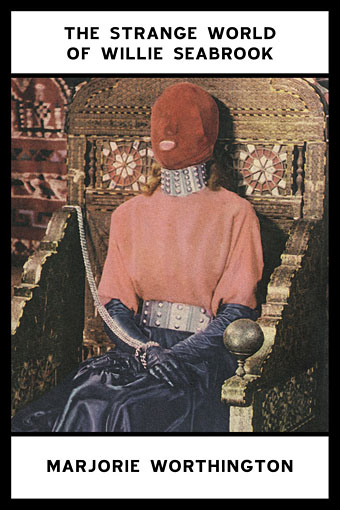
Worthington logs these and similar exploits with dismay, and one of the many curious aspects of her memoir is the unexamined nature of the attraction between herself and “Willie” as she calls him. Their relationship was an unusual one from the outset. Seabrook and Worthington were both married to other partners before they met; Worthington fell in love almost immediately but rather than go through the usual adulterous games the four people simply swapped partners and went on their way, all still married but now living with their opposite numbers. Worthington remained in love with Seabrook even though they were sexually incompatible, Seabrook having an obsession with bondage games whose outlet was provided by compliant women hired for the purpose. Worthington tried to be understanding but Seabrook’s fetishes and recurrent alcoholism strained their relationship, despite their mutual dependence. One of the ironies of the book is that Worthington recounts her abhorrence each time Seabrook retires to the barn for an endurance session with one of his new women but offers little detail as to what took place. This has the effect of stoking the reader’s curiosity which could hardly have been her intention. Seabrook told her he was interested in the mental effects caused by his bondage experiments—we see a photograph of one session on the cover of the new edition from Spurl—but the sexual dimension remains undiscussed.
The Strange World of Willie Seabrook isn’t an account of continual torment, however. Seabrook had many successful years, and the pair were friends with Jean Cocteau, Man Ray, Aldous Huxley, the Astors and others. One of the best parts of the book concerns a journey by plane from Paris to Timbuktu at a time when international air travel was still a difficult and dangerous business. Worthington’s account of a noisy flight across the Sahara in a cramped aircraft that could only fly during the day makes contemporary moans about air travel seem like the whining of spoiled children. Her narrative comes alive when it assumes the character of travel writing, and she writes evocatively about her experience of the Sahara Desert. I’d have preferred more along these lines but for this it may be necessary to turn to Seabrook’s own works of the period, Air Adventure (1933) and The White Monk of Timbuctoo (1934).
The Strange World of Willie Seabrook is published by Spurl Editions on 25th October.


_-_panoramio.jpg)