Écorché

ecorche01.jpg

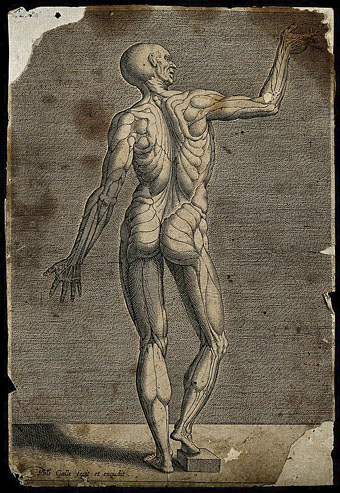
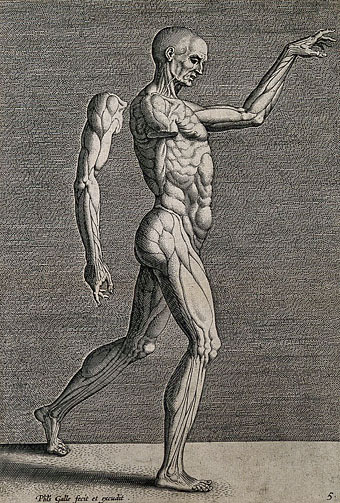
Engraving by Philip Galle.

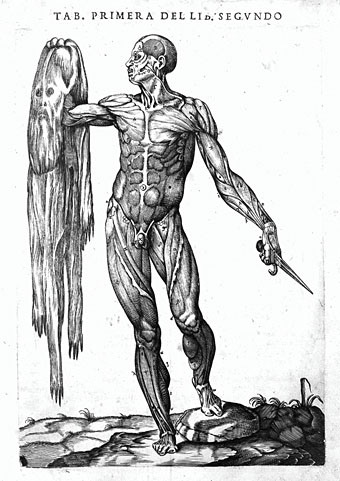
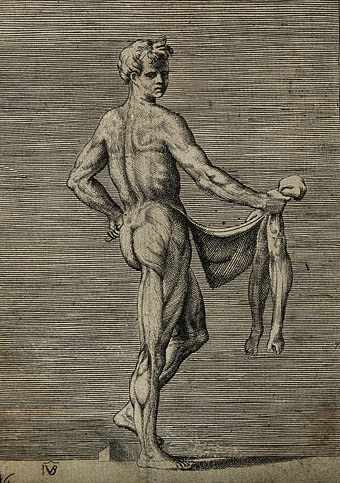
Écorché, from the French verb to flay, was the traditional term applied to depictions of the skinless man found in anatomical studies, and the musculature models made for the use of artists and sculptors. This is almost always a male figure. Women tend to feature in the anatomical works of previous centuries in order to illustrate the conditions of pregnancy, the male body being considered the default for the usual sexist reasons.

I’ve been revisiting the history of these figures while working on a new book design so what follows are a few choice examples, some of which carry a pleasantly Surrealist charge. In the years that followed the pioneering studies by Vesalius and co. there was a period of playfulness in anatomical illustration during which time the figures are shown peeling away their flesh to reveal the muscles or even the organs beneath, a striptease where the substance of the body itself is removed. As William Burroughs was fond of quoting: “‘T ain’t no sin to take off your skin, and dance around in your bones.”

ecorche07.jpg

Valverde de Hamusco (1556).

ecorche06.jpg

Engraving by G. Bonasone (15–).

ecorche02.jpg

Engraving by Philip Galle.

Continue reading “Écorché”

A Book of Satyrs revisited

spare.jpg

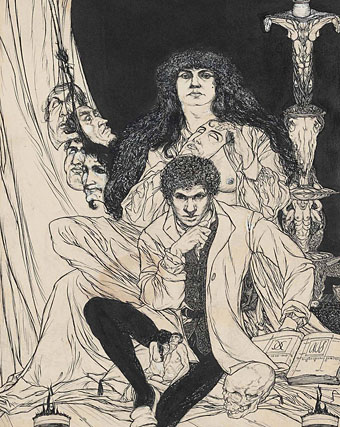
Searches for art by Austin Osman Spare continue to lead people to these pages so here’s another link to Spare’s A Book of Satyrs (1909). Spare’s second self-published volume, created when he was 20 years old, was featured here in 2015 but the copy linked to at the Internet Archive was an unsatisfactory reprint with reproductions that did no favours to the fine line drawings. Matters have improved a little with a more recent scan that has better reproductions of the 12 full-page plates. This, like the earlier copy, is a reprint of the scarce original that includes an additional set of notes (possibly from another book) by Spare scholar William Wallace who examines the symbolism in the drawings and some possible influences. Browse it or download it here.

Previously on { feuilleton }
Form and Austin Osman Spare
More Spare things
A Book of Satyrs by Austin Osman Spare
Spare things
Dreaming Out of Space: Kenneth Grant on HP Lovecraft
MMM in IT
Abrahadabra
Murmur Become Ceaseless and Myriad
New Austin Spare grimoires
Austin Spare absinthe
Austin Spare’s Behind the Veil
Austin Osman Spare

Weekend links 539

earle.jpg

Fire, Red and Gold (1990) by Eyvind Earle.

Roger Penrose won a Nobel Prize recently for his work in physics. I read one of his books a few years ago, and was intimidated by the “simple” equations, but I always like to hear his ideas. This 2017 article by Philip Ball is an illuminating overview of Penrose’s life and work.

• At Dangerous Minds: Joe Banks on the incidents that led to Lemmy’s dismissal from Hawkwind in 1975, an extract from Hawkwind: Days of the Underground. The book is available from Strange Attractor in Europe and via MIT Press in the USA.

• “Not married but willing to be!”: men in love (with each other) from the 1850s on. It’s always advisable to take photos like these with a pinch of salt but several of the examples are unavoidably what they appear to be.

Most of all, this resolutely collaborative production stood against the vanity and careerism of individual authorship; Breton called it the first attempt to “adapt a moral attitude, and the only one possible, to a writing process.” The text itself is peppered with readymade phrases, advertising slogans, twisted proverbs, and pastiches of such admired predecessors as Rimbaud, Apollinaire, and Lautréamont, whose pluralistic credo, “Poetry must be made by all. Not by one,” anticipates the sampling aesthetic by a century. But the intensity was draining, and as the book moves toward its final pages and the writing becomes increasingly frenetic, you can almost feel the burnout taking hold. After eight days, fearing for his and Soupault’s sanity, Breton terminated the experiment.

Mark Polizzotti reviews a new translation by Charlotte Mandell of The Magnetic Fields by André Breton and Philippe Soupault

• The hide that binds: Mike Jay reviews Dark Archives: A Librarian’s Investigation into the Science and History of Books Bound in Human Skin by Megan Rosenbloom.

• “A photographer ventures deeper into Chernobyl than any before him.” Pictures from Chernobyl: A Stalker’s Guide by Darmon Richter.

John Van Stan’s reading of Frankenstein by Mary Shelley uses my illustrations (with my permission) for each of its chapters.

Susan Jamison, one of the artists in The Art of the Occult by S. Elizabeth, talks to the latter about her work.

William Hope Hodgson: The Secret Index. A collection of Hodgson-related posts at Greydogtales.

Gee Vaucher talks to Savage Pencil about her cover art for anarchist punk band, Crass.

Weird, wacky and utterly wonderful: the world’s greatest unsung museums.

Tom Cardamone chooses the best books about Oscar Wilde.

• At Dennis Cooper’s: Jean-Pierre Melville Day.

You by The Bug ft. Dis Fig.

Magnetic Dwarf Reptile (1978) by Chrome | Magnetic Fields, Part 1 (1981) by Jean-Michel Jarre | Magnetic North (1998) by Skyray
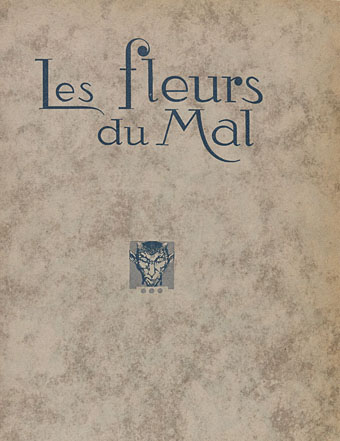
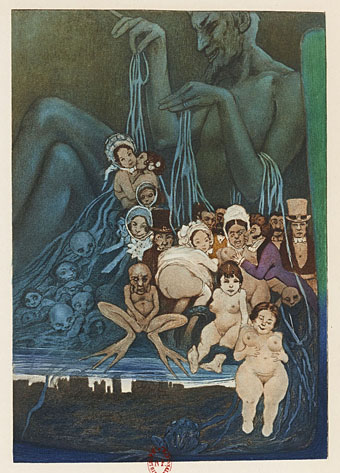
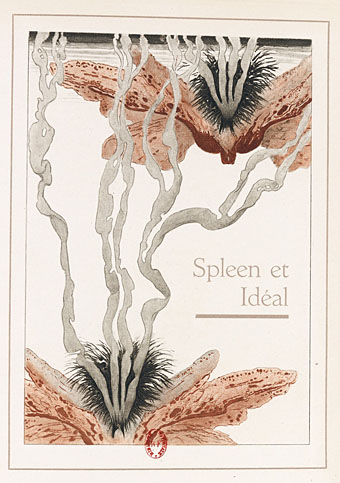
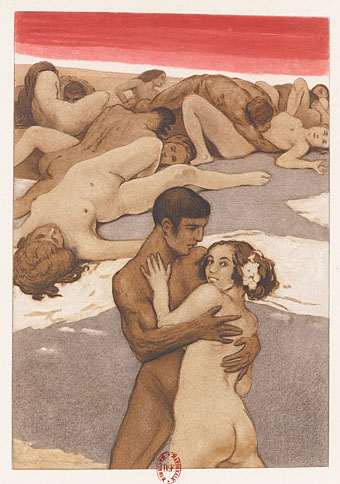
Manuel Orazi’s Fleurs du Mal

orazi01.jpg

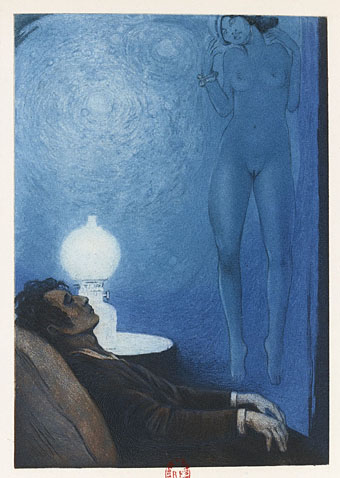
This collection of Baudelaire’s poems with illustrations by French artist Manuel Orazi (1860–1934) didn’t turn up when I was searching for illustrated editions a few years ago. With over 50 full-page drawings or vignettes it’s more profusely illustrated than most. It’s also more determinedly erotic than most, concentrating on depictions of female flesh at the expense of the poet’s other themes; Orazi’s fleurs on the title pages are a succession of priapic or vaginal orchids and fungi. The book was published in 1934, which means it was probably the last thing that Orazi worked on, but it resembles something from the fin de siècle, especially the work of Félicien Rops. Browse it or download it here.

orazi02.jpg

orazi03.jpg

orazi04.jpg

orazi05.jpg

Continue reading “Manuel Orazi’s Fleurs du Mal”

Llewellyn occult magazine and book catalogue, 1971

llewellyn1.jpg

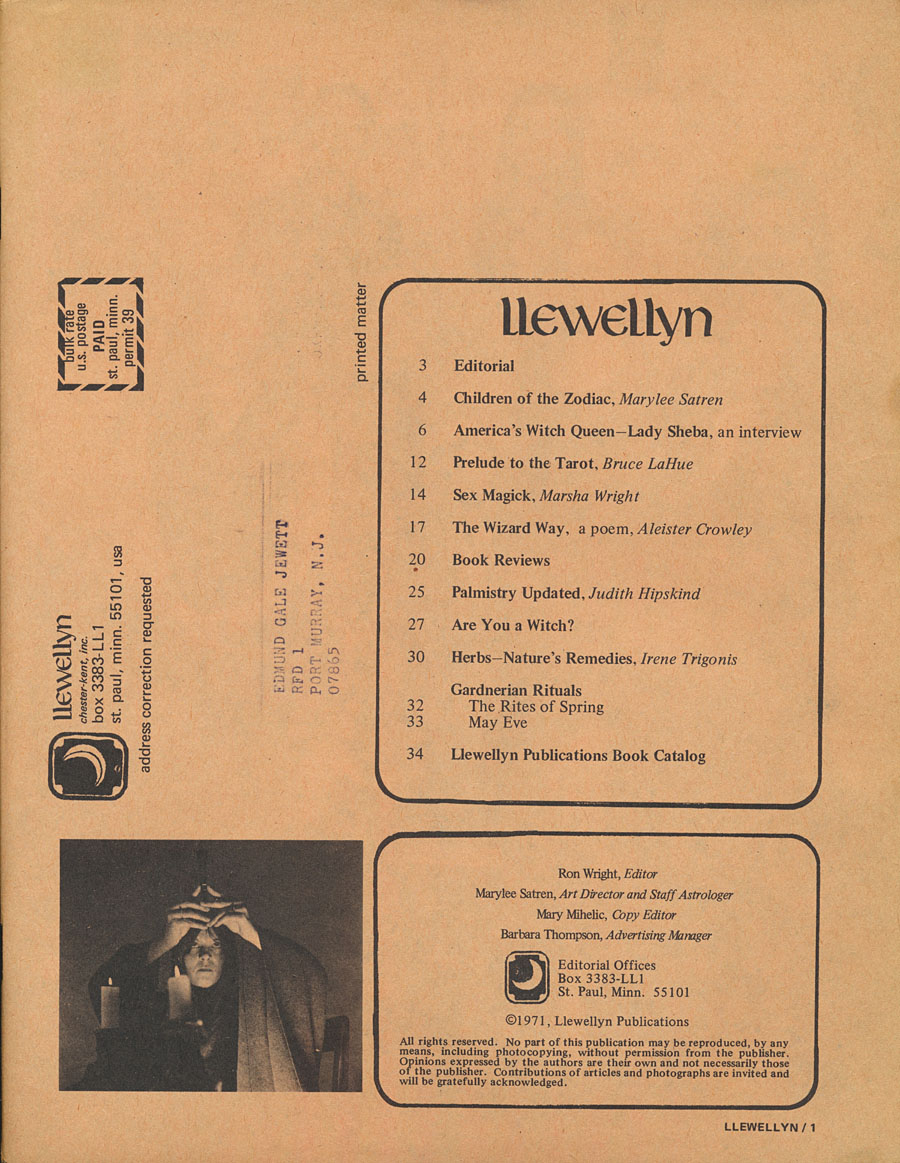
A table of contents that reads like a track list from an album by Blood Ceremony: Children of the Zodiac, America’s Witch Queen, Prelude to the Tarot, Sex Magick, The Wizard Way…

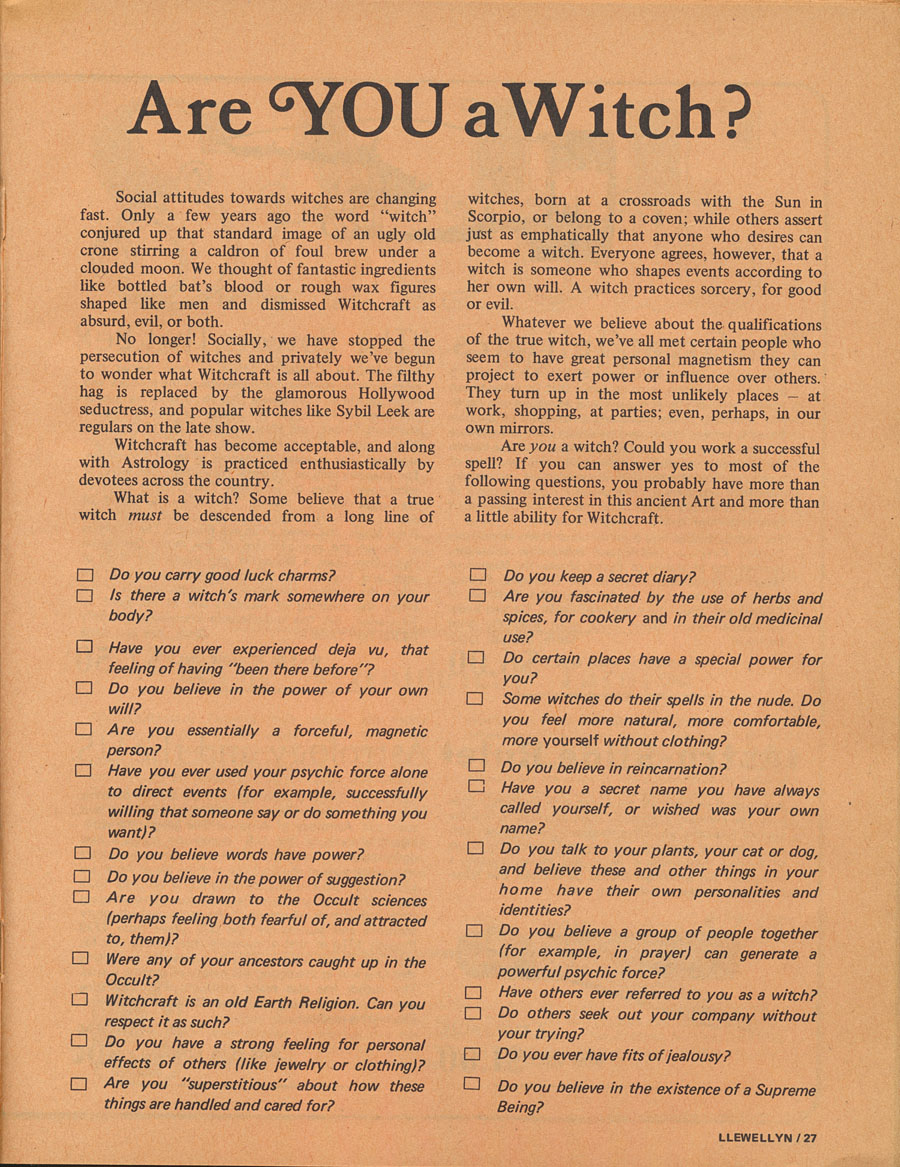
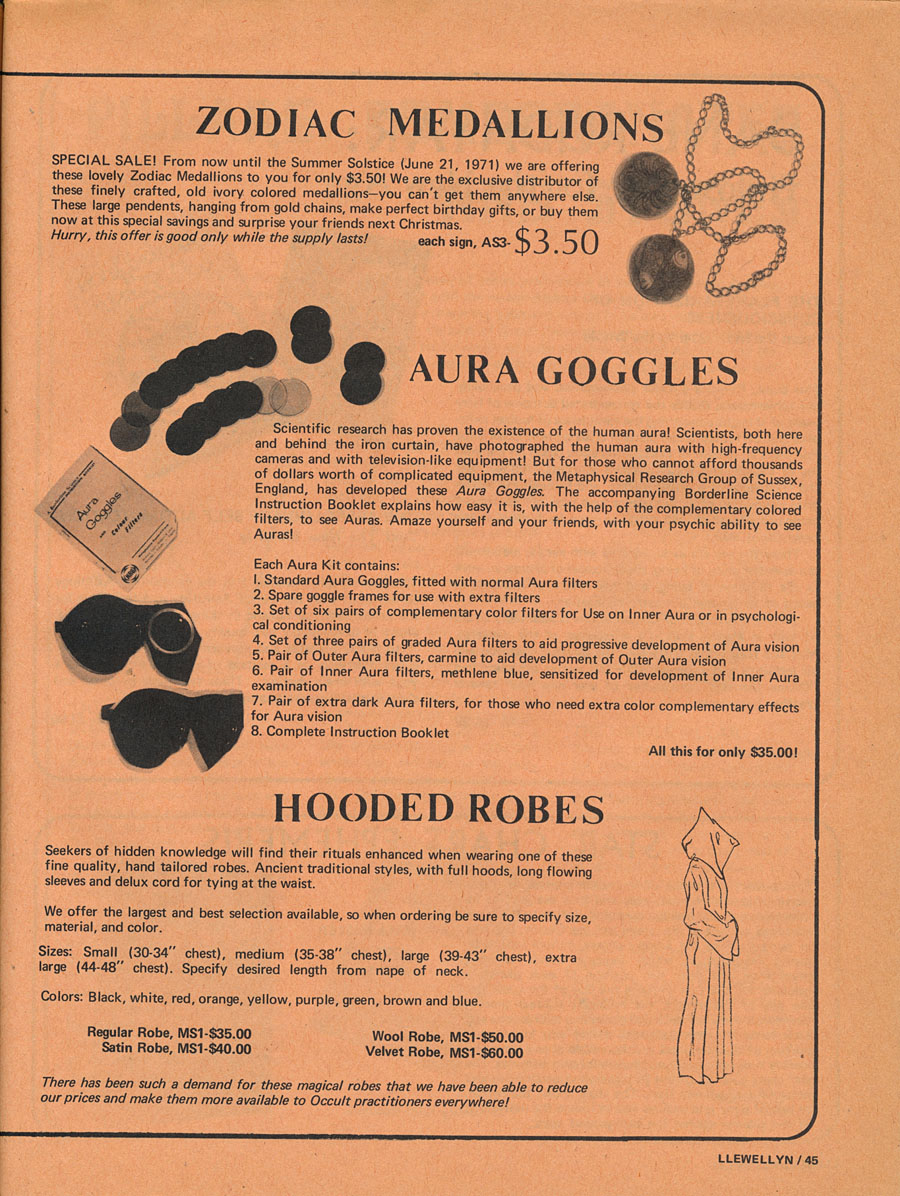
Are you a witch? Maybe you are but you don’t know it yet. You can find out by answering the questionnaire in the Llewellyn occult magazine and book catalogue for 1971, a publication which contains a number of witchy articles among its catalogue pages. This is one of many catalogues and publicity brochures from the Ted Nelson Junk Mail Cartons (6,856 items) at the Internet Archive, and is such a product of its time that it’s a shame there aren’t more like it. In addition to a photo of the hippyish Llewellyn staff there’s an interview with Lady Sheba, “America’s Witch Queen”, reprints of incantations by Aleister Crowley and Gerald Gardner, and headlines set in Davida, one of the typefaces of the occult revival. Among the artefacts for sale are a set of “Aura Goggles” from the Metaphysical Research Group, a company that sounds like something from a Charles Williams novel but which has been trading in the UK for many years, and is still active today. They no longer seem to carry Aura Goggles, however. A shame.

llewellyn2.jpg

llewellyn3.jpg

Previously on { feuilleton }
The Art of the Occult
Calendrier Magique
Typefaces of the occult revival
MMM in IT
The Book of the Lost
The Occult Explosion
Forbidden volumes
The Sapphire Museum of Magic and Occultism
Occultism for kids