Weekend links 148

lanna.jpg

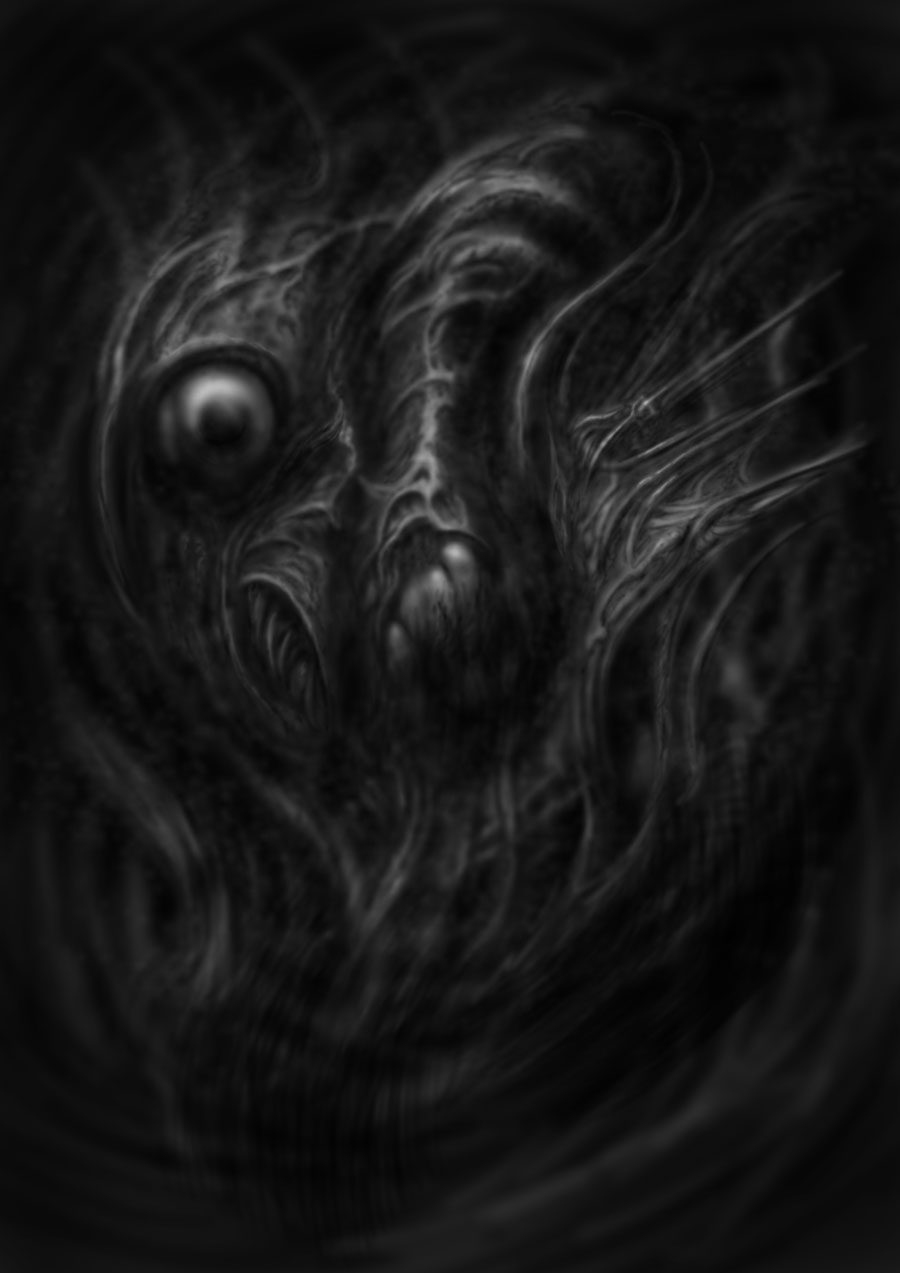
Quantum Entanglement by Duda Lanna.

An hour-long electronica mix (with the Düül rocking out at the end) by Chris Carter for Ninja Tune’s Solid Steel Radio Show.

• “…a clothes-optional Rosicrucian jamboree.”: Strange Flowers on the paintings of Elisàr von Kupffer.

• A Paste review of volume 2 of The Graphic Canon has some favourable words for my contribution.

It is an entertaining thought to remember that Orlando, all sex-change, cross-dressing and transgressive desire, appeared in the same year as Radclyffe Hall’s sapphic romance The Well of Loneliness. The two novels are different solar systems. The Well is gloomy, beaten, defensive, where women who love women have only suffering and misunderstanding in their lonely lives. The theme is as depressing as the writing, which is terrible. Orlando is a joyful and passionate declaration of love as life, regardless of gender. The Well was banned and declared obscene. Orlando became a bestseller.

Jeanette Winterson on Virginia Woolf’s androgynous fantasia.

Jim Jupp discovers the mystical novels of Charles Williams.

Michael Andre-Driussi on The Politics of Roadside Picnic.

Les Softs Machines: 25 August 1968, Ce Soir On Danse.

• At 50 Watts: Illustrations and comics by Pierre Ferrero.

Soviet posters: 1469 examples at Flickr.

Oliver Sacks on drugs (again).

• At Pinterest: Altered States.

• Farewell, Kevin Ayers.

Darkest London

Why Are We Sleeping? (1969) by The Soft Machine | Lady Rachel (1969) by Kevin Ayers | Decadence (1973) by Kevin Ayers

Cthulhu Labyrinth

cthulhulabyrinth.jpg

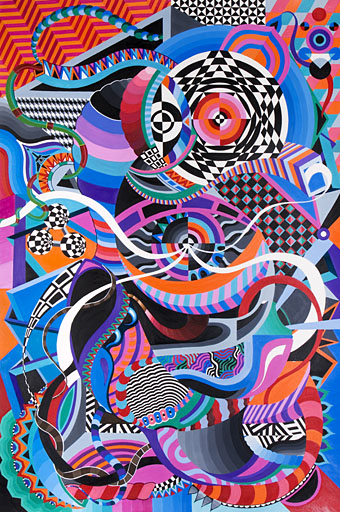
Something I was working on last August when I was putting together new pictures for the Cthulhu calendar, I’d actually forgotten about this until this week. The idea was to do something that was more of an abstract design than the rest of the art; having got this far I was undecided whether I wanted to try and incorporate the labyrinth shape into a larger picture. With time running out and nothing resolved I ended up using the Keep Calm Cthulhu design which, looking back, I feel this alone could easily have replaced. (They both share the same Cthulhu glyph.) As it is I may make this one available as another CafePress design since it’s more suited to T-shirts and things. If it needs a justification then consider the story of The Call of Cthulhu as a labyrinthine investigation which reveals Cthulhu dreaming at its centre.

Elsewhere on { feuilleton }
The Lovecraft archive

The Eighth Court

shevdon.jpg

Mid-January and here’s the first book cover design of the year, and another title for Angry Robot. This is the fourth book in Mike Shevdon‘s Courts of the Feyre series; since I’d already provided the three earlier books with a uniform design it didn’t take long to create this one. I’ve been very pleased with the reception of these covers, the positive response shows that it’s possible to design something for a fantasy series that isn’t the customary generic illustration plus florid typography. I wrote about the problems of designing fantasy covers last year with a lengthy examination of M. John Harrison’s Viriconium books.

angryrobot.jpg

Two recent Angry Robot covers: Joey HiFi‘s cover for Chuck Wendig and Amazing15‘s Pelican-styled design for Chris F. Holm.

Credit should be given to Angry Robot’s Marc Gascoigne for encouraging this direction, the company has been producing a range of very smart covers which don’t pander to the clichés of the marketplace. There’s more of an incentive for smaller publishers to do this when small press imprints and self-publishers often have terrible cover designs (sad but true) while the multinationals play safe for fear of losing readers. If you want to stand out from the crowd then it helps to look good.

Elsewhere on { feuilleton }
The book covers archive

Previously on { feuilleton }
The Courts of the Feyre

Reverbstorm on sale

reverbstorm1.jpg

At long last, the news that many people have been waiting for: the Reverbstorm book is now on sale at Savoy. From the hyperbolic press release:

“Surfin’ bird Bbbbbbbbbbrbrbrbrbrb…awawawawawawawaaaaaah! A-pa-pa-pa-pa-pa-pa-pa-pa-pa-pa-pa-pa-pa-pa-pa-pa-pa-pa-pa-pa-pa-pa-pa-pa-pa-pa-pa-pa-pa-pa-ooma-mow-mow Papa-oom-mow-mow!” The Trashmen, Surfin’ Bird

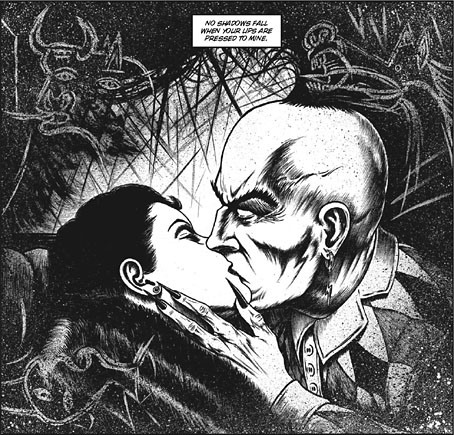
Welcome to the nightmare metropolis of Torenbürgen, where New York’s Art Deco architecture has fused with the termination machinery of Auschwitz. In this urban inferno Jessie Matthews is singing Sondheim, James Joyce is at work on a new novel and Lord Horror, ex-Nazi propaganda broadcaster and Torenbürgen’s model citizen, is stalking the streets in search of fresh victims for his razors. Murderous apes infest the alleyways, Ononoes feast on the living and the dead, while above the rooftops the Soul of the Virgin Mary drifts like a swollen Lovecraftian dirigible, picking at bodies destined for the charnel furnaces.

Lord Horror: Reverbstorm is a unique graphic collaboration between writer David Britton, the author of four Lord Horror novels, and artist John Coulthart, whose book of Lovecraft-derived comic strips and illustrations, The Haunter of the Dark, featured a collaboration with Alan Moore. Reverbstorm was originally published in serial form and is now being presented in a single volume for the very first time. Britton’s debut novel, Lord Horror (1990), was the last work of fiction to be banned in the UK; an earlier Lord Horror comic series, Hard Core Horror, was also banned by a British court in 1995. Coulthart’s death-camp artwork from the final issue in that series appears in Reverbstorm as a prelude to the main narrative.

There’s never been a comic like this surreal collision between Modernist art and pulp aesthetics, a world where Finnegans Wake is drenched in Alligator Wine and Picasso’s Guernica is invaded by Tarzan’s simian hordes. Ambitious, transgressive and meticulously rendered, Reverbstorm is one answer to the eternal question posed by those cultural philosophers, The Cramps: “How far can too far go?”

“Bababadalgharaghtakamminarronnkonnbronntonnerronn-
tuonnthunntrovarrhounawnskawntoohoohoordenenthurnuk!”
James Joyce, Finnegans Wake

reverbstorm2.jpg

rev2.jpg

Previously on { feuilleton }
Reverbstorm in print
Reverbstorm update
James Joyce in Reverbstorm
A Reverbstorm jukebox
Reverbstorm: Bauhaus Horror
Reverbstorm: an introduction and preview
Calendars galore

calendars.jpg

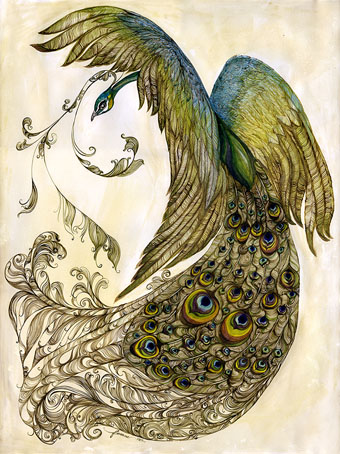
It’s those calendars again. I’ve had requests recently to put my Lewis Carroll-themed psychedelic designs back on sale but the past few months have been pretty work-heavy, and since I deleted the original product pages it was going to require some effort to make new ones. This weekend I finally found the time to tackle the CafePress upload system and make them available again. I’ve taken the year date off the covers so both calendars will remain available in the future. See below for details.

Meanwhile, this year’s Cthulhu Calendar is still on sale and proving almost as popular as the Wonderland one did in 2009. Thanks again for the support!

wonderland.jpg

A Mad Tea-Party from Psychedelic Wonderland (2009).

• Psychedelic Wonderland at CafePress | See preview pages here.

lookingglass.jpg

Jabberwocky from Through the Psychedelic Looking-Glass (2010).

• Through the Psychedelic Looking-Glass at CafePress | See preview pages here.

Previously on { feuilleton }
Scenes from a carriage
Through the Psychedelic Looking-Glass: the 2011 calendar
Jabberwocky
Alice in Acidland
Return to Wonderland
Dalí in Wonderland
Virtual Alice
Psychedelic Wonderland: the 2010 calendar
Charles Robinson’s Alice’s Adventures in Wonderland
Humpty Dumpty variations
Alice in Wonderland by Jonathan Miller
The Illustrators of Alice