Alice’s Adventures in the Underground: Feed Your Head

alice.jpg

My work will appear in two exhibitions in the new year. The first hasn’t been announced yet so this post concerns the second event which will take place in London on 1st February:

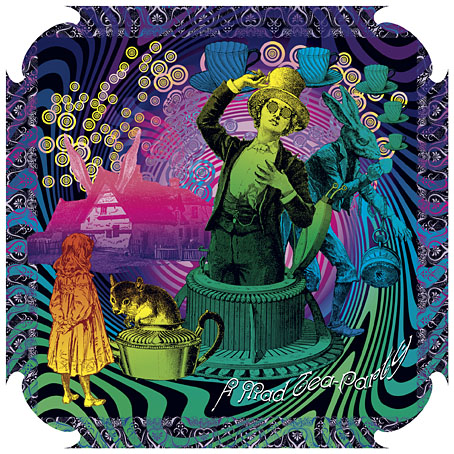
“Feed your head…” An evening discourse on all things Wonderland, with John Coulthart, Andy Roberts, Nikki Wyrd and Jake Fior (facilitator).

This event marks the opening of a three day exhibition hosted by the Horse Hospital, featuring John Coulthart’s psychedelia-themed ‘Alice’ artwork, printed for the first time as (drug-free) blotter art. John’s depictions of the twelve chapters of ‘Alice’s Adventures in Wonderland’ view the 1860s through the iridescent lens of the 1960s; Victoriana refracted through a psychedelic prism. Come along for a discussion of the links between psychedelic art and music, and the persistent fascination of Lewis Carroll’s books. There will be talk of many things, not only cabbages and kings, but far more than you can possibly imagine before breakfast.

Signed blotter prints will be on sale.

Psychedelic artists – particularly in the 60s – and many other outsider creative types (before and since that influential decade), have drawn their inspiration from the well of imagery found within the ‘Alice’ books. As well as John’s artwork, there will be Alice themed creations by other artists on show. In addition, the Psychedelic Museum will be holding its second pop-up museum display, with particular focus on the 60s counterculture.

The event was suggested by Paul at Blotterart, a specialist in quality printing on the perforated blotting-paper sheets that used to be (and possibly still are) the commonest carrier for doses of LSD. My psychedelic take on the Lewis Carroll books was a reaction to the way in which psychedelic culture had adopted Alice and co. as part of the larger collision of childhood and Victoriana that was so prevalent at the end of the 1960s. So in that respect blotting sheets are a much more fitting medium for these pictures than the calendar pages they filled originally. As noted above, I’ll be talking about the artwork and related matters, and will also be on hand to sign things. I’ve been involved with a number of exhibitions recently but they’re not all as close to home as this one.

The Horse Hospital website has the ticket details. Those who can’t make it but are interested in the prints should know that they’ll be for sale online at some point. Further details will be posted here.

Previously on { feuilleton }
Psychedelia and Other Colours by Rob Chapman
LSD-25 by The Gamblers
More trip texts
Listen to the Colour of Your Dreams: Part Six
Listen to the Colour of Your Dreams: Part Five
Listen to the Colour of Your Dreams: Part Four
Listen to the Colour of Your Dreams: Part Three
Listen to the Colour of Your Dreams: Part Two
Listen to the Colour of Your Dreams: Part One
Trip texts
Acid albums
Acid covers
Lyrical Substance Deliberated
The Art of Tripping, a documentary by Storm Thorgerson
What Is A Happening?
My White Bicycle
Ogdens’ Nut Gone Flake
Tomorrow Never Knows
Enter the Void
In the Land of Retinal Delights
Smashing Time
The Dukes declare it’s 25 O’Clock!
A splendid time is guaranteed for all
The art of LSD
Hep cats

BEHOLD! Oddities, Curiosities and Undefinable Wonders

behold.jpg

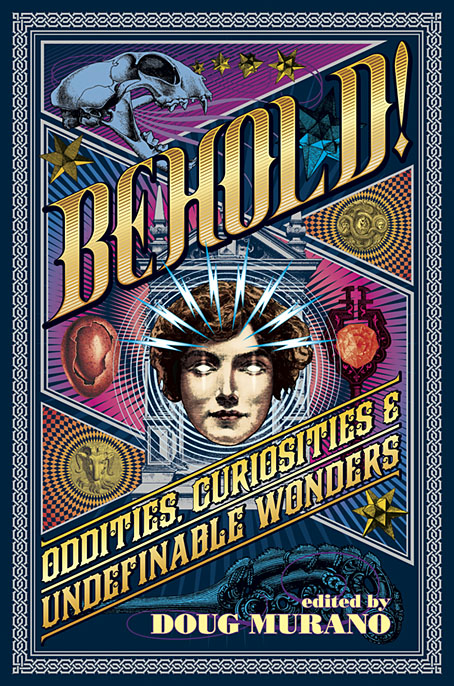
Behold: another book cover. This is a design I was working on in October, the contents of which haven’t been disclosed yet but the cover has been made public so I can post it here. BEHOLD! Oddities, Curiosities and Undefinable Wonders is an anthology of short fiction with a Wunderkammer brief similar to that of The Thackery T. Lambshead Cabinet of Curiosities, the collection that I illustrated in 2011 for Ann & Jeff VanderMeer. There’s an antique slant to both the books so I’ve reflected this in the graphics which are mostly from 19th-century sources. I was supposed to do the cover for the VanderMeers’ collection but HarperCollins went with their own designer; this was disappointing for the editors as well as myself so the latest cover makes up for that. Doug Murano is editing the new volume for Crystal Lake Publishing, one of five companies listed recently at Dirge Magazine as notable publishers of transgressive horror (and another of Doug Murano’s collections is their “must read”). BEHOLD! is slated for publication in early 2017 so watch this space.

Previously on { feuilleton }
A Cabinet of Curiosities
The Thackery T. Lambshead Cabinet of Curiosities
The specimens of Alex CF
Walmor Corrêa’s Memento Mori
The art of Ron Pippin
Custom creatures
Jan Švankmajer: The Complete Short Films
Cryptozoology
The Bowes Swan
The Museum of Fantastic Specimens

Things

thing01.jpg

Art by Drew Struzan.

One of my current commissions is a piece of art for a book based on John Carpenter’s The Thing, due to be published next year. This was a request I agreed to immediately, having been astonished by the film when it appeared in 1982 (I saw it three times), and having rated it ever since as Carpenter’s best, as well as one of my all-time favourite horror films. I haven’t started on the planned piece just yet but the commission encouraged me to upgrade my DVD copy of the film to the Blu-ray version, and to also read for the first time John W. Campbell’s “Who Goes There?”, the short story that was the origin of both Carpenter’s film and The Thing From Another World (1951) directed by Christian Nyby. Reading the story set me hunting around for other interpretations of Campbell’s alien.

thing02.jpg

UK poster. Art by Les Edwards.

The story was instructive in several ways, the first being how closely Bill Lancaster’s script for the Carpenter film follows the story’s outline. The paperback collection I was reading has an introduction by James Blish which complains about the Howard Hawks/Christian Nyby production turning the polymorphous alien into another clone of Frankenstein’s monster. That’s true but the Nyby film still scared me to death when I first saw it aged 11 or so, and it has its merits. Lancaster not only stayed closer to the original shape-shifting premise but also kept many of the character names, plus details such as the blood test and the Thing’s attempt at the end to build a machine to escape from the encampment. The unforgettable opening, however, with the lone helicopter pursuing the dog, is all Lancaster’s.

thing03.jpg

Astounding Science-Fiction, August 1938; artist unknown. “Don A. Stuart” was a pseudonym for John W. Campbell, at that time the newly appointed editor of Astounding. Campbell’s editorship changed the name of the magazine from Astounding Stories to Astounding Science-Fiction.

It was face up there on the plain, greasy planks of the table. The broken haft of the bronze ice-axe was still buried in the queer skull. Three mad, hate-filled eyes blazed up with a living fire, bright as fresh-spilled blood, from a face ringed with a writhing, loathsome nest of worms, blue, mobile worms that crawled where hair should grow—

Campbell’s description of the ice-bound alien is better than some of his writing elsewhere. I’m used to tempering my judgement when visiting stories written for the pulps but Campbell’s writing is really awful, and a reminder of why I never got very far with the early SF writers. Weird Tales magazine had its share of ham-fisted journeymen (and women), but Campbell’s contemporaries such as Clark Ashton Smith and HP Lovecraft read like the most finessed and mandarin prose stylists in comparison. Well, The Thing isn’t the first great film to be based on a poor-quality story so we can at least thank Campbell for his scenario, although how much of it was his own has never been clear. The idea of ancient aliens in Antarctica (some of which are amorphous shape-shifters) had already been explored by HP Lovecraft in At the Mountains of Madness; Lovecraft’s story was published in 1936 by Astounding Stories, the same magazine that published “Who Goes There?” two years later. This lineage, and the possible influence, makes The Thing one of the foremost Lovecraftian films even without all of its tentacled abominations.

thing04.jpg

Art by Hannes Bok.

The story provided the title of Campbell’s debut collection of short fiction in 1948. I’ve known the Hannes Bok cover art for many years but hadn’t realised until recently that the three-eyed monster on the front was a Bokian rendering of Campbell’s alien. The figure on the back is presumably a human/husky hybrid, while I’d guess the robot relates to one of the author’s other stories.

Continue reading “Things”

Pirate Utopia by Bruce Sterling

pirateutopia.jpg

Here at last is the small hardback book I spent most of February and March working on. Pirate Utopia is published this week, and I’m pleased that it’s been very well received, with reviews drawing attention to the illustration and design as well as the text. This is a dieselpunk alternate history which begins in 1920:

WHO are these bold revolutionaries pillaging their confused European neighbours? The Futurists! Utopian outlaws of Italy’s tiny Regency of Carnaro, unlikely scourge of the Adriatic Sea!

It is the end of the Great War, and yet there is unrest in newly formed Carnaro. Carnaro is utterly in thrall to all things new, no matter how impractical or improbable. Futurism unites artists, pirates, propagandists, veterans, scientists, and libertines alike; military innovation and unabashed gratification rule the day. No one will rest until they crush Europe’s communists, capitalists, fascists, and bewildered coastal townsfolk.

But some have theorized that the Soldier-Citizens of Carnaro are not completely sane. At the dawn of mutiny, they are led by on ever-changing, passionate coterie, which may include:

* Lorenzo Secondari, the infamous Pirate Engineer, leader of ferocious Croatian raiders (and theatre enthusiasts)
* Blanka Piffer, staunch patriot and smartly clad Syndicalist manager of a torpedo factory staffed exclusively by women
* The Prophet, charismatic warrior-poet ruthless dictator, and very active proponent of free love
* The Ace of Hearts, dashing aristocrat spy, yogi, drug pusher, and combat pilot
* The Art Witch, the compelling Milanese millionairesse in the inner circle and mysterious, avid occultist

Two infamous Americans have arrived in Carnaro offering a Faustian bargain. Will HP Lovecraft and Houdini betray their own nation, and lead the Futurists to international glory?

No need to emphasis the pertinence of a story of global political turmoil appearing at this point in time. Back in March the traumas of Brexit and the US election were mere possibilities rather than the unavoidable facts they are today. Pirate Utopia doesn’t necessarily reflect the present moment but some of the resonances are, shall we say, suggestive. Bruce Sterling, as noted earlier, is a futurist (as distinct from a Futurist), and had this to say recently about the current state of affairs.

pirate1.jpg

The chapter spreads and other interior graphics run variations of the works of Fortunato Depero and others. Depero was an ideal choice not only because his work tends to the cartoonish—this is a humorous book about serious matters—but much of it is bold and monochromatic, ideal for deployment as black-and-white graphics. Ordinarily I’d write a little more about the art influences, but since I already did so inside the book itself it seems better to encourage those who want to know more to buy a copy. You can, however, see a few more of the page layouts here. A book about Interesting Times for Interesting Times. Join the Futurist Revolution!

pirate2.jpg

pirate3.jpg

pirate4.jpg

pirate5.jpg

pirate6.jpg

pirate7.jpg

Previously on { feuilleton }
Futurismo!

Nightmares calendar

calendar14.jpg

Presenting the latest Coulthart calendar. Last year’s Lovecraft-themed collection was well-received (and is on sale again this year) so I thought I’d try a similar accumulation of horror imagery. Much of the artwork this time is from my intensive painting period circa 1996–1998, and includes one piece—the red painting below—that hasn’t been made public before. Further traces of Lovecraft may be found in the tentacles of the Lord Horror canvas—HPL by way of Frank Frazetta—and the two panels of the Red Night Rites diptych. The latter was a large picture of Reverbstorm-level grotesquery done as a wraparound cover for The Unspeakable Oath, a Lovecraftian gaming journal. While working on it I had William Burroughs in mind as much as Lovecraft, and Burroughs happened to die while work was still in progress so the picture is dedicated to him. Also Lovecraftian is In Spaces Between, one of the pages from my Kabbalistic collaboration with Alan Moore, The Great Old Ones. Howl from Beyond is a title that some people may recognise from Magic: The Gathering. I painted over 20 pictures for the card game but most of them were done in haste, and not to my satisfaction. Howl from Beyond is one of the few I felt worked as intended.

As before, this calendar is available at Zazzle, and comes with black pages and a minimal layout for the dates. Larger images of the artwork may be seen here. I said last year that I’d move some of the other calendar designs to Zazzle (CafePress having discontinued the vertical format I’d been using for years) but I still haven’t done this. One day… And speaking of nightmares, earlier this year I was designing the interiors for another excellent collection of horror stories edited by Ellen Datlow which happens to bear this title. When I get some of that elusive spare time I’ll add the book to the website.

calendar01.jpg

January: Steps of Descent (digital, 2008).

calendar02.jpg

February: Untitled (acrylics on board, 1997).

calendar03.jpg

March: Waltzes and Whispers (acrylics on board, 1998).

Continue reading “Nightmares calendar”