Weekend links 233

casas.jpg

Alchemical Stone (2014) by Daniel Lasso Casas. Via full fathom five.

• “I am unsure if this reality is an everyday one. We don’t know if the universe belongs to a realist genre or a fantastic one, because if, as idealists believe, everything is a dream, then what we call reality is essentially oneiric.” Jorge Luis Borges in 1984 in conversation with Argentinian poet and essayist Osvaldo Ferrari.

• “I am transgender, so ‘he’ is not appropriate and ‘she’ is problematic. I’m what I think of as pure transgender.” Antony Hegarty talks to Cian Traynor about Turning, a new DVD and album project.

Unearthing Forgotten Horrors 2014 is a weekend festival of rural weirdness at the Star and Shadow Cinema, Newcastle-upon-Tyne.

Henry Darger, one of the most celebrated examples of an outsider artist (see: Vivian Girls), has been uniformly ignored by the literary firmament. Despite the success of his artwork, none of his fiction manuscripts have seen print. The language of literature is the language of privilege, in which even the stories of the working class are regularly clad in a bourgeois prose. The language of literature cannot be extricated from its white, genteel roots. Those of us without access to education are welcome to practice, but we must come in from the cold, adopt the house language. We must be civilized, scrubbed clean. Naiveté has no place in the colosseum of words.

Ravi Mangla on Coming in from the Cold: Outsider Art in Literature

Carel de Nerée tot Babberich en Henri van Booven, a collection of Beardsley-like drawings by a neglected Dutch artist.

Forever Butt is a new collection of the best of recent issues of BUTT magazine, still the best print mag for gay men.

Anne Billson’s guide to Brussels, another European city I’d like to visit some day.

• At BibliOdyssey: Schönschreibmeister, a calligraphy master’s album.

Third Ear Band live (and in colour!) on French TV in 1970.

• Mix of the week: Secret Thirteen mix 132 by Spatial.

• The Internet Archive now has an Internet Arcade.

Crazy Cat Lady Clothing

The Pattern Library

Stone Circle (1969) by Third Ear Band | Sacred Stones (1992) by Sheila Chandra | Stoned Circular I (1996) by Coil
Weekend links 232

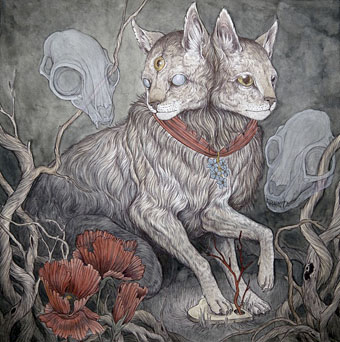
hackett.jpg

Forget Me Not (no date) by Caitlin Hackett.

• Halloween brings out the articles about weird fiction: “No one would now write of [HP Lovecraft] as the critic Edmund Wilson did, in the New Yorker in 1945: ‘The only real horror in most of these fictions is the horror of bad taste and bad art.’ The true horror was in fact that of judging Lovecraft by the standards of a defunct literary culture,” says John Gray. At The Atlantic there’s Jeff VanderMeer on the uncanny power of weird fiction, while Matt Seidel at The Millions explores the mysteries and attractions of Robert Aickman’s “strange stories”.

The Witching Hour is a video essay by Pam Grossman “examining the many different faces of witches in film”. Pam’s video opens with a scene from Suspiria; over at FACT, Goblin’s Claudio Simonetti talks about the creation of Suspiria‘s peerless soundtrack.

• David Rudkin and Alan Clarke’s uncanny television film, Penda’s Fen, is given a 40th anniversary screening later this month at the Horse Hospital, London. For those who can’t attend (and those who haven’t already read it) there’s my post from 2010.

Nabokov sees each day’s weather as a palette: “The weather this morning was soso: dullish, but warm, a boiled milk sky, with skin – but if you pushed it aside with a teaspoon, the sun was really nice, so I wore my white trousers”. He listens carefully to the sound of the rain, which his letters brilliantly orchestrate. He provides fantastic descriptions of puddles, some of which contain shifts in perspective reminiscent of the nearly cinematic transitions found in the novel he would write shortly afterwards, King, Queen, Knave:

“I looked out of the window and saw: a red-haired housepainter caught a mouse in his wheelbarrow and killed it with the stroke of a brush, then he tossed it in a puddle. The puddle reflected the dark-blue sky, quick black upsilons (reflections of swallows flying high) and the knees of a squatting child, who was attentively studying the little grey round corpse.”

Eric Naiman on Vladimir Nabokov’s Letters to Véra

• Occult rock: Peter Bebergal talks to Expanding Minds about his new book, Season of the Witch: How the Occult Saved Rock and Roll. There’s an hour-long film of Black Sabbath saving rock and roll in Paris, 1970, here.

• Mixes of the week: Burning The Existence, “a three-hour sonic exploration of the outer fringes of Goth”, and a horror soundtrack mix by Death Waltz.

• “‘Capital loathes the old,’ [Gareth] Evans said, ‘for anchoring us in the reality of the lived.'” Iain Sinclair on London’s lost cinemas.

Desirina Boskovich, co-editor of the Steampunk Users Manual, offers “7 Reasons Why Steampunk Is Totally ‘Now'”.

• Penguin has new collage covers by Julian House for The Cut-Up Trilogy by William Burroughs.

Hear a homemade synthesizer turn weather into music.

• Grotesque doodles by William Makepeace Thackeray.

full fathom five is Thom’s new blog.

Weird Dream (1976) by Harmonia 76 | Weird Caravan (1980) by Klaus Schulze | Weird Gear (1991) by Ultramarine

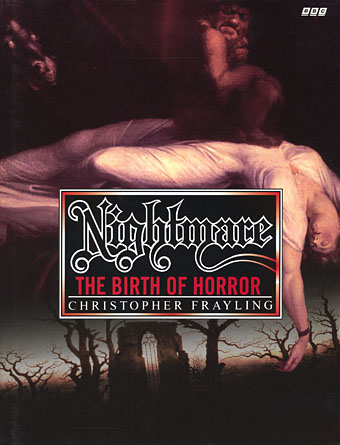
Nightmare: The Birth of Horror

frayling.jpg

Nightmare: The Birth of Horror (1996): Dracula (and Louis Jourdan again).

Christopher Frayling, like Marina Warner, is that rare thing: a British academic with an enthusiasm for popular culture, and a talent for communicating that enthusiasm to a general audience. Both writers also have more than a passing interest in the darker areas of fiction, whether that means Gothic romance or contemporary horror films. One of Frayling’s first books was The Vampyre: Lord Ruthven To Count Dracula (1978); the same year he contributed an excellent Lovecraft essay, Dreams of Dead Names, to George Hay’s The Necronomicon: The Book of Dead Names, one of the two Necronomica published in the 1970s (three if you count Giger’s art book). Frayling’s essay, and another by Angela Carter are among the highlights in Hay’s curious volume.

frayling2.jpg

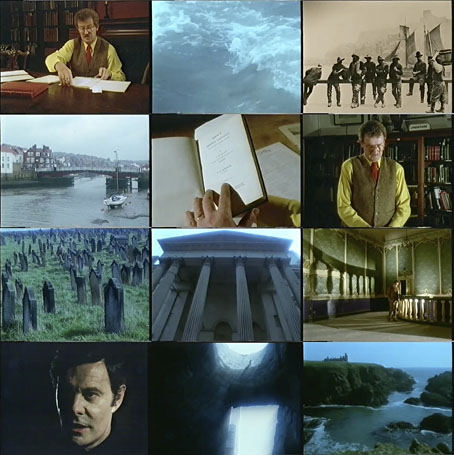
Nightmare: The Birth of Horror was both a book and a television series produced by the BBC in 1996. The year before, Frayling had written and presented Strange Landscape, an examination of the culture and philosophy of the Middle Ages. Nightmare looks at the creation of four British horror novels: Frankenstein, Dracula, The Strange Case of Dr Jekyll and Mr Hyde, and The Hound of the Baskervilles. Two of these stories—Frankenstein and Jekyll and Hyde—were famously the product of nightmares so Frayling stretches this coincidence to include the others; I’m still not sure the case is properly made for Bram Stoker but it hardly matters.

Another aspect of Frayling’s thesis is the extraordinary power of these works, all of which have had a lasting global influence. The book is naturally more detailed than the TV series, delving into the fiction for the subtexts that contribute to the power of the stories. The Dracula section is a tour-de-force of condensed information, sketching a history of fictional vampires then looking at Stoker’s career as assistant to actor Henry Irving, a man whose outsize personality was an inspiration for that of the vampiric count. There’s also some interesting speculation about Stoker’s sexuality; a letter he wrote to Walt Whitman is (to borrow a phrase from Sherlock Holmes)…suggestive. The rest of the chapter looks in detail at the slow creation of the novel. In the TV series what you lose in the literary specifics you gain in visits to some of the locations mentioned in the story, so for Dracula that means windswept Whitby on the Yorkshire coast. The same applies to the other novels: for Frankenstein there’s a visit to the Villa Diodati on the shore of Lake Geneva, a journey to Dartmoor for Hound of the Baskervilles, and so on.

I was hoping the whole series might be on YouTube but for the moment the Frankenstein episode seems to be missing. The Dracula one is the best quality, the other two look a little rough. In the meantime copies of the book may still be found at reasonable prices.

Nightmare: The Birth of HorrorDracula | Dr Jekyll & Mr Hyde | The Hound of the Baskervilles

Count Dracula

dracula1.jpg

Vampires: if they’ve never been very scarce they didn’t used to be quite so commonplace. The fortunes of Dracula, on the other hand, seem to have diminished in recent years following a centenary peak in 1997. The surprising spike of interest in the 1970s might explain the BBC’s decision to adapt Bram Stoker’s novel for television in 1977. I often used to wonder why the corporation didn’t turn some of its costume-drama prowess to more generic material. Anthony Trollope’s The Pallisers sprawled over 26 50-minute episodes in 1974 but you’d search in vain for an adaptation of HG Wells. The closest was the yearly Ghost Story for Christmas most of which were period pieces.

dracula2.jpg

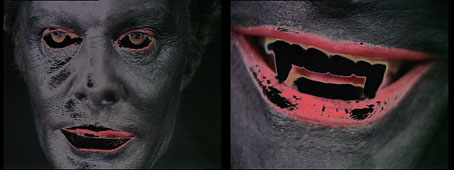
Louis Jourdan bares his fangs.

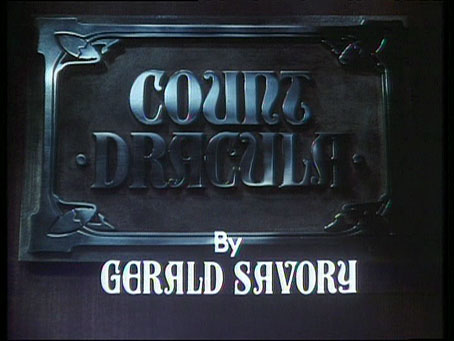
Gerald Savory’s Count Dracula, subtitled “A Gothic Romance”, was broadcast a few days before Christmas, 1977, in a single 150-minute programme. Repeat screenings broke the drama into two episodes so it’s often referred to as a mini-series. I’d read Dracula for the first time earlier that year so it was a thrill to see the story presented in such a faithful manner after all the liberties taken by feature films and derivative dramas. Count Dracula may seem primitive when compared to lavish Hollywood productions but 37 years later it’s still the adaptation that most closely adheres to Stoker’s epistolary novel.

dracula3.jpg

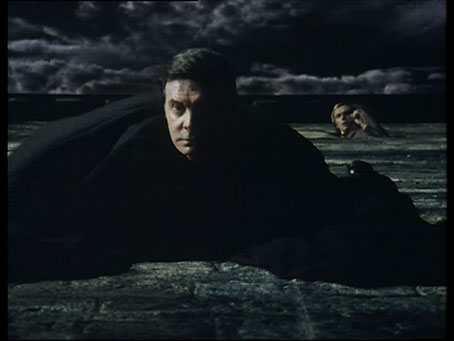
Louis Jourdan and Bosco Hogan (Jonathan Harker).

Continue reading “Count Dracula”

Weekend links 228

moss.jpg

White, Red and Black (1949) by Marlow Moss.

• British television’s greatest director, Alan Clarke, rates on the cult scale here for his work on Penda’s Fen but his career was long, uncompromising and still hasn’t received the full appraisal it deserves. His more violent dramas—Scum, Made in Britain, The Firm, etc—have all appeared on DVD but many of his less notorious films can be hard to find. Paul Duane looks back at the remarkable Contact (1985), an hour-long study of the conflict in Northern Ireland, and a better film about soldiering than any number of big-budget features.

• I’ve wondered for years why one of the Daft Punk helmets seemed so familiar. It’s because they swiped the design from industrial designer and visual futurist, Syd Mead. Mark Wilson talked to Mead about wearable technology; Mr Mead, it seems, isn’t impressed by the French popsters. Related: paintings from Mead’s Sentinel (1979), and Syd Mead designs at Pinterest.

• Remembering that time in 1982 when Alan Moore interviewed Hawkwind. More interviews: Adam Bychawski talks to Jenny Hval about “sonic extremity, the violence of voyeurism and inhabiting bodies”, and Laurent Fintoni talks to (that man again) Bernard Szajner about Visions Of Dune, laser shows, and finding his way back to music.

Our attitudes towards work are extremely schizophrenic: we secretly aspire to sloth, while we loudly praise work. There isn’t an election poster that doesn’t promise more jobs. The call for more work is similar to the Stockholm syndrome, in which the victims of hostage-taking eventually develop a positive relationship with their captors.

Patrick Spaet on the universal employment fetish

• “Marlow Moss was one of Britain’s most important Constructivist artists…a radical lesbian and Drag King,” says Dal Chodha. An exhibition of Moss’s work has just opened at Tate Britain. Related: Marlow Moss: forgotten art maverick.

Yuki Koshimoto plays the Hang, aka the Spacedrum. Via Metafilter where there are more Hang links. The instrument was prominently featured in the score Cliff Martinez wrote for Solaris (2002).

• Broadcast’s Trish Keenan would have been 46 last week. James Cargill posted two demo songs for her birthday.

• At the BFI: Exclusive materials from the making of Powell and Pressburger’s The Tales of Hoffmann.

• Of Tutus and Tortures: Thoughts on the Decadent and the Weird by Christopher Burke.

Faber has launched a Modern Classics imprint with some smart cover designs.

• At Dangerous Minds: Good to see big scans of the Surrealists’ playing cards.

• Mix of the week: Afrofuturist Flowering by Nigel Rampant.

• Writer and editor Russ Kick has a new website.

Infographic: Why Readers Still Prefer Paper.

Superficial Music 1–3 (1981) by Bernard Szajner | Fahrenheit 451 (1982) by Hawkwind | Black Lake (2014) by Jenny Hval & Susanna