Weekend links 408

sasada.jpg

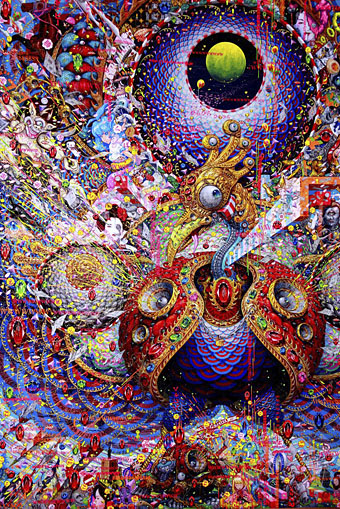
Kujaku (2018) by Yasuto Sasada.

• “The Ernst picture [Of This Men Shall Know Nothing] has also been interpreted as depicting sexual alchemy, which also ties in with much of Peter Grey’s writing on Babalon and the goddess’ connection to sexual magic and the three ‘Fs’: f(e)asting, flagellation and fucking!” Hawthonn’s Phil & Layla Legard talk to Folk Horror Revival about their superb new album, Red Goddess (of this men shall know nothing).

• South London “Psychic Circuit”: A walk with London writer Iain Sinclair inspired by cult writer Steve Moore—from Shooter’s Hill and the Shrewsbury burial mound to Charlton House then Maryon Park and the locations used in Antonioni’s Blow Up.

• Czech filmmaker Juraj Herz, director of The Cremator (1969) and Morgiana (1972), died last week. One of his later films, The Ninth Heart (1978), featured an animated title sequence by Jan Švankmajer and Eva Švankmajerova.

• The week in psychedelic visuals: Ben Marks on Bill Ham’s San Francisco light shows (a piece from 2016), and Dangerous Minds on Astralvision’s Electric Light Voyage (1979), a light show on Betamax tape.

• “From glaciers to nuclear bunkers, photographer Chloe Dewe Mathews descends into the dark heart of the Swiss mountains that inspired Mary Shelley.”

• Mix of the week: Secret Thirteen Mix 250 by Sote, and XLR8R Podcast 537 by SNTS.

When The Horses Were Shorn Of Their Hooves, new music by Dylan Carlson.

Emily Temple on Edward Gorey’s illustrated covers for literary classics.

Hidden Hydrology: Coil’s Lost Rivers studio sessions.

Tube: Minimalist YouTube search

Sukhdev Sandhu is In Wild Air

• Lost Roads (1988) by Bill Laswell | Lost Sanctum (1994) by Lull | Lost Ways (2016) by Pye Corner Audio

Weekend links 407

alonso.jpg

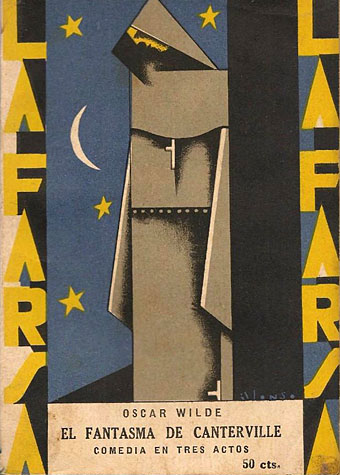
Cover art by Alonso for a 1929 Spanish edition of The Canterville Ghost by Oscar Wilde.

• Major music news of the week is the announcement, after a hiatus of nine years, of a new Jon Hassell album. Listening To Pictures (Pentimento Volume One) will be released on Hassell’s new label, Ndeya, in June. Meanwhile, Paul Schütze has a new album (also his first in a long while), The Sky Torn Apart, released at the end of this month by Glacial Movements. For those impatient for new sounds, Red Goddess (of this men shall know nothing) by Hawthonn is out now, and very good it is too.

Ghost Story (1974): a British film directed by Stephen Weeks, and starring (among others) Marianne Faithfull, Penelope Keith, Murray Melvin and (in a rare appearance) Vivian MacKerrell, the real-life model for Withnail from Bruce Robinson’s Withnail and I. Also from 1974, a TV adaptation of Oscar Wilde’s The Canterville Ghost starring David Niven.

Nandini Ramnath on how an Indian film distributor in London (Mehelli Modi of Second Run DVD) is helping rescue forgotten classics from obscurity.

Simon Reynolds explains why he thinks Boards of Canada’s Music Has the Right to Children is the greatest psychedelic album of the ’90s.

• At I Heart Noise: an interview with Dylan Carlson about his forthcoming solo album, Conquistador.

• At Dennis Cooper’s: David Ehrenstein presents…Donald Cammell Day.

• Photos by David Graham of Mexico City’s “gay subway”.

Circuit Des Yeux‘s favourite albums.

The Gospel of Filth: a book list.

Fountain Of Filth (1974) by Devo | The Heart’s Filthy Lesson (1995) by David Bowie | Filthy/Gorgeous (2004) by Scissor Sisters

A Year In The Country: the book

ayitc.jpg

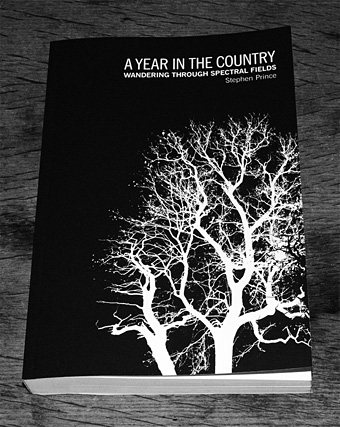
I kept intending to mention this before but the workload has been off the scale this year: all very stimulating but it’s been eating into my spare time. More about all of that later, for now there’s the new book from A Year In The Country’s Stephen Prince which was launched earlier this month in ebook form, and which will be available in print next month.

ayitc2.jpg

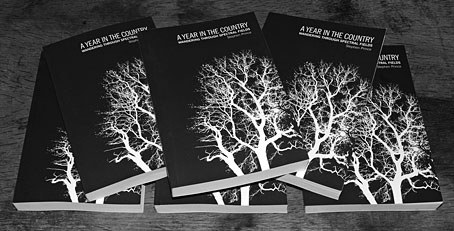
The book is a reworking of the Year In The Country website in printed form, hence the subtitle—”Journeys in Otherly Pastoralism, the Further Reaches of Folk and the Parallel Worlds of Hauntology”—and as such is very useful as a guide to the byways which the site has been exploring for the past few years. The folk-horror subgenre isn’t exactly unexplored today—the Folk Horror Revival book to which I contributed ran to 500 pages—but A Year In The Country has always had a broader reach, taking in related works in the music world, in science-fiction film and television, and in offshoots of science fact such as Cold War paranoia and nostalgia for the Space Race. I regard myself as being reasonably au fait with most of this material but there’s still a lot on the website (and now in the book) which I hadn’t come across before. There are no illustrations, unfortunately, but the website has recently been posting the missing pictorial content. A Year In The Country: Wandering Through Spectral Fields will be published on April 10th, and is available for pre-order here.

Previously on { feuilleton }
All The Merry Year Round
The Quietened Cosmologists
Undercurrents
From The Furthest Signals
The Restless Field
The Marks Upon The Land
The Forest / The Wald
The Quietened Bunker
Fractures
Folk Horror Revival: Field Studies

HR Giger’s Passagen

giger1.jpg

HR Giger’s art books were always very thorough in detailing all the media manifestations of the artist’s work, including film and television appearances. For years this presented tantalising questions, especially regarding the lengthy pre-Alien documentaries that were listed there: what were these films, and when would we get to see them? Giger’s Necronomicon (1976) did finally appear on YouTube a few years ago, and now here’s the second of the pair thanks to an upload of what appears to be a Japanese laserdisc.
giger2.jpg

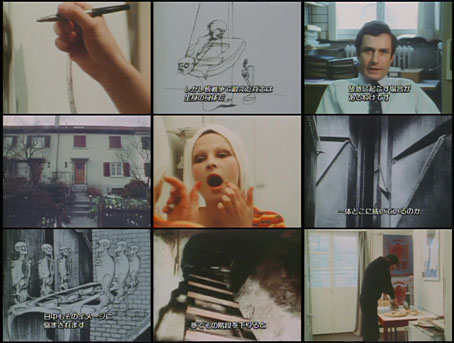
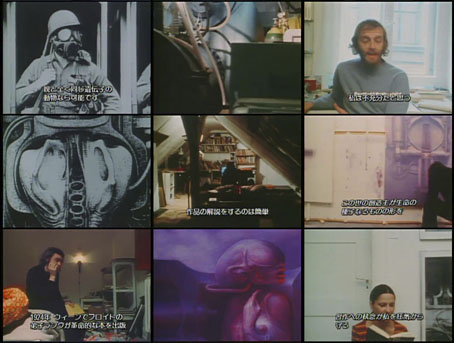
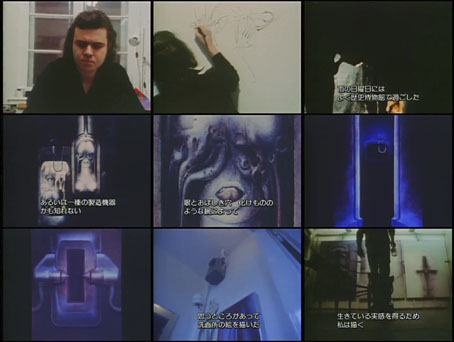
Passagen was made in 1972 by Giger’s friend Fredi M. Murer, their third film collaboration after Heimkiller and High (1967) and Swiss Made 2069 (1968). The latter (which Giger co-directed) is still frustratingly absent from the web, and similarly tantalising for being a 45-minute piece of underground science fiction which features Giger’s first production designs for cinema. Passagen was less ambitious, a 50-minute documentary about Giger’s work made for the German TV station, WDR. As a documentary it functions as a companion to Giger’s Necronomicon, while both films complement the subsequent art books, especially Giger’s Necronomicon (the book) which features many of the paintings seen in the films, together with anecdotes about their origins and inspiration. One of these anecdotes, about the nightmares induced in the young Hans Rudi by a stairway in the hotel next door to the Giger family home, is recounted in Passagen alongside the vertiginous drawings the nightmares inspired. It’s impossible to consider this piece of child psychology, and to watch the artist walking up and down stairs and stepladders, without recalling that Giger died after falling down a flight of stairs in 2014.
giger3.jpg

Giger’s Necronomicon is the more interesting of the two documentaries, especially now that the life and work is so well known; the art is taken more for granted, and we also get to see Giger at work on one of his big airbrush paintings. Passagen spends much of its time attempting to contextualise Giger’s drawings and paintings for an unwitting television audience, so a great deal of the running time is given over to newsreel footage of wars, riots, terrorism, atomic explosions and so on. A geneticist discusses the effects of atomic mutation while Giger’s earliest series of pictures, Atomkinder, is shown; psychoanalysts examine his paintings from a psychosexual angle.

Of more interest for Giger aficionados is the presence of his partner at the time, Li Tobler, the subject of several memorable portraits from this period. Among the working shots, the best shows Giger improvising a drawing with the same speed as Philippe Druillet in the Ô Sidarta film. Giger only started using an airbrush in 1972 so most of the works seen here are either early drawings or the paintings in the Passagen and Alptraum series, the style and colouring of which is much closer to the art world of 1972 than anything which would follow. For me the greatest revelation comes early on when Giger picks out a record to play while he’s working. The disc he chooses is just identifiable as Universal Consciousness by Alice Coltrane, an album which had been released the year before. (This isn’t the music heard on the soundtrack, however.) Alice Coltrane’s brand of ecstatic, pan-religious jazz would seem remote from Giger’s own universe but the choice isn’t so surprising if you know that he’d been a jazz enthusiast since the 1950s; in The Book of Alien (1979) his list of influences includes HP Lovecraft, John Coltrane and Miles Davis.

As is evident from the screen grabs, the film is hard-coded throughout with Japanese subtitles. Unlike Giger’s Necronomicon there’s no English overdub either, the soundtrack is in German throughout. I can’t complain when I’ve been waiting so long to be able to see this at all. For those who watched the later film divided into four YouTube clips there’s now a complete version (also Japanese but with English overdub) here.

Previously on { feuilleton }
Heimkiller and High
The Man Who Paints Monsters In The Night
Hans by Sibylle
HR Giger album covers
Giger’s Necronomicon
Dan O’Bannon, 1946–2009
Alejandro Jodorowsky’s Dune
The monstrous tome

Derek Jarman: Know What I Mean…

dj1.jpg

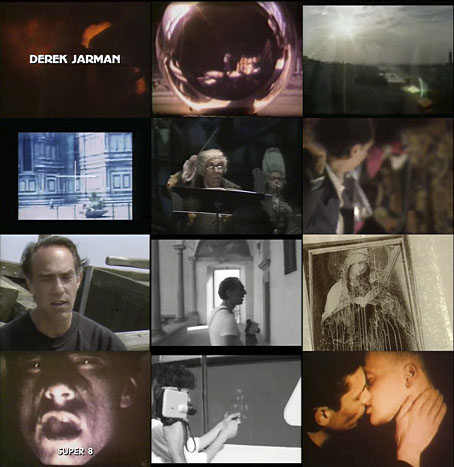
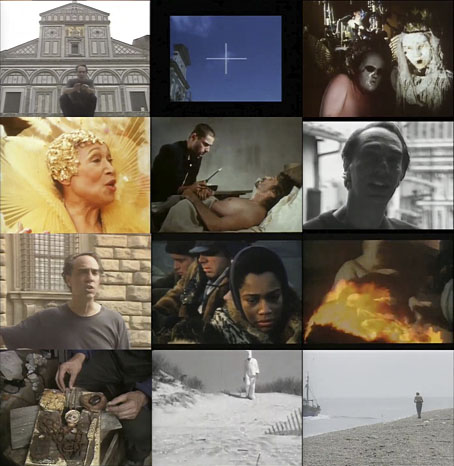
The recent news from the BFI about their forthcoming collections of Derek Jarman films sent me to YouTube once more in search of a documentary I’d been hoping to see again. Derek Jarman: Know What I Mean… is the film in question, and was posted a few months ago by director Laurens Postma on his own YouTube channel. Postma produced a number of arts features for Channel 4 (UK) in the 1980s, one of which, Six Into One: The Prisoner File, a documentary about the making of Patrick McGoohan’s The Prisoner, has been mentioned here already. The Jarman film was made in 1988, and I think was the first lengthy television examination of Jarman’s career. It’s still one of the best since the later documentaries tended to be either shortish interview sessions or posthumous works such as Derek (2008) by Isaac Julien and Bernard Rose.

dj2.jpg

Postma’s film captured Jarman shortly after he’d moved to his cottage at Dungeness, a relocation that was a kind of semi-retirement even though his films were becoming more visible as a result of funding and screening from Channel 4. This was also the period when he was becoming more vocally political thanks to what seemed at the time to be the unending reign of the iniquitous Margaret Thatcher. The Tories of the day had recently announced the now-infamous Section 28 of the 1988 Local Government Act (discussed in the film as both Clause 28 and—confusingly—Clause 29, the labels by which the amendment was first known), a ruling that forbid councils from promoting homosexuality, especially in schools. The late 80s saw the peaking of anti-gay bigotry in Britain, a reaction against the growing freedoms of the 1970s and, inevitably, the menace of AIDS which was still being regarded as “the gay plague”. Jarman had recently been diagnosed as HIV+, something he discusses here with typical good cheer although the conversation is generally more about art than his health, and about the way his own works were always related to gay sexuality. Jarman was one of many gay artists who welcomed their sexual identity as fixing them in the position of outsiders, and it’s notable how many of his films are concerned with outsider figures. When discussing The Tempest (1979) he compares Prospero’s island to gay sexuality, an uncharted enclave and a home to outcasts where different rules apply. This was still a common view among gay men and lesbians in the 1980s—Jarman’s friends in Coil used to say similar things in their interviews—and very different from today’s drive towards conformity and social assimilation. Postma’s film ends with Jarman on the beach at Dungeness, the perfect zone for a lifelong outsider, midway between the land and the sea.

(Note: the Winston Churchill referred to in the film is the grandson of the famous Prime Minister. Winston Churchill Jr. was an MP in the Thatcher government who tried to bring in a bill banning the public exhibition of “explicit homosexual acts” following Channel 4’s TV broadcast of Jarman’s Sebastiane.)

Previously on { feuilleton }
David Tibet meets Derek Jarman
Shooting the Hunter: a tribute to Derek Jarman
Derek Jarman’s landscapes
Derek Jarman album covers
Ostia, a film by Julian Cole
Derek Jarman In The Key Of Blue
The Dream Machine
Jarman (all this maddening beauty)
Sebastiane by Derek Jarman
A Journey to Avebury by Derek Jarman
Derek Jarman’s music videos
Derek Jarman’s Neutron
Mister Jarman, Mister Moore and Doctor Dee
The Tempest illustrated
In the Shadow of the Sun by Derek Jarman
Derek Jarman at the Serpentine
The Angelic Conversation
The life and work of Derek Jarman