Weekend links 485

jansson.jpg

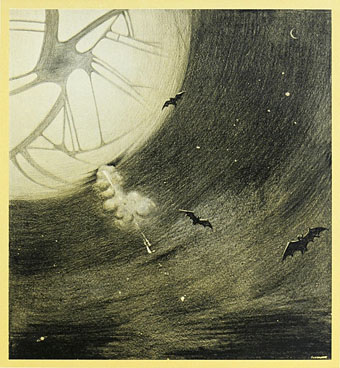
Art by Augustus Jansson for the Queen City Printing Ink Company (c.1906).

• Much of my music listening for the past couple of weeks has been the compositions and soundtracks of the late Jóhann Jóhannsson, so these links are pertinent: Jóhannsson and ensemble live at KEXP in 2010, and a memorial performance of Virdulegu Forsetar from last year.

• “[Her] approach to making electronic music was hard work, too, but it was less about controlling sounds and more about surrendering to them.” Geeta Dayal on Éliane Radigue whose Chry-Ptus has been reisssued by Important Records.

• Safe From Harm: Tim Murray on how Coil helped AIDS awareness on VHS. The video in question, The Gay Man’s Guide to Safer Sex, may be viewed at the Internet Archive.

• In the LRB podcast Ian Penman and Jennifer Hodgson discuss Penman’s new collection of essays, It Gets Me Home, This Curving Track.

• “A land of fog and emotional nightmares.” Oliver Wainwright on why Britain booted out the Bauhaus.

• Mapping Scotland’s Grim History of Witch-Hunting by Feargus O’Sullivan.

• Long-Haired Stars & the End of the World: John Boardley on comets.

My Will by Minimal Compact, a new version of an old song.

• La Danse Des Comètes (1970) by Nino Nardini | Kohoutek-Kometenmelodie 1 & 2 (1973) by Kraftwerk | Cometary Wailing (Valley Plateau) (1981) by Bernard Xolotl

The Gourmet by Kazuo Ishiguro

gourmet1.jpg

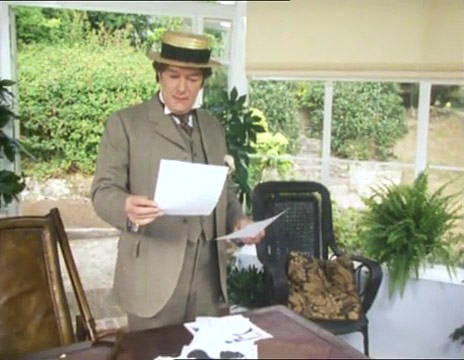
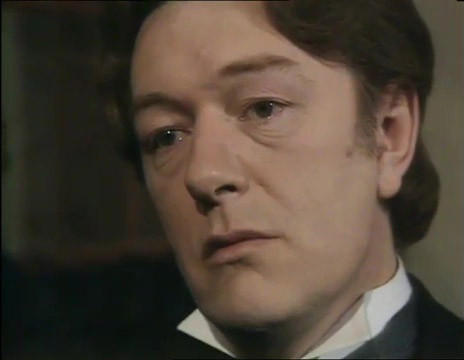
The Gourmet (1986), an original television drama written by Kazuo Ishiguro and directed by Michael Whyte, has long been in the top ten of TV films I was hoping would turn up on YouTube, and here it is at last. With a running time of under 50 minutes this is shorter than one-off dramas tend to be but its plus points are considerable, the first of which is its being an early yet neglected work by the Nobel Prize-winning author. The gourmet of the title is Manley Kingston, played by the inimitable Charles Gray in one of his few leading roles. Gray inhabits the part of the preoccupied and obsessed Kingston so well the character might have been created with him in mind; he’s even more imperious and commanding here than he was as Mycroft Holmes in the Granada TV Sherlock Holmes adaptations being made around the same time.

gourmet2.jpg

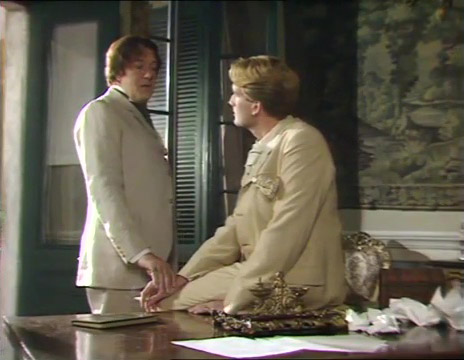
Ishiguro’s script presents us with a world of competitive international gourmets whose palettes are so jaded that their search for new tastes propels them to increasingly outré extremes, up to and including the consumption of human flesh. In a lesser drama this might be the shocking end revelation but the long-pig scene is a brief and wordless reminiscence on the way to Kingston’s ultimate gustatory experience, the devouring of a ghost. The film is almost worth watching solely for the moment when Gray enunciates the words “Not of this Earth?!” after being informed of the spectral meal by one of his gourmet associates. Another associate, played by David Rappaport (in an upper-class role for once, albeit with a dubbed voice), provides Kingston with the directions to a church where a suitable phantom may be found. The building isn’t identified but Hawksmoor aficionados will recognise it as St. George in the East, an apt location not only for the sinister quality the Hawksmoor churches acquired in the wake of Peter Ackroyd’s celebrated novel, but also for the building’s smaller towers which are always described as resembling pepper pots. I used to think the Hawksmoor church was a coincidental choice of location but Ackroyd’s novel had been discussed and partly dramatised on The South Bank Show the year before The Gourmet was made; the actor who played the architect’s hapless assistant in the dramatisation was Mick Ford, the same actor who appears in The Gourmet as a homeless man enjoined by Kingston to assist him in his ghost-catching ritual.

gourmet3.jpg

Despite its grotesque elements, The Gourmet isn’t an overt work of horror, which no doubt explains why the film is never mentioned in lists of neglected TV dramas. Watching it again I was less interested in the genre elements than the interplay between Kingston’s abstracted fervour and the human beings he ignores while pursuing his quarry. The latter encompasses the fellow gourmets who regard him as a world authority, his wife (who he doesn’t kiss when he leaves the house), his chauffeur (whose name he never remembers), and the derelicts who are also led to the church by hunger, queuing for a bowl of soup and a bunk in the crypt. Seen today, the gulf of inequality, and the self-indulgence of Kingston’s pursuit for the rarest of foods while people around him are starving, may be taken as a critique of Thatcherism as well as a foretaste of the future. The scenes outside the church show the East End of London as it was before its ongoing and unending redevelopment, when a new breed of rapacious appetites would arrive to sweep the homeless from those desirable riverside properties. The real ghost-eaters, the devourers of London’s history, have been consuming the capital ever since. (Thanks to Amelia for alerting me to this!)

Previously on { feuilleton }
Terror and Magnificence

Weekend links 481

gaussot.jpg

L’Hamestoque (1977) by Christine Gaussot.

• Another announcement from Strange Attractor Press: Of Mud & Flame: A Penda’s Fen Sourcebook edited by Matthew Harle and James Machin will be published at the end of October. Among the contents will be the screenplay of David Rudkin’s cult television play, an item that’s always been impossible to find in print.

• A trailer for Journey to the Beginning of Time (1955), another semi-animated fantasy film by Karel Zeman which will released on disc next month by Second Run.

• “There was craziness in getting lost and dizzy.” Stereolab choose favourite songs from their back catalogue.

E=MC² (1976), an album of spacey jazz-electronica by Teddy Lasry which has never been reissued.

• “Why do so many book covers look the same? Blame Getty Images,” says Cory Matteson.

• Mix of the week: The Ephemeral Man’s Teapot by The Ephemeral Man.

Masataka Nakano has been photographing a deserted Tokyo for almost 30 years.

• Beyond the bounds of depravity: an oral history of David Cronenberg’s Crash.

Woodblocks in Wonderland: The Japanese Fairy Tale Series.

• A new novel by M. John Harrison is always a good thing.

Hamid Drake‘s favourite music.

Warm Leatherette (1980) by Grace Jones | Crash (1980) by Tuxedomoon | A Crash At Every Speed (1994) by Disco Inferno

Echoes And Reverberations

echoes.jpg

Echoes And Reverberations, the latest themed collection of music presented by A Year In The Country, has a title that might refer to the Hauntological idiom in general. Not so much nostalgia, more the refashioning of memories, or imagined remembrances of the past, into something new.

Echoes And Reverberations is a field recording-based mapping of real and imaginary film and television locations.

It is in part an exploration of their fictional counterparts’ themes; from apocalyptic tales to never-were documentaries and phantasmagorical government-commissioned instructional films via stories of conflicting mystical forces of the past and present, scientific experiments gone wrong and unleashed on the world, the discovery of buried ancient objects and the reawakening of their malignant alien influence, progressive struggles in a world of hidebound rural tradition and the once optimism of post-war new town modernism.

Track list:
1) Grey Frequency—King Penda
2) Pulselovers—The Edge Of The Cloud
3) Dom Cooper—What Has Been Uncovered Is Evil
4) Listening Center—From Bull Island To Avondale
5) Howlround—Smashing
6) A Year In The Country—Not A Playground
7) Sproatly Smith—Gone Away
8) Field Lines Cartographer—Mr Scarecrow
9) Depatterning—The Ogham Stones
10) The Heartwood Institute—Ribble Head Viaduct

Using field recordings as a basis for music or sound art is as old as musique concrète, but the processes of Pierre Schaeffer and his followers were cumbersome and limited, and the results were invariably placed in the frame of Serious Music. The limitations of the approach can be seen in how quickly this avenue of exploration ran its course. It’s taken the flexibility and widespread use of digital sound tools to revitalise a moribund form to a degree that an acclaimed TV series like Chernobyl can use field recordings for a score (by Hildur Guðnadóttir) that matched the power of the on-screen drama.

The first piece in Echoes And Reverberations, King Penda, immediately caught my attention for the reference to David Rudkin’s Penda’s Fen, another TV drama with notable sound design by Paddy Kingsland of the Radiophonic Workshop. I thought the industrial thuds and clangs summoned by Grey Frequency might be taken from the scene where Stephen and his mother travel into Birmingham, but the release notes reveal that the sound source is the church where Stephen plays the organ, and in a later scene experiences a different kind of summoning. Whatever the source, the suggestion of menace suits a film whose transcendent message has to rise through an atmosphere of oppressive malevolence.

The Radiophonic Workshop is the ghost at this particular feast, unsurprisingly when the majority of the pieces are based on film and TV dramas from the Workshop’s golden decade, the 1970s: Flambards (The Edge Of The Cloud by Pulselovers, a beautiful piece of solo violin and piano with birdsong accompaniment); Survivors (Gone Away, a brittle instrumental by Sproatly Smith); and No Blade of Grass (Ribble Head Viaduct by The Heartwood Institute, a lumbering theme for one of the many angry and violent apocalypse films of the 70s). Of the other pieces Dom Cooper’s What Has Been Uncovered Is Evil takes the Hammer film of Quatermass and the Pit as its focus, creating a soundscape of sinister electronics in a nod to Tristram Carey’s Martian soundtrack, while the equally sinister electronics of Field Lines Cartographer’s Mr Scarecrow follows Stephen Gallagher’s gene-splicing thriller, Chimera, to the rain-drenched Lake District. The shadows of disaster lying over this release feel uncomfortably timely when the past week in Britain saw a heatwave like something from The Day the Earth Caught Fire, while this week we’ve had a village evacuated after torrential rains have threatened a dam with collapse, and an announcement from China about “hybrid chimeras“.

Echoes And Reverberations will be released on 16th August, and is available for pre-order now.

Previously on { feuilleton }
The Watchers
The Corn Mother
The Quietened Mechanisms
The Shildam Hall Tapes
Audio Albion
A Year In The Country: the book
All The Merry Year Round
The Quietened Cosmologists
Undercurrents
From The Furthest Signals
The Restless Field
The Marks Upon The Land
The Forest / The Wald
The Quietened Bunker
Fractures

Weekend links 473

spectra.jpg

“Spectra of various light sources, solar, stellar, metallic, gaseous, electric”, print by René Henri Digeon; plate IV in Les phénomènes de la physique (1868).

• More polari: Thom Cuell this time with another review of Fabulosa!: The Story of Polari by Paul Baker. Good as it is to see these articles, one thing they all share is paying tribute to the polari-enriched radio series Round the Horne without crediting its writers, Barry Took and Marty Feldman.

• “…with its conspiracy theories, babbling demagogues and demonised minorities, Bahr’s investigation is sadly all too relevant today.” Antisemitism (1894) by Hermann Bahr, is the latest new translation from Rixdorf Editions.

Isao Tomita in 1978 showing a presenter from NHK around his tiny studio. Japanese-only but the discussion reveals that the words “synthesizer”, “tape recorder” and “mixer” sound the same as they do in English.

Ben Frost talks to Patrick Clarke about his music for German TV series, Dark.

• PYUR composes a guide through limbo with Oratorio For The Underworld.

• Steven Heller on Don Wall’s book design for a Paolo Soleri retrospective.

• Coming soon from Fulgur Press: Ira Cohen: Into the Mylar Chamber.

Will Harris compiles an oral history of Q: The Winged Serpent.

• Mix of the week: a mix for The Wire by Overlook.

• At Dennis Cooper’s: Magic Shop Internationale.

Shadow In Twilight by Pram.

The Feathered Serpent Of The Aztecs (1960) by Les Baxter | The Serpent (In Quicksilver) (1981) by Harold Budd | Black Jewelled Serpent Of Sound (1986) by The Dukes Of Stratosphear