The Marvellous

melly.jpg

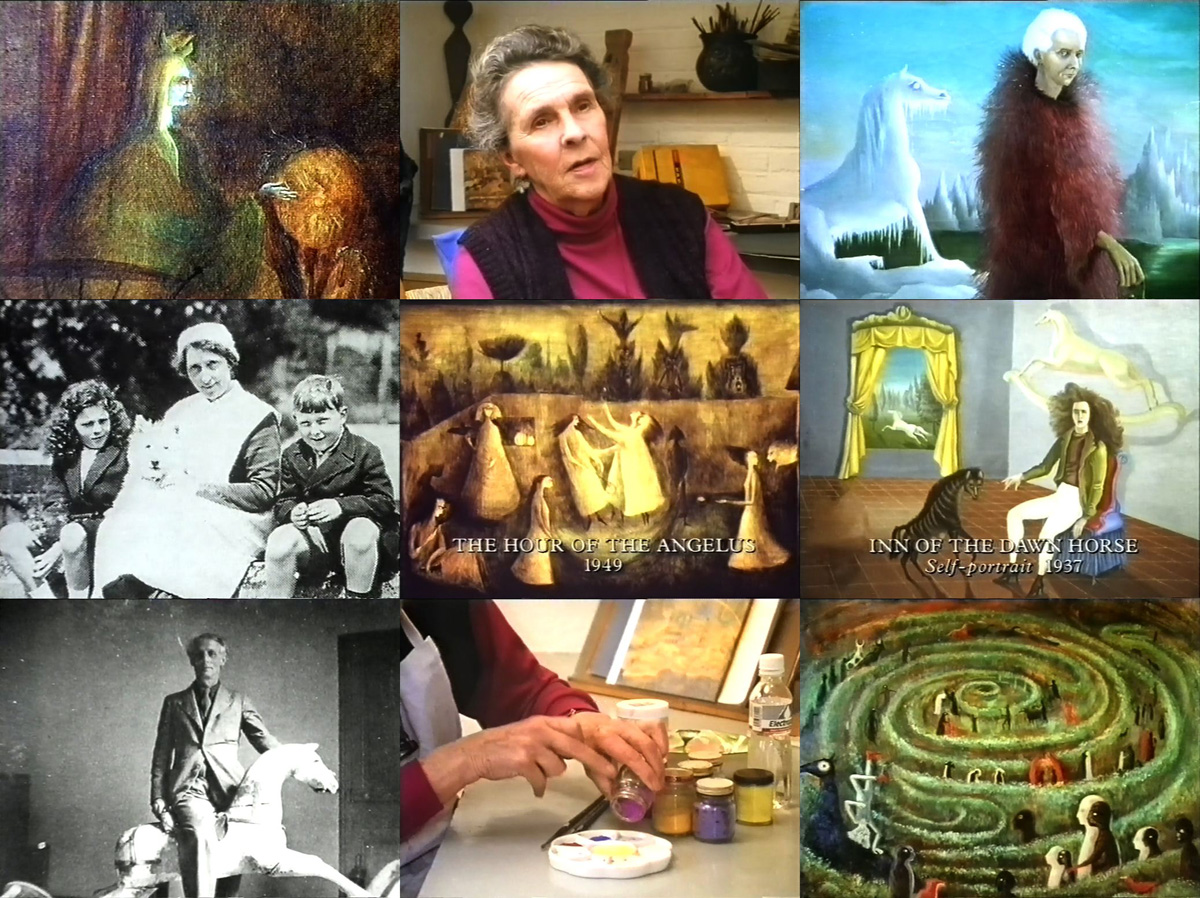
The marvellous is always beautiful. Anything marvellous is beautiful. In fact only the marvellous is beautiful.

George Melly (above) quoting André Breton’s declaration from the first Surrealist Manifesto, 1924

Two posts in one week—quelle surprise. This is partly because I’m trying to get WordPress to post updates to Twitter, something that hasn’t been possible for many years without going through the long-winded process of signing up as a Twitter developer. Anything that limits my involvement with Twitter’s burning café feels like a positive thing at the moment, so thoughts that I previously cast into the flames may find their expression here instead.

svankmajer.jpg

The two screengrabs are from recent re-viewings. George Melly’s short guide to Surrealism for the BBC’s Arena, and Jan Švankmajer’s equally short BBC profile have both been featured here in the past, but my recent purchase of a box of blu-rays from Švankmajer’s shop has prompted a journey back into the Surrealist praxis via whatever books and videos I have to hand. It’s been interesting looking again at René Passeron’s Encyclopedia of Surrealism (1975), a book which for many years was more interesting for the 24-page section devoted to the precursors of Surrealism, all the artist-eccentrics, architects, illustrators, Mannerists, and (especially) the Symbolists whose works I spent most of the 1980s pursuing. Today there are more threads to be followed in the Surrealist section of Passeron’s study so I’m looking forward to seeing where they lead. As for The Marvellous, the Švankmajer discs are this with and without the capital “M”. I recommend them.

Update: And the post didn’t announce itself at Twitter which isn’t so surprising; I’ll keep working at this behind the scenes. Social media is the anti-Marvellous.

Weekend links 519

minotaure.jpg

Cover of Minotaure no. 8 (1936) by Salvador Dalí.

• At Dangerous Minds: Irmin Schmidt talks to Oliver Hall about his new album of prepared piano, Nocturne, and also reveals more about the planned release of live recordings by Can.

• “Even the most zealous fan of the genre can learn something new from this book,” says Geeta Dayal in a review of Bring That Beat Back: How Sampling Built Hip-Hop, by Nate Patrin.

• The subject of a previous post but the video was later removed: Italo Calvino in a rare documentary feature for an English audience, on the BBC’s Bookmark in 1985.

• On 9th May, carillonneur Malgosia Fiebig played The Model by Kraftwerk on the bells of the Dom Tower in Utrecht as a tribute to the late Florian Schneider.

• Film footage of Alice Coltrane in her prime is a rare thing so even 17 minutes of TV from 1970 is something special.

Dan Reynolds on the fantastic alphabets designed by Jean Midolle. See also Luc Devroye’s page.

• Mix of the week: Jon Hassell tribute, part 1: Jon and his collaborators, by Dave Maier.

Nicolas Winding Refn on some of the films he’s been watching during lockdown.

• At Haute Macabre: Surrealist décor and tiny secret drawers.

HP Lovecraft dreams of a Providence trolley car in 1927.

The Museum of Ridiculously Interesting Things

Xerrox Voyage, a new recording by Alva Noto.

• At Dennis Cooper’s: Jean-Pierre Léaud Day.

The Model (1979) by Snakefinger | Model (1992) by The Balanescu Quartet | Das Modell (1997) by Rammstein

Weekend links 517

magritte.jpg

Edward James by René Magritte; La Reproduction Interdite (1937).

• “James was filmed in the late 1970s, striding round Las Pozas in a sweater and a tattered dressing-gown, surmounted by parrots (The Secret Life of Edward James can be seen on YouTube). When asked what motivated him, he replied: ‘Pure megalomania!’ He was having his second childhood, he said, though he wasn’t sure the first had ever ended.” Mike Jay on lifelong Surrealist, Edward James (1907–1984), and the concrete fantasia he built in the Mexican jungle.

• “I found the roots of electronic music in a cupboard!” Musician Paul Purgas (one half of Emptyset) on the discovery of early electronic music from India’s National Institute Of Design. Related: Purgas talks about his discovery with Patrick Clarke.

• RIP Phil May. Here’s The Pretty Things in their guise as psych band “Electric Banana” for an appearance in What’s Good for the Goose (1969). A decent moment in an otherwise terrible film.

• Music is a memory machine: David Toop explores how the transmission of music between disparate cultures can be a tool against populism and prejudice.

• Kraftwerk’s remarkable journey, and where it took us: Bob Boilen and Geeta Dayal discuss the tanzmusik of Düsseldorf.

• At Dangerous Minds: Acid Drag & Sexual Anarchy: Fifty years ago The Cockettes turned drag upside down.

Hua Hsu on the secret lives of fungi: “They shape the world—and offer lessons for how to live in it”.

• The great writer who never wrote: Emma Garman on the flamboyant Stephen Tennant.

• Cult 1998 PlayStation game LSD: Dream Emulator is finally playable in English.

Jim Jupp of Ghost Box records talks about the Intermission compilation album.

Jonathan Moodie on psychoactive cinema and sacred animation.

Alex Barrett on where to begin with Akira Kurosawa.

• At Dennis Cooper’s: Skeletons.

Skeleton Makes Good (1982) by Captain Beefheart & The Magic Band | Red Skeletons (1996) by Coil | Kids Will Be Skeletons (2003) by Mogwai

Weekend links 516

correa.jpg

Bats in space: an illustration by Henrique Alvim Corrêa from a 1906 edition of The War of the Worlds.

• Auf wiedersehen to Florian Schneider. Until he left Kraftwerk in 2009 (or 2006 or whenever it was), Schneider had been the group’s longest-serving member, keeping things running for the few months in 1971 when Ralf Hütter was absent. The brief period when Kraftwerk was Schneider plus soon-to-be-Neu! (Michael Rother, guitar, and Klaus Dinger, drums) fascinates aficionados over-familiar with the later albums. The music they produced was a wild and aggressive take on the rock idiom but Scheider maintained the link with Kraftwerk before and after, not only instrumentally but with his ubiquitous traffic cones, as noted in this post. There’s no need for me to praise Kraftwerk any more than usual, this blog has featured at least one dedicated post about them for every year of its existence, and besides which, the group itself is still active. Elsewhere: Simon Reynolds on how Florian Schneider and Kraftwerk created pop’s future; A Kraftwerk Baker’s Dozen Special; Dave Simpson attempts to rank 30 Kraftwerk songs (good luck getting anyone to agree with this); Jude Rogers with ten things you (possibly) don’t know about Kraftwerk; Dancing to Numbers by Owen Hatherley; Pocket Calculator in five languages; Florian Schneider talks about Stop Plastic Pollution.

Intermission is a new digital compilation from Ghost Box records featuring “preview tracks from forthcoming releases and material especially recorded for the compilation during the global lockdown”. In a choice of two editions, one of which helps fund Médecins Sans Frontières.

• How groundbreaking design weirdness transformed record label United Artists, against all odds. By Jeremy Allan.

Sex in an American suburb is not quite the same phenomenon as sex in, say, an eastern European apartment block, and sex scenes can do a great deal to illuminate the social and historical forces that make the difference. All of which is to say that sex is a kind of crucible of humanness, and so the question isn’t so much why one would write about sex, as why one would write about anything else.

And yet, of course, we are asked why we write about sex. The biggest surprise of publishing my first novel, What Belongs to You was how much people wanted to talk about the sex in a book that, by any reasonable standard, has very little sex in it. That two or three short scenes of sex between men was the occasion of so much comment said more about mainstream publishing in 2016, I think, than it did about my book. In fact, in terms of exploring the potential for sex in fiction, I felt that I hadn’t gone nearly far enough. I’ve tried to go much further in my second novel, Cleanness. In two of its chapters, I wanted to push explicitness as far as I could; I wanted to see if I could write something that could be 100% pornographic and 100% high art.

Garth Greenwell on sex in literature

James Balmont’s guide to Shinya Tsukamoto, “Japan’s Greatest Cult Filmmaker”.

• A Dandy’s Guide to Decadent Self-Isolation by Samuel Rutter.

Maya-Roisin Slater on where to begin with Laurie Anderson.

• The Count of 13: Ramsey Campbell’s Weird Selection.

Adam Scovell on where to begin with Nigel Kneale.

When John Waters met Little Richard (RIP).

RB Russell on collecting Robert Aickman.

Weird writers recommend weird films.

Campo Grafico 1933/1939.

Ruckzuck (1970) by Kraftwerk | V-2 Schneider (1977) by David Bowie | V-2 Schneider (1997) by Philip Glass

Oscar (1985)

oscar1.jpg

I’ve mentioned John Hawkesworth’s three-hour television biography of Oscar Wilde in previous Wilde-related posts, but was never able to point to a viewable copy until now. Oscar was broadcast by the BBC in three parts in 1985, and if it was ever shown again I don’t recall it; I certainly missed capturing it on tape. This was frustrating because I always remembered Michael Gambon’s portrayal of Wilde as being the best I’d seen, but the only reissues for home viewing were long-deleted tapes and discs produced for other countries. Having watched the drama again I’m pleased to find it as good as I remembered, possibly more so since I’ve read a several Wilde biographies in the interim so I’m better able to judge its accuracy.

oscar2.jpg

Oscar examining Aubrey Beardsley’s Salomé illustrations.

As a writer and TV producer John Hawkesworth specialised in period drama, creating and writing episodes for The Duchess of Duke Street, Danger UXB (about wartime bomb disposal), and the celebrated Granada TV Sherlock Holmes series featuring Jeremy Brett’s definitive portrayal of the detective. Oscar was based on biographical books by H. Montgomery Hyde, an MP who lost his seat for his campaigns in the late 1950s and 1960s against the British laws forbidding homosexual acts. Knowing this it’s significant that Hawkesworth’s opening scene in the first episode is a brief parliamentary discussion about the notorious Labouchere Amendment of 1885 (“The Blackmailer’s Charter”) which the narrator informs us would send Oscar Wilde to prison ten years later. Hawkesworth divides his drama into three distinct phases: Gilded Youth (concerning Wilde’s relationship with Alfred Douglas, his artistic success and the ire of the Marquess of Queensberry); Trials (the personal as well as legal variety); and De Profundis (imprisonment and its aftermath).

oscar3.jpg

In the dock at the Old Bailey.

The arc of tragedy is a familiar one, of course, but other dramatisations are seldom as well-balanced as here. Feature films about Oscar Wilde generally have shorter running times so devote their larger budgets to a recreation of the glamorous fin-de-siècle rise and the terrible downfall. Oscar is a typical BBC production of the period, mostly recorded on video in studio sets with occasional film work for exteriors. What we see of Victorian London appears sparse compared to the Sherlock Holmes episodes which were being filmed at this time. Hawkesworth may have been restricted by budget but three hours allows him to pay greater attention to the later episodes, especially the courtroom scenes. Oscar was the first screen biography to include the discussion of sexual details during the trial, as well as to show Wilde alone with a naked boy. This was a considerable advance at a time when gay sex of any kind was a rare sight on British television, and when even the straight variety could cause problems, as it did for Gambon and co. a year later when Dennis Potter’s The Singing Detective inspired the contemptible Mary Whitehouse to complain to the BBC. Hawkesworth also runs through the later years to the very end, a period of decline usually avoided or, as in Brian Gilbert’s Wilde (1997), disingenuously truncated so as to provide a “happy” resolution. Given this, I would have preferred some of the earlier scenes to be longer and to offer a sense of Wilde’s status as a serious thinker about art and aesthetics. Wilde’s flamboyant persona made him famous but he was influential not for his dandyish manner but for his ideas and their articulation in essays, lectures and the plays; his aesthetic theories were the foundation of all his writing. The most famous line from his final poem is a statement of philosophic principle: “Yet each man kills the thing he loves”.

oscar4.jpg

Oscar and Bosie.

Aesthetics aside, the public perception of Oscar Wilde presents a hurdle for dramatisations which risk resurrecting the caricatures that flourished while Wilde was alive. Michael Gambon’s performance shows Wilde as a human being, not merely a charming dispenser of witty aphorisms. This has always seemed to me crucial for any actor; it’s not enough to merely look like Wilde—as Robert Morley and Stephen Fry did—but you have to be able to convey the horrors, the indignity (and, with regard to his wife, the culpability) of his later years. Stephen Fry is a good comic actor but he never could have played the Singing Detective. Gambon’s seductively purring voice is another plus, and he even allows a hint Irish brogue to slip through now and then. Of the other actors, Robin Lermitte looks more like Alfred Douglas than does Jude Law in Brian Gilbert’s film, but Law is better at conveying Bosie’s mercurial and tempestuous character; likewise Tom Wilkinson made the Marquess of Queensbury seem a little more human in Gilbert’s version, at least in the beginning, whereas Norman Rodway presents the man from the outset as a perpetually furious goblin. Missing from Hawkesworth’s drama are Wilde’s good friend Ada Leverson, and his mother, Speranza, whose urging him to stand tall and remain in England when the police were coming for him was one of the factors that sealed his fate.

Oscar may be seen here: Part One | Part Two | Part Three

For now, and possibly the foreseeable future, this is the only way to see this drama so I’d suggest downloading it if you can. It’s a rare work that could easily vanish once again.

Elsewhere on { feuilleton }
The Oscar Wilde archive

Previously on { feuilleton }
The Importance of Being Oscar