Televisual art

sotn1.jpg

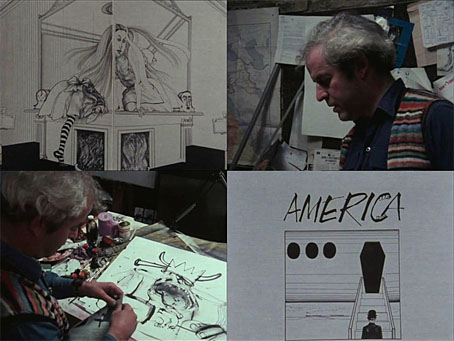
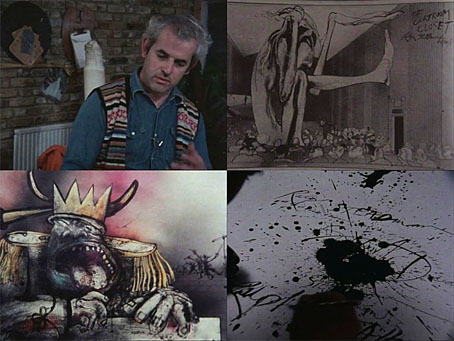
A few words of praise for The Shock of the New, Robert Hughes’ eight-part TV series about art in the 20th century. Not that it’s ever been lacking in praise—it was lauded from the outset back in 1980—but, having read the book of the series twice, then dipped back into it on regular occasions, it occurred to me recently that I’d not seen the series itself for a very long time.

If you don’t know—and is anyone today really unaware of this?—Hughes was commissioned by the BBC and his employers at TIME magazine to travel the world presenting a history of modern art from the 1880s to the end of the 1970s. The series was part of a run of costly co-productions that flattered viewers with colour television sets (still a luxury item in the UK) while engaging the intellect; Kenneth Clarke’s Civilisation, Jacob Bronowski’s The Ascent of Man and David Attenborough’s Life on Earth established the template that Hughes was required to follow. If you have the time and the money, the globetrotting is the easy part of an enterprise such as this. Much more difficult is making sense of the increasingly fragmented development of art in a century of two world wars and rapid technological change. Hughes did this by selecting a single route of evolution for each episode, often missing out significant artists or entire movements, then winding back the clock in the following episode to trace a different route that included the neglected names. Some of them, anyway. In the introduction to the book he admits the difficulty of trying to summarise a century of complex aesthetic activity and philosophy in a mere eight hours. The book is inevitably much more thorough, making the TV series seem like a sketch beside it; but there are good sketches and bad ones, and this one is exceptional.

sotn2.jpg

Hughes had an enviable talent for lucid explanation, an ability to tell you what was important about an artist or an idiom or an artistic development in a few simple, memorable sentences, free of jargon or the obfuscation that bedevils art criticism. This is best seen in his collected reviews from TIME magazine, Nothing if Not Critical (1991), which offers bite-sized appraisals of individual artists or group shows, from the Renaissance to the present day. Difficult to do well when you’re limited to a few hundred words, near impossible when you have to explain something using a minimum of words while simultaneously talking to a camera and walking down a busy Paris street. Some of his statements, like the following one, have been lodged in my memory for years:

A Rodin in a parking lot is still a misplaced Rodin, but this in a parking lot is just bricks.

“This” being Carl Andre’s oblong of 120 firebricks, Equivalent VIII, a minimalist sculpture that caused a huff of outrage from the philistine British tabloids in the 1970s. Hughes’ comment occurs when he examines the way that galleries in the same decade became frames for creations such as Andre’s, works that wouldn’t be recognised as art without the building they were situated in.

sotn3.jpg

The explication is very familiar but I’d forgotten about all the foreign travel. This seems profligate at times although it’s only the same as David Attenborough flying to a remote jungle to film a lemur or a lizard. Paintings and sculptures seen in their natural habitats, as it were, together with the locations that inspired them: van Gogh’s Arles, Matisse’s Côte d’Azur, de Chirico’s Turin, and so on. One of the axioms of Hughes’ criticism, repeated here as elsewhere, was that art has to be studied in situ, not appraised via mediated representations, whether that means halftone dots in a book, 16mm film delivered by cathode ray tube, or a gallery website. It’s an attitude I sympathise with even though I don’t visit galleries very often. Sculptures have a physical presence that doesn’t reproduce at all, while paintings are more subtle or more dramatic or more detailed or more dimensioned when you’re standing in front of them. Piranesi’s prints are big; William Blake’s paintings are very small; Max Ernst’s engraving collages are not only smaller than you expect but they’re also toned by age; Picasso’s canvases reveal the direction his brush was travelling when he painted a line in a single stroke…

sotn4.jpg

Hughes and Complex One, an artwork that few people are allowed to visit.

Something else I’d forgotten about was the artist interviews in the later programmes, especially those with land artists Michael Heizer and Walter De Maria. The final episode in the series examines the collapse of the idea of the avant-garde, with land art being presented as work that can’t be bought by wealthy collectors or appropriated by mass media. Hughes treks into the Nevada desert to see Heizer’s Complex One which at the time was all that existed of the massive site known today as City; Walter De Maria is seen walking through The Lightning Field in New Mexico accompanied by synthesizer chords from Jean-Michel Jarre’s Equinoxe. Electronic music abounds in this series, from Peter Howell’s clanging Radiophonic theme, to extracts from albums by Tangerine Dream and Brian Eno, Music For Films being a popular choice with TV producers at the time. It’s notable that the phrase “the shock of the new” only occurs once, near the very end, possibly as a capitulation to the BBC who Hughes says chose the title for him. In a later book, Things I Didn’t Know: A Memoir (2006), you’ll find another of those memorable statements:

Some new works of art have values of some kind or another. Others, the majority, have little or none. But newness as such, in art, is never a value.

I’m following this with a re-viewing of Hughes’ multi-part American Visions (1996), a history of American culture that I’ve not seen since its first broadcast. The Shock of the New is all over YouTube if you require it, also at the Internet Archive. The series took three years to create and was broadcast at 8:00pm on Sunday evenings to an audience of millions. They really don’t make them like this any more.

Previously on { feuilleton }
Robert Hughes, 1938–2012
Land art

Something Rich and Strange: The Life and Music of Iannis Xenakis

xenakis1.jpg

In the days before our present age of cultural plenitude, recordings by Greek composer Iannis Xenakis weren’t always easy to find. My haphazard introduction to contemporary composition came via record libraries and secondhand shops but even in these havens of obscurity discs of Xenakis music remained frustratingly elusive. Today I do own a few Xenakis CDs but there’s still a large portion of his work that I’ve yet to hear. After watching Mark Kidel’s documentary I’m persuaded once again that the gaps in my listening ought to be filled.

20th-century composition can be intimidating to the unitiated. Intimidating to listen to when so much of it is about finding new sounds, new structures, new modes of performance; and intimidating to read about when the discussion involves the analysis of very cerebral or technical conceptions. It can also disappoint when the results of those conceptions fail to hold the attention or excite the emotions. Many Xenakis compositions had their origin in mathematics or scientific theory but the musical results are consistently powerful and dramatic, even unnerving in a manner familiar from the works of Penderecki and Scelsi.

xenakis2.jpg

Mark Kidel’s hour-long documentary gives a small taste of the musical power and drama, especially in Roger Woodward’s performance of Eonta, a short composition for solo piano that’s astonishing to hear and see. Something Rich and Strange was made for the BBC in 1990 but it’s one I missed on its original broadcast so it’s good to find in a quality copy on the director’s Vimeo pages. The note there describes the film as a definitive portrait which sounds like a boast but there aren’t many Xenakis documentaries to choose from and it is very good, if a little too short for its subject. The film follows the composer and his wife, Françoise, as they journey to the Greek island of Spetsai where Xenakis spent several years at school in the 1930s. His reminiscences (or refusal of them) are interwoven with a sketch of his remarkable life which in its early years involved fighting with the Greek Resistance during the Second World War (and losing the sight in one eye as a result), fleeing to Paris in the post-war period after being condemned to death in absentia by the authoritarian Greek government, and working as an architect with Le Corbusier in the 1950s before deciding to devote the rest of his life to music. Kidel’s views of the Greek landscape wordlessly demonstrate the parallels between Xenakis’s music and the sounds of that landscape—goat bells, water lapping in a cave, a priest hammering a piece of wood—but we don’t hear much discussion of the composer’s musical evolution. His interest in electronic music, for example, is briefly mentioned but dismissed as being a direction he was unwilling to follow. But it was a direction he followed intermittently for at least a decade, and his electronic compositions would occupy several hours of your time if listened to in sequence. That’s the problem with trying to sum up a diverse career within the bite-sized limits of broadcast media; if the film was longer there would have been more time to address both the life and the details of the work. As it is, this is still an excellent introduction to a great composer.

Previously on { feuilleton }
Vasarely, a film by Peter Kassovitz
A playlist for Halloween: Orchestral and electro-acoustic

Weekend links 607

cadmus.jpg

Jerry (1931) by Paul Cadmus.

• “I wanted to photograph naked young men as opulently and as attentively as those professional ladies appearing in Playboy-type magazines.” RIP James Bidgood, photographer and director of no-budget gay-porn classic Pink Narcissus. Also in the obituary notices this week: Monica Vitti and John Appleton, composer of electronic music and inventor of the Synclavier sampling keyboard.

• “…the Sola Busca deck is limited in its use for divinatory purposes today, and yet, since its enigmatic imagery irresistibly invites decoding, the deck nonetheless beckons twenty-first century cartomancers into a game of high imagination.” Kevin Dann on the mysteries of the world’s oldest complete Tarot deck.

• “This Missouri company still makes cassette tapes, and they are flying off the factory floor.” Jennifer Billock reports.

He attended to his own talent, not in the interest of bombast or self-aggrandisement, but rather like a faithful watchman. He had the fixity of the great and therefore no need of vanity. He estimated that three shillings would be a reasonable price for Ulysses. A tiresome book, he admitted. At the same time he was dogged by fear that the printing house would be burnt down or that some untoward catastrophe would happen. He assisted Miss Beach in wrapping the copies, he autographed the deluxe editions, he wrote to influential people, he hawked packages to the post office. He knew that the illustrati would change their minds many a time before settling down to a final opinion and that many another would know as much about it as the parliamentary side of his arse.

Edna O’Brien on James Joyce

• At Wormwoodiana: Mark Valentine on The Secret Glory by Arthur Machen, another novel now in its centenary year.

• At Aquarium Drunkard: It Is Not My Music, (1978) an hour-long Swedish TV documentary about Don Cherry.

• At Bandcamp: The transportive psychedelia of Moon Glyph records.

• Mix of the week: Fact Mix 844 by A Psychic Yes.

• Steven Heller’s font of the month is Show.

• At Dennis Cooper’s: Guitar.

Mumblin’ Guitar (1960) by Bo Diddley | Electric Guitar (1979) by Talking Heads | Impossible Guitar (1982) by Phil Manzanera

Weekend links 605

ufo.jpg

UFO Mk2 (1967), a poster for the UFO club by Hapshash and the Coloured Coat (Michael English & Nigel Waymouth).

• Link of the week without a doubt is Yuka Fujii’s raw video footage of the sessions for David Sylvian’s solo debut, Brilliant Trees, which includes appearances by Jon Hassell, Holger Czukay and Ryuichi Sakamoto. Czukay’s contribution to this and other albums in the 1980s included the use of a second-hand IBM Dictaphone, a machine which was often credited on album sleeves but seldom discussed in interviews beyond Czukay’s claims that it was a superior sound-sampling tool. You can see the mysterious “instrument” in this film and discover (at last!) more about the machine here. Big thanks to Colin for the tip!

• “Part of what makes watching it so compelling now is Berger’s fascinated immersion in the culture of images itself.” Olivia Laing on 50 years of Ways of Seeing by John Berger.

• At The Wire: David Toop on what happens when the performance of music is extended over long durations, from all night concerts to sacred rituals that last for weeks.

• At Bandcamp: Tony Rettman profiles Audion magazine and its editors, indefatigable Krautrock experts Alan & Steve Freeman.

• New music: W by Boris, a remix of Laurie Anderson’s Big Science by Arca, and a cover of King Crimson’s Red by Hedvig Mollestad.

• The latest exploration of psychedelic graphics by DJ Food is a collection of posters for London’s UFO Club.

• Wolf Moon: Nina MacLaughlin has some questions for our ancient satellite.

• At Dennis Cooper’s: Frank’s Box: The Real Telephone to the Dead.

• Mix of the week: XLR8R Podcast 731 by Anthea.

• At Strange Flowers: 22 books for 2022.

UFO (1970) by Guru Guru | UFO Over Paris (1978) by Steve Hillage | El UFO Cayó (2005) by Ry Cooder

Arena: Andrei Tarkovsky

tarkovsky1.jpg

More slow cinema. The Antonioni documentary was broadcast by the BBC in their regular Arena arts strand, as was this 50-minute profile from 1987. Andrei Tarkovsky is a favourite Arena of mine, one I’ve watched many times over the years, whether original broadcast, VHS tape or digitised copy. As with the Antonioni film it’s one of many such episodes which functions as an ideal introduction to its subject.

tarkovsky2.jpg

1986 was the year of Tarkovsky’s untimely death so Charlie Pattinson’s documentary served as a memorial as well as a celebration of a director whose reputation had been growing throughout the decade. I love the way this one starts cold with a series of clips from all seven of the feature films; no comment required. Further clips follow but the real value is in the extracts from interviews and talks given by the director which punctuate the biographical chronology. The first of these is a declaration of Tarkovsky’s belief that film-making is a unique medium in its ability to capture and assemble temporal moments, something he explored in depth in his book, Sculpting in Time. In his talks and his writings he can often seem overly serious when discussing his work, especially in a world where film-making is largely regarded as merely another division of the entertainment industry. But he regarded both art and film-making as serious affairs, and many of his films required considerable effort to be made at all. Hollywood has long been notorious for confounding the endeavours of maverick directors but the apparatchiks at Goskino were seldom better, continually rejecting new proposals or interfering with the films after they were made. Tarkovsky’s diaries are filled with accounts of his struggles with the bureaucrats who oversaw film production. When he wasn’t fighting censorship attempts or refusals to release a new film, he was dealing with other refusals to approve his projects altogether. We’re fortunate that Stalker exists at all when most of the exterior footage needed to be reshot after the negative was ruined by incompetent processing. This calamity wasn’t the director’s fault but Goskino were reluctant at first to let him finish the film. These constant struggles eventually compelled him to leave the Soviet Union in order to make films elsewhere, a painful decision which is discussed in the final part of Pattinson’s documentary by the director’s wife and production assistant, Larisa. The pair were allowed to leave the country but they were also forced to do so without their young son, a typically cruel and petty punishment by the Soviet authorities.

In the Antonioni post I mentioned that Tarkovsky’s present popularity is sustained by Solaris and Stalker much more than by his other films. People who only know the director from his excursions into science fiction may be surprised to hear him dismiss Solaris as his least successful feature on a personal level. Documentaries such as this may encourage some of those viewers to explore the rest of his filmography.

Previously on { feuilleton }
Zone music
Sine Fiction
Rerberg and Tarkovsky: The Reverse Side Of “Stalker”
The Stalker meme