Weekend links 18

fini.jpg

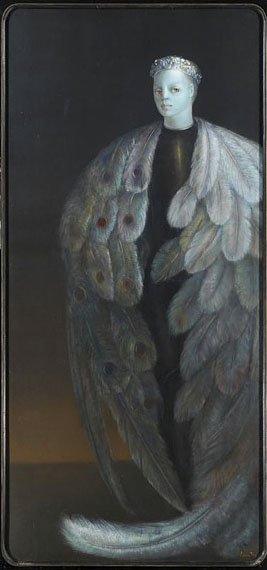
Rogomelec (1978) by Leonor Fini. Via.

Moving Through Old Daylight: A recording of Mark Fisher, Jim Jupp and Julian House of Ghost Box Recordings and Iain Sinclair in conversation at the Roundhouse, Camden, London, 5 June 2010. Topics under discussion included Nigel Kneale, TC Lethbridge, John Foxx, BBC Radiophonic Workshop, alchemies of sound, the homogenisation of culture, imagining space and the impersistence of memory.

The Surreal House, “a mysterious dwelling infused with subjectivity and desire” at the Barbican, London.

Ars Homo Erotica at the National Museum of Warsaw. Related: “(Gothenburg) Museum stops exhibition about homosexuality in religion“.

• A lot of people still arrive here looking for art by Zack aka Oliver Frey. Bike Boy, 96 pages of Frey’s exuberantly homoerotic comic strips, is published in August by Bruno Gmünder.

• “EM Forster was a virgin until the age of thirty-nine, when he had his first ‘full’ sexual experience (a ‘hurried sucking off’, Wendy Moffat informs us) with a passing soldier on a beach in Alexandria.”

• JG Ballard’s archive is accepted by the British Library, or “saved for the nation” as they rather grandiloquently describe the process. Samples from the documents to be preserved at the BBC and the Guardian.

• Shades of Ballard’s singing sculptures, Sun Boxes is a solar-powered audio installation by Craig Colorusso. There’s more at Designboom.

• Nathalie visited the MAXXI, Rome’s new museum of contemporary art designed by Zaha Hadid.

Stephen Pinker wants everyone to stop fretting over the alleged distractions of electronic media.

• “It basically comes from love”: John McLaughlin in conversation with Robert Fripp, 1982.

• More collections of print ephemera: Agence Eureka and Ephemera Magica.

The Serpent and the Sword, an Alan Moore rarity from 1999.

Gulliverovy Cesty (1968) at A Journey Round My Skull.

Within the Without: a new Thombeau Tumblr.

The Hidden Posters of Notting Hill Gate.

The Letters of Sylvia Beach reviewed.

• It’s Kubrick Season in St Albans.

Riot In Lagos (1980) by Ryuichi Sakamoto still sounds futuristic thirty years on.

Monsieur Fantômas by Ernst Moerman

fantomas.jpg

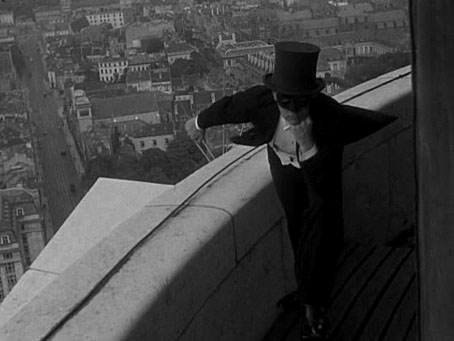
Jean Michel as Fantômas.

Ernst Moerman’s Belgian short from 1937 is available for viewing at Ubuweb and is described on its title card as “Un film Surrealiste”. One might equally describe it as “un film amateur” since it’s very much in the home movie mould as was much of the independent cinema of this time. The direction may be perfunctory but the photography is surprisingly good in places. The action, such as it is, concerns an avatar of the Surrealists’ favourite anti-hero, Fantômas, in a series of farcical scenes many of which are filmed on a beach with a few spare props. The most notable moment for me is one which none of the online documentation mentions, a brief appearance by a youthful René Magritte who pretends to be painting Le Viol. Magritte was a great Fantômas enthusiast so his presence here isn’t too surprising.

Previously on { feuilleton }
The Dark Ledger
Judex, from Feuillade to Franju
Fantômas

The art of Michael Hutter

hutter1.jpg

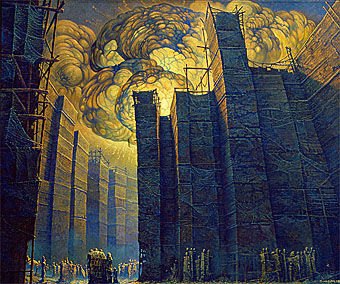
Stadtlandschaft I (City I) (1999).

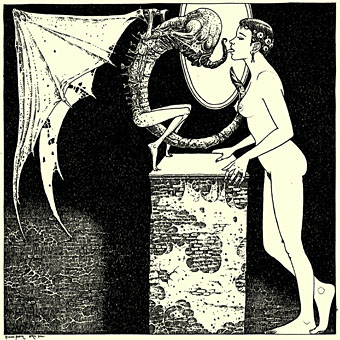
Michael Hutter‘s work is pitched at that enjoyably nebulous zone which lies on the borderlands of fantasy, science fiction and Surrealism, from which hybrid visions emerge that are never too defined in one direction or another. It’s a zone that French and Belgian artists often visit but whose inhabitants from other nations often seem all too few. Hutter’s art encompasses oil paintings and also ink drawings which include some erotic scenes like the example below. His site is well worth a browse, especially the vast and detailed Triptych which recalls similar works by Wayne Barlowe and Hieronymus Bosch. For more inhabitants of the nebulous zone, see the archive link below.

hutter2.jpg

Pterdactyl II.

Elsewhere on { feuilleton }
The fantastic art archive

Engelbrecht lives to fight another day

engelbrecht1.jpg

The beat Engelbrecht had drawn for the early morning rise was a stretch of jet black water between the Jubilee Gasometer and the Municipal Slaughter House. A dank mist lay over the canal. The vampire bats were out in swarms. The bot-fly waltzed in virid clouds. You could hardly have had a better surrealist fishing day.

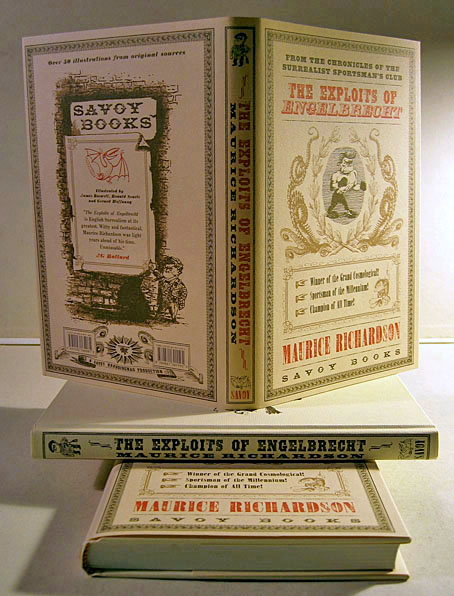
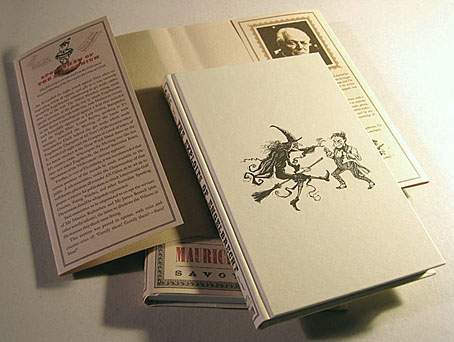
Thus Maurice Richardson in The Exploits of Engelbrecht, newly-printed copies of which I picked up this week from the Savoy Books’ office. This is the reprint of the Savoy edition which was published in 2000 and would have been out two years ago had various problems not intervened. As a result it’s inadvertently become an anniversary edition which is fitting since Engelbrecht was the first title in the line of books from Savoy’s publishing relaunch ten years ago. I’ve mentioned before that I was dissatisfied with my original design so it was a pleasure being able to rework the book slightly in a manner which better suits Richardson’s marvellous stories. The main change is a completely re-designed dust jacket done in three colours printed on textured paper; this has made the book a nice thing to handle as well as look at. A few new illustrations were added courtesy of Savoy artist Kris Guido. Kris is a far better cartoonist than I and his drawing of Engelbrecht facing one of his broomstick-riding foes adorns the front board.

engelbrecht2.jpg

Another cartoonist, Martin Rowson (currently at the Guardian), reviewed the earlier edition for The Independent on Sunday:

Far more obscure, but for my money the best book of the year, is The Exploits of Engelbrecht by Maurice Richardson. Richardson, who died in 1978, was one of the old school of hacks; he later became a stalwart infester of the Colony Rooms and the sordid pubs round Soho that teemed with pissed-up talent in the 1940s and 1950s. The Exploits of Engelbrecht, the dwarf surrealist boxer, and his adventures shooting witches, boxing grandfather clocks, playing football on Mars and games of surrealist golf which last for infinity, originally appeared in Lilliput when it was at its post-war zenith. The stories were illustrated by, among others, Searle and Hoffnung. Ah, God, those were the days.

This edition is lavishly illustrated and comes with endorsements from artist James Cawthorn (who provided some illustrations and an introduction), Michael Moorcock (who provided the afterword), and JG Ballard (who provided a blurb). Since its original publication in 1950 Engelbrecht had been one of Ballard’s favourite books; I wish he could have lived long enough to see this latest edition.

Engelbrecht isn’t on sale yet as I don’t think a price has been decided on but since this is a limited run it’ll be around £25 + p&p. Any queries should be directed to Savoy Books who have a PDF of the first chapter (plus illustrations) available to read. Next up is the enormous Moorcock tome; more about that soon.

Previously on { feuilleton }
Ronald Searle book covers
Engelbrecht again
Mervyn Peake in Lilliput

Repin and Ljuba

repin.jpg

Sadko in the Underwater Kingdom (1876).

This painting by Russian artist Ilya Yefimovich Repin (1844–1930) is included in one of my Symbolist art books despite its pre-dating the Symbolist period and there being little else in the artist’s career which might suit the label. It’s a curious picture, however, illustrating a medieval folk tale and depicting the moment when the Sadko of the title is forced by the Sea Tsar to choose a wife from a line of aquatic maidens. It was art historian Philippe Jullian who had me returning to Repin, and the reminder gives me an excuse to post something by Serbian Surrealist Ljuba (aka Ljuba Popovic) whose colours, fauna and metamorphic female figures are a match for Repin’s sirens. Last time I looked for Ljuba pictures there were few available, a situation which has now been remedied by blogs such as this one.

ljuba.jpg

Lot and Lotus (1972).

Previously on { feuilleton }
The art of Ivan Bilibin, 1876–1942
Magic carpet ride
Short films by Walerian Borowczyk
The art of Ljuba Popovic