Weekend links 474

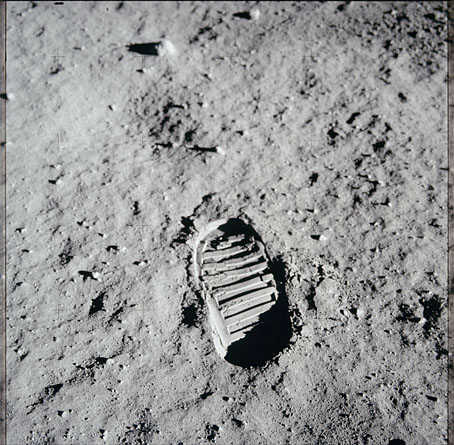
moon.jpg

AS11-40-5877 (1969).

• A minimum of Moon-related links this week because this is a subject I always return to. Previous links to NASA’s photo archives are now redundant after they changed their website but the archive of photos from the Apollo missions are currently hosted on Flickr…while Flickr lasts, anyway. The Albums section features whole film rolls from each of the missions.

• Mixes of the week: Stephen O’Malley presents In Session: Richard Pinhas (a re-posting of a mix from last year), and The Ivy-Strangled Path Vol. XVII by David Colohan.

• Living With The Human Machines: experimental artist Sarah Angliss speaks to Matthew Neale about the cyborgs, dummies and ghosts that populate her work.

• On And On And On: A Guide to Generative Electronic Music. Related: Deconstructing Brian Eno’s Music for Airports.

• At Dennis Cooper’s: Jesse Bransford presents…A List of Grimoires for the Twilight of the Age of the Book.

A Dandy in Aspic exclusive: Paul Gallagher interviewed cult author Derek Marlowe in 1984.

• From Ted Hughes to HG Wells: Jeanette Winterson picks the best books about the Moon.

• Tate acquires vast archive of British surrealist Ithell Colquhoun.

• At Greydogtales: Ten supernatural stories which stay with you.

• Emptyset turn to machine learning on new album Blossoms.

• Paul Grimstad on the absolute originality of Georges Perec.

• Valerie Stivers on cooking with Bruno Schulz.

• Blown out ’77: in the studio with Suicide.

Astronauts on record covers.

Back Side Of The Moon (1991) by The Orb | Moonshot (1999) by Hallucinator | Under The Moon (2019) by Brian Eno with Daniel Lanois & Roger Eno
Weekend links 473

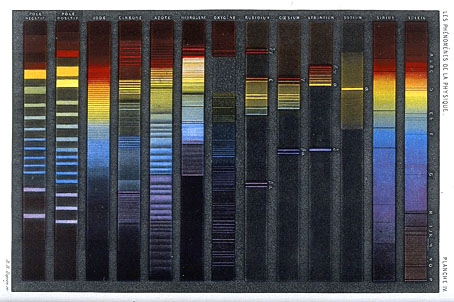
spectra.jpg

“Spectra of various light sources, solar, stellar, metallic, gaseous, electric”, print by René Henri Digeon; plate IV in Les phénomènes de la physique (1868).

• More polari: Thom Cuell this time with another review of Fabulosa!: The Story of Polari by Paul Baker. Good as it is to see these articles, one thing they all share is paying tribute to the polari-enriched radio series Round the Horne without crediting its writers, Barry Took and Marty Feldman.

• “…with its conspiracy theories, babbling demagogues and demonised minorities, Bahr’s investigation is sadly all too relevant today.” Antisemitism (1894) by Hermann Bahr, is the latest new translation from Rixdorf Editions.

Isao Tomita in 1978 showing a presenter from NHK around his tiny studio. Japanese-only but the discussion reveals that the words “synthesizer”, “tape recorder” and “mixer” sound the same as they do in English.

Ben Frost talks to Patrick Clarke about his music for German TV series, Dark.

• PYUR composes a guide through limbo with Oratorio For The Underworld.

• Steven Heller on Don Wall’s book design for a Paolo Soleri retrospective.

• Coming soon from Fulgur Press: Ira Cohen: Into the Mylar Chamber.

Will Harris compiles an oral history of Q: The Winged Serpent.

• Mix of the week: a mix for The Wire by Overlook.

• At Dennis Cooper’s: Magic Shop Internationale.

Shadow In Twilight by Pram.

The Feathered Serpent Of The Aztecs (1960) by Les Baxter | The Serpent (In Quicksilver) (1981) by Harold Budd | Black Jewelled Serpent Of Sound (1986) by The Dukes Of Stratosphear

Weekend links 472

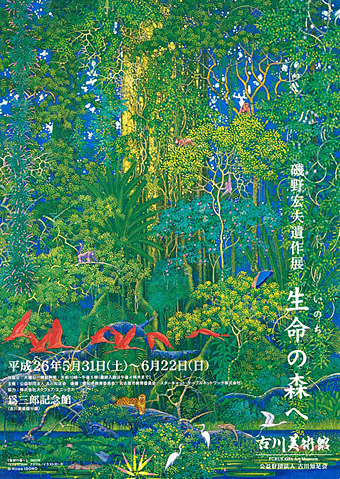
isono.jpg

Poster art by Hiroo Isono.

• “[Divine] didn’t want to pass as a woman; he wanted to pass as a monster. He was thought up to scare hippies. And that’s what he wanted to do. He wanted to be Godzilla. Well, he wanted to be Elizabeth Taylor and Godzilla put together.” I can’t help linking to yet another John Waters interview when he always has things like this to say.

• Fifty shades of grey: great towers of the Eastern bloc photographed by David Navarro & Martyna Sobecka.

• Seeking Beastliness and Defining Beauty: Clive Hicks-Jenkins on visualisations of Beauty and the Beast.

Fire Temple by Bobby Krlic (The Haxan Cloak) from the Midsommar soundtrack.

Brad Jolliff & Mark Robinson on the scientific legacy of the Apollo programme.

John Boardley on Renaissance memes and the chemical pleasure garden.

• “It’s important to go out and feel the so-called reality,” says David Lynch.

Peter Strickland talks to Robert Barry about his new film, In Fabric.

Nico in Manchester: “She loved the architecture—and the heroin”.

• Mix of the week: Secret Thirteen Mix 292 by Paco Sala.

• Andrei Codrescu on the many lives of Lafcadio Hearn.

Hiroo Isono: Into the Depths of the Sacred Forest.

• At Dennis Cooper’s: Queer.

The Beast (1956) by Milt Buckner | The Beast (1989) by Rhythm Devils | Beast (1994) by Brian Eno

Weekend links 471

maclean.jpg

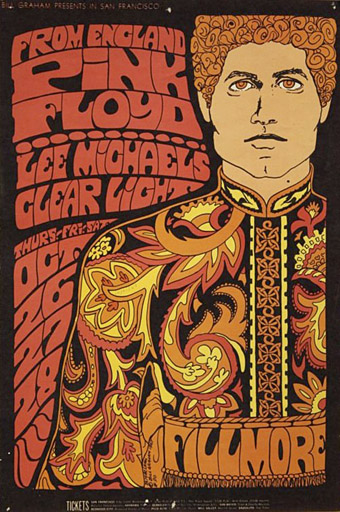
Pink Floyd, Lee Michaels, Clear Light (1967) by Bonnie MacLean.

• Electronic musician Mort Garson has been subject to a revival of interest recently, with reissues of his works as Ataraxia (The Unexplained), and Lucifer (Black Mass). The latest reissue is Mother Earth’s Plantasia (1976), an album released under Garson’s own name, and one of several works of plant mysticism from the 1970s (see Stevie Wonder’s Journey Through The Secret Life Of Plants, and Green by Steve Hillage).

• “It is striking how much of this work sounds like a missing link from the art world to the popular groups of the time, such as the Detroit techno pioneers Cybotron and the Japanese electro legends Yellow Magic Orchestra.” Geeta Dayal on the reconfigured Speak & Spell machinery of Paul DeMarinis.

The cost of free love and the designers who bore it: Madeleine Morley meets the women of psychedelic design.

For the transhumanist anarchist Wilson, the neurological relativism revealed by his own learning and personal deprogramming experiments called for a form of ‘guerrilla ontology’ that lampooned, rejected and transmitted much needed interference into the ‘reality tunnels’ that attempt to control much of contemporary society and individual behaviour. In the Schrödinger’s Cat Trilogy, characters are repeatedly placed in positions of cognitive dissonance, where they are forced to reevaluate their own belief systems due to experiences that they are unable to accommodate.

Sean Kitching on the 40th anniversary of Robert Anton Wilson’s Schrödinger’s Cat Trilogy

• They said books were dead, they were wrong: Adrian Shaughnessy on a decade of Unit Editions.

• Mixes of the week: Xianedelica by Jesús Bacalão, and Kosmische Mix By Tarotplane.

• Swinging 60s surrealist Penny Slinger: “Collectors thought I came with the art”.

• Cabaret Voltaire: Chance Versus Causality (Teaser).

Luc Sante on postcards of American violence.

• At Dennis Cooper’s: Peter Whitehead Day.

Computerwelt (1981) by Kraftwerk | Speak And Spell (1984) by Christina Kubisch | Time Space Transmat (1985) by Model 500

Weekend links 470

genso.jpg

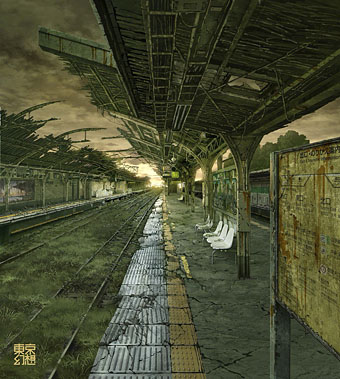
A rail station in ruins by Tokyo Genso. From a series of views of Tokyo showing a ruined and abandoned city.

• Old music technology of the week: The EKO ComputeRhythm, a programmable drum machine from 1972 used by Chris Franke (who didn’t like the sounds so he used it to trigger other instruments), Manuel Göttsching (the rhythms on New Age Of Earth), and Jean-Michel Jarre (on Equinoxe); and Yuri Suzuki‘s digital reconstruction of Raymond Scott’s Electronium.

• At Dennis Cooper’s: Spotlight on…Ishmael Reed Mumbo Jumbo (1972), and DC’s favourite fiction, poetry, non-fiction, film, art, and internet of the year so far. Thanks again for the link here!

• “Pauline told her to shove her shyckle up her khyber.” Philip Hensher on the origins and revival of Polari, the secret gay argot. Related: a Polari word list, plus other links.

In Star, Mishima fuses his major theme of the mask, the public role all humans are destined to play out, with the theme of suicide, an act which Mishima considered a work of art. All of his work is punctuated by suicide, and it is peopled with masks, with people knowing they are nothing but masks, who are aware that the center doesn’t hold because there is no center, that character is a flowing fixture, a paradoxical constancy and a definite variable, always.

Jan Wilm on Star, a novella by Yukio Mishima receiving its first publication in English

• “How have these places managed to transform from monuments to atrocity and resistance into concrete clickbait?” Owen Hatherley on the popularity of spomeniks.

• The late George Craig on translating the scrawl of Samuel Beckett’s letters (written in French) into coherent English.

• Outsider Literature, Part 1: a Wormwoodiana guide by RB Russell.

• Mix of the week: Secret Thirteen Mix 291 by Arturas Bumsteinas.

Symbiose, a split album by Prana Crafter and Tarotplane.

Robby Müller’s Polaroids

Apollo 11 in Real-time

Tokyo Shyness Boy (1976) by Haruomi Hosono | Tokyo (1979) by Jean-Claude Eloy | Tokyosaka Train (2002) by Funki Porcini