Weekend links 567

dean-osibisa.jpg

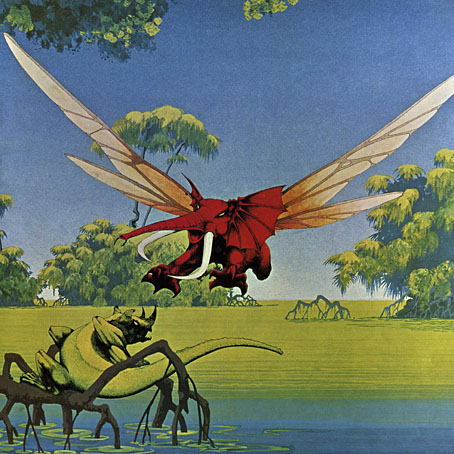
Cover art by Roger Dean for Woyaya (1971), the second album by Osibisa. Dean’s flying elephants made their first appearance on the group’s debut album, and have been an Osibisa emblem ever since.

• Many of Roger Dean’s early album covers are better creations than the music on the albums they decorate. This isn’t the case with Osibisa, however, a Ghanaian group based in London whose discography includes (uniquely, I think) two covers by Dean together with one by Mati Klarwein. The group’s first two albums, Osibisa and Woyaya, are exceptional blends of Ghanaian music with rock, funk and jazz whose omission from the generally reliable Kozmigroov list is a serious error. Garth Cartwright talked to Teddy Osei and Lord Eric Sugumugu about Osibisa past and present.

• “The antiheroes of Angry Young Men cinema railed against the limited life opportunities available to them. Wired and frustrated, they especially chafed against girlfriends, wives, domesticity. Yet they never questioned heterosexuality itself. Not, at least, until The Leather Boys (1964), a relatively little-known film directed by Canadian expatriate Sidney J. Furie.” Sukhdev Sandhu on a film about gay life in pre-decriminalisation Britain that offered a slightly more positive view of its subject than the justifiably angst-ridden Victim (1961).

• “Brian Aldiss once confided to me that the big problem with American science fiction writers was that they loved to write about Mars but knew nothing about Indonesia.” Bruce Sterling on the attractions of being an expatriate writer who adopts a foreign persona, as he did for the stories collected in Robot Artists and Black Swans.

• New music: Fire Tower by The Grid / Fripp. Dave Ball, Richard Norris and Robert Fripp have been collaborating on and off since The Grid’s 456 album in 1992. Fire Tower is a preview of Leviathan, a new album out in June on CD/DVD and double vinyl.

• RIP Michael Collins, the astronaut who orbited the Moon alone, listening to Symphonie Fantastique by Berlioz in the Command Module of Apollo 11 while Neil Armstrong and Buzz Aldrin were walking on the satellite’s surface.

• “‘Walking with a thesis’ could easily function as the subtitle for a significant number of Iain Sinclair’s books.” Tobias Carroll on Iain Sinclair and the radical act of walking through a city.

• “‘Plain speaking, like plain food, is a puritan virtue and thus no virtue at all,’ Meades pronounces.” Steven Poole reviews Pedro and Ricky Come Again by Jonathan Meades.

• Building a panorama: Clive Hicks-Jenkins‘ latest progress report on his Cocteau-inspired illustrated edition of Beauty and the Beast.

• At Unquiet Things: Groovy Goddesses From Dimension X: Gene Szafrans’ Kaleidoscopic Book Covers.

• From leather boys to leather men: Miss Rosen on the little-known photography of Tom of Finland.

Alexis Petridis attempts the impossible again, with a list of Grace Jones’ best songs.

• At Dennis Cooper‘s: Cars.

I’m A Leather Boy (1967) by The Leather Boy | Warm Leatherette (1980) by Grace Jones | Leather Bound (2017) by Patrick Cowley

Weekend links 566

hokusai.jpg

The Amida Falls in the Far Reaches of the Kisokaido Road. From the series A Tour of Waterfalls in Various Provinces (c. 1832) by Hokusai.

• New music: In Love With A Ghost by Kevin Richard Martin (aka Kevin Martin, The Bug, etc), a preview from his forthcoming alternative score for Andrei Tarkovsky’s Solaris (1972). In other hands I’d probably dismiss a further addition to the trend of creating new scores for films that don’t require them. Tarkovsky’s film certainly doesn’t need any new music, and we’ve already had an album-length homage from Ben Frost & Daníel Bjarnason. But I like Martin’s sombre atmospherics so he gets a pass with this one.

• “[Pauline] Oliveros wrote a piece for the New York Times in 1970 titled And Don’t Call Them Lady Composers, focusing on the difficulties of women being noticed and taken seriously in her field. It’s still online and could have been written yesterday.” Jude Rogers on Sisters With Transistors, a documentary about women in electronic music. Madeleine Siedel interviewed Lisa Rovner, the film’s director. Watch the trailer.

Submissions to the 16th number of Dada journal Maintenant will be open at the beginning of October, 2021, following an announcement of the theme of the new issue in September. All you would-be (or actual) Dadaists out there have the summer to plot your potential contributions.

Our reverence for originals takes an absurdly extreme form in the recent craze for NFTs (non-fungible tokens), where collectors and traders spend huge sums of money on unique ‘ownership’ of a digital artwork that anyone can download for free. Since there’s no such thing as the original of a digital file, the artist can now certify the file as the one and only ‘original copy’, and make a fortune. Time will tell whether this is a transient fad or a new way of establishing the feeling of a relationship to the mind of the digital artist.

But our reverence for originals isn’t universal. Treating the original as special and sacred is a Western attitude. In China and Japan, for example, it’s acceptable to create exact replicas, and these are valued as much as the original—especially because an ancient original might degrade over time, but a new replica will show us how the work looked originally. And, as mentioned, there are studios in China where artists are employed to create fakes. Perhaps our culture teaches us to respond to artworks by inferring the mind behind the art.

“Works of art compel our attention—but can they change us?” asks Ellen Winner

• “What Don basically did here is find a series of one or two bar riffs, or parts, that he liked, have me write them down, and then say, in essence, ‘make something out of this’.” John French (aka Drumbo) recalls the making of Trout Mask Replica.

• From 1988 (and relevant this week because I’m reading a Pynchon novel): Thomas Pynchon’s review of Love in the Time of Cholera.

• Andy Thomas on fusion legend Ryo Kawasaki, pioneer of the synth guitar.

• At Dennis Cooper’s: Dimitri Kirsanoff Day.

Gareth Jones’ favourite music.

• RIP Monte Hellman.

The Sea Named “Solaris” (1978) by Tomita | Solaris (2014) by Docetism | Solaris Return (2019) by Jenzeits

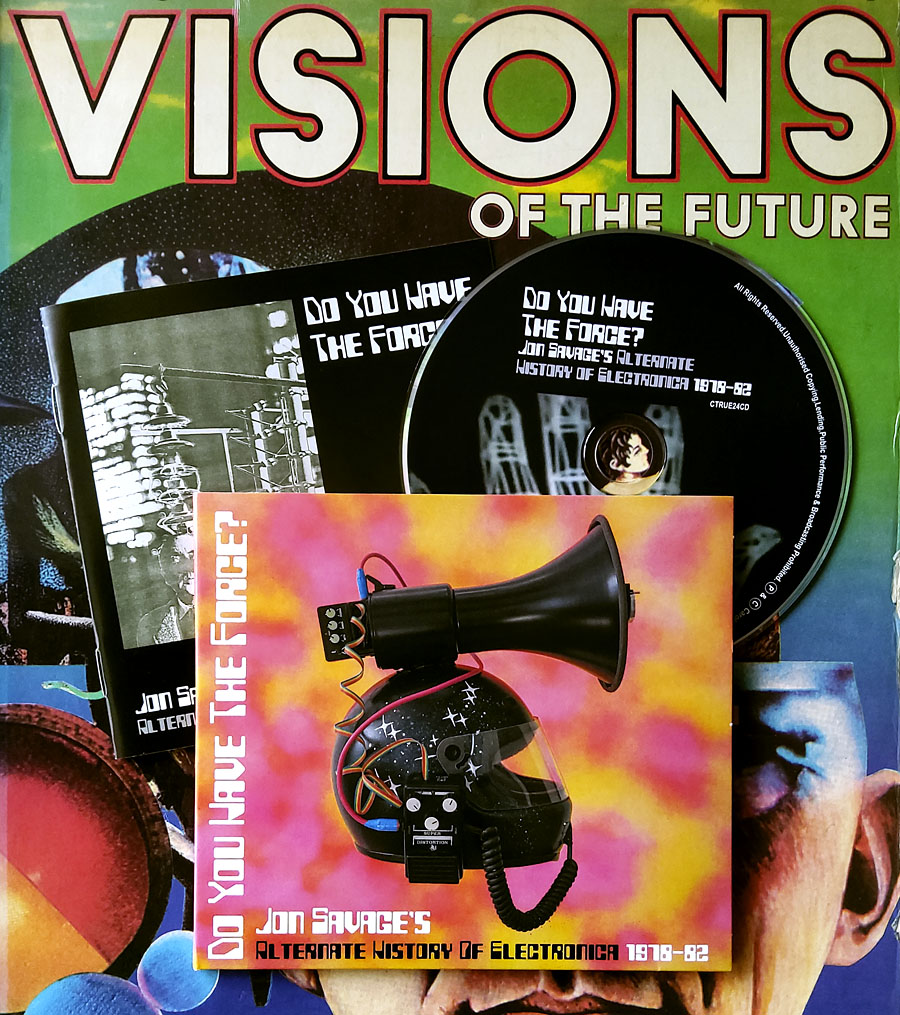
Do You Have The Force?

force.jpg

Forget all the Disco Sucks bollocks, this was where the creativity was. Many of the qualities of Disco that were so derided were mirror images of those qualities that were celebrated in Punk: an annihilating insistence on sex as opposed to puritan disgust; a delight in a technology as opposed to a Luddite reliance on the standard Rock group format; acceptance of mass production as opposed to individuality. It was the difference between 1984 and Brave New World: between a totalitarian nightmare or a dystopia accomplished through seduction. […] Disco’s stateless, relentlessly technological focus lent itself to space/alien fantasies which are a very good way for minorities to express and deflect alienation: if you’re weird, it’s because you’re from another world. And this world cannot touch you.

— Jon Savage

Don’t let that title fool you into expecting more blather about Space Nazis or belligerent muppets, these are not the Droids you’re looking for. Do You Have The Force? is catnip for this listener, being a compilation of electronic/dance obscurities that’s also another album compiled by the very authoritative Jon Savage. One of Savage’s curatorial hallmarks is a wandering from the beaten path in search of previously unnoticed trails and connections. This 80-minute collection continues the trend with an eclectic mix of energetic space disco and post-punk futurism, together with an extended ambient interlude by The Sea Of Wires, the British cassette world’s answer to the Berlin School of synthesizer music. I’d only heard a couple of these selections before, and the ones I had heard are all unpredictable choices: tracks by Suicide (Mr Ray) and The Flying Lizards (Steam Away) from each group’s less popular second albums; also Invocation, an obscure piece by Cabaret Voltaire from their post-Rough Trade, pre-Virgin recordings for the Disques du Crépuscule label.

Most of the unknown quantities here are all stimulating enough to warrant further investigation, even Droids (Fabrice Cuitad & Yves Hayat) whose Star Wars-themed dance groove may be excused its attachment to the wretched Lucas mythos by virtue of there having been a lot of similar opportunism at work in the late 1970s. In the notes to his album Savage mentions two chart-topping singles that might have warranted inclusion: I Feel Love by Donna Summer (previously), and the majestic Magic Fly by Space. The latter may be heard on the first Cosmic Machine collection of French electronic music, together with another track by Droids. Both of the Cosmic Machine collections make excellent companions for Do You Have The Force?, as does the four-disc Close To The Noise Floor collection, another exploration of the byways of Britain’s post-punk electronic scene which also includes an instrumental by the enigmatic Sea Of Wires. Savage ends his collection with a Mexican mix of tracks by the great Patrick Cowley, a producer who pointed the way to an electronic future he didn’t live long enough to experience for himself.

Do You Have The Force? is out now on Caroline True Records. Kudos to the label for making a CD available. Some of us still prefer to shoot lasers at spinning silver discs, and will support those who continue to produce them.

Previously on { feuilleton }
Just the ticket: Cabaret Voltaire
Summer of Love
Queer Noises

Jóhannssonia

johannsson.jpg

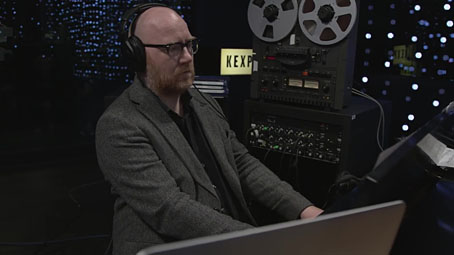
Looking around at the weekend for Jóhann Jóhannsson concerts turned up a few freely available recordings plus a two-hour mix by the composer that I hadn’t come across before. I must have about three quarters of the Jóhannsson discography on disc by now but a handful of rarities remain stubbornly out of reach. Discoveries like this help me resist the temptation to consider spending £150 on a secondhand copy of End Of Summer, a CD/DVD recording of a Jóhannsson collaboration with Hildur Guðnadóttir and Robert Aiki Aubrey Lowe. Given Jóhannsson’s reputation, and that of Hildur Guðnadóttir who worked with him on other albums, I’d be surprised if some of these scarce recordings weren’t reissued eventually.

KEXP (2010).
Jóhannsson with the Acme String Quartet in a 36-minute session for the Seattle radio show. The ensemble perform five pieces which include a version of Flight From The City six years before its appearance on the Orphée album. Also two compositions that are only available on singles or compilation albums, Tu Non Mi Perderai Mai and Corpus Camera.

FatCat Podcast #66—The Miners’ Hymns live at Winter Gardens (2012).
The Miner’s Hymns was a score for a Bill Morrison documentary about the mining communities of North East England for which Jóhannsson used a range of brass instruments like those found in colliery bands. This is a live performance of the entire score by the Wordless Music Orchestra that accompanied a screening of the film in New York.

FACT Mix 527 (2015).
Linked here before, a 55-minute mix which includes a number of unsurprisingly sombre orchestral selections from Mihaly Vig, Gloria Coates and Witold Lutoslawski, together with two pieces by Meredith Monk. The latter point the way to the Monk-inflected vocalisations on the score for Arrival.

KEXP (2016).
A 50-minute session on video which includes more selections from the Orphée album. During the discussion interlude with Kevin Cole, Jóhannsson talks about his soundtrack work, including his score for Arrival.

Electronic Explorations 461 (2017).
A two-hour mix which repeats some of the FACT mix—Lutoslawski’s Funeral Music was evidently a favourite—and which also shows Jóhannsson’s sense of humour. Of all the many pieces he might have chosen by the early music historian David Munrow, the two recordings that open and close this mix are from Munrow’s unreleased score for John Boorman’s Zardoz. Then a third of the way through there’s an abrupt transition from the droning doom of Sakrifis by Mohammad to Au Suivant by Jacques Brel, a song better known to Scott Walker and Alex Harvey listeners in its Mort Schuman translation, Next.

Previously on { feuilleton }
Last and First Men

Weekend links 564

kolbe.jpg

Fantastical Tree (c. 1830) by Carl Wilhelm Kolbe.

• “It’s just a square and a semi-circle at the end of the day.” Pete Adlington navigates the rapids of high-profile cover design for the UK edition of Kazuo Ishiguro’s Klara and The Sun. I’m not always keen on the minimal approach but the Faber edition is a better design than the equally minimal US cover whose circle in a hand makes it look like a reprint of Logan’s Run. Faber also produced a limited edition with the sun circle wrapped onto sprayed page edges.

• “‘With a mysterious smile on her lips,’ writes the Chilean film director Alejandro Jodorowsky, ‘the painter whispered to me, “What you just dictated to me is the secret. As each Arcana is a mirror and not a truth in itself, become what you see in it. That tarot is a chameleon.”‘” The painter referred to is the now-ubiquitous Leonora Carrington whose own Tarot deck is investigated by Rhian Sasseen.

• “‘Horror is an emotion,’ Douglas E. Winter tells us. I would respectfully like to amend that assertion. Horror is a range of emotions. And each of these moods, if they are to be successful, must be cultivated differently.” Brian J. Showers offers his thoughts on horror fiction.

• “You move from awareness of—and preoccupation with—how sounds affect our bodies, into how that might create a web of connection with the external world—with the natural world.” Annea Lockwood talking to Jennifer Lucy Allan about her career as a composer and sound artist.

• Gay cruising and its geography in cinema and documentary, a list of films by Mike Kennedy. Related: Shiv Kotecha on O Fantasma (2000), a film by João Pedro Rodrigues.

• Coming from Strange Attractor in June: Coil: Camera Light Oblivion, a photographic record by Ruth Beyer of the first live performances by Coil from 2000–2002.

• At Wormwoodiana: Mark Valentine on The Star Called Wormwood (1941), a strange novel by Morchard Bishop.

• At Unquiet Things: Ephemeral and Irresistible: The Spectacular Still-life Botanical Drama of Gatya Kelly.

• “Fevers of Curiosity”: Charles Baudelaire and the convalescent flâneur by Matthew Beaumont.

• 1066 and all that: Explore the Bayeux Tapestry online.

• Mix of the week: Secret Thirteen Mix 311 by Arigto.

• New music: Terrain by Portico Quartet.

Fever (1956) by Little Willie John | Fever (1972) by Junior Byles | Fever (1980) The Cramps