Weekend links 372

mognetti.jpg

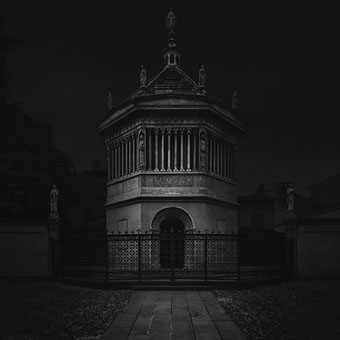
Battistero della Basilica di Santa Maria Maggiore, Bergamo (2017) by Mattia Mognetti.

• “Mumbo Jumbo: a dazzling classic finally gets the recognition it deserves.” Jonathan McAloon on Ishmael Reed’s unique novel being reissued as a Penguin Modern Classic.

• Amanda Gefter talks to Donald D. Hoffman, professor of cognitive science at the University of California, about “the evolutionary argument against reality”.

• Geeta Dayal on composer Raymond Scott. A new compilation, Three Willow Park, collects more of Scott’s electronic music from the 1960s.

Nagle critiques the follies of campus identity politics and social media liberalism not from the right, but as a left-leaning feminist. As she elucidates point after reasonable point, it feels as if a grown-up has finally entered the room. Like Mark Fisher, the Marxist critic who was savaged by his putative comrades for decrying “the stench of bad conscience and witch-hunting moralism” of the online left, Nagle has no sympathy for Twitter/Tumblr liberalism’s “cult of fragility and victimhood mixed with a vicious culture of group attacks, group shaming, and attempts to destroy the reputations and lives of others”. It is reassuring to find a self-described feminist disdaining the “hysterical” liberal call-out culture, and acknowledging that it has produced “a breeding ground for an online backlash of irreverent mockery and anti-PC”. Without joining the forces of reaction or losing sight of the vileness of the alt-right, she writes of “the deep intellectual rot of contemporary political progressivism”; “the moral self-flattery of … a tired liberal intellectual conformity”; and “the hysteria and faux-politics of liberal Internet culture”.

Rob Doyle reviewing Kill All Normies by Angela Nagle

• Mixes of the week: XLR8R Podcast 501 by Ryan Elliott, and ReMelodiya vol. 1 by Laurent Fairon.

Sumit Paul-Choudhury on the slime mould instruments that make sweet music.

The Wire Salon: an audience with photographer and writer Val Wilmer.

Simon McCallum‘s list of 10 great lesser-known British LGB films.

Zaria Gorvett on the ghostly radio station that no one claims to run.

S. Elizabeth reposted her Coilhouse interview with me from 2010.

• “Boys are selling sex in Japan. Who is buying?” Boys For Sale

• At Spoon & Tamago: Ando Tadao’s Hill of Buddha.

• At Dennis Cooper’s: Gisèle Vienne Day.

Sun Ra is now on Bandcamp.

Shaolin Buddha Finger (1994) by Depth Charge | Atomic Buddha (1998) by Techno Animal | Psycho Buddha (2001) by Acid Mothers Temple & The Melting Paraiso U.F.O.
Weekend links 366

kashiki.jpg

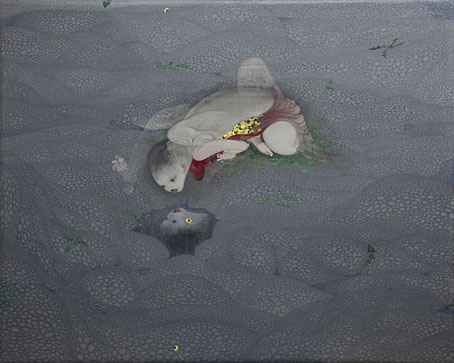
Dandelion (2009) by Tomoko Kashiki.

• “Standard Ebooks takes ebooks from sources like Project Gutenberg, formats and typesets them using a carefully designed and professional-grade style guide, lightly modernizes them, fully proofreads and corrects them, and then builds them to take advantage of state-of-the-art ereader and browser technology.”

Obscenity and the Arts, a previously unpublished essay by Anthony Burgess, will appear in book form later this year via Pariah Press.

• Mixes of the week: VF Mix 97: Talk Talk by The Last Dinosaur, and Secret Thirteen Mix 225 by Janek Schaefer.

Rub any two writers together and similarities will show. No two writers, however different, are completely different. Here’s a crucial instance: Lovecraft and Ballard both put architecture at the heart of their fiction, even though neither had the slightest formal training in the subject. And it is via this interest that the two intersect in an unexpected way. They are connected, through time and space, by that most humble of architectural events: the corner, the junction between two walls. What Lovecraft and Ballard did was to make the corner into a place of nightmares — and in doing so, they reveal its secret history.

Will Wiles in a long and rewarding essay, The Corner of Lovecraft and Ballard

• Dungeons Deep, Forests Dark – A beginner’s guide to Dungeon Synth by Daniel Pietersen.

Alex Ross on Joséphin Péladan, the Symbolists and the occult roots of Modernism.

• Cooling the Tube: engineering heat out of the [London] Underground by IanVisits.

Caroline on the mysteries of Pye Corner: Flames, poltergeists and bodysnatchers.

• The Saint of Sin City – Tony Kail Visits Las Vegas’ Santuario de la Santa Muerte.

• Photographs of Art Nouveau architecture by Keiichi Tahara.

• A stream of the new Porter Ricks album, Anguilla Electrica.

Jasper Sharp on 100 years of Japanese animation.

• At Dennis Cooper’s: 197 clocks.

On The Corner [Take 4] (1972) by Miles Davis | Corner Crew Dub (1976) by Augustus Pablo | Empty Avenues And Dark Corners (Pye Corner Audio Mix) (2013) by John Foxx and the Belbury Circle

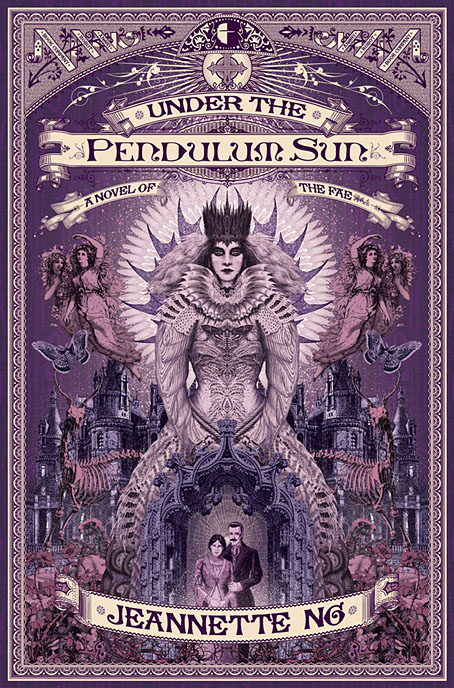
Under the Pendulum Sun by Jeannette Ng

pendulum.jpg

Once again I’m a little behind with putting new pieces of work on these pages, a consequence of the reduced rate of posting and the delay between finishing various works and them being announced by publishers.

Under the Pendulum Sun is a fantasy novel by Jeannette Ng whose cover was revealed this week by Angry Robot. I was very pleased with the way this one turned out so it’s good to see it being given a positive reception. Jeannette’s novel is a dark hybrid of Gothic drama and fairy story, the main characters being a pair of Victorian missionaries attempting to bring the Gospel to Arcadia, a very real and very sinister fairyland. The model is that of the Victorian missionary heading into what were regarded as the benighted places of the world then finding themselves and their beliefs subverted by the alien culture they were hoping to enlighten. It’s a clever concept, and the novel is filled with strange invention, so much so that I had to scale down the amount of things I wanted to get into the cover. This often happens with inventive novels (the ones I’ve done for KW Jeter suffered from this), you find yourself with enough material for three or more covers but only the one cover to contain everything.

There’s no need for me to go into any detail about the art and design when I did that earlier for the cover reveal at Fantasy Faction. The book itself will be published at the beginning of October.

The art of John Thompson

thompson01.jpg

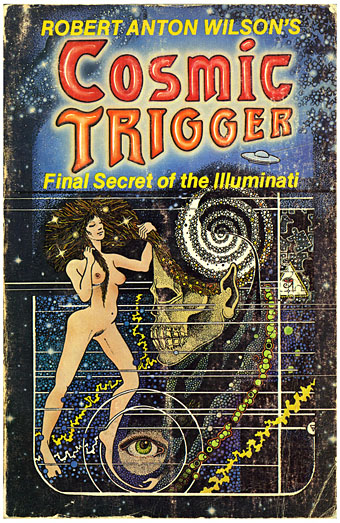
Cosmic Trigger: Final Secret of the Illuminati (And/Or Press, 1977).

John Thompson’s detailed, mystical and erotic illustrations gained prominence in the San Francisco comic scene in the late 1960s–early 1970s, appearing in a handful of titles drawn in their entirety by Thompson or done as collaborations with local artists including Robert Crumb. But it’s as an illustrator of Robert Anton Wilson’s Cosmic Trigger that Thompson is probably best known, something I was reminded of recently with the opening of Daisy Campbell’s play based on Wilson’s book. Wilson had seen Thompson’s comics work, and approached him as illustrator of his (ostensibly) non-fiction sequel to the very popular Illuminatus! trilogy, an encounter that Thompson elaborates on in this interview.

thompson02.jpg

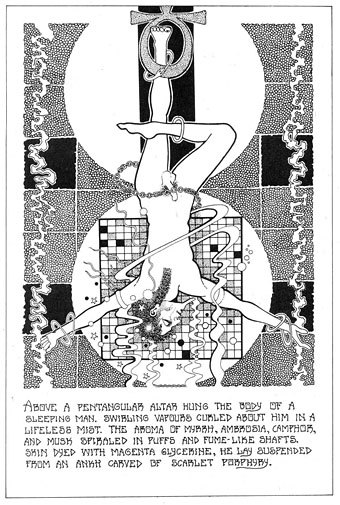
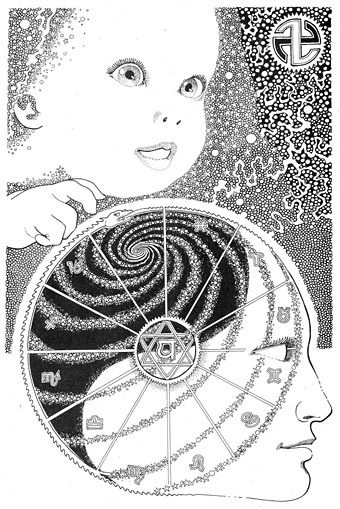
Here in the UK the comics published by Last Gasp et al weren’t always easy to find (imported comics were still being seized by UK customs into the 1990s), so Cosmic Trigger was my first introduction to Thompson’s art via a sighting of the US edition in a London shop in 1978. The UK paperback was a disappointment when it appeared a year or so later: Thompson’s cover art had been replaced with something more generic but they did at least retain the interior illustrations, albeit shrunk to fit the smaller book size. Many of the drawings in Cosmic Trigger had appeared already in Thompson’s comics which may seem surprising when they don’t resemble typical comic pages, but Thompson’s comics are unusual even compared to the undergrounds of the time. The undergrounds were most obviously radical in the wildness and excess of their content, especially where sex and drugs were concerned. But there’s a smaller subset of underground strips whose approach to narrative is so far removed from typical comic storytelling as to verge on the abstract. Victor Moscoso’s comics exemplify this style but even an ostensible traditionalist like Robert Crumb could experiment with the form (see his Cubist Bee Bop Comics in XYZ, 1972). Thompson’s comics are of this type at all times, blending motifs from a variety of myths and religions with Tantric yoga, astrology, alchemy and pop culture. When speech balloons appear they often contain allusive, esoteric phrases along with untranslated Greek or Hebrew text. It’s a beguiling mix which shows the ability of the comic book to do more than simply ape the stories of film or television. As with many other things from the late 1960s it’s a direction that hasn’t been pursued very much since.

thompson03.jpg

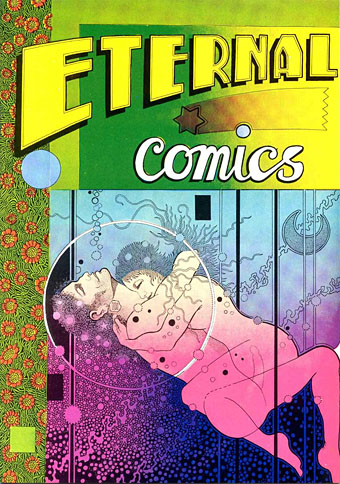
The interview with Thompson explains why he seemed to vanish after the work for Cosmic Trigger: he says he quit comics and illustration to become a therapist although he still creates private work. The examples here are from The Kingdom of Heaven is Within You (1969), Kukawy [sic] Comics 1 (1969; “Kukawy” is actually a Greek word meaning Cyclops), Tales from the Sphinx 2 (1972) and Eternal Comics (1973).

thompson04.jpg

Continue reading “The art of John Thompson”

Weekend links 359

azuma.jpg

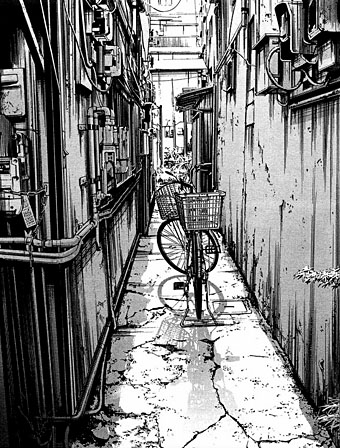
An urban scene from Yotsuba&! by manga artist Kiyohiko Azuma.

• The resurgence of interest in Alice Coltrane’s music is very welcome even if she joins for the moment the list of those artists (usually women: see Leonora Carrington) tagged by editors as “lost”, “forgotten”, “unrecognised”, etc. Alice Coltrane was only ever lost if you weren’t paying attention, and was notable enough fifteen years ago to be given the cover of The Wire magazine. Articles appearing this week have been prompted by a compilation of the devotional music that Coltrane recorded for a series of self-released cassettes in the 1980s. Geeta Dayal writes about the creation of the ashram recordings, while Stewart Smith suggests starting points for new listeners.

• Mentioned here before, but there’s now a page for the book: a new edition of Hashish (1902) by Oscar Schmitz will be published by Wakefield Press in November. “A collection of decadent, interweaving tales of Satanism, eroticism, sadism, cannibalism, necrophilia, and death”, illustrated by Alfred Kubin.

• Mixes of the week: A Dark Entries mix for the 400th issue of The Wire, Procedure, LA, April 25, 2017 by Pinkcourtesyphone, and Secret Thirteen Mix 220, a 4-hour epic by Ricardo Gomez Y De Buck.

• More off-the-beaten-path film lists: Sarah Lyons for Dirge Magazine on three occult documentaries, and Terry Ratchett for Dennis Cooper on 18 needlessly obscured avant-garde films.

• An Island of Peace: James Conway on Amanda DeMarco’s new translation of Walking in Berlin: A Flâneur in the Capital by Franz Hessel.

Ryuichi Sakamoto talks to Aaron Coultate about overcoming cancer, The Revenant and his new album, async.

Ingrid D. Rowland on Caravaggio: The Virtuoso of Compassion.

• “I think I am weirdly politically correct,” says John Waters.

Mnemonic Generator

• Berliner Nächte Part 1 (1990) by Seigen Ono | Berlinerstrasse (1995) by Coco, Steel & Lovebomb | Berlin (1998) by Pole