Weekend links 275

wessi.jpg

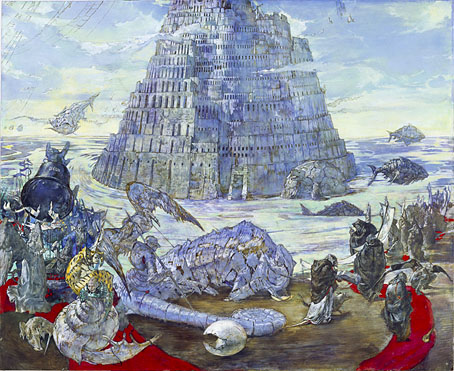
A painting from the Projekt Babelturm series by Wessi.

• “The first thing I would say is that I have no idea what authentic psych music is, and I have no wish to pursue that either. To me the idea of real psych is a paradox. I can’t see how you can have such a thing as real psychedelia when the whole thing is based on a psychedelic drug that gives you hallucinations and illusions and layers and layers of unreality.” Rob Chapman talking to Ben Graham about his new book, Psychedelia And Other Colours.

Elsewhere in a rather psychedelic week: Rob Young reviewed Chapman’s book for the New Statesman; Dangerous Minds posted “Hypnotic video of how a psychedelic masterpiece is made“; and in Germany a homeopathy conference “ended in chaos in Germany after dozens of delegates took a LSD-like drug and started suffering from hallucinations.”

• Coming soon from Dark Entries (so to speak), another collection of Patrick Cowley‘s music for gay porn films.

Jonathan Barnbrook works some quotes from JG Ballard into the British Road Sign Project.

• “Sorcery is more popular than football in Morocco,” says writer and filmmaker Abdellah Taïa.

• “If you’re going to make something, you should try and be wild,” says Mica Levi.

• Coca-Cola Milanese: Patrick Ellis considers the state of the world’s fair in 2015.

• Hear two pieces from Collapse, the forthcoming album by Drew McDowall.

• Mix of the week: Secret Thirteen Mix 162 by Ketev (Yair Elazar Glotman).

Emptyset’s Signal transforms Earth’s ionosphere into sound art.

Paul Laffoley: The Force Structure of the Mystical Experience.

• Fuck off, Star Wars, Ben Wheatley’s High Rise is on its way.

Ideologic Organ

Psychedelic Ride (1967) by The Ides | Psychedelic Warlords (Disappear In Smoke) (1974) by Hawkwind | Psychedelic Sewing Room (1989) by Bongwater

Weekend links 267

morgan.jpg

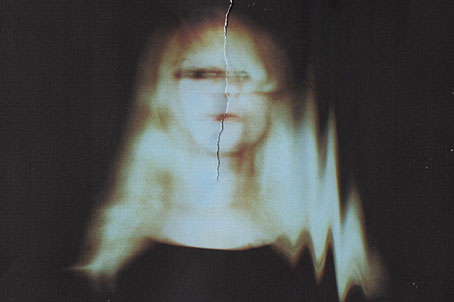
Black Fever (2010) by Polly Morgan.

• “She was something of an Auntie Mame figure for me. We spent years haunting secondhand bookstores in Berkeley, Los Angeles, and New York, talking for hours over ever more bizarre dishes of Chinese Hakka cuisine in a hole-in-the-wall eatery at Stockton and Broadway in San Francisco, watching Kenneth Anger flicks and the surrealistic stop-motion puppet masterpieces of Ladislas Starevich, which Tom Luddy would screen for us at the Pacific Film Archive, over and over again until our eyeballs nearly fell out.” Steve Wasserman remembers Susan Sontag.

California Dreams is “the first career-spanning compendium of Mouse’s work; it includes his recent landscapes and figurative paintings. Taken as a whole, the work is a weird, gilded, space-age, flame-licked way to chart the rise of late-twentieth-century youth culture”. Jeffery Gleaves on the psychedelic art of Stanley Mouse.

• “Not only does moral preoccupation corrupt the artfulness of fiction, but fiction is an inefficient and insincere vehicle for moralizing,” says Alice Gregory, joining Pankaj Mishra to address the question: “Do Moralists Make Bad Novelists?”

Nabokov’s posthumously published Lectures on Literature reprints a corny magazine ad that Nabokov liked to show to his students at Cornell, as an example of a certain kind of sunny American materialism and kitsch (or poshlost, in Russian): it’s an ad for flatware featuring a young housewife, hands clasped, eyes brimming as she contemplates a place setting. Nabokov titled it “Adoration of Spoons,” and it undoubtedly played a significant role in his creation of the suburban widow Charlotte Haze. From such strangely endearing trash was a masterpiece born.

John Colapinto reviewing Nabokov in America by Robert Roper

• “How many typefaces is too many typefaces?” asks Adrian Shaughnessy. “What happens to our ability to discriminate and exercise good judgment when we have a near-infinite number of possibilities?”

• At BUTT: a clip from one of the more dreamlike scenes in Wakefield Poole’s gay porn film, Bijou (1972). Poole’s “sensual memoir”, Dirty Poole, is published by Lethe Press.

John Banville reviews The Prince of Minor Writers, selected essays of Max Beerbohm edited by Phillip Lopate.

• My thanks once again to Dennis Cooper for featuring this blog on his list of cultural favourites.

• More Moogery: Sarah Angliss, Gazelle Twin and Free School in the Moog Sound Lab.

• Mix of the week: XLR8R Podcast 394 by Francesca Lombardo.

Atlas Obscura gets to grips with the enormous Devil’s Bible.

Feel You, a new song by Julia Holter.

Spoonful (1960) by Howlin’ Wolf | Spoon (1972) by Can | Spoon (2013) by Mazzy Star

Weekend links 263

nakayama.jpg

Dancing Horse (1972) by Tadashi Nakayama.

• The Wounded Galaxies Festival of Experimental Media takes place in Bloomington, Indiana, on October 7–11, 2015. The event is an offshoot of the earlier Burroughs Century, and the phrase “wounded galaxies” is one of Burroughs’ own. It’s also the partial title of Wounded Galaxies Tap At The Window, the most recent album by Cyclobe who will be performing at the festival. Cyclobe’s Stephen Thrower will be in London later this month for the launch of his new book, Murderous Passions: The Delirious Cinema of Jesús Franco, and a screening of Franco’s Vampyros Lesbos (1971).

• Gallery sites showcasing erotic art are often coy about the details of the work they’re exhibiting. That’s not the case with Artists Space, NYC, whose Tom of Finland: The Pleasure of Play is running from June 14–August 23, 2015.

• “I just loved the songs, and I didn’t mind the age in their voices, and I didn’t mind the fact that they were unaccompanied, it didn’t matter.” Shirley Collins talking to Ben Graham about her love of English folk music.

The more important question is what do we do with psychedelia now? I think the drugs themselves and the experiences they produce in individuals and for society are too important and vital to be pigeon-holed and taken hold of by a bloodthirsty media that always aims to reduce all experience to a few simple straplines for improved consumerism.

Dr Ben Sessa talking to Barnaby Smith about psychedelic drugs. Breaking Convention 2015, the Third International Conference on Psychedelic Consciousness, takes place at the University of Greenwich next month.

• “…if someone opens a door or if sunlight falls on them they shoot off the grid and suddenly you have a roomful of what sounds like sick bagpipes.” Will Gregory on the physicality of Moog synthesizers.

• Mixes of the week: The Necromancer-Queens of Neverland, an exotic collection by SeraphicManta, Secret Thirteen Mix 156 by Asusu, and an Ornette Coleman playlist.

• “In 2015, the thought of anything as incendiary as Scum or Made in Britain turning up on TV just seems bizarre.” Danny Leigh on the great Alan Clarke.

• More psychedelia: ‘Art That Transcends‘, my article for Communication Arts, has been posted on the magazine’s website.

Phantasmaphile recommends Thus Were Their Faces, a collection of short stories by Silvina Ocampo.

Earth filmed playing live in Brooklyn, NY, September 24, 2014. The full set, and a great performance.

• At Dangerous Minds: “How Far Will You Go?” Meet Smokey, the outrageously gay 70s cult rockers.

Peter Strickland on six films that fed into The Duke of Burgundy.

Things I Found In Records

Christopher Lee sings!

Polly On The Shore (1970) by Shirley & Dolly Collins | The Quiet Joys Of Brotherhood (1972) by Sandy Denny | The Banks of Red Roses (1988) by June Tabor

Weekend links 261

hardie.jpg

Salome (2013) by Lucie Hardie.

Aickmanesque, “A list of films that possess the same strange ambiguities, disturbing illogicalities, grim mundanities, psychological unpleasantness, narrative open-endedness, Freudian oddness and genuine disturbing moments of horror as the short stories of Robert Aickman.” One of those films, Symptoms (1974), has been out of circulation for a long time but may be watched at YouTube.

• “If this was psychedelia, then it had more in common with the variety peddled by US bands like The Rain Parade, The Three O’Clock…and The Bangles…all of whom had been grouped into a movement known as The Paisley Underground.” Joseph Stannard looks back at Around The World In A Day by Prince And The Revolution.

• “…what I do is not magical realism. I do realistic magic.” Alejandro Jodorowsky talking to Ilan Stavans about writing and filmmaking. A substantial interview in which Jodorowsky isn’t forced to express himself solely in English.

[Angela] Carter thoroughly upset the bien pensants with her essay The Sadeian Woman (1978) where she argued that Sade “was unusual in his period for claiming rights of free sexuality for women and in installing women as beings of power in his imaginary worlds … I would like to think that he put pornography in the service of women, or, perhaps, allowed it to be invaded by an ideology not inimical to women.” She also makes the connection between Sade’s misanthropy, as she calls it, and his splitting of women’s bodies from “the mothering function”. McQueen seems to me to fascinate for similar reasons. Some of the pull he exerts on huge numbers of people arises from this side of his sensibility: there’s no hint of motherhood; he disliked the way that traditional décolletage revealed the breasts, and instead encased the whole female torso in coiled silver, mussel shells or razor clams—even glass.

Marina Warner on Alexander McQueen whose Savage Beauty exhibition is currently running at the V&A

• London’s American poster king: Graham Twemlow on E. McKnight Kauffer’s posters for the London Underground.

• At Celluloid Wicker Man: Electronic music and mental illness in cinema.

• Mix of the week: Secret Thirteen Mix 154 by Moniek Darge.

#1 (1994), the first album by Skylab, has been reissued.

Vir·tu·al Ge·om·e·try

Tamborine (1985) by Prince And The Revolution | Indigo (1994) by Skylab | Metronomic Underground (1996) by Stereolab

More trip texts

parry1.jpg

More psychedelia of a sort. Anthologist Michel Parry, who died last year, was a familiar name to British readers of fantasy, horror and science fiction for his themed collections: Beware of the Cat (1972; horror stories about cats), The Devil’s Children (1974; horror stories about children), The Hounds of Hell (1974; horror stories about dogs), Jack the Knife (1975; Jack the Ripper stories), The Supernatural Solution (1976; occult investigators), Sex in the 21st Century (1979), and so on.

Parry also compiled multi-volume anthologies throughout the 1970s, two of which have always stood out for me: the Mayflower Books of Black Magic Stories ran to six volumes presenting a wide range of occult fiction that included a number of obscure tales from Victorian and Edwardian writers; for Panther Books he compiled three collections of drug-related fantasy and SF stories that are just as varied, and may even be unique for the way they place authors as such as Lord Dunsany and Norman Spinrad together in the same volume. Both series are very much of their time—occult psychedelia!—and are worth seeking out, if you can find them. I emphasise the last point because it’s taken me a while to find a copy of Strange Ecstasies that wasn’t being offered for bizarrely inflated prices; my paperback habit has its limits… None of these anthologies have been reprinted so they’ll become increasingly scarce. For more invented drugs, there’s a good list at Wikipedia.

parry2.jpg

Cover art by Bob Haberfield.

Strange Ecstasies (1973)
The Plutonian Drug (1934) by Clark Ashton Smith
The Dream Pills (1920) by FH Davis
The White Powder (1895) by Arthur Machen
The New Accelerator (1901) by HG Wells
The Big Fix (1956) by Richard Wilson
The Secret Songs (1962) by Fritz Leiber
The Hounds of Tindalos (1929) by Frank Belknap Long
Subjectivity (1964) by Norman Spinrad
What to Do Until the Analyst Comes (1956) by Frederik Pohl
Pipe Dream (1972) by Chris Miller

parry3.jpg

Cover art by Bob Haberfield.

Dream Trips (1974)
The Hashish Man (1910) by Lord Dunsany
As Dreams Are Made On (1973) by Joseph F. Pumilia
The Adventure of the Pipe (1898) by Richard Marsh
Dream-Dust from Mars (1938) by Manly Wade Wellman
The Life Serum (1926) by Paul S. Powers
Morning After (1957) by Robert Sheckley
Under the Knife (1896) by HG Wells
The Good Trip (1970) by Ursula K. Le Guin
No Direction Home (1971) by Norman Spinrad
The Phantom Drug (1926) by AW Kapfer

parry4.jpg

Cover art by Brian Froud.

Spaced Out (1977)
The Deep Fix (1964) by Michael Moorcock
All the Weed in the World (1961) by Fritz Leiber
The Roger Bacon Formula (1929) by Fletcher Pratt
Smoke of the Snake (1934) by Carl Jacobi
Melodramine (1965) by Henry Slesar
My Head’s in a Different Place, Now (1972) by Grania Davis
Sky (1971) by RA Lafferty
All of Them Were Empty— (1972) by David Gerrold

Previously on { feuilleton }
Trip texts
Acid albums
Acid covers
Lyrical Substance Deliberated
The Art of Tripping, a documentary by Storm Thorgerson
Enter the Void
In the Land of Retinal Delights
Haschisch Hallucinations by HE Gowers
The art of LSD
Hep cats