Arthur Penn, 1922–2010

bandc.jpg

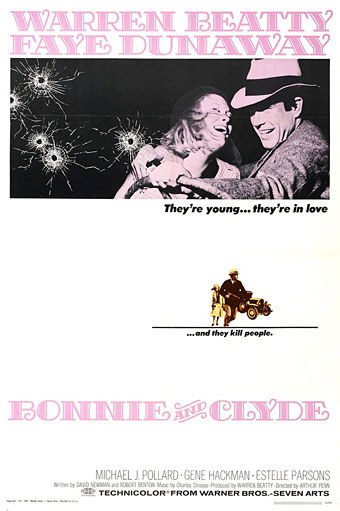
Design by Bill Gold.

With respect to Bonnie and Clyde and my other films, I would have to say that I think violence is a part of the American character. It began with the Western, the frontier. America is a country of people who act out their views in violent ways—there is not a strong tradition of persuasion, of ideation, and of law.

Let’s face it: Kennedy was shot. We’re in Vietnam, shooting people and getting shot. We have not been out of a war for any period of time in my lifetime. Gangsters were flourishing during my youth, I was in the war at age 18, then came Korea, now comes Vietnam. We have a violent society. It’s not Greece, it’s not Athens, it’s not the Renaissance—it is the American society, and I would have to personify it by saying it is a violent one. So why not make films about it.

From The Bonnie and Clyde Book (1972)

Thus film director Arthur Penn, whose death was announced earlier this week, speaking at a press conference in Montreal in 1967 following the first screenings of Bonnie and Clyde. Penn’s film shocked critics and audiences at the time ostensibly for its graphic violence although the disturbance went deeper than that. What I found shocking the first time I saw it—home alone one evening, watching TV with no idea what to expect—was the abrupt shifts of tone from near comedy (the speeding cars and bluegrass soundtrack, Gene Wilder’s role) to awful realism as the consequences of a life of bank-robbing became apparent. This was disturbing for audiences used to being spoon-fed their morality tales with easily identifiable heroes and villains; the sudden, savage conclusion was especially jolting. A “nightmare comedy” quality was a hallmark of Penn’s best work, and he followed Bonnie and Clyde with another nightmare comedy that’s also a further exploration of America’s troubled history, Little Big Man (1970). Here Dustin Hoffman’s character finds himself caught between the Native Americans who raised him and the warring Cavalry intent on massacring the native tribes. Like Robert Aldrich in Ulzana’s Raid (1972), Penn was using Western history to make a statement about America’s involvement in Vietnam; the soldiers in Little Big Man are murderous racists and General Custer is presented not as a doomed hero but as an unhinged psychopath. For me the film has always been distinguished by the character of Little Horse, the first (only?) gay Native American character in cinema. There’s plenty of documentary evidence for gay individuals in Native American tribes but these have seldom been seen in films. It’s Thomas Berger we have to thank for this detail, since it was Berger’s novel which Penn adapted, but the film’s writer and director are also to be congratulated for keeping a minor character who might easily have been excised.

It’s surprising when you see Bonnie and Clyde cited as one of the films that enabled directors to have more artistic freedom during the 1970s that Penn didn’t manage to do more during that golden decade. After Little Big Man there were two films which seem minor in comparison but would be major works from many lesser directors. Night Moves (1975) is one of the handful of attempts at updating film noir which appeared in the 1970s (for others see The Long Goodbye, Robert Aldrich’s Hustle and Taxi Driver), with a screenplay by Alan Sharp, the writer of Ulzana’s Raid. It’s a curio even by the standards of the decade, part detective story set in the Florida Keys, part symbolic drama with chess games and boats named “Point of View”; it’s also Penn’s last great film. The Missouri Breaks (1976), another Western, is fascinating for its pairing of Marlon Brando and Jack Nicholson but Brando’s eccentric performance is the start of his decline as an actor. It’s hard to believe that Penn only made five more films after this but he was one of a number of individual talents who flourished in the 1960s and 1970s then found themselves shut out in the 1980s as intellect was ousted by commerce. There’s even less room for him today than there was then. We’ve travelled from a time of intelligent and challenging films made by adults for adults to an era of shitty action movies and worthless adaptations of equally worthless costumed vigilantes. But I never counsel despair; celebrate what we have rather than bemoaning what we might have lost. Fuck Star Wars in 3D, watch Little Big Man instead.

Guardian obituary | NYT obituary
David Thomson on Penn

Der Eigene: Kultur und Homosexualität

eigene1.jpg

Der Eigene, collected edition, 1906. Design credited to Adolf Brand.

The subtitle is from an article (see below); Der Eigene, the world’s first homosexual periodical was devoted to an ideal of “masculine culture” which looked to Ancient Greece for a model of same-sex relationships. Adolf Brand (“Editor, photographer, poet, polemicist, activist, anarchist, enfant terrible“) founded Der Eigene in Berlin 1896, and to give some idea of how advanced the Germans were in these matters, consider that not only was this a year after Oscar Wilde had been imprisoned in Britain but that Brand’s publication was only the first of several journals advocating gay rights at a time when homosexual acts were still illegal in Germany. The radicalism fell short of including women, unfortunately; like many Grecophile pioneers of the time, Brand’s world had no place for females. All this activity was part of a peculiar ferment in Germany around 1900 which saw the rise of many small groups devoted to naturism, Theosophy, occultism in general, and various pagan revivals. There were also plenty of fiercely nationalist factions, of course, and these took a dim view of Brand’s outspoken homo-anarchism. When the nationalists later turned into the Nazis they destroyed Germany’s nascent gay culture.

eigene3.jpg

Morgendämmerung (Dawn) by Sascha Schneider, 1897. This drawing also appeared in Jugend magazine the same year.

The pictures here are from sets at Wikimedia Commons where the section devoted to the magazine has finally been amended with some higher-resolution copies. It’s a shame there isn’t more to see given that Der Eigene ran until 1932. I’ll be hoping for further works to come to light as the digitisation of rare publications gathers pace.

eigene2.jpg

Der Eigene, November, 1920.

Elsewhere on { feuilleton }
The gay artists archive

Previously on { feuilleton }
Sanctuarium Artis Elisarion
Jugend Magazine revisited
The art of Sascha Schneider, 1870–1927
Hadrian and Greek love

Weekend links 30

woody.jpg

Did someone say “woody”? Plenty more toy antics at TheOneCam.

• And yet more Haeckelisms: Praying in Haeckel’s Garden, recent works by artist Mary O’Malley.

Seasons of the Peacock, the perennial showoff as depicted by a handful of Art Nouveau artists. A couple of examples there I hadn’t seen before.

• Dorian Cope presents On This Deity, “Commemorating culture heroes and excavating world events.”

• At long last, Fantagraphics will be publishing Ah Pook is Here, the comic strip collaboration between William Burroughs and artist Malcolm McNeill. Something to look forward to for next year. Related: Malcolm McNeill’s website.

David Lynch Dark Splendor: “Der große Filmemacher David Lynch als Fotograf, Maler, Zeichner und Grafiker.”

More on the forthcoming album from Brian Eno, Leo Abrahams and Jon Hopkins. With this degree of hype the end result is going to be a disappointment.

Book design by Richard Hollis, including John Berger’s essential Ways of Seeing.

A fistful of Vignellis: the work of Lella and Massimo Vignelli celebrated.

• Berni Wrightson’s Frankenstein at Golden Age Comic Book Stories.

Jimi Hendrix, Philip José Farmer reader.

Imagerie du Chemin de Fer.

El UFO Cayó (2005) by Ry Cooder.

Weekend links 25

borgespesos

A commemorative Borges coin.

He says, “Two aesthetics exist: the passive aesthetic of mirrors and the active aesthetic of prisms. Guided by the former, art turns into a copy of the environment’s objectivity or the individual’s psychic history.” There, of course, he sums up all of realism, no? “Guided by the latter, art is redeemed, makes the world into its instrument and forges, beyond spatial and temporal prisons, a personal vision.” That’s Borges.

The Borges Behind the Fiction: Colin Marshall talks to translator Suzanne Jill Levine. Related: The Garden of Forking Paths.

• From The Quietus: Blondie in Conversation with William S. Burroughs by Victor Bockris, 1979; An Interview with Laurie Anderson by Robert Barry, 2010.

In 962 Abd-er Rahman III was succeeded by his son Al-Hakim. Owing to the peace which the Christians of Cordova then enjoyed […] the citizens of Cordova, Arabs, Christians, and Jews, enjoyed so high a degree of literary culture that the city was known as the New Athens. From all quarters came students eager to drink at its founts of knowledge. Among the men afterwards famous who studied at Cordova were the scholarly monk Gerbert, destined to sit on the Chair of Peter as Sylvester II (999–1003), the Jewish rabbis Moses and Maimonides, and the famous Spanish-Arabian commentator on Aristotle, Averroes.

Entry for The Diocese of Cordova from The Catholic Encyclopedia (1917).

Professor Newt’s Distorted History Lesson. A riposte to the ignorance of the wretched Gingrich. Related: the Mezquita de Córdoba.

borgeskat

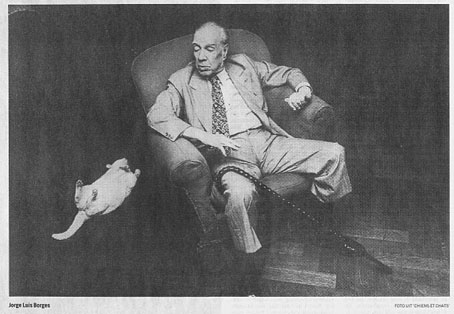
Jorge Luis Borges and a cat. Via.

Joseph and His Friend—A Story of Pennsylvania (1870) by Bayard Taylor, America’s first (?) gay novel. Related: 20 classic works of gay literature.

Elegies For Angels, Punks and Raging Queens at the Shaw Theatre, London, from 10–28 August 2010.

• Tristan Perich’s 1-Bit Symphony is released later this month. Café Kaput’s first release, Electronic Music in the Classroom by DD Denham, appears in September.

• “Just relax and enjoy it.” k-punk on the ambition and vision of David Rudkin’s Artemis 81.

• Chris Watson explores Alan Lamb’s The Wires: three audio recordings to download.

• Jonathan Barnbrook: Tuxedomoon fan, 1988, and Tuxedomoon designer, 2007.

• Rob Young’s Electric Eden reviewed by Michel Faber.

Brian Eno gets the Warp factor.

No Tears (1978) by Tuxedomoon; Atomic (1979) by Blondie; Everything You Want (1980) by Tuxedomoon; Next One Is Real (1984) by Minimal Compact; Hologram (2010) by These New Puritans.

Vintage swordplay #5

vintage.jpg

In honour of the overturning of Prop 8 in California—and because I haven’t posted one of these for a while—another piece of beefy weapon-handling. No idea who this fellow is but he can be seen a lot bigger (if not actually tumescent) at the Haunted Lamp, a place of assorted delights that you really ought to go and browse.

Elsewhere on { feuilleton }
The men with swords archive