William Mortensen’s Salomés

mortensen1.jpg

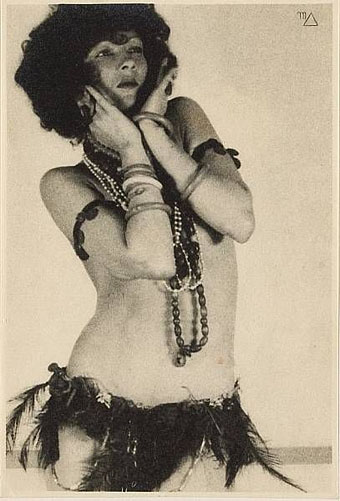
Joyzelle Joyner as Salomé.

Two undated photographs by William Mortensen (1897–1965) which use the Salomé theme as a possible disguise for motives that have little to do with Biblical storytelling; looking at this collection of Mortensen’s work he evidently had a thing for arty erotica. Joyzelle Joyner was an American actress who appeared in minor roles in a number of silent films. Her lascivious scene in Cecil B. DeMille’s The Sign of the Cross (1932) was deemed scandalous enough to later be cut from the film by censors. Watch it here. (Tip via Beautiful Century.)

mortensen2.jpg

Elsewhere on { feuilleton }
• The Salomé archive

Silent Engine

schutze1.jpg

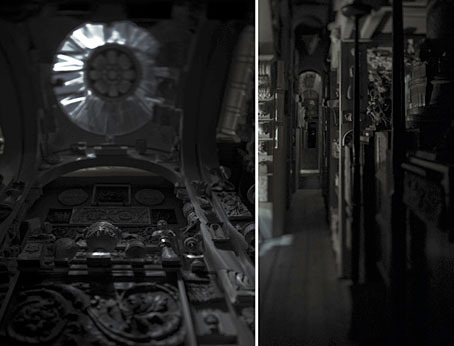
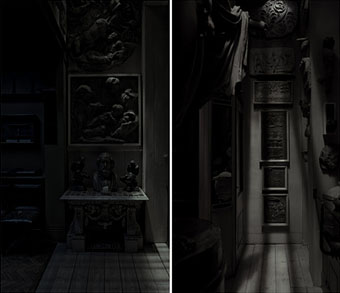
Artist/composer Paul Schütze unveiled some new photo prints this weekend, a series he calls Silent Engine. At first glance I thought the view on the left above was indeed an engine interior, with that radial construction being some kind of extractor fan. But these are actually nocturnal views of one of my favourite places in London, Sir John Soane’s Museum in Lincoln’s Inn Fields. The photos use only the available light which makes Soane’s collection of ancient sculpture and architectural fragments seem like the components of some antiquarian generator. Anyone familiar with Schütze’s 1997 album Second Site will know that this isn’t the first time he’s applied the word “engine” to architecture.

schutze2.jpg

Previously on { feuilleton }
• Paul Schütze online

Weekend links 115

vandamme.jpg

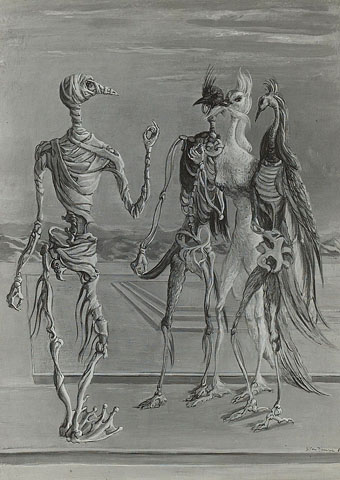
Untitled painting by Suzanne Van Damme (1901–1986).

• Eric Berkowitz, author of Sex and Punishment: 4000 Years of Judging Desire, chooses five books for The Browser.

• Venus febriculosa is running another competition: Design a new cover for Brian Eno’s Music For Films.

• Paul Mayersberg and Tony Richmond on making The Man Who Fell to Earth.

When a good idea occurs, it has been prepared by a long time of reflection. But you have to be patient. We all have what I call the invisible worker inside ourselves; we don’t have to feed him or pay him, and he works even when we are sleeping. We must be aware of his presence, and from time to time stop thinking about what we are trying to do, stop being obsessed about answers, and just give him the room, the possibility, to do his work. He is tenacious, you see. He never loses hope.

Screenwriter Jean-Claude Carrière discusses his remarkable career. Related: The Discreet Charm of the Bourgeoisie revisited.

• Tragic Time Capsules: Capturing the Decay of Forgotten Olympic Venues.

• Louis Menand on “The Puns and Detritus in James Joyce’s Ulysses“.

• Saul Bass’s original ending for Phase IV unearthed in Los Angeles.

• Katherine Lanpher uses witchcraft to find a New York apartment.

• Italo Calvino’s adolescence – that in-between time.

• The early film posters of Waldemar Swierzy.

• Psychedelic nano-art in oils and ferrofluids.

• David Toop has a blog.

• Callum James Paper.

• Bodies of Water (1995) by David Toop

Avebury panoramas

avebury1.jpg

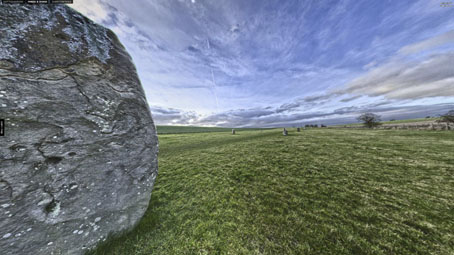
The Avenue, Avebury. Photo by Sophie Morse.

I’ve been a little surprised that there aren’t more photo panoramas of stone circles, their shape being optimal for the 360-degree view. The stones at Avebury in Wiltshire are too widely situated to be seen effectively from a single viewpoint so the view above shows the West Kennet Avenue that leads towards the circles. The same photographer also has a view of the entrance to the West Kennet Long Barrow.

avebury2.jpg

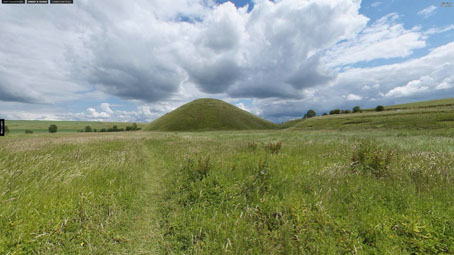
Silbury Hill, Avebury. Photo by Matthew Kaye.

Close to Avebury village is Silbury Hill, one of the largest artificial mounds in the world and—since its purpose is still contested—a good contender for Britain’s most mysterious creation. The hill and Avebury stones (not to mention Stonehenge) are only the most spectacular landmarks in a remarkable county that’s scored all over with prehistoric remains. It’s this area of England—Wiltshire and Somerset—I always regard as the true ancient heart of the country, not London which was founded by Roman invaders thousands of years after these structures were raised.

Elsewhere on { feuilleton }
• The panoramas archive

Stonehenge

stonehenge1.jpg

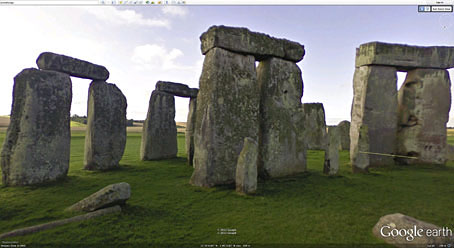
The trilithons of Stonehenge as they appear in Google Earth, a view that few people these days are allowed to experience since visitors are kept to a small path that runs around the monument. Thirty years ago this week, on the day of the Summer Solstice, I was fortunate to be present at the small Stonehenge Free Festival that was taking place in a field across the road. English Heritage always opened up the stones for the Solstice so I got to stand in the centre of the circle and watch a couple of improvised hippie weddings taking place. (Every now and then I wonder whether those couples are still together.) The festival had been staged annually since 1972 and, unlike the walled and ticketed Glastonbury Festival, was a thoroughly anarchist affair: people simply turned up, stayed for a week or so then left. That changed in 1985 when someone at English Heritage decided that the festival wasn’t going to happen; police cordoned off the area and the resulting conflict put an end to the festival for good.

stonehenge2.jpg

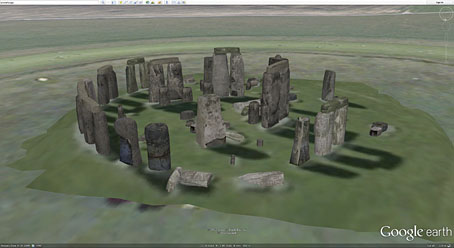
One of Google Earth’s army of diligent model-makers, Tom Harvey, is responsible for the 3D view of the stones. These work better than many of the 3D buildings in Google Earth which often look painfully isolated in otherwise flattened cityscapes. Stonehenge also suits this treatment better than most of Britain’s other ancient monuments which tend to be smaller stone circles or mounds of earth. There is a Silbury Hill but nothing for nearby Avebury as yet.

Previously on { feuilleton }
• Stonehenge panorama
• Born again pagans