La Tour Eiffel

eiffel1.jpg

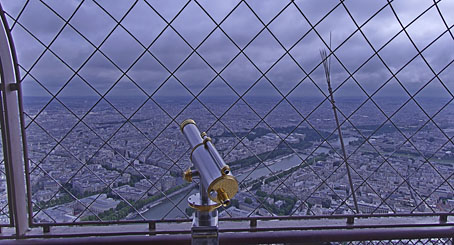
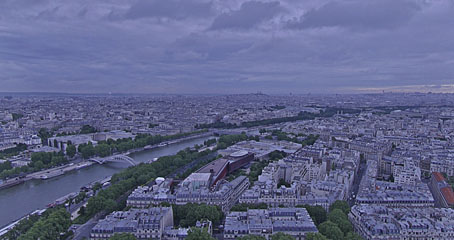
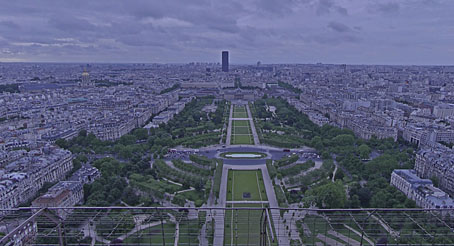
Another Google visit to a very tall structure. The views from the Eiffel Tower may not reach as high as those of the Burj Khalifa but you are at least looking at one of the greatest cities in the world. These pictures were taken in June of this year on a particularly gloomy day, possibly the early morning judging by the lack of people or car traffic. The views above and below look down on the section of the 7th arrondissement that was the site of the Exposition Universelle in 1900. As with the Burj Khalifa you can choose which floor to navigate.

eiffel2.jpg

eiffel3.jpg

The Champ de Mars.

Previously on { feuilleton }
Henri Rivière’s Eiffel Tower
Peter Eudenbach’s Eiffel Ferris wheel
City of Light

Weekend links 169

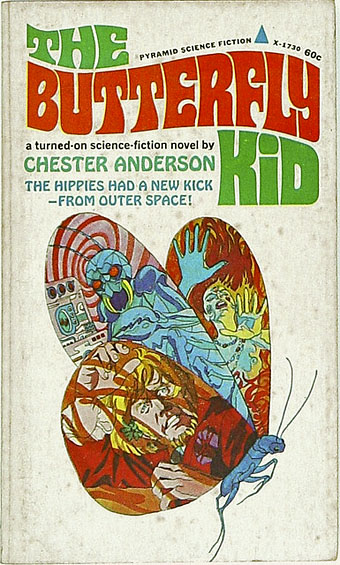
anderson.jpg

Cover illustration by Gray Morrow, 1967. One of the less exploitative examples from a collection of hippy book covers.

• Ten Photographs by Alain Resnais: Mise en scène of Memory, Aesthetics of Silence by Ehsan Khoshbakht. In the comments to that post someone shows an old Penguin book with cover photos by Chris Marker. This confirms that the “C. Marker” whose name I found on the back of another Penguin book was indeed Monsieur Chat.

• There’s more (there’s always more…): Cornelius Castoriadis interviewed by Chris Marker in 1989, the complete footage of an interview edited down for Marker’s TV series L’héritage de la chouette (The Owl’s Legacy). Watch the series itself at YouTube.

• “A generation of innovators want to change the way we have sex and consume porn, but Google, Apple, and Amazon won’t let them,” says Andrea Garcia-Vargas. Related: Sam Biddle on how Tumblr is pushing porn into an internet sex ghetto.

• Mix of the week: the Chop Quietus Mix, “a jagged journey all the way from Broadcast to the uneasy thrum of Suicide, kosmische flavours from Popol Vuh and Cluster, Alexander Robotnik and many more.”

Strange Flowers looked back at The Student of Prague: “the first art film, the first horror film and the first auteur film”, and now a century old.

Clive Hicks-Jenkins talked to animator Barry Purves about the pleasures and difficulties of creating animated films for adults.

• Mazzy Star released a song, California, from their new album which arrives in September. Can’t wait.

Suzanne Ciani, “American Delia Derbyshire of the Atari Generation” explains synthesizers, 1980.

Christer Strömholm‘s photos of Parisian transgender communities in the 1950s.

What are These Giant Concrete Arrows Across the American Landscape?

• How Kiyoshi Izumi built the psych ward of the future by dropping acid.

Alan Moore: The revolution will be crowd-funded.

Fuck Yeah Mazzy Star

• Suzanne Ciani: Lixiviation | The First Wave—Birth Of Venus (1982) | The Eighth Wave (1986)

Fetish photographer Rick Castro

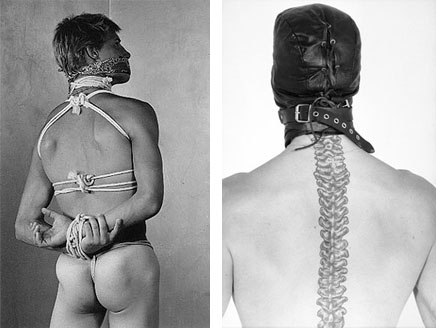
castro.jpg

Photographs by Rick Castro.

Presenting another guest post from John Wisniewski who back in May contributed an interview with William E. Jones about gay film director Fred Halsted. The subject this time is Rick Castro, pioneering bondage/S&M photographer, and also the proprietor of the Antebellum Gallery in Los Angeles which bills itself as the only fetish gallery in America. Castro has worked with Joel-Peter Witkin and Bruce LaBruce, and also photographed subjects as diverse as the Dalai Lama and Kenneth Anger, neither of them in bondage, unfortunately. As before, John offers a list of ten questions. Read on to discover why hustlers always used to wear white jeans (I have wondered about this)…

* * *

John Wisniewski: When did you begin photographing?

Rick Castro: 1986…around June…. My first photo was of my longtime friend (and former GF!), Odessa. I was a wardrobe stylist at the time, so I dressed her like Morticia Addams. Very high contrast/high shadowed B&W.

My second photo was of Tony Ward. I cast him for his first “mainstream” photo shoot. Editorial for a now defunct men’s magazine, INSTYLE, (published by porn mag IN TOUCH). We were working for photographer Albert Sanchez at the time. Between takes I’d dressed him up in full leather fantasy—leather hood, harness, gauntlets, codpiece, boots and horsetail!

JW: Whom are some of your influences in photography and art?

RC: I like the dead guys: Brassai, Pierre Moliner, F. Holland Day, Julia Margaret Cameron, Otto Dix, Paul Cadmus, Egon Schiele, Tennessee Williams, Pier Paolo Pasolini, Gilles De Rais.

JW: When did you meet fellow photographer Joel-Peter Witkin?

RC: Also during 1986, I bought Joel’s first book. At the back of the book was a request: “I am looking for people with physical deformations, amputees. Quadriplegics, burn victims, persons into extreme S&M, a woman with three breasts, geeks, pinheads, a woman with severe skin disease that will pose in an evening gown, anyone bearing the wounds of Christ, Christ.”

Later that year the new annex of Book Soup on Sunset Blvd hosted the first LA photo exhibit for Joel. I attended, introduced myself and gave him a stack of photos I had taken of my potential “models.” He called me the next morning. From then I worked with Joel on 13 of his most iconic photographs as a wardrobe stylist, costume designer, location scout, model scout, casting director, photo assistant, art director, make up artist and all around assistant.

Continue reading “Fetish photographer Rick Castro”

Weekend links 167

field.jpg

Poster by Luke Insect & Kenn Goodall.

In recent years I’ve had little patience for British cinema: too much dour “realism” with little of Alan Clarke’s vitality, too many comedies that aren’t funny, too many Hollywood calling cards, too much Colin Firth… So it’s been a pleasure to see Peter Strickland’s Berberian Sound Studio followed this month by Ben Wheatley’s A Field In England, a pair of films that stand out by daring to be different in a medium which seems to grow more creatively conservative with each passing year. A Field In England adds to the micro-genre of weird British films set around the time of the English Civil War. In place of witchfinders and devil worshippers we have magic, murder, madness, and a field of hallucinogenic mushrooms. Wheatley, like Strickland, takes risks that wouldn’t be allowed with a bigger budget which makes me excited to see what they’ll be doing next. A Field In England is already out on DVD & Blu-ray. The trailer is here. The director talked to Mat Colegate about the genesis of the film (spoiler alert). There’s more big hats and cloaks in this list of ten 17th century films.

• “I like to look at men…the way they look at women,” photographer Ingrid Berthon-Moine says about her pictures of sculpted testicles.

Roger Dean has finally sued James Cameron over the designs for Avatar. Will be interesting to see how this one turns out.

• Google has taken its Street View cameras to Battleship Island, “the most desolate city on earth“.

• The strange fantasy novels of Edward Whittemore are available again in digital editions.

Julia Holter talks about her forthcoming Gigi-inspired album Loud City Song.

• At Pinterest: Maneki-neko, the beckoning cat of good fortune.

Beautiful Books: Decorative Publishers’ Cloth Bindings.

• The abstract paintings of Hilma af Klint (1862–1944).

Lee Brown Coye illustrates August Derleth in 1945.

Bill Laswell’s discography intimidates the collector.

• Mix of the week: Kit Mix #23 by Joseph Burnett.

• The Soundcarriers: Last Broadcast (2010) | Signals (2010) | This Is Normal (2012)

Strange Days

doors1.jpg

Strange Days was the second album by The Doors, released in October 1967. It’s the album that veers the closest to what people think of today as a psychedelic sound—which puts it in my favour—and is also unique in the group’s catalogue for minimising their presence on the gatefold sleeve, something Jim Morrison was always eager to do even as the record company were trying to turn him into a pop star.

doors2.jpg

The cover photo by Joel Brodsky of street performers was intended to be reminiscent of a scene from Fellini. For years I was under the impression that this street was European, it certainly doesn’t look typically American, so it was a surprise to read earlier today that the location is Sniffen Court, a small mews in the heart of New York City. New York or not, I’ve always wanted to live in a place like this. You can keep your gardens and empty lawns, I’d be quite happy to see those wonderfully eroded flagstones every day. Contemporary views of Sniffen Court show that much of its atmosphere on the cover derives solely from Joel Brodsky’s skill at capturing the light as it reflects from the paving stones. The place today looks neater, cleaner and a lot less attractive, but that’s not too surprising for a historic area in one of the most expensive cities on earth.

doors3.jpg

sniffen.jpg

Sniffen Court, NYC, in 2012. The plaques at the rear were sculpted by Malvina Hoffman.

Elsewhere on { feuilleton }
The album covers archive