Weekend links 427

davis.jpg

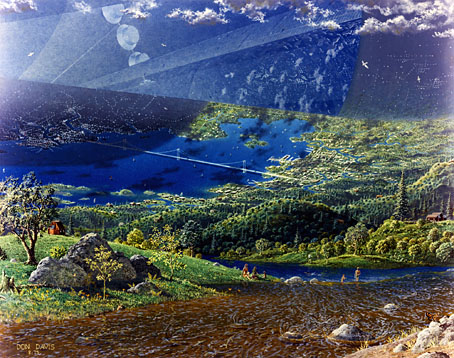
Inside an O’Neill Cylinder, an orbital megastructure. Painting by Don Davis, 1975.

• RIP Lindsay Kemp: dancer, actor, choreographer and (if we have to drop names) mentor to David Bowie and Kate Bush. Kemp’s work has been featured here on a number of occasions, particularly his landmark productions of an all-male Salomé, and Flowers, A Pantomime for Jean Genet. There was also considerable overlap with Kemp’s troupe and the films of Derek Jarman via appearances by Kemp himself, David Haughton and the irrepressible Jack Birkett. The Genet production was filmed in 1982, and is now available on DVD. (There’s also a rougher copy with unmatched audio and video.) From 1970: Pierrot in Turquoise, or The Looking Glass Murders, a Commedia dell’arte performance for Scottish TV featuring David Bowie. And reversing roles, Mick Rock’s video for Bowie’s John, I’m Only Dancing featuring Kemp and company.

• At Expanding Mind: Erik Davis in conversation with activist and writer David Nickles about “the DMT Nexus, psychedelic militancy, extraction tek, the Statement on Open Science for Psychedelic Medicines, MAPS, and the trouble with for-profit psilocybin companies”.

• From the end of August to January 2019: Spellbound at the Ashmolean; “Spellbinding stories, fascinating objects…from crystal balls and magic mirrors to witch bottles and curse poppets”.

On Earth, as on the International Space Station, the collective misperception of a flat plane helps build community and culture. We are all equal in our geometric relationship to one another. The reality, of course, is that we do not stand parallel. Each of our bodies corresponds with a distinct radial vector on the surface of a sphere, pointing away from a common center that we can never perceive or occupy. Our vectors diverge by imperceptible angles.

In “inside-out” worlds like the Bernal Sphere and the concave Earth, the situation is reversed. Our feet all point outward, into an inaccessible, but technologically habitable void, while our heads point inward, some of us apparently “upside-down.” Standing, we rise toward a visible center, which can be reached simply by climbing a hill, strapping on wings, and jumping into the air, as low-tech as Icarus.

The Shape of Space by Fred Scharmen

Michael Moorcock again, interviewed this time by Bernard Braden in 1968. I think this one was for a Braden TV series which was never broadcast.

• “Stupid things are best”: Neil Fox on Conny Plank: The Potential of Noise, a documentary about the great music producer.

• Mixes of the week: XLR8R Podcast 556 by Helios, and An Ode to Eris with An Other Ode to Eris by The Ephemeral Man.

• A monstrous primer on the works of HP Lovecraft by Emma Stefansky. With illustrations by Michael Bukowski.

Silent Agents by Julius-Christian Schreiner: photographs of hostile architecture from around the world.

• Back to the Futuro: Mark Hodgkinson on the spaceship house that landed in Yorkshire.

• The Great Chinese Art Heist by Alex W. Palmer.

Rhizome: a new recording by Drew McDowall.

The Starman Tarot

Mad Pierrot (1978) by Yellow Magic Orchestra | Spellbound (1981) by Siouxsie And The Banshees | Sphere (2011) by Emptyset

Weekend links 426

slinger.jpg

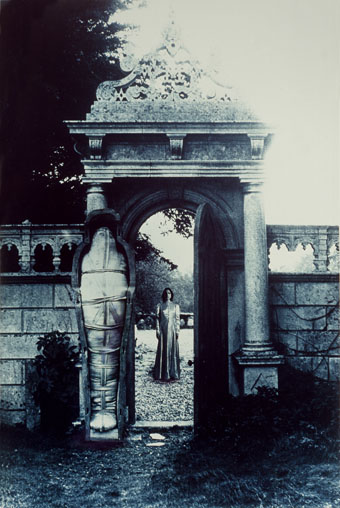
Self Preservation (1970–77), a collage by Penny Slinger from the series An Exorcism.

• RIP John Calder, one of the most important British publishers of the last century whose death was acknowledged in the Washington Post (and in the Telegraph, a paper that would have given him no support during his censorship battles) but at the time of writing hasn’t been mentioned at all in the increasingly useless Guardian. The omission in the latter seems even more surprising when Calder himself wrote obituaries for the paper, and they ran an archive piece two weeks ago for the 50th anniversary of Calder & Boyars’ successful court defence of Last Exit to Brooklyn. “Publishing is an industry run by capitalists now.

• Another 50th anniversary: David Bushman asked Alan Moore for his memories of Patrick McGoohan’s superb TV series The Prisoner.

Michael Moorcock in conversation with Hari Kunzru at Shakespeare and Company, Paris.

Stephen O’Malley presents Acid Quarry Paris – In Session with Richard Pinhas (Heldon).

• When a rock is a stone: Louise Steinman on finding Robert Smithson’s Spiral Jetty.

• Victorians, Vaults, and Violet Water: a profusion of links at Greydogtales.

• Mix of the week: FACT mix 666 by Róisín Murphy.

• The amazing adventures of Melinda Gebbie.

Starbirthed

Exorcism (1971) by Lucifer | The Final Calling (Physical Exorcism) (1984) by CTI | Exorcism Of The Hippies (2010) by Mater Suspiria Vision

Weekend links 424

calder.jpg

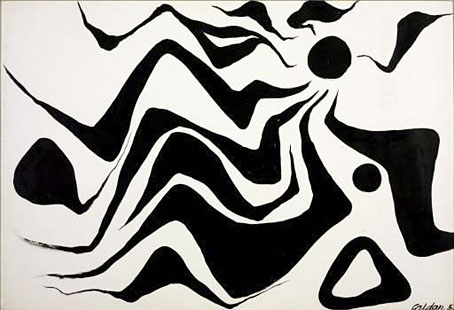
Black Sun (1953) by Alexander Calder.

• “But Berlin Alexanderplatz transcends its genre elements, largely because of Döblin’s deep lack of hope about what can be expected of human beings.” Adam Kirsch on Alfred Döblin’s Berlin.

• “I occasionally dream of finding books that do not seem to exist (yet), and sometimes remember their titles,” says Mark Valentine.

• “I don’t read fiction.” He does, however, own 11,000 books. Alan Garner on writing a memoir of his wartime childhood.

What is it that I really like? I mean that’s the question that I think every musician and artists and everybody actually, is asking themselves; what they really like. And that means the emphasis is on REALLY like, meaning how do you push aside what you’ve been told, what you’ve been taught, what your friends like, and how much you like something because your friends like it or because it’s socially popular at the moment, or your girlfriend likes it or any of those ideas.

Jon Hassell (again) in an interview at Ableton

• How Alexander Calder sparked a modern fascination with mobiles (sculptures, that is, not telephones).

• Deep in Italy, one man’s Surrealist mini-city sleeps: Francky Knapp on Tomaso Buzzi’s La Scarzuola.

• “Even before electricity, robots freaked people out”: Lisa Hix on the history of clockwork automata.

Nicolas Winding Refn’s website devoted to neglected/abandoned films was launched this week.

• Mixes of the week: FACT Mix 664 by Lucy, and XLR8R Podcast 552 by Thomas Fehlmann.

Jean-Paul Goude‘s best photograph: an androgynous Grace Jones.

Marquis de Sade: 112 pages, 100 erotic illustrations.

The world’s most beautiful libraries

Sade Masoch (1968) by Bobby Callender | I’ve Seen That Face Before (Libertango) (1981) by Grace Jones | Black Sun (2011) by Demdike Stare

Weekend links 421

wojnarowicz.jpg

The Death of American Spirituality (1987) by David Wojnarowicz.

Dau: “Art imitating life on an unprecedented scale”. Siddhant Adlakha on a colossal Russian feature-film project that sounds like a real-life equivalent of Synecdoche, New York. Adlakha’s piece, which claims that Dau is finished, was written a year ago but there’s still no sign of the film itself. Wikipedia has more details and links.

Metropolis Magazine from Phantasm Press is a facsimile republication of the 32-page theatre programme produced for the UK premier of Fritz Lang’s feature film.

Children Of The New Dawn is a preview of the score for Mandy by the late Jóhann Jóhannsson. From last year: The Drowned World (live) by Jóhann Jóhannsson.

Grand Panorama of a Whaling Voyage ’Round the World (1848) by Benjamin Russell & Caleb Purrington is the longest painting in North America.

• “This summer, there is only one book to take to the Terminal Beach”: Applied Ballardianism: Memoir from a Parallel Universe by Simon Sellars.

• “La série des Fredi en trois volumes est une étude sincère et consciencieuse de l’inversion sexuelle.”

• “The Book was Mallarmé’s total artwork, a book to encompass all books,” says Sylvia Gorelick.

• At BLDGBLOG: Graphic Inferno, art by Rico Lebrun based on Dante’s Divine Comedy.

• Mixes of the week: XLR8R Podcast 549 by Hólmar, and FACT Mix 661 by Kelly Lee Owens.

• “Dealing with creative block? A deck of cards might help,” says Abigail Cain.

The Instagram account archiving exquisite interiors from vintage porn.

Polish composers report from Outer Space

Wind From Nowhere (1994) by Uzect Plaush | Slolooblade : The Drowned World (1994) by Mo Boma | Inner Space Memorial for JG Ballard (2014) by Janek Schaefer

The artists of Future Life

future.jpg

My earlier post about Future Life magazine mentioned the regular Portfolio series which featured interviews with illustrators and space artists, the latter group being the people who providing conceptual paintings for astronomy books and government entities such as NASA. Since the magazine files at the Internet Archive aren’t searchable I thought it worth making note of the interviews here, for my own benefit as much as anything else. (This blog has often served as a useful notebook.)

fl01-bonestell.jpg

Issue 1: Chesley Bonestell.

Many of the artists featured in Future Life were receiving their first (in some cases, only) high-profile feature at a time when little attention was given to the producers of this kind of work even in popular science-fiction magazines. The story magazines have always run interviews with writers but prior to Future Life, Science Fiction Monthly was the only magazine that I’d seen with a regular illustration feature, and that title didn’t last very long. Future Life covered some of the same people, Chris Foss, for example, while seeking out the prominent figures of the US illustration world. Not all the art is to my taste at all but the interviews are of interest even if you don’t like the pictures. One surprise was finding an interview in one of the issues that I’d missed with Ludek Pesek, a Czech artist whose views of the Solar System and depictions of the evolution of life on Earth I knew from the Puffin books he worked on with Peter Ryan. Those books were aimed at a young readership and were great favourites of mine before I’d seen anything by Foss and co. Another of the space artists interviewed is David Hardy, a British contemporary of Pesek’s whose view of an alien planet will be familiar to Hawkwind enthusiasts on the back cover of Hall Of The Mountain Grill. Another notable feature of the series is the lack of women artists, although this isn’t so surprising given that women creating pictures of space hardware are few even today. All the same, they might have featured Rowena Morrill, a popular cover artist for SF and fantasy novels at the time, and someone whose work I prefer to many of the people they did profile.

fl03-boris.jpg

Issue 3: Boris Vallejo.

fl04-mccall.jpg

Issue 4: Robert McCall.

fl05-nagaoka.jpg

Issue 5: Shusei Nagaoka.

A Japanese artist best known in the West for his album-cover art for ELO, Earth, Wind and Fire, and many others.

fl06-miller.jpg

Issue 6: Ron Miller.

fl07-hildebrandt.jpg

Issue 7: The Brothers Hildebrandt.

fl08-hardy.jpg

Issue 8: David Hardy.

Continue reading “The artists of Future Life”