Volcano: Turner to Warhol

wright.jpg

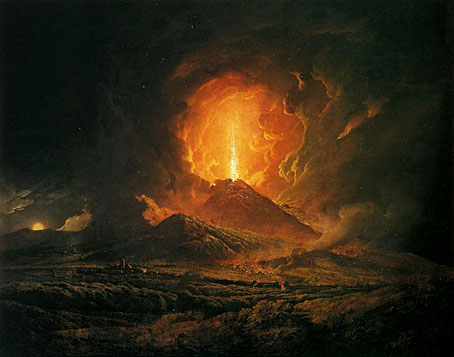
An Eruption of Vesuvius, Seen from Portici (c.1774–6) by Joseph Wright of Derby.

Joseph Wright of Derby captured the eruptions of Vesuvius in several pictures of which this is one of the more spectacular examples. The painter enjoyed spectacle as he also the rendering of chiaroscuro effects so it’s no wonder he was attracted to an apocalyptic night view such as this. Wright is one of the artists featured in a new exhibition at Compton Verney in Warwickshire, Volcano: Turner to Warhol, which presents the depiction of volcanoes in art through the ages.

The exhibition ranges from early engravings, showing imagined cross-sections of the fiery centre of the earth, to an explosive series of paintings by Joseph Wright, JMW Turner and Andy Warhol. It is a chance to examine the presence of volcanoes as geological phenomena and their power and influence, through an exciting range of historic and recent works of art. (More.)

The gallery site doesn’t have a complete list of the featured works but there’s some additional detail in a Telegraph preview from a couple of months ago. Volcano: Turner to Warhol opens on July 24th and runs to October 31st, 2010.

Previously on { feuilleton }
• Chiaroscuro II: Joseph Wright of Derby, 1734–1797
• Chiaroscuro
• Shadows at Compton Verney
• Death from above
• The apocalyptic art of Francis Danby
Marsi Paribatra: the Royal Surrealist

marsi1.jpg

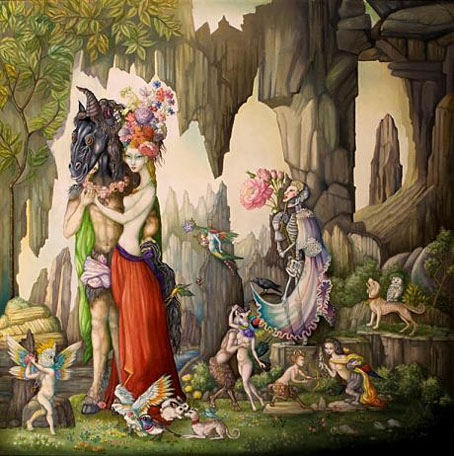
La Menace (1994).

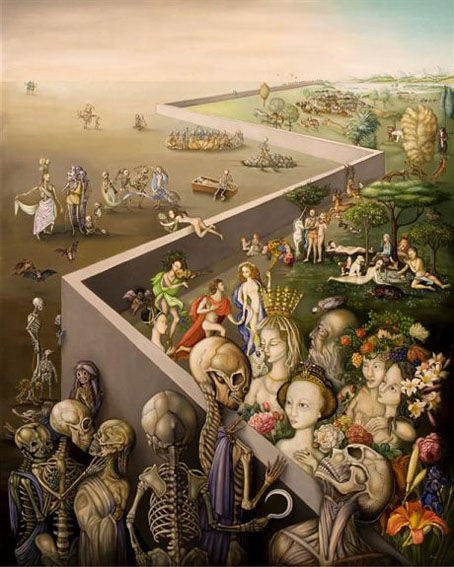
Two paintings by Princess Marsi Paribatra, a member of the royal family of Thailand who lists Dalí, Arcimboldo and Titian among her artistic influences. If it seems surprising that a princess should not only be an accomplished painter but also be possessed of a distinctly vivid imagination we might ask why this is the case. There’s no reason why a member of a royal family shouldn’t be as good a painter as anyone else although it’s the case that here in Britain our views of royalty are inevitably tainted by the uninspiring members of the current House of Windsor. Prince Charles in particular is a singularly dreary and frequently philistine figure, and also a painter whose daubs would never have received any attention at all were it not for his being born into the right family.

This hasn’t always been the case. It used to be that being an aristocrat gave you the free time and the wealth to indulge no end of manias and eccentricities. The British Isles are littered with architectural follies of various kinds built to appease the whims of rich landowners; William Beckford (1760–1844) is renowned for having written the Gothic melodrama Vathek and also for having built the lavish (and unfortunately short-lived) pile of Fonthill Abbey. In the 20th century we had Edward James (1907–1984), a lifelong champion of Surrealism who spent much of his later life building Las Pozas in the Mexican jungle at Xilitla, a concrete fantasia which looks like something dreamed up by Antonio Gaudí and JG Ballard. James collected the work of Leonora Carrington and Dorothea Tanning and I’d imagine him being equally entranced by some of Marsi Paribatra’s paintings. The recurrence of skeletal figures in her work invokes the Mexican Day of the Dead traditions which always excited the Surrealists.

marsi2.jpg

No title or date available.

Dali House has more about Marsi Paribatra’s life and art while further examples of her paintings can be found here and here. Thanks again to Monsieur Thombeau for pointing the way!

Elsewhere on { feuilleton }
• The fantastic art archive

Previously on { feuilleton }
• Angels of Anarchy: Women Artists and Surrealism
• Return to Las Pozas
• The art of Leonor Fini, 1907–1996
• Surrealist women
• Las Pozas and Edward James

Surrealism, graphic design and Barney Bubbles

starowieyski.jpg

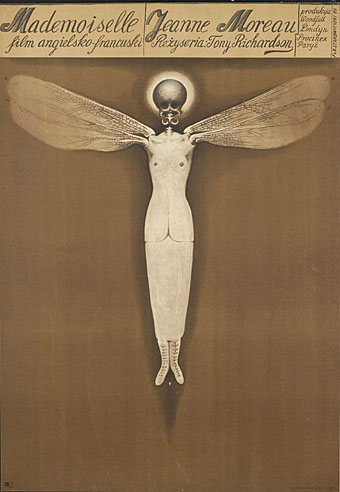
Poster for Mademoiselle (1970) by Franciszek Starowieyski.

Work has cranked into overdrive this week so posting will no doubt be minimal until some semblance of normality is restored. I can however mention two essential exhibitions which will be running through the forthcoming months.

Uncanny: Surrealism and Graphic Design at the Moravian Gallery in Brno, Czech Republic, is curated by design writer Rick Poynor and runs to 24 October, 2010. On display is an intriguing mix of work from familiar names such as Jan Švankmajer and Eva Švankmajerová, poster artist Franciszek Starowieyski, graphic designers Vaughan Oliver and Stefan Sagmeister, and many others.

Uncanny: Surrealism and Graphic Design uncovers the presence of an alternative tradition in graphic design. The Surrealist movement of the 1920s and 1930s focused on literature, painting, photography and the object, and the Surrealists’ publishing activities provided only hints of what a fully conceived Surrealist graphic design or typography might look like. Many of the most suggestive early examples came from Czechoslovakia, where Surrealism would become a lasting influence. Subsequently, Surrealist ideas and images had a profound impact on image-makers in every sphere of art and design, and by the 1960s the effects of Surrealism were widely felt in international graphic communication. Uncanny traces this intermittent line of development up to the present.

There’s further information at the gallery site including a page of related works.

process.jpg

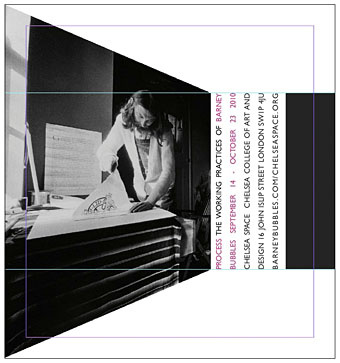
And launching later in the year is Process: The Working Practices of Barney Bubbles, a very timely exhibition of the designer’s work at Chelsea Space, London. Bubbles biographer Paul Gorman is the curator and the event will also see the launch of a second edition of his study of Barney’s life and work, Reasons To Be Cheerful.

The show will contain many never-before-seen items drawn from private collections, including student notebooks, working sketches, original artwork, paintings, books and photography. These were the raw material for videos, record sleeves, t-shirts and posters created by Bubbles for such performers as Ian Dury, Hawkwind, Elvis Costello, The Damned and Billy Bragg (who is contributing a one-off rug with a rendition of the designer’s Masereel-quoting cover for his album Brewing Up With).

Process opens on September 14 and will run to October 23, 2010.

Previously on { feuilleton }
• Franciszek Starowieyski, 1930–2009
• Jan Švankmajer: The Complete Short Films
• Barney Bubbles: artist and designer

Rammellzee RIP

rammellzee.jpg

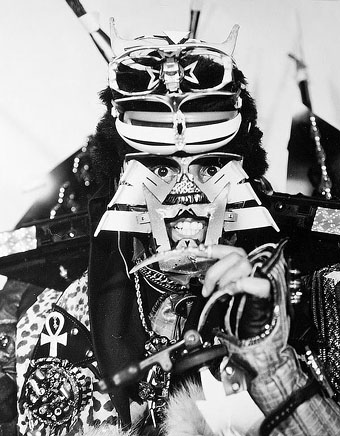
Rammellzee.

I consider that immortality is the only goal worth striving for: immortality in space. Man is an artefact created for space travel.
William Burroughs, 1982

We have to leave this tasteless mould of a planet.
Rammellzee, 2004

It’s fitting that a post about the late Rammellzee should follow one about Brion Gysin even if the circumstances aren’t those one would wish. Before he was involved in music Rammellzee was a graffiti artist and the convoluted mythologising which he later wove around the art of the graffiti tag—and his obsession with words and their meaning—bears comparison with Gysin and Burroughs’ similar mythologising, their theories about the viral origins of language. Look at Gysin’s calligraphic paintings (which he based on Arabic script) and you’ll see an exact analogue with the stylisations of graffiti taggers.

Given all of that, it’s even more fitting that Rammellzee was one of the voices chosen by Bill Laswell to set beside William Burroughs on Material’s finest forty minutes, Seven Souls, in 1989. I knew that voice from the great 1983 single he made with K-Rob, Beat Bop, one of many highlights on the best of the Street Sounds compilations, Electro 2, so it was a pleasant surprise finding it on the album which remains the best musical work that Burroughs was involved with. Rammellzee’s subsequent recordings with Laswell and others evolved an elaborate strain of what’s now known as Afrofuturism which he extended into paintings, collages and sculptural work. When you look at his detailed, science fiction philosophies, or at the underwater mythologies of Drexciya, it’s evident that there’s a rich seam of the African-American imagination which exactly parallels Burroughs’ visionary work. Visionaries right now are in short supply; we can’t afford to lose another.

• Rammellzee: The Remanipulator versus Syntactical Virus by Peter Shapiro (1997)
• No Guts No Galaxy—Rammellzee & phonosycographDISK (1999)
• Rammellzee: The Ikonoklast Samurai by Greg Tate (2004)

Previously on { feuilleton }
• Street Sounds Electro
• The art of Shinro Ohtake

Brion Gysin let the mice in

gysin.jpg

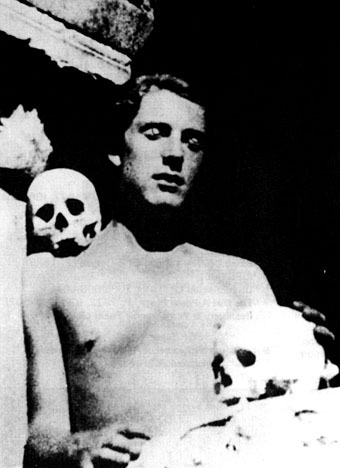
Brion Gysin—autoportrait (1935).

“A shaman to me is always a pansexual being,” says the gay Canadian filmmaker. “These guys all came out of that period where queer was really hardcore, it was part of their radical art — and of course it was illegal.” (more)

The filmmaker in question is Nik Sheehan discussing FLicKeR, his 2007 documentary about artist and writer Brion Gysin. Sheehan’s film is available for viewing at Ubuweb although I haven’t got round to watching it yet so I can’t say much about it. (Reality Studio has a review.) Gysin’s life and work is certainly worthy of study, however, his art and writing—which encompassed novels and experimental poetry—often having been overshadowed by his close association with William Burroughs. He gets a raw deal in Ted Morgan’s curiously bad-tempered biography of Burroughs, for example, despite having given his co-conspirator the cut-up technique, collaborated with him on The Third Mind, and so on. FLicKeR‘s title refers to Gysin’s Dreamachine, the first sculpture which needs to be experienced with the eyes closed, being a homemade hallucination engine which works by flickering light and shadow at a rapid rate on the closed eyelids. I made some Dreamachines of my own in the mid-1980s by carefully studying photos in RE/Search #4/5, and they certainly do work. It’s a shame that 78rpm record players are more difficult to find than they used to be since the original template devised by Gysin and Ian Sommerville needs a high speed in order to create the optimum flicker rate. As you might expect, various psychonauts have since created their own variations such as this one for a 45rpm player.

I mentioned a few weeks ago that the New Museum in NYC is staging the first US retrospective of Gysin’s work, an exhibition which they happen to call Dream Machine, and which opens on July 7th. The New York Times ran a piece about Gysin in advance of that. Ubuweb has further Gysin materials, such as this Burroughs piece about Gysin’s invention of the cut-up method, and some recordings of the permutated poems. Finally, if you’re wondering about the title of the post, it’s a reference to this.

Previously on { feuilleton }
• Burroughs: The Movie
• William S Burroughs: A Man Within
• Emil Cadoo
• The Great God Pan
• The Final Academy
• William Burroughs book covers
• Towers Open Fire