Weekend links 455

brocken.jpg

• At Expanding Mind: Tarot expert Mary Greer talks with Erik Davis about Tarot artist Pamela Colman Smith, the Golden Dawn, the art of illustration, Jung’s active imagination, Smith’s musical visions, and the recent study of Smith’s life and work, Pamela Colman Smith: the Untold Story.

• Almost five years have passed since the last album from Earth (if you discount the Bug vs. Earth collaboration Concrete Desert) but the band will release a new album, Full Upon Her Burning Lips, in May. Cats On The Briar is a taster.

Charles Bramesco on Sergei Bondarchuk’s astonishing 7-hour adaptation of War and Peace. I watched the whole thing last weekend: all superlatives are justified.

• The History of the Future: James Conway on leaving Australia for a life in Berlin and publishing. Related: Where is Rixdorf?

• At Spoon & Tamago: Keisuke Aiso‘s artworks, including the Ubume sculpture that became the face of the Momo Challenge hoax.

• Mixes of the week: Secret Thirteen Mix 282 by Tourist Gaze, and Big Sister’s Scratchy Singles Vol 1 by radioShirley.

Alexander Rose on the 26,000-Year Astronomical Monument Hidden in Plain Sight.

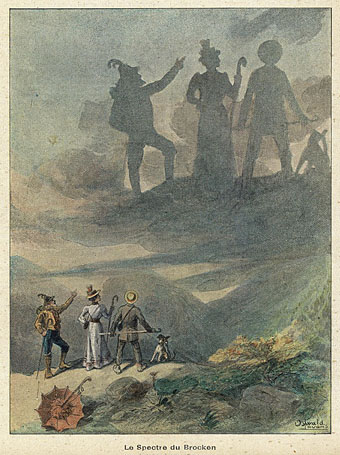
Rebecca Cole and Janise Elie go in search of the Brocken spectre on Burley Moor.

M. John Harrison: Critical Essays, edited by Rhys Williams and Mark Bould.

Forest of Resonating Lamps – One Stroke, Cherry Blossoms by teamLab.

• Tour de France: Jonathan Meades selects 13 exercise-bike Classics.

• At Greydogtales: The Cthulhu Mythos for Beginners.

The Black Tower (1987), a short film by John Smith.

• At Dennis Cooper’s: Jean Rollin Day.

Ishmael Reed doesn’t like Hamilton.

Babylonian Tower (1982) by Minimal Compact | The Tower (Black Advance) (2007) by Mordant Music | The Tower (Empty Fortress) (2007) by Mordant Music
Weekend links 453

mccarthy.jpg

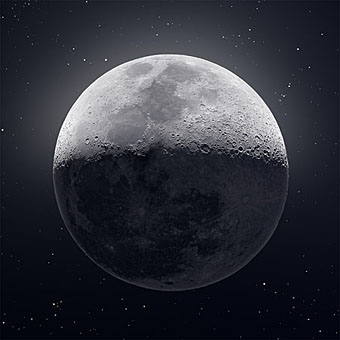
The Moon photographed by Andrew McCarthy.

• Top twenties of the week: Anne Billson on 20 of the best (recent) Japanese horror films, and Britt Brown‘s suggestions for 20 of the best New Age albums. (I’d recommend Journey To The Edge Of The Universe as the best from Upper Astral.) Related to the latter: Jack Needham on lullabies for air conditioners: the corporate bliss of Japanese ambient.

• At Expanding Mind: Erik Davis talks with writer and ultraculture wizard Jason Louv about occult history, reality tunnels, his John Dee and the Empire of Angels book, Aleister Crowley’s secret Christianity, and the apocalyptic RPG the West can’t seem to escape.

• “It’s like someone looked at the vinyl revival and said: what this needs is lower sound quality and even less convenience.” Cassette tapes are back…again. But is anyone playing them?

• Mixes of the week: Secret Thirteen Mix 280 by O Yuki Conjugate, Bleep Mix #53 by Pye Corner Audio, and 1980 by The Ephemeral Man.

• The fifth edition of Wyrd Daze—”The multimedia zine of speculative fiction + extra-ordinary music, art & writing”—is out now.

Midian Books has a new website for its stock of occult publications and related esoterica.

Mark Sinker on three decades of cross-cultural Utopianism in British music writing.

• At Dennis Cooper’s: Nastassja Kinski Day.

Utopia No. 1 (1973) by Utopia | Utopia (2000) by Goldfrapp | Utopian Facade (2016) by John Carpenter

Blood And Rockets by The Claypool Lennon Delirium

blood1.jpg

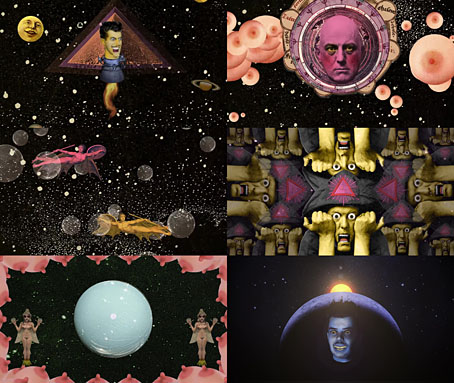
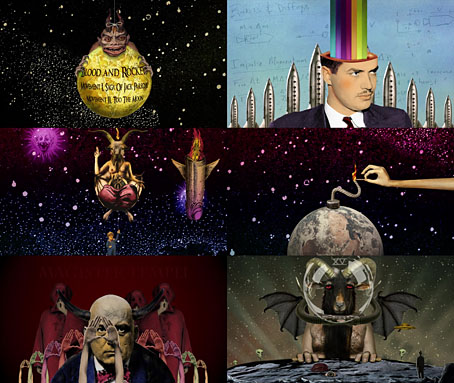
In an overburdened media landscape the words “Terry Gilliam-like animation” could easily mean some hastily-compiled film with a few nods to the collage style that Gilliam popularised in his interludes for the Monty Python TV series. Rich Ragsdale’s music video for The Claypool Lennon Delirium (Les Claypool and Sean Lennon) is much more than this, being a witty and inventive pastiche of the complete Gilliam style, replete with an abundance of sight gags, and familiar touches such as fizzing bombs, clutching hands and chattering heads.

blood2.jpg

The subject of the song is Jack Parsons, the ill-fated Californian rocket engineer whose wild life and entanglement with the West Coast chapter of Aleister Crowley’s Ordo Templi Orientis led to scandal and an untimely death. Parsons’ story is one of the more curious episodes in 20th-century occultism—a pre-Scientology L. Ron Hubbard was also involved in the Crowley shenanigans—but this must be the first time the history has been recounted in the form of a psychedelic ballad. Ragsdale is no slouch with the occult symbolism either, adding a number of Thelemic touches to the inevitable Satanic iconography. As befits the sex-obsessed Parsons the video also contains a fair amount of phallic imagery and boob constellations that somehow evaded the attentions of the YouTube Penis Police. Watch it here. (Thanks to Erik Davis!)

Previously on { feuilleton }
Aleister Crowley: Wandering The Waste revisited
Occult gestures
Konx om Pax
Aleister Crowley: Wandering The Waste
Brush of Baphomet by Kenneth Anger
Rex Ingram’s The Magician
The Mysteries of Myra
Gilliam’s shaver and Bovril by electrocution
Aleister Crowley on vinyl

Weekend links 450

redon.jpg

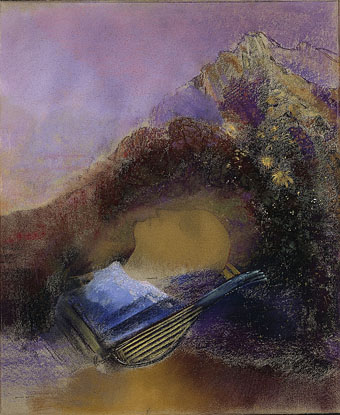
Orpheus (c. 1903–1910) by Odilon Redon. One of 30,000 public-domain images from the Cleveland Museum of Art’s collection.

• Network DVD has announced the premiere home release of Orson Welles’ Great Mysteries, a British TV series that ran from 1973 to 74. Welles’ involvement was limited to introducing each episode but the series itself was one I enjoyed a great deal: 26 short adaptations of period mystery stories that featured a wealth of British and American acting talent. The theme by John Barry was an additional bonus.

• The trailer for Apollo 11, a documentary by Todd Douglas Miller which presents for the first time the 70mm footage recording the Earth-bound parts of the Moon mission. Related: Michelle Santiago Cortés on how NASA used art to shape our vision of the future.

• At Dangerous Minds: a preview of Third Noise Principle, the latest in an excellent series of electronic music compilations from Cherry Red, and Cosey Fanni Tutti talks about her first solo album since 1983.

“The way I understood theory, primarily through popular culture, is generally detested in universities,” Mark [Fisher] told me in 2005, when I interviewed him for the Village Voice. “Most dealings with the academy have been literally clinically depressing.” He darkly surmised that his blog, K-Punk, and the surrounding blogosphere, “seemed like the space—the only space—in which to maintain a kind of discourse that had started in the music press and the art schools, but which had all but died out, with appalling cultural and political consequences.” Mark and the Village Voice are both dead now, leaving unfathomable voids in their wake.

Geeta Dayal on Mark Fisher

• At The Witch Wave: Peter Bebergal and Pam Grossman discuss Bebergal’s latest book (also my current reading), Strange Frequencies: The Extraordinary Story of the Technological Quest for the Supernatural.

• At Bandcamp: another release from the retro-synth cosmos of Jenzeits, and Ufology , an investigation of Britain’s flying-saucer landscape by Grey Frequency.

• Surprising collaboration of the week: Beth Gibbons and Krzysztof Penderecki have made a new recording of Henryk Górecki’s Third Symphony.

Alchemy (1969) the debut album by the Third Ear Band, receives an expanded reissue next month.

The Burn: a science-fiction story by Peter Tieryas with illustrations by Arik Roper.

• Mix of the week: Self-Titled Needle Exchange 275 by Black To Comm.

Amy Turk plays Bach’s Toccata and Fugue in D Minor on her harp.

Chrismarker.org is seeking donations.

Mystery Train (1955) by Elvis Presley | Mystery R.P.S. (No 8) (1981) by Holger Czukay, Jah Wobble, Jaki Liebezeit | Mystery Room (1985) by Helios Creed

Weekend links 446

pca.jpg

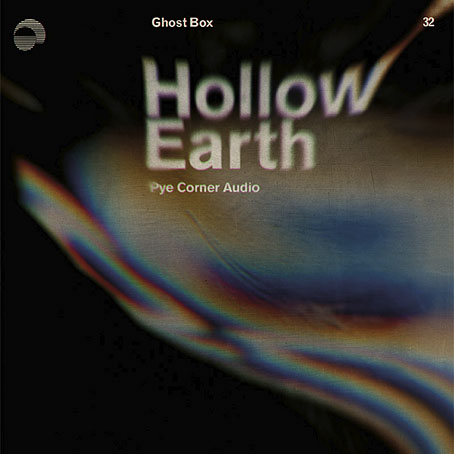
The Ghost Box label releases a new album by the excellent Pye Corner Audio in February (previews are here). The spectral design, as ever, is by Julian House.

• “In October 1966, Phyllis Willner arrived on motorcycle in San Francisco as a teenage Jewish runaway from Jamaica, Queens. She quickly fell in with the Hell’s Angels, the San Francisco Mime Troupe and, most crucially, the Diggers, who were just getting their street radical thing together in the Haight-Ashbury. The next two years would be eventful: many extraordinary highs, some really terrible lows.” Jay Babcock talks to Phyllis Willner about her involvement with “the executive branch of the hippie movement”, the Diggers.

• At Expanding Mind: Erik Davis talks with religious scholar Diana Pasulka about UFOs, scientific believers, book encounters, elite cabals, studying weirdness, and her new book American Cosmic: UFOs, Religion, Technology.

• Kenneth Anger is now 91 but he still appears hale, and looks even more magus-like than ever. This short film by Floria Sigismondi finds him reminiscing in the antiquated confines of the Chateau Marmont hotel on Sunset Boulevard.

David Wojnarowicz did not write dark fantasy. He wrote real life. In The Waterfront Journals he brilliantly captures electric tales from the mouths of strangers, those he described as “junkies, prostitutes, male hustlers, truck drivers, hobos, young outlaws, runaway kids, criminal types”, whose lives echo his own ostracized existence. He was thirteen when he was first paid for sex and sixteen when he started “turning tricks” regularly. His mother kicked him out of the house. By the time Wojnarowicz came out to friends in New York, he was in his early twenties. He was on the cusp of finding his voice as a writer and his confidence as an artist. It was the mid-1970s. AIDS was about to tear through the gay community.

Lara Pawson reviews three books by artist and writer David Wojnarowicz

John Banville reviews Kafka’s Last Trial by Benjamin Balint: “A scrupulous study of the squabble between Germany and Israel over Kafka’s papers, and the two women caught in the middle.”

• A sitting with the diva of the diode: electronic musician Suzanne Ciani in conversation with Christine Kakaire.

• Mixes of the week: Secret Thirteen Mix 076 by KK Null, and XLR8R Podcast 574 by SHXCXCHCXSH.

Cassie Packard on the colorful and clairvoyant history of aura photography.

Edward Gorey’s Children’s Books Illustrations, Revisited.

Alison Flood on the fascination of miniature books.

Magic Hollow (1967) by The Beau Brummels | Hollow Stone (1972) by Khan | Through Hollow Lands (For Harold Budd) (1977) by Brian Eno