Ron Hays Music Image: Odyssey

hays1.jpg

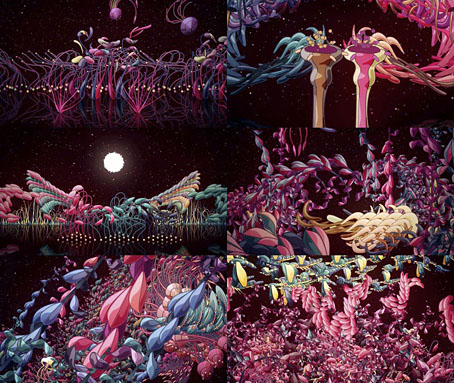
More of an oddity than an odyssey, discovered while browsing YouTube. Ron Hays Music Image: Odyssey is a 45-minute collection of video-synth graphics, animation and other effects made for Pioneer’s LaserDisc system in 1979. Among the visuals there’s slit-scan work from Con Pederson, creator of some of the effects for 2001: A Space Odyssey, animation by John Whitney, rudimentary computer graphics, and some very of-their-time dance sequences with glowing women working out in a cosmic void.

hays2.jpg

Each sequence is set to a different piece of music provided by Wagner, Pachelbel, Frank Serafine, and Larry Fast aka Synergy. It’s difficult to imagine anyone paying money to watch this unless it was the only disc on sale; more likely it would have been playing in television shops as a promotional tool, although you can also imagine it being piped into the rooms of inmates of the Arboria Institute in Beyond the Black Rainbow. I used to own Games, the Synergy album from which Delta 1 is taken. Hearing that piece again makes me regret getting rid of the album several years ago.

Elsewhere on { feuilleton }
The abstract cinema archive

Weekend links 277

elledge.jpg

Sunday by Amanda Elledge.

• Coming from Strange Attractor this November: The Moons at Your Door, an anthology of strange tales selected by David Tibet. “The Moons At Your Door collects over 30 tales, both familiar and unknown from: Robert Aickman, Algernon Blackwood,  DK Broster, AM Burrage, RW Chambers,  Aleister Crowley, Sheridan Le Fanu, Elizabeth Gaskell, WW Jacobs, MR James, Vernon Lee, LA Lewis, Thomas Ligotti, Arthur Machen, Guy de Maupassant, Perrault, Thomas De Quincey, Saki, Count Stenbock, Montague Summers, HR Wakefield and Edith Wharton. The volume also includes extracts and translations by the author from Babylonian, Coptic and Biblical texts alongside poems and fairy tales.”

Gay-rights activists give their verdict on Stonewall: “This film is no credit to the history it purports to portray”. The only surprise about this episode is that anyone expected Roland Emmerich to make a historically accurate film in the first place. Related: Edmund White’s first-hand report written a few days after the riots.

• “If you hate [Boom!], I hate you, and I could never be your friend or your boyfriend. Divine and I had seen Boom! right before we made Pink Flamingos, and it’s about Elizabeth Taylor, retired, writing her memoirs, which is what Pink Flamingos was too, in a way.” John Waters (again) gives Hayley Campbell some dating tips.

• “We moderns may too-often suffer from a mixing up of historical sequences, but better that, surely, than risk raising a population that is entirely not-arsed about its past.” Julian Cope explores the Celts: Art and Identity exhibition at the British Museum, London.

• “But I am talking about psychedelic music, and obviously some of that comes from early psychedelic rituals, which are all about losing yourself…and I did come back into the world in a different way.” Natasha Khan on her new musical project, SEXWITCH.

• At Dangerous Minds: Vincent Price teaches the dark arts on his 1969 album An Adventure in Demonology.

• A trailer for Salthouse Marshes, “a short, landscape obsessed ghost story” by Adam Scovell.

• Rare video of Young Marble Giants playing for 45 minutes in Vancouver, 1980.

• A collection of Ghost Box posters and flyers designed by Julian House.

• Mix of the week: Secret Thirteen Mix 163 by Ssleeping desiresS.

Ministry, a new photo series by Ellen Rogers.

Julia Holter‘s favourite albums.

Boom Stix (1962) by Curley & the Jades | Things That Go Boom In The Night (1981) by Bush Tetras | Boom! (1991) by The Grid

Weird metal

shadow1.jpg

Weird metal isn’t A Thing, is it? I reckon it ought to be A Thing, especially when so much black/death/doom/drone metal intersects with The Weird. I mentioned last month that British doomsters The Wounded Kings had used my De Profundis piece for the gatefold and poster insert in their reissue of The Shadow Over Atlantis. My copy of the album arrived this week; it’s a handsome production that sounds tremendous so I’m very pleased to be associated with it. The relationship to Cthulhu isn’t as overt as more well-known compositions such as The Call of Ktulu by Metallica or Cthulhu Dawn by Cradle of Filth. But those are one-off pieces whereas The Shadow Over Atlantis sustains its atmosphere of cosmic dread throughout. It’s available from Ván Records, and I recommend it highly.

shadow2.jpg

All of which reminded me that my Lovecraftian art has featured sporadically in the metal world over the past few years. In the margins of my discographic work you’ll find the following releases.

otao.jpg

Thought-Cathedral (2000) by Of Trees and Orchids.

The perennially popular view of R’lyeh is featured on the cover of the second album by a German death metal band who later changed their name to Ingurgitating Oblivion. Inside the CD there’s also a detail from a Cthulhu drawing of mine.

azathoth.jpg

Azathoth (2007) by Azathoth.

There are many bands named after Lovecraft’s chaotic deity. This group is from the US, and this EP is their only substantial release to date.

portal.jpg

Demonstration 1998 (2009) by Portal.

And there are many groups named Portal. This lot are Australian, and have been going longer than most. Demonstration 1998 is a reissue on 7-inch vinyl of a cassette demo from 1998; the sleeve art shows a fuzzy detail from my R’lyeh spread from The Call of Cthulhu. Nobody asked permission to use the artwork, I only discovered this release since I get a credit for it on Discogs. So there may well be other releases out there that I haven’t seen yet. If you know of one then leave a comment or send an email.

Previously on { feuilleton }
The Shadow Over Atlantis by The Wounded Kings
Rock shirts
De Profundis

The original Gandharva

gandharva1.jpg

Cover art by Wilfried Sätty. Lettering by David Singer.

Collage artist Wilfried Sätty has been in my thoughts this month, it being ten years ago that Jay Babcock, Richard Pleuger and I drove up to San Francisco and Petaluma to talk to Walter Medeiros and David Singer about Sätty’s life and work. Looking today at the Sätty cover art for Gandharva (1971) by Beaver & Krause reminded me that the original pressing of this album came with the sleeve in a predominantly pink colouration rather than the more familiar blue. I have three copies of the album—vinyl and two CDs, one of which pairs it with Beaver & Krause’s In A Wild Sanctuary (1970)—but I’ve never seen one of the pink variations, and didn’t even know they existed until they started appearing on the web. The CD reissues favour the blue version, as do I, although this may only be a result of familiarity. I’ve enthused about Sätty’s cover a couple of times already but the music is worth hearing for its connections backwards to Cammell & Roeg’s Performance (for which B&K provided the ominous synthesizer tones), and forwards to Robert Fuest’s The Final Programme. Fuest asked Gerry Mulligan to score his film after hearing the Gandharva suite (described in the sleeve notes as “a score from a non-existent film”) which occupies side two of the album.

gandharva2.jpg

Elsewhere on { feuilleton }
The album covers archive

Previously on { feuilleton }
The Occult Explosion
Wilfried Sätty album covers
Nature Boy: Jesper Ryom and Wilfried Sätty
Wilfried Sätty: Artist of the occult
Illustrating Poe #4: Wilfried Sätty
Gandharva by Beaver & Krause

Weekend links 276

hope.jpg

Beautiful Void: Holy Void II (2015) by Andy Diaz Hope.

• “Feeling like a woman. Looking like a man.” Rick Poynor on the cover art for Nightclubbing by Grace Jones. Related: A One Man Show, Jean-Paul Goude’s essential film of Jones’ 1982 tour where many of the songs are better than their album versions.

• Crammed Discs’ revival of the Made To Measure series continues with the release in October of Blue Velvet Revisited by Tuxedomoon & Cult With No Name, a soundtrack from the Peter Braatz documentary about David Lynch’s film.

• “We were learning from point zero; we created something that wasn’t around before…” Hans-Joachim Roedelius talking to Bruce Tantum about his work with Cluster and Harmonia.

• “In the Shangri-La pool there are no floating impurities. Apart from myself.” Iain Sinclair swims in “the highest pool in Europe” on the 52nd floor of The Shard, London.

• From 2012: “Possible Bubbles of Spacetime Curvature in the South Pacific” by Benjamin K. Tippett.

• After 23 years of delays and bootleg versions, Backwards by Coil is being given an official release.

• “Relaxed terror”, “perky dismay” and “unspecified uncertainty”: library music at Scarfolk.

• Mix of the week: a 4-hour collection of favourite music compiled by Autechre.

Masakazu Shirane and Reuben Young make a human-size kaleidoscope.

• “I always was a weird child,” says John Waters.

• A new version of Argent by Jane Weaver.

Chaos Magic (sic): The Fashion Trend

Void (2009) by Monolake | Void (2011) by Emptyset | Void (2014) by The Bug feat. Liz Harris