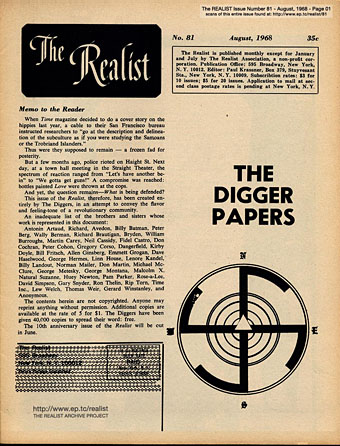
The Digger issue, August 1968.
Here’s something of major importance, The Realist Archive Project. Four complete issues online so far, with a promise of all 146 issues to be uploaded eventually. The Realist started out as a satirical magazine in the late Fifties and moved into the slipstream of the counter-culture as the Sixties progressed. Editor Paul Krassner is introduced in the RE/Search Pranks (1987) book thus:
Paul Krassner is famous for doing The Realist (1958-1974; now revived), described by OUI magazine as “the most satirical and irreverent journal to appear in America since the days of HL Mencken.” The Realist published explicit photos, outrageous cartoons, vicious satire, and extreme paranoid conspiracy theories on topics ranging from the Kennedy assassinations to Jonestown. When Mike Wallace asked him on a 60 Minutes interview about the difference between the underground press and mainstream media, he told him that Spiro Agnew was an anagram for Grow A Penis, adding, “The difference is that I could print that in the Realist, but it’ll be edited out of this program.” That prediction came true. Harry Reasoner said of Krassner that he “not only attacks establishment values; he attacks decency in general.”
During his lifetime of weird experiences and friendships with notables like Lenny Bruce and Timothy Leary, Krassner claims (among other things) to have taken LSD when he testified at the Chicago 8 trial, on the Johnny Carson show, with Groucho Marx, and with Squeaky Fromme and Sandra Good. In 1977 he became publisher of Hustler magazine for six months.
I first encountered the Realist from mentions in Robert Anton Wilson’s books (RAW was one of its writers) but, unlike UK undergrounds which often turned up secondhand, there was no way to ever see a copy over here. Hence the value of this archive. If you want an idea of Krassner’s outrageousness—which makes much of the political sniping of Private Eye seem very tame indeed—look no further than the May 1967 issue with its lead story describing Lyndon B Johnson fucking the dead John F Kennedy’s neck wound shortly before his being sworn in as president. And in the same issue there’s the notorious cartoon spread by Wally Wood depicting a host of Disney characters doing all the things that recently-deceased Uncle Walt wouldn’t allow them to do in the cartoons. That drawing was so scurrilous that it’s generally supposed Disney preferred not to sue for fear of giving it greater publicity.
The issue edited by the anarchist Diggers was altogether more serious, and the list of names involved shows a lineage connecting the Beats to the hippies:
Memo to the Reader
When Time magazine decided to do a cover story on the hippies last year, a cable to their San Francisco bureau instructed researchers to “go at the description and delineation of the subculture as if you were studying the Samoans or the Trobriand Islanders.”
Thus were they supposed to remain—a frozen fad for posterity.
But a few months ago, police rioted on Haight St. Next day, at a town hall meeting in the Straight Theater, the spectrum of reaction ranged from “Let’s have another be-in” to “We gotta get guns!” A compromise was reached: bottles painted Love were thrown at the cops.
And yet, the question remains—What is being defended?
This issue of the Realist, therefore, has been created entirely by The Diggers, in an attempt to convey the flavor and feeling-tone of a revolutionary community.
An inadequate list of the brothers and sisters whose work is represented in this document:
Antonin Artaud, Richard Avedon, Billy Batman, Peter Berg, Wally Berman, Richard Brautigan, Bryden, William Burroughs, Martin Carey, Neil Cassidy, Fidel Castro, Don Cochran, Peter Cohon, Gregory Corso, Dangerfield, Kirby Doyle, Bill Fritsch, Allen Ginsberg, Emmett Grogan, Dave Haselwood, George Hermes, Linn House, Lenore Kandel, Billy Landout, Norman Mailer, Don Martin, Michael McClure, George Metesky, George Montana, Malcolm X, Natural Suzanne, Huey Newton, Pam Parker, Rose-a-Lee, David Simpson, Gary Snyder, Ron Thelin, Rip Torn, Time Inc., Lew Welch, Thomas Weir, Gerard Winstanley, and Anonymous.
The contents herein are not copyrighted. Anyone may reprint anything without permission. Additional copies are available at the rate of 5 for $1. The Diggers have been given 40,000 copies to spread their word: free.
Many of those writers are no longer around but happily Paul Krassner is and he’s been writing regularly for The Huffington Post, the Arthur magazine weblog and other sites.
Via Boing Boing.
Previously on { feuilleton }
• Ginsberg’s Howl and the view from the street
• Simplicissimus
• Revenant volumes: Bob Haberfield, New Worlds and others
• Underground history
• Wallace Burman and Semina
• Robert Anton Wilson, 1932–2007
• Barney Bubbles: artist and designer
• 100 Years of Magazine Covers
• Oz magazine, 1967-73