Weekend links: the queer edition

queer.jpg

A T-shirt design by artist Daryl Vocat.

• Tove Jansson: Out of the Closet. The unorthodox life and work of the woman who gave us the Moomins.

• Submissions are now open for PANK’s October special online issue featuring Queer prose, poetry & art.

• More new magazines: Zeus and Made in Brazil Magazine, the latter being a spin-off from the justly-praised weblog of Brazilian hotness.

• An old magazine, called, er…Magazine: “Everything about Magazine was new, from the stark photoless cover design with its bold typeface to the way the men were photographed. The pictures weren’t overtly sexual, but proudly confronted the viewer in a different way: “To us, showing a face was the most important thing because back in 1980, gay people still had to hide their faces,” Lestrade says.” A few pictures from Magazine.

• Revealed: The Tradition of Male Homoerotic Art, an exhibition at the Leslie-Lohman Gallery, NYC, from May 12th.

• The programme for the International Dublin Gay Theatre Festival which is running to May 16th.
scissors.jpg

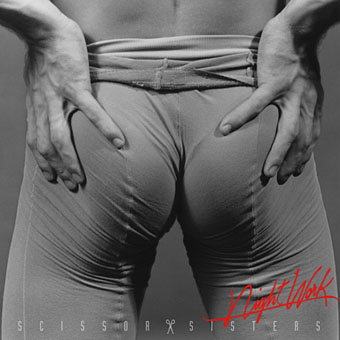
• Scissor Sisters have a new album, Night Work, out next month. The cover picture is a photo of dancer Peter Reed by Robert Mapplethorpe. Antony and the Johnsons have announced a new album (and accompanying book) for October.

• Headline of the week: “Christian right leader George Rekers takes vacation with ‘rent boy’ ”. Rekers took issue with the story; his Rentboy.com escort took issue with Rekers’ issue-taking. Then things became unpleasant. And now another escort has come forward.

• Henry & Glenn Forever, “a love story to end all love stories”. “Who knew Rollins was such a caring spouse? Who knew Hall and Oates were so infernally evil—yet so considerate?”

• This week’s Tumblr silliness: Lesbians Who Look Like Justin Bieber.

• I’m not on Facebook, nor will I ever be. If you are, however, here’s ten reasons why you should quit. The EFF has six things you need to know about Facebook Connections. Wired thinks that Facebook has gone rogue and an alternative is needed. What does Facebook publish about you and your friends? Finally, Gawker has ten reasons why you’ll be on Facebook forever.

• The Prague Pneumatic Post.

• How to serve absinthe.

• Cthulhu is not cute.

• Song of the week: Gay Messiah by Rufus Wainwright.
Jugend, 1900

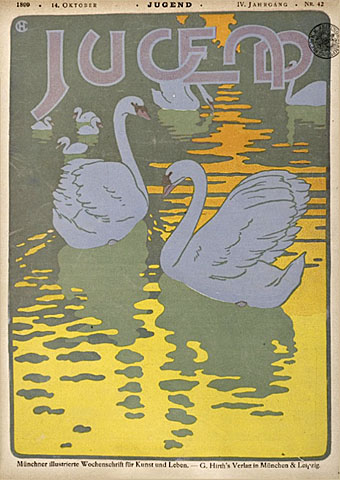
jugend-1900-01.jpg

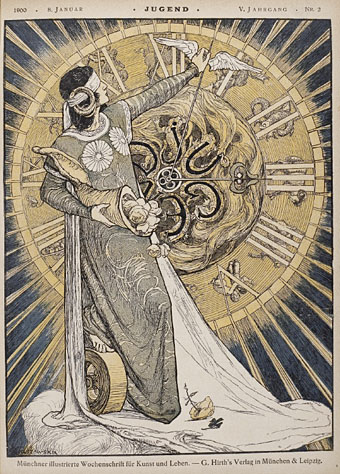
Continuing the rake through back issues of Jugend magazine, the German fin de siècle periodical of “art and life”, this post covers the year 1900 and will be the final Jugend image trawl. I mentioned in the post for 1899 that the magazine loses its Art Nouveau dynamism as the years pass. 1900 represents the point where all the graphics which make Jugend valued today—and which gave the name to the German manifestation of Art Nouveau: Jugendstil—are being pushed aside by the burgeoning nationalist and militarist fervour which led eventually to the First World War. At this point a couple of the notable Art Nouveau stylists such as Otto Eckman and Julius Diez are still present, and the work of Hugo Höppener, aka “Fidus” is increasingly prominent. In subsequent years the eccentric Fidus is mostly on his own, pursuing his obsession with naked figures, and his work seems even more curious in such staid surrounds. As before, anyone wanting to see more of these graphics is advised to explore the bound volumes at the Heidelberg University archive. The two books for 1900 can be found here and here.

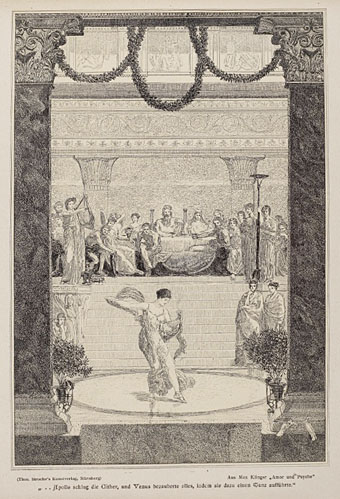
jugend-1900-02.jpg

A picture by the Symbolist and Secession artist, Max Klinger.

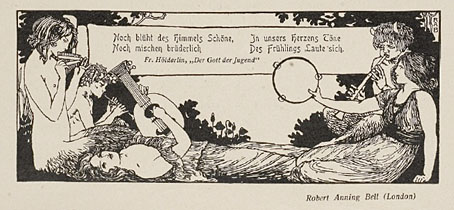
jugend-1900-03.jpg

Nymphs and satyrs by English artist and illustrator Robert Anning Bell.

Continue reading “Jugend, 1900”

Weekend links 12

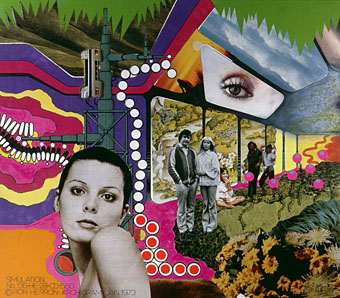
archigram.jpg

Simulation No. 136 (1973); From the Archigram Revival Project.

• Scientific American looks at DMT: “the only psychedelic known to occur naturally in the human body”. Related: Hofmann’s Elixir: LSD and the New Eleusis, a book from the Beckley Foundation Press.

• “People weren’t quite sure what this guy was doing.” Colin Marshall talks to Eno biographer David Sheppard.

• LA FAN presents its debut group show, Eve in the Garden of Lost Angels, curated by Milla Zeltzer, at Optical Allusion Gallery, downtown Los Angeles, from May 15 to June 12, 2010.

• Masturbation: literature’s last taboo. The words “last” and “taboo” should never be used together; taboos don’t vanish, they migrate.

• Announcing the Text: Development of the Title Page, 1470–1900.

• The Anachronism is an award-wining Steampunk short about two children who discover the wreck of a giant squid submarine on a beach near their home.

• Out There is a brand new, bi-annual, international magazine for gay men and their friends.

• The Big Picture looks at the eruption of Eyjafjallajokull.

• Expo 2010 opens in Shanghai on May 1st.

• (Walter) Benjamin in Extremis.

• Nathalie returns to Bomarzo.

• Acronymic songs of the week: Lucy In The Sky With Diamonds (1967) by The Beatles; The Stars That Play With Laughing Sam’s Dice (1967) by The Jimi Hendrix Experience; London Social Degree (1968) by Billy Nicholls; Love’s Secret Domain (1991) by Coil.

Jugend, 1899

jugend-99-01.jpg

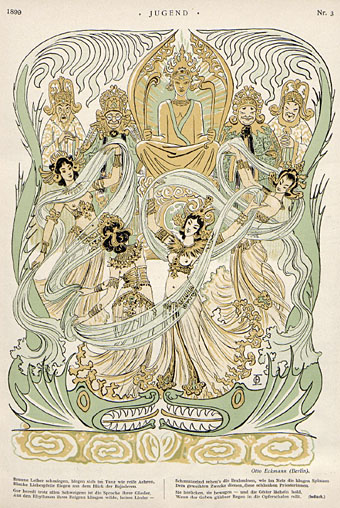
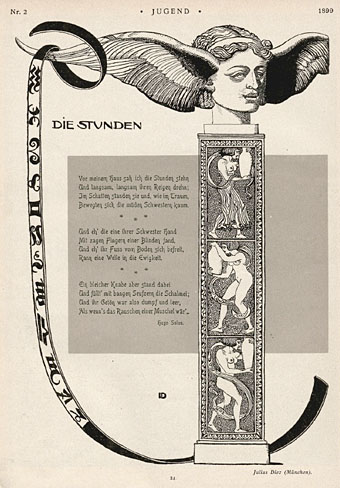
Continuing the delve into back issues of Jugend magazine, the German fin de siècle periodical of “art and life”, this post covers the year 1899. The earlier years of the magazine are replete with a variety of elegant and often bizarre graphics, as well as some classic examples of Art Nouveau graphic design. 1899 is the point in the magazine’s history that the variety (and, for me, the interest) begins to diminish. The covers lose their earlier inventiveness while the Art Nouveau stylings within are being replaced by drab illustrations of the German middle classes and patriotic depictions of country folk. There are still gems to be found, however, some of which follow below. As before, anyone wanting to see more of these graphics is advised to explore the bound volumes at the Heidelberg University archive. The two books for 1899 can be found here and here.

jugend-99-02.jpg

Otto Eckman (above) and Julius Diez (below) were heavily featured in the earlier years of the magazine and Diez in particular produces some of the best work in this year’s run.

jugend-99-03.jpg

Continue reading “Jugend, 1899”

Mayuri lute

lute.jpg

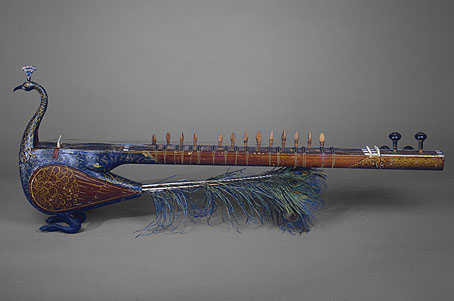
Mayuri means “peacock” and although this splendid instrument doesn’t look like a European lute, a lute it is, albeit styled for Indian court performances. Via Wunderkammer.

Popular at nineteenth-century Indian courts, this bowed lute borrows features of other Indian stringed instruments, such as the body shape of the sarangi and the frets and neck of the sitar. There are four melody strings and fifteen sympathetic strings, which sound when the instrument is played to accompany popular religious song. The peacock is the vehicle of Sarasvati, the goddess of music, and it appears in Indian poetry as a metaphor for courtship. (More.)

peacock-crane.jpg

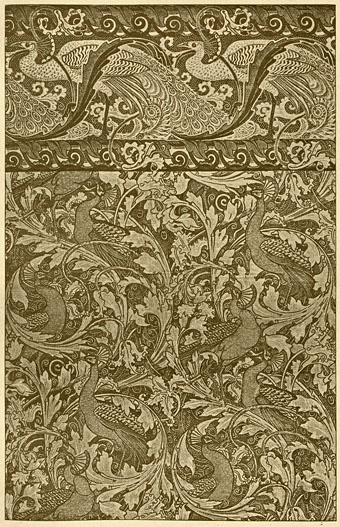
As a complement, here’s something I’m still hoping to find in a good colour reproduction, all one usually sees are details. The Peacock Garden (1889) was one of a number of wallpaper designs created for William Morris by Walter Crane. This copy showing the full pattern is from an 1897 issue of the German arts periodical Pan, part of a section highlighting arts and crafts in England. Walter liked his peacocks, here’s Juno and her birds from The Baby’s Own Aesop (1887).

Previously on { feuilleton }
• Jaipur peacocks
• Maruyama Okyo’s peacocks
• Louis Rhead’s peacocks
• The White Peacock
• Peacocks
• Whistler’s Peacock Room
• Beardsley’s Salomé