Weekend links 12

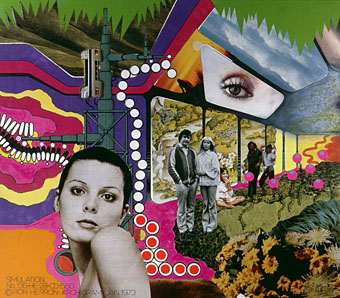
archigram.jpg

Simulation No. 136 (1973); From the Archigram Revival Project.

Scientific American looks at DMT: “the only psychedelic known to occur naturally in the human body”. Related: Hofmann’s Elixir: LSD and the New Eleusis, a book from the Beckley Foundation Press.

• “People weren’t quite sure what this guy was doing.” Colin Marshall talks to Eno biographer David Sheppard.

• LA FAN presents its debut group show, Eve in the Garden of Lost Angels, curated by Milla Zeltzer, at Optical Allusion Gallery, downtown Los Angeles, from May 15 to June 12, 2010.

Masturbation: literature’s last taboo. The words “last” and “taboo” should never be used together; taboos don’t vanish, they migrate.

Announcing the Text: Development of the Title Page, 1470–1900.

The Anachronism is an award-wining Steampunk short about two children who discover the wreck of a giant squid submarine on a beach near their home.

Out There is a brand new, bi-annual, international magazine for gay men and their friends.

The Big Picture looks at the eruption of Eyjafjallajokull.

Expo 2010 opens in Shanghai on May 1st.

• (Walter) Benjamin in Extremis.

Nathalie returns to Bomarzo.

• Acronymic songs of the week: Lucy In The Sky With Diamonds (1967) by The Beatles; The Stars That Play With Laughing Sam’s Dice (1967) by The Jimi Hendrix Experience; London Social Degree (1968) by Billy Nicholls; Love’s Secret Domain (1991) by Coil.
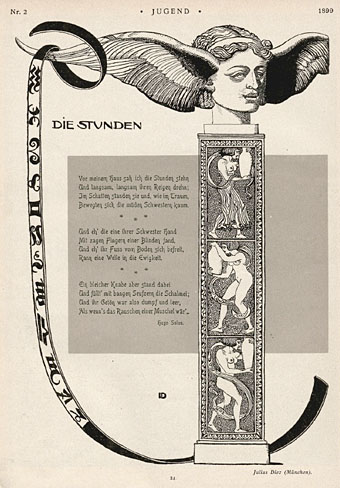
Jugend, 1899

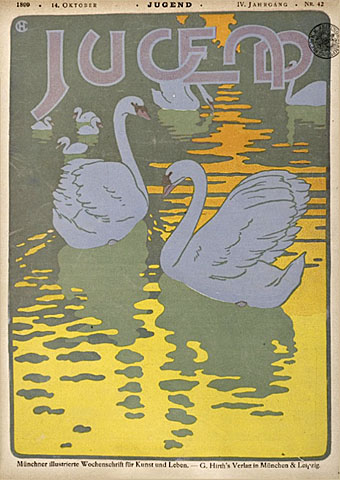
jugend-99-01.jpg

Continuing the delve into back issues of Jugend magazine, the German fin de siècle periodical of “art and life”, this post covers the year 1899. The earlier years of the magazine are replete with a variety of elegant and often bizarre graphics, as well as some classic examples of Art Nouveau graphic design. 1899 is the point in the magazine’s history that the variety (and, for me, the interest) begins to diminish. The covers lose their earlier inventiveness while the Art Nouveau stylings within are being replaced by drab illustrations of the German middle classes and patriotic depictions of country folk. There are still gems to be found, however, some of which follow below. As before, anyone wanting to see more of these graphics is advised to explore the bound volumes at the Heidelberg University archive. The two books for 1899 can be found here and here.

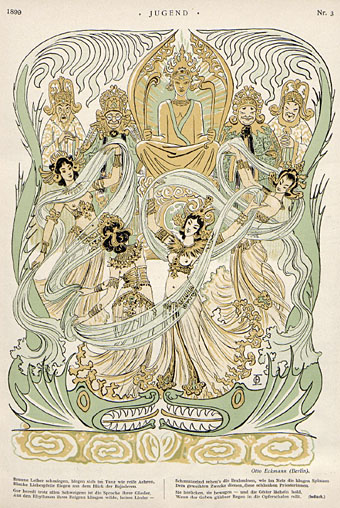
jugend-99-02.jpg

Otto Eckman (above) and Julius Diez (below) were heavily featured in the earlier years of the magazine and Diez in particular produces some of the best work in this year’s run.

jugend-99-03.jpg

Continue reading “Jugend, 1899”

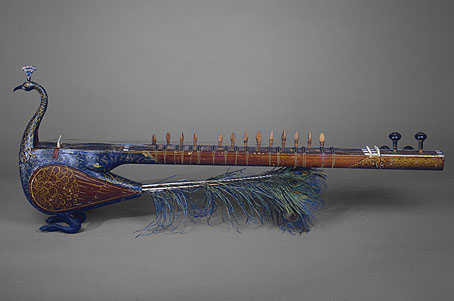
Mayuri lute

lute.jpg

Mayuri means “peacock” and although this splendid instrument doesn’t look like a European lute, a lute it is, albeit styled for Indian court performances. Via Wunderkammer.

Popular at nineteenth-century Indian courts, this bowed lute borrows features of other Indian stringed instruments, such as the body shape of the sarangi and the frets and neck of the sitar. There are four melody strings and fifteen sympathetic strings, which sound when the instrument is played to accompany popular religious song. The peacock is the vehicle of Sarasvati, the goddess of music, and it appears in Indian poetry as a metaphor for courtship. (More.)

peacock-crane.jpg

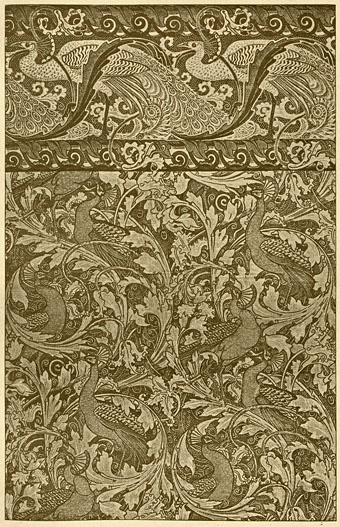
As a complement, here’s something I’m still hoping to find in a good colour reproduction, all one usually sees are details. The Peacock Garden (1889) was one of a number of wallpaper designs created for William Morris by Walter Crane. This copy showing the full pattern is from an 1897 issue of the German arts periodical Pan, part of a section highlighting arts and crafts in England. Walter liked his peacocks, here’s Juno and her birds from The Baby’s Own Aesop (1887).

Previously on { feuilleton }
Jaipur peacocks
Maruyama Okyo’s peacocks
Louis Rhead’s peacocks
The White Peacock
Peacocks
Whistler’s Peacock Room
Beardsley’s Salomé

Weekend links 9

arthur7.jpg

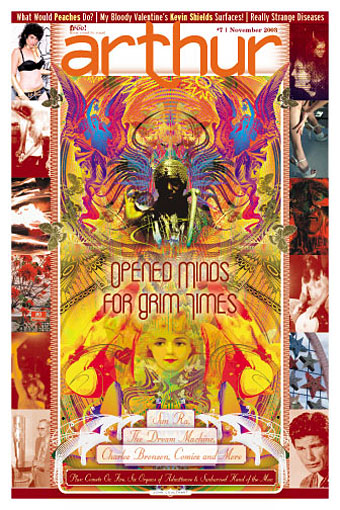
Own a copy of Arthur #7 (October 2003) with my swirling cover pic featuring cosmic jazz maestro Sun Ra. Lots of good stuff inside, details here.

Spinetingler Magazine announced their nominees the 2010 Spinetingler Award this week. Jeff VanderMeer’s Finch is one of the titles in the Best Novel category while my cover for Jeff’s book is in the Best Cover category.

• A Journey Round My Skull posted the results of the Raymond Roussel illustration contest. Entrants were asked to read Roussel’s story Bertha, The Child-Flower then create a picture based on that.

Has Dottie got legs? The New Criterion on the poetry of Dorothy Parker.

• The gays: Fuck Yeah Hot Weird Guys, more from the Tumblr hall of mirrors; Simon Callow reviews Gay Icons Through the Ages by Tom Ambrose; Wessel + O’Connor Fine Art is open again with a new exhibition at a new location in Lambertville, NJ; some things never change: “Secret tape reveals Tory backing for ban on gays.”

• “Make the inaccessible exciting.” Colin Marshall interviews Chris Bohn, editor of music magazine The Wire.

• More music: Jon Savage’s brief history of Krautrock. The new Soul Jazz compilation, Deutsche Elektronische Musik, is released next week.

Sage of the Apocalypse; Samuel R Delany’s Dhalgren comes to the stage in New York.

• Further Penguin fetishism: “Penguin Decades bring you the novels that helped shape modern Britain.”

• Yes, they’re out there, the Clients From Hell. For a palliative there’s Herbert W Kapitzki’s elegant poster designs from the 1960s.

• Song of the week: House of Glass (1967) by The Glass Family.

The Dukes declare it’s 25 O’Clock!

dukes1.jpg

25 O’Clock (1985). Andy Partridge’s great cover design.

The DUKES say it’s time…it’s time to visit the planet smile…it’s time the love bomb was dropped…it’s time to eat music…it’s time to kiss the sun…it’s time to drown yourself in SOUNDGASM and it’s time to dance through the mirror. The DUKES declare it’s 25 O’CLOCK.

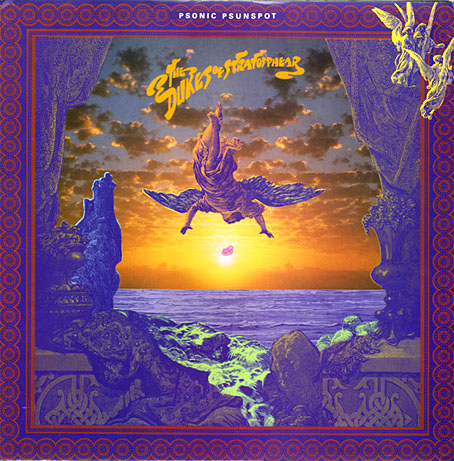
It was twenty-five years today—April 1st, 1985—that Virgin Records released what was supposed to be a reissue of a lost psychedelic album from the late 1960s, 25 O’Clock by The Dukes of Stratosphear. The catalogue number was WOW 1 and the vinyl label was printed with the old black-and-white Virgin logo by Roger Dean even though Virgin Records wasn’t founded until 1972. No one was supposed to know that the album was really a pastiche project by XTC but I don’t recall anyone actually being fooled by this, all the reviews acknowledged XTC as the originators, and band members Andy Partridge and Colin Moulding were happy to give interviews enthusing about their musical obsessions. As well as being incredibly successful artistically the album was a surprising commercial success which led the bemused record label to ask for a sequel. Psonic Psunspot followed two years later, and the Dukes’ vibe infected XTC’s own work for a while, with their 1988 album, Oranges & Lemons, pitched somewhere between the pastiches and XTC’s more usual sound .

dukes2.jpg

Psonic Psunspot (1987). Design by Dave Dragon and Ken Ansell.

Continue reading “The Dukes declare it’s 25 O’Clock!”