The Return of the Sorcerer

sorcerer1.jpg

The story’s first appearance in Strange Tales of Mystery and Terror, September 1931. No illustrator credited.

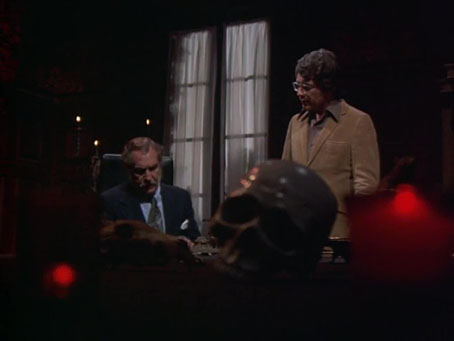
Rod Serling’s Night Gallery is a series I’d have happily watched if one of the UK channels had rebroadcast it in the 1980s, the way that Channel 4 did with the original Twilight Zone. This weekend I watched for the first time the opening episode of Night Gallery‘s third and final season, an adaptation by Halsted Welles of Clark Ashton Smith’s The Return of the Sorcerer. Smith is a writer whose works are still mostly neglected by film and television but he was in good company in Night Gallery, a series which featured adaptations of stories by a number of fellow Weird Tales writers including HP Lovecraft, Fritz Leiber and Robert Bloch. The story is one of Smith’s modern-day horror tales in which a poverty-stricken translator is offered a lucrative position at an old and sinister house, a place where a fearful occultist requires translations of an ancient volume. The Arabic text turns out to be passages from an early edition of everybody’s favourite forbidden tome, the Necronomicon, and Smith’s story, which was published in Strange Tales of Mystery and Terror in 1931, is the first outside Lovecraft’s own to mention the book, thus beginning the expansion of the Cthulhu Mythos by other hands.

sorcerer2.jpg

The Night Gallery adaptation was broadcast in 1972. Unlike the first two seasons, where episodes ran for an hour, the third season reduced the running time to under 30 minutes which doesn’t give director Jeannot Szwarc (credited as Jean Szwarc) any time to build up the suspense, if he was capable of such a thing. If you’ve ever seen any of Swarc’s feature films you know not to raise your expectations. As a compensation for the absense of atmosphere we get some striking set designs and a decent cast. The fearful magus, John Carnby, is played by Vincent Price, encountering the Necronomicon for the second time in his career after he’d earlier used the book to summon an eldritch monstrosity in Roger Corman’s The Haunted Palace. Bill Bixby plays the wary translator, while Patricia Sterling is Carnby’s toad-loving partner in Satanism, an addition to the story by Halstead Welles, whose presence adds an extra dimension to the proceedings. The episode could never be considered a lost classic but I enjoy seeing stories by the Weird Tales writers making their first infiltrations into the wider culture. This one is worth watching for Vincent Price and the magical decor alone. I think I ought to go looking for more Night Gallery episodes.

sorcerer3.jpg

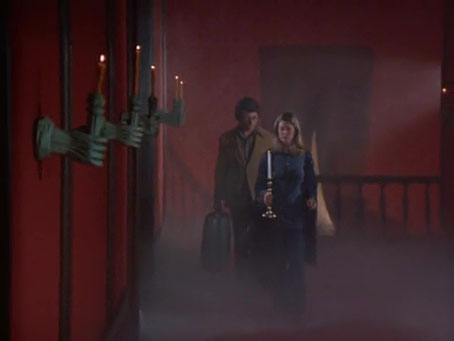
More of those Cocteau hands-through-the-wall. Bixby’s character doesn’t seem very perturbed that the scarlet hall is filled with mysterious vapours.

sorcerer4.jpg

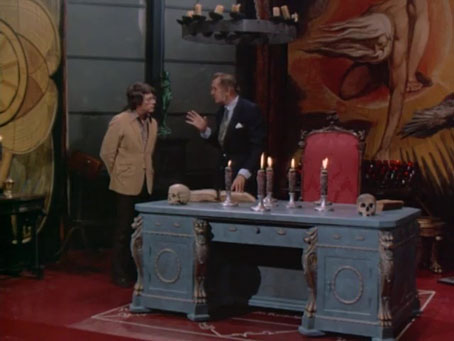
Mystical decor: on the left, Frieda Harris’s Ace of Discs from the Thoth Tarot deck; on the right, The Ancient of Days by William Blake.

sorcerer5.jpg

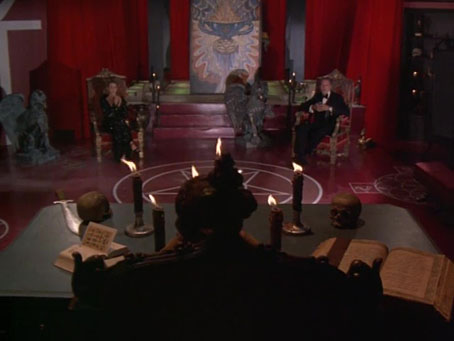
Mystical/Satanic decor: the painting in the background is Frieda Harris’s Ace of Cups from the Thoth Tarot deck.

Previously on { feuilleton }
The Cthulhu Mythos in the pulps
Illustrating Zothique
The Plutonian Drug
More trip texts
Yuggoth details
The Garden of Adompha
The City of the Singing Flame
Haschisch Hallucinations by HE Gowers
Odes and Sonnets by Clark Ashton Smith
Clark Ashton Smith book covers

Weekend links 748

leighton.jpg

• In Tate Britain yesterday afternoon I finally got a proper look at Frederic Leighton’s An Athlete Wrestling with a Python (1877). It’s been part of the Tate collection for years but I never used to see it there, my only sighting being a view through a glass door into a locked gallery where the exhibits were being rearranged. I put the statue into my adaptation of The Call of Cthulhu in 1988 (see this post). Virgil Finlay also borrowed the pose for a Tarzan illustration in 1941.

• At Smithsonian magazine: See the first section of the largest-ever cosmic map, revealed in stunning detail by the Euclid space telescope.

• At The Daily Heller: Your Next Stop, The Twilight Zone. An interview with Arlen Schumer about the TV series.

• At Wormwoodiana: Mark Valentine on Punch and the Surrealists.

• Mix of the week: DreamScenes – October 2024 at Ambientblog.

• New music: A House Where I Dream by Mattias De Craene.

• RIP Lillian Schwartz, pioneering computer animator.

• At Bandcamp: The Acid Mothers Temple Dossier.

• Where to start with Alan Garner.

Jim Reid’s favourite music.

The Twilight Zone (1963) by The Ventures | The Twilight Zone (1979) by The Manhattan Transfer | Twilight Zone (1998) by Helios Creed

New Worlds 224

NW-224-1.jpg
Illustration by Mark Reeve.

New issues of New Worlds magazine have been rare things in recent years so the announcement last week of issue number 224 was a special moment:

New Worlds Vol. 66 No. 224, ed. Michael Moorcock (to commemorate the sixtieth anniversary of his taking over editorship of the title), 09/’24, 978-0-9575764-6-9, a new full-colour A4 stapled outsized paperback/magazine, 72pp., illustrated by John Coulthart, Mal Dean, Herbert Sydney Foxwell, Allan Kausch, Mark Reeve, Julius Stafford-Baker; fiction/non-fiction anthology, contributors: John Clute, Coulthart, John Davey, Thomas M. Disch, Kausch, Roz Kaveney, Moorcock (a brand-new Cornelius story), Iain Sinclair, John Sladek, Pamela Zoline; first edition: £20.00 (for pre-ordered signed copies [while stocks last]).

N.B. This title is published on 30th September, 2024. Pre-ordered copies will be signed by Michael Moorcock and the magazine’s publisher.

See: https://jaydedesign.com/products_new.php

Copies in the U.S.A. will soon be available via www.ziesings.com @ $25 (for pre-ordered signed copies [while stocks last]).

If you’re in the mood for a spoilerish review you can see the entire issue leafed through and described here. In addition there’s also the New Worlds Annex which I’m hosting on these pages, a small repository of supplementary material.

There’s no need for me to recount the history of New Worlds, you can read about it in detail here. If you do know the history then you’ll know that the magazine under Michael Moorcock’s editorship acquired a considerable reputation in the late 1960s, upsetting politicians, the proprietors of WH Smiths, and the more conservative readers and writers of science fiction while publishing many important stories. In the 1970s New Worlds became a paperback series for a few years, managing ten numbers before resuming magazine format and increasingly sporadic publication.

NW-224-3.jpg

Mike Moorcock’s Jerry Cornelius story is a Holiday on the Buses scenario set in the usual Cornelius landscape of geo-political chaos. Mark Reeve and Allan Kausch also illustrated this one. I think my piece may be the first time I’ve ever had reason to draw a bus despite being a regular user of public transport. In order to create a contrast with the other illustrations I opted for something in the isometric manner of George Hardie. Not as severely styled as Hardie’s drawings often are but it’s heading in that direction.

The last Moorcock-edited number prior to the present one was in 1996, an issue which included a drawing of mine from the Reverbstorm comic series. The new issue sees Moorcock returning to the editor’s chair for what he insists will be the final time so I feel fortunate to be able to contribute more substantially to this issue than I did in 1996. As well as designing the magazine I’ve illustrated four of the stories, and also wrote a page about the hundredth anniversary of Surrealism which provides a loose theme for the issue as a whole. In a reversal of the usual state of affairs the writing was commissioned first, the design having been offered to other parties earlier this year. This didn’t work out, however, so Mike asked if I could take over, something I was more than happy to do. Rather than follow any pre-existing layouts I started with a blank slate, something I prefer in these situations. The erratic nature of the magazine schedule has meant that many of the recent issues have been standalone items even though each one bears an issue and volume number. The issues that followed the paperback series in the 1970s differed widely from one another, a trend that continued up to 1996; consequently I didn’t have to worry about retaining any attributes of the previous issues.

Continue reading “New Worlds 224”

The art of Hannes Bok, 1914–1964

bok01.jpg

Altars of Patagonia (1946)

Like the huge cache of Virgil Finlay art that turned up at the Internet Archive a couple of years ago, the pictures here are from a two-volume collection made by an enthusiast gathering together yet more illustrations from the pulp magazines of the 1940s and 50s. Hannes Bok (real name Wayne Francis Woodard) wasn’t as prolific as Virgil Finlay, but the careers of the two men intersected in the pages of Weird Tales where they both used stipple shading to compensate for the poor reproduction of pulp paper. Bok’s work tended to be more stylised than Finlay’s, with a quirkiness that makes his art easy to spot once you’ve seen a few examples.

bok02.jpg

Boomerang (1947)

The two volumes contain a total of over 300 illustrations so any selection will only be a small sampling. Many of the drawings were new to me. The first volume is mostly work from magazines such as Weird Tales and the minor SF mags; the second includes book covers, calendar illustrations and other work. As with the Finlay collections, both volumes are available in a range of file formats which include cbz files, a format I prefer to pdf for browsing image-heavy documents. For more about cbr/cbz files, see the end of this post.

bok03.jpg

Cross of Mercrux (1942)

bok04.jpg

Daughter of Darkness (1941)

bok05.jpg

Dimensional Doors (1944)

Continue reading “The art of Hannes Bok, 1914–1964”

Weekend links 730

beardsley.jpg

Cover Design for ‘The Yellow Book’ Vol.I (1894) by Aubrey Beardsley.

• “[Dorian Gray’s] version of Decadence filled the popular imagination when Decadence became an ostentatiously stylish zeitgeist—stylish being the operative word. For Decadent style encapsulated the attitude of being hellbent on thrilling experiences.” The danger of Decadence is also its value. We need more of it, says Kate Hext.

• At Swan River Press: Of Wraiths, Spooks and Spectres. Robert Lloyd Parry, in an interview with John Kenny, talks about the researches that led to the compiling of his latest ghost-story collection, Friends and Spectres.

• The latest pictorial accumulation from DJ Food is a collection of late-60s concert posters by Jim Michaelson, an artist whose designs look like Mad magazine going fully psychedelic.

• Old music: Future Travel by David Rosenboom; new music: Taking Shasta Mountain (By Strategy) by John Von Seggern & Dean DeBenedictis.

• At Public Domain Review: Hunter Dukes on Rückenfiguren, views of the human back as a subject in the history of art.

• In a week when Adobe has been in the news for pissing off its users, a list of alternatives for Adobe software.

• At Spoon & Tamago: Hokusai-inspired erasers reveal Mt. Fuji the more they get used.

• At Unquiet Things: A celebration of Annie Stegg Gerard’s enchanting worlds.

• Mix of the week: DreamScenes – June 2024 by Ambientblog.

• At The Quietus: The Strange World of…Diamanda Galás.

Wraith (2002) by Redshift | El Wraith (2002) by Amon Tobin | Wraith (2015) by John Carpenter