Weekend links 351

burgkmair.jpg

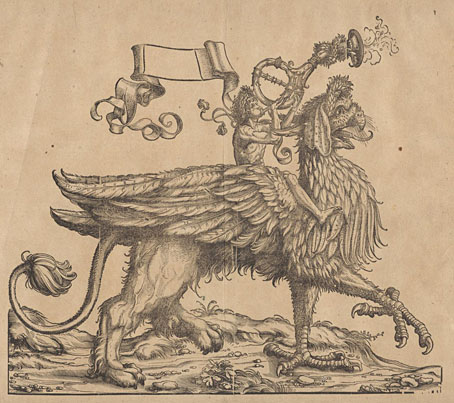
Herald on Griffin (1516-1518) from The Triumphal Procession of Emperor Maximilian I series by Hans Burgkmair the Elder.

• My design and illustration work for Pirate Utopia by Bruce Sterling continues to gain favourable comments, a novelty when reviewers often pass over the visual component of the books under their consideration. One of the most recent examples is in the latest edition of Locus Magazine; this can only be read in full by subscribers but the Tachyon Tumblr has an extract.

Paul La Farge on the complicated friendship of HP Lovecraft and Robert Barlow. Related: The Night Ocean, a short story by Barlow & Lovecraft. Meanwhile, Lovecraft enthusiasts are still raising money for a Providence statue (spot my art and design work in the photo of the Lovecraft Art and Sciences Council).

• At The Quietus this week: Children Of Alice talk to Patrick Clarke about audio collage and English Surrealism, Lottie Brazier enters The Strange World of Annette Peacock, and Manuel Göttsching tells Robert Barry how Ash Ra Tempel became the loudest band in Berlin.

• “Mind the doors!” Eight reviewers pick ten films featuring the London Underground. Not a bad list but choosing a Doctor Who film while ignoring the great Quatermass and the Pit (1967) is an error.

• Mixes of the week: Swedenborgian Hobos by acephale, Secret Thirteen Mix 214 by Fabio Perletta, and a mix for NTS by Six Organs Of Admittance.

• More Surrealism: Leonor Fini, Surrealist Sorceress, a lecture by Dr Sabina Stent, will take place at Treadwell’s Bookshop, London, on 19th May.

• “Michael Chapman’s road-weary guitar resonates with a new generation,” says Joel Rose.

A Journey Round my Room (1794), a book by Xavier de Maistre.

Lyrical Nitrate (1991), a film by Peter Delpeut.

The Sorcerer (1967) by Miles Davis | Impressions Of Sorcerer (1977) by Tangerine Dream | Venom Sorcerer (2014) by Cultural Apparati
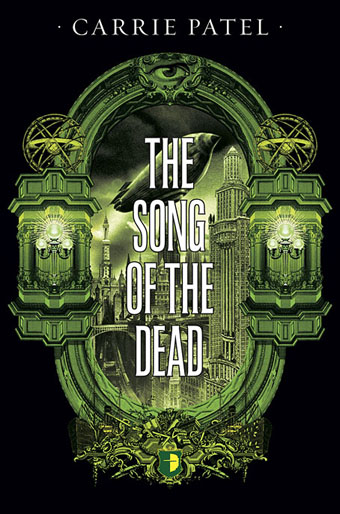
The Song of the Dead by Carrie Patel

patel1.jpg

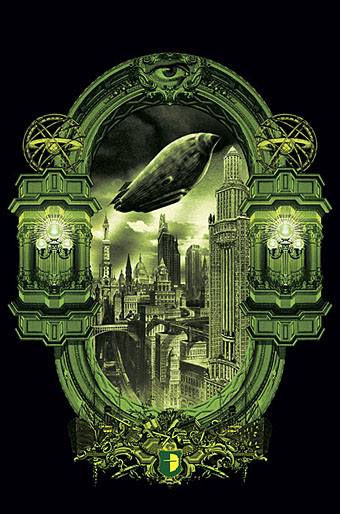
Presenting my latest cover for Angry Robot books, and the third cover I’ve done for Carrie Patel. The Song of the Dead is a sequel to Carrie’s two previous novels in the Recoletta series, The Buried Life and Cities and Thrones. For the new volume I maintained continuity by keeping the architectural frame while changing some of the details; the use of green after doing the previous covers in blue and red means that this is now the second series I’ve done for Angry Robot (KW Jeter’s being the first) using a red/green/blue colour scheme. This wasn’t intentional but was the result of choosing colours that differ from each other as much as possible. (Or almost as much: red, blue and yellow are primary colours, green is a secondary colour.) The requirement for the pictorial content was to show a city of disparate architecture but with less of an antique style than that seen on The Buried Life. Almost all the buildings in my palimpsest creation are taken from renderings of unbuilt skyscrapers or views from the early 20th century showing New York “as it will be in the future”. The airship is my own invention, based on the French model of dirigible which favoured pointed ends. The Song of the Dead will be published at the beginning of May.

patel2.jpg

And while I’m writing about recent work, it’s worth mentioning that The Thing: Artbook is now available for pre-order from Printed In Blood. This is a 400-page tribute to John Carpenter’s horror masterwork laden with responses and interpretations of Thingery from a wide range of international artists, myself included. The book will be out in July, and copies pre-ordered from the publisher will come with two bonus prints. More about this later.

Previously on { feuilleton }
Things
Two covers

Fritz Eichenberg’s illustrated Poe

eichenberg1.jpg

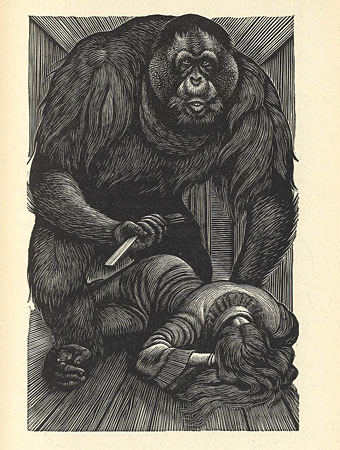
The Murders in the Rue Morgue.

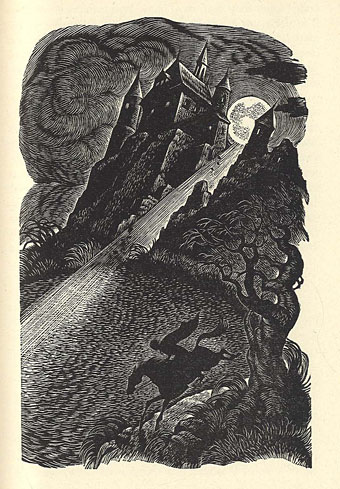
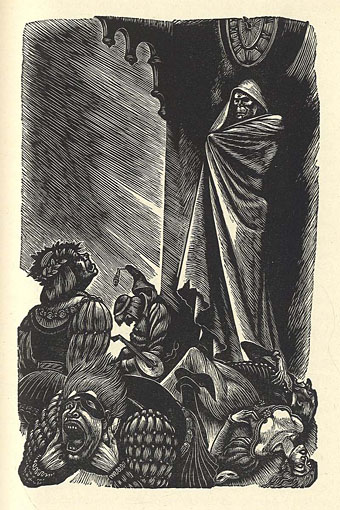
My current workload is very Poe-oriented (about which more later) so I’ve been spending some time looking at earlier illustrators of the Boston maestro. Edgar Allan Poe’s stories don’t receive as much attention from illustrators as other popular works—horror and the macabre having a limited appeal—but there are nevertheless many illustrated editions, including this one from 1944 by Fritz Eichenberg which I hadn’t seen before. Eichenberg was a German who moved to America in the 1930s; his speciality was wood engraving, a technique particularly suited to Poe’s sombre dramatics. As always with illustrations of familiar stories, a large part of the interest lies in seeing how the artist has treated the work in their own manner. Several of the illustrations here show the climax of each story but The Pit and the Pendulum breaks with custom by showing the interrogation from the beginning (Harry Clarke showed both the beginning and the end). Also of note is the ape from The Murders in the Rue Morgue which for once looks like an orangutan rather than the unspecified simian monster seen in many other renderings.

Not all of Eichenberg’s illustrations are to my taste so this is a selection of favourites. You can see the rest at VTS together with more of the artist’s work.

eichenberg2.jpg

The Fall of the House of Usher.

eichenberg3.jpg

The Masque of the Red Death.

Continue reading “Fritz Eichenberg’s illustrated Poe”

L’outrageant Lord Horror

shoah1.jpg

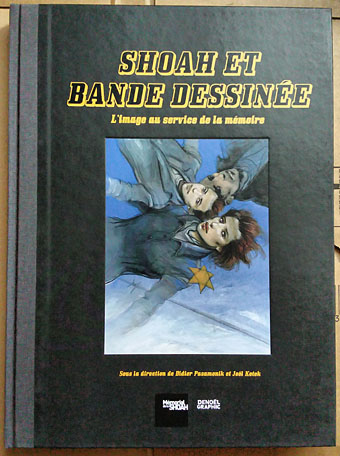
Cover art by Enki Bilal.

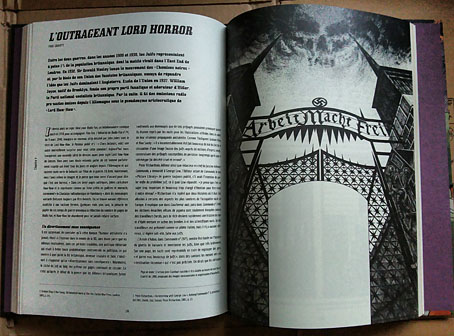
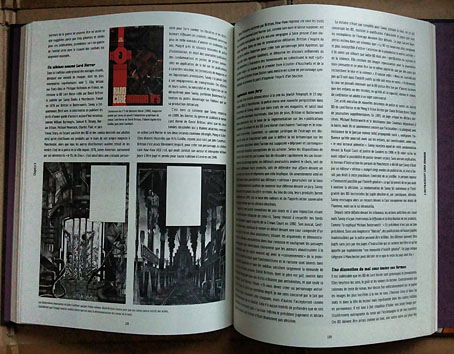
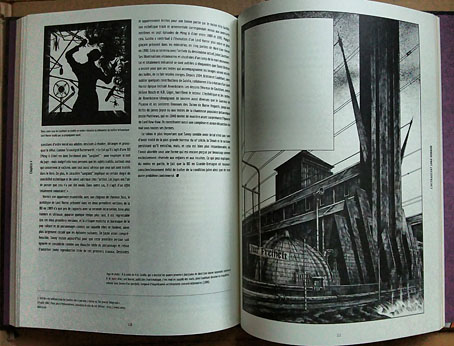
Arriving in the post this week was the catalogue for the Shoah et bande dessinée exhibition which is currently running in Paris at Mémorial de la Shoah. I’ve mentioned previously that the exhibition includes some of my pages from my first collaboration with David Britton/Savoy, the death-camp issue of the first Lord Horror series, Hard Core Horror, but until the catalogue arrived I wasn’t sure how that work would be presented. Consequently, I’m surprised to find the comic and Britton’s wider Lord Horror project given a section of its own in the catalogue, with a lengthy appraisal by British comics historian Paul Gravett. The text is French throughout so I can’t follow Gravett’s piece very well but it looks to be an expansion of earlier pieces he’s written about the Savoy comics and their troubled history.

shoah2.jpg

The book itself is a solid production that I’m pleased to find following the hardback “album” format used by Continental comics. Denoël Graphic, a publisher of bandes dessinées, is the publisher. Among the other artists represented are Will Eisner and Art Spiegelman (of course), plus many French artists whose work I hadn’t seen before. The exhibition runs throughout the year to 30th October, 2017.

shoah3.jpg

shoah4.jpg

Previously on { feuilleton }
Exhibitionism

Weekend links 347

kubin.jpg

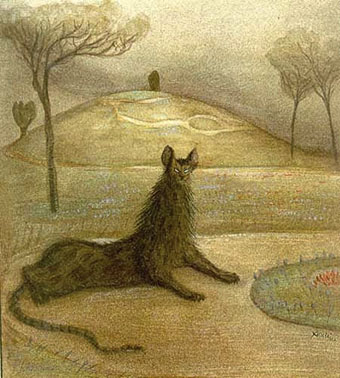
Dream Animal (1903) by Alfred Kubin.

• The week in Finland: A set of Finnish emojis includes icons for notable cultural exports such as Tom of Finland and Moominmamma. Tove Jansson’s creations have received fresh attention this month with the debut release of the electronic soundtrack music for The Moomins, an animated TV series made in Poland in 1977, and first broadcast in the UK in 1983. Andrew Male talked to Graeme Miller and Steve Shill about creating Moomins music with rudimentary instrumentation.

• Russian company Mosfilm has made a new copy of Andrei Tarkovsky’s science-fiction masterpiece, Stalker (1979), available on their YouTube channel. Tarkovsky’s films have been blighted by inexplicable flaws in their home releases, as Stalker was when reissued on a Region B Blu-ray last year. The new Mosfilm upload looks better than my old DVD so for the moment this is the one I’ll be watching.

• Before straight and gay: the discreet, disorienting passions of the Victorian era. Deborah Cohen reviews A Very Queer Family Indeed by Simon Goldhill. Related: Kevin Killian reviews Murder in the Closet: Essays in Queer Clues in Crime Fiction Before Stonewall, edited by Curtis Evans.

• “How many graphic designers owe their introduction to typography to a teenage encounter with the typefaces and lettering found on album covers?” asks Adrian Shaughnessy.

• Mixes of the week: Secret Thirteen Mix 210 by Ascion, FACT Mix 587 by Seekersinternational, and The Séance, 4th February 2017.

Pankaj Mishra on Václav Havel’s lessons on how to create a “parallel polis”. Related: The Power of the Powerless by Václav Havel.

Hans Corneel de Roos on Dracula‘s lost Icelandic sister text: How a supposed translation proved to be much more.

• “I live outside the world in a universe I myself have created, like a madman or a holy visionary.” — Michel de Ghelderode.

• The Metropolitan Museum of Art makes 375,000 images of public art freely available under Creative Commons Zero.

Richard H. Kirk on Thatcherite pop and why Cabaret Voltaire were like The Velvet Underground.

Emily Gosling on what David Lynch’s use of typography reveals (or doesn’t).

White Noise Sounds of Frozen Arctic Ocean with Polar Icebreaker Idling.

John Gray on what cats can teach us about how to live.

• At Dennis Cooper’s: Day of the Mellotron (Restored).

The Warburg Institute Iconographic Database.

Sastanàqqàm by Tinariwen.

Tanz Der Vampire (1969) by The Vampires of Dartmoore | Dracula (1983) by Dilemma | Vampires At Large (2012) by John Zorn