Weekend links 390

possession.jpg

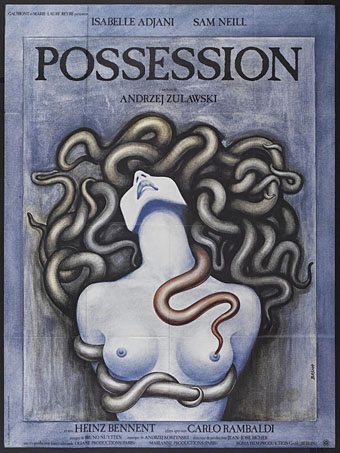
French poster by Basha (Barbara Baranowska) for Andrzej Żuławski’s extraordinary Possession (1981).

• “Alive from Off Center, renamed Alive TV in 1992, was an American arts anthology television series aired by PBS between 1984 and 1996. Each week, the series featured experimental short films by a mixture of up-and-coming and established directors. Notable episodes included As Seen on TV, starring comic actor Bill Irwin as an auditioning dancer who becomes trapped in a television, wandering among daytime dramas, MTV, and PBS’s own Sesame Street and the atmospheric puppet melodrama Street of Crocodiles, adapted by the Brothers Quay from the Bruno Schultz story. […] Arguably the series’ best-known episode was What You Mean We? a short film written by, directed by, and starring Laurie Anderson, which aired in 1986.” Alive from Off Center, 11 episodes at Ubuweb.

• “[Count] Stenbock was a homosexual convert to Roman Catholicism and owner of a serpent, a toad, and a dachshund called Trixie. It was said that toward the end of his life he was accompanied everywhere by a life-size wooden doll that he believed to be his son. His poems and stories are replete with queer, supernatural, mystical, and Satanic themes; original editions of his books are highly sought by collectors of recherché literature.” Of Kings and Things: Strange Tales and Decadent Poems by Count Eric Stanislaus Stenbock will be published by Strange Attractor in March, 2018.

• Music news of the week (in this house, anyway) is a new song, The Mysterious Vanishing of Electra, by Anna von Hausswolff. A new album, Dead Magic, is due in March, and I’m doubly-thrilled to read that Randall Dunn of Master Musicians of Bukkake (and producer/engineer for Earth, Sunn O))), etc.) is involved.

• “Why do Texas prisons ban Freakonomics but not Adolf Hitler’s Mein Kampf?” asks Lauren McGaughy. On the banned list is the three-volume The Graphic Canon, edited by Russ Kick, which includes my adaptation of The Picture of Dorian Gray.

• “To understand how other planets are made, exogeologists are synthesizing those planets in miniature in the earthbound equipment in their labs.” BLDGBLOG on speculative mineralogy.

• “What does the Bardo sound like?” Lauria Galbraith on Éliane Radigue‘s Trilogie de la Mort, three hour-long electronic compositions based on The Tibetan Book of the Dead.

• And speaking of Earth, Joseph Stannard talked to Dylan Carlson (Earth) and Kevin Martin (The Bug) about their recent collaboration.

• Mixes of the week: FACT mix 630 by Hanz, XLR8R Podcast 519 by Setaoc Mass, and Secret Thirteen Mix 239 by Blush Response.

• The League’s seven deadly sins: Reese Shearsmith on the cinematic influences behind The League of Gentlemen’s TV series.

• Donnie & Laurie, a jam from the late 1970s with Laurie Spiegel on Electrocomp 101 synthesizer, and Don Christensen on drums.

• Guests and dates for the Dublin Ghost Story Festival have been announced.

• David Bowie sang for Devo, and Mark Mothersbaugh might have the tapes.

• The albums of the year according to The Quietus.

• At Dennis Cooper’s: Isabelle Adjani Day.

• Possessed (1979) by MX-80 Sound | Possession (1988) by Danzig | Possessed (1992) by Balanescu Quartet
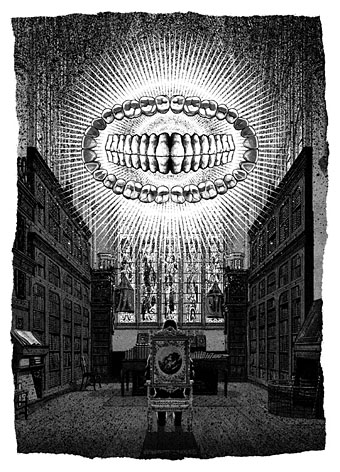
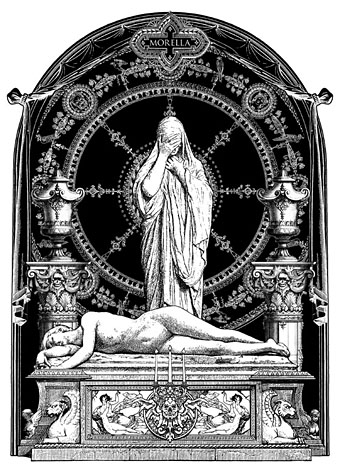
Narraciones extraordinarias by Edgar Allan Poe

poe01.jpg

Berenice.

Narraciones extraordinarias was the first commission that arrived from Spanish publisher Editorial Alma earlier this year but it’s the second one to be revealed here. (Copies of the pictures at a larger size may be seen on the main website.) I confess I was rather dismayed when the request came through for this. I was pleased to have the opportunity to illustrate so many stories but Edgar Allan Poe is a tough brief when Harry Clarke has already created the definitive set of illustrations. The challenge, then, became one of trying to successfully illustrate the stories without repeating anything by Clarke or the many other illustrators who’ve tackled Poe, not least my favourite collagist, Wilfried Sätty.

poe02.jpg

Morella.

One advantage of the collection was the inclusion of several pieces that you seldom find in the common English reprints of Poe, stories such as A Tale of the Ragged Mountains. The style is Sätty-esque, of course, although less surreal in approach thanks to the flexibility of digital tools. I’ve been developing this engraving collage style over the past year or so to create a hybrid that blends drawn and collaged material into a seamless whole. When this works, as with The Man in the Crowd (below), you shouldn’t be able to easily tell which elements are drawn and which collaged. (And more importantly, it shouldn’t really matter.) This technique has been developed further in the most recent work I’ve done for Editorial Alma but you’ll have to wait a while to see the results.

poe03.jpg

Ligeia.

Despite my initial misgivings, this job worked out better than I expected, not least because the deadline was so tight. Several of these pictures were created in a day, a work-rate common to many comic artists but not one that I’m used to (or happy with) at all. I’m still unhappy with MS. Found in a Bottle which lazily swiped a chunk of a Gustave Doré illustration; if I’d had the time I would have changed it, and if this series of pictures is ever reprinted that’s one I’ll be reworking.

As before, this is a Spanish-language hardback, and the only purchase link I have is an Amazon one. My next contribution to this series should be out early next year.

poe04.jpg

The Fall of the House of Usher.

Continue reading “Narraciones extraordinarias by Edgar Allan Poe”

The Thing on the Doorstep

thing1.jpg

Workwise, this year has been a major one for interior illustration. So far I’ve completed about 80 illustrations for different titles, and I’m still not finished. The majority of the work has been for a Spanish publisher, Editorial Alma, based in Barcelona. Earlier this year they launched a line of reprints of classic works of fiction, each of which is illustrated. To date I’ve worked on three of the titles, the first of which, Narraciones extraordinarias by Edgar Allan Poe, will feature in a later post.

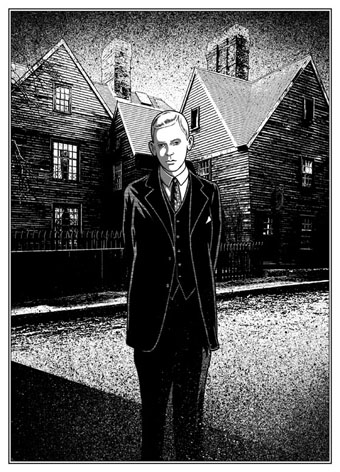
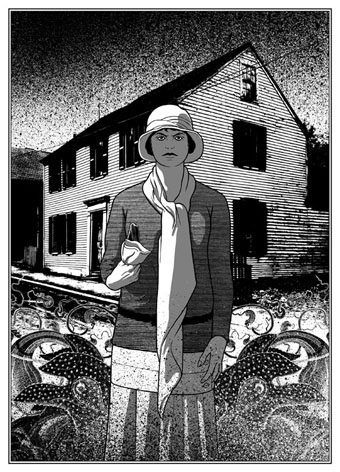
The second title, La llamada de Cthulhu by HP Lovecraft, is a small collection comprising the rather odd pairing of The Call of Cthulhu with The Thing on the Doorstep, two very different stories that you wouldn’t usually expect to see together. I provided six illustrations, three for Cthulhu which are slightly reworked pages from my comic-strip adaptation of the story, and three new ones for The Thing on the Doorstep. This is a story I’d never considered illustrating before when so much of its horror is psychological. It does, however, feature two characters who (by Lovecraft’s standards) are well-defined: the ineffectual Edward Pickman Derby and his sinister future wife, Asenath Waite. So that’s what you see here: portraits of the two main characters plus a view of the climactic scene that gives the story its title. Ideally, I would have liked to have done a fourth picture showing Derby’s surprise awakening at a nightmarish ritual but the deadlines on these books have been tight and there simply wasn’t time.

thing2.jpg

For those interested in this title, the only purchase link I have is an Amazon one. All the books are hardbacks (without dustjackets) complete with decorated endpapers—I provided a tentacle pattern for this one—and a bookmark ribbon. Deadlines aside, it’s been a very pleasant experience working for Alma. The next two books are the big ones so watch this space.

thing3.jpg

Elsewhere on { feuilleton }
• The Lovecraft archive

Weekend links 387

liquidsky.jpg

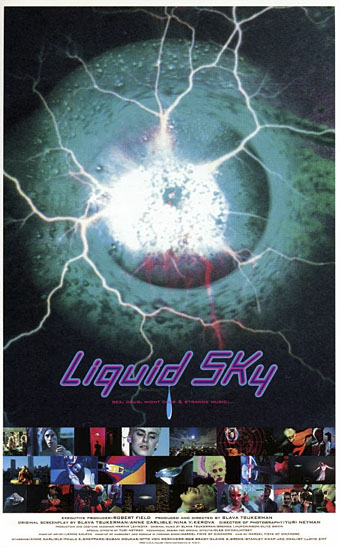
Japanese (?) poster for Liquid Sky (1982).

• The announcement this week of the death of Carl T. Ford, former editor of Dagon magazine, prompted a handful of memorial pieces. Dagon was notable for being a small British magazine devoted to Lovecraftian and other weird fiction (and the Call of Cthulhu games) at a time when the majority of such publications were American; it was also very well-produced, its later issues being typeset and filled with quality black-and-white illustration. Dagon interviewed many notable writers, including people such as Thomas Ligotti whose work at the time was still only known to a small group of enthusiasts. Mark Valentine posted a reminiscence at Wormwoodiana; Yog-Sothoth.com has an interview with Carl from 2010.

• Michael “Dik Mik” Davies, manipulator of an audio generator and tape echo for Hawkwind, also died this week. Dik Mik’s primitive background electronics, augmented by Del Dettmar’s synthesizers, were an essential component of the early Hawkwind sound.

• Erik Davis talks to writer, photographer, and curator Joanna Ebenstein about Goth obsessions, memento mori, Santa Muerta, and her extraordinary new illustrated collection Death: A Graveside Companion.

• Slava Tsukerman’s cult film Liquid Sky (1982) finally gets a blu-ray release. From 2014: Punks, UFOs, and Heroin: Daniel Genis on how Liquid Sky became a cult movie.

• Geeta Dayal explores the MOMA exhibition Thinking Machines: Art and Design in the Computer Age: 1959–1989.

• You Should Come With Me Now is a collection of new fiction by M. John Harrison published this week.

• VinylHub: “Our mission is to document every physical record shop and record event on the planet.”

• Vladimir Nabokov‘s dream diary reveals experiments with “backwards timeflow”.

• Flawed Greatness: DB Jones on beauty and balance in John Ford’s The Searchers.

• Irakli Kiziria on 9 synth artists who defined Eastern Europe’s post-Soviet sound.

• Edgar Allan Poe’s Hatchet Jobs: Mark Athitakis on Poe’s book reviews.

• Mix of the week: FACT mix 627 by Oneohtrix Point Never.

• At Creative Review: The design of Mute Records.

• How generative music works.

• Laraaji‘s favourite albums.

• We Do It (1970) by Hawkwind | Adjust Me (1971) by Hawkwind | Electronic No. 1 (1973) by Hawkwind

Weekend links 386

ward.jpg

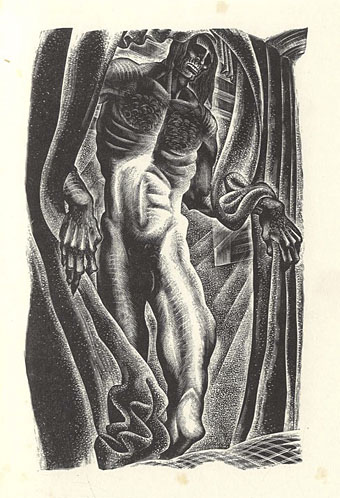
Lynd Ward again, and one of his illustrations for Frankenstein (1934).

• “Julio Mario Santo Domingo was a collector and visionary who filled his homes and warehouses with the world’s greatest private collection related to the subjects of drugs, sex, magic, and rock and roll: a library of more than 50,000 items…” Altered States: The Library of Julio Santo Domingo by Peter Watts catalogues some of the artefacts.

• “His vision of Gay Liberation was deeply, and uniquely, inflected by his study of, and belief, in anarchism.” More on the late Charles Shively: Michael Bronski remembers a pivotal figure in the gay liberation movement.

• William Friedkin’s Sorcerer was released on region-free blu-ray a couple of years ago but it’s being reissued again in the UK for its fortieth anniversary. Julian House has created a series of designs for the insert.

• Electronic musician and podcaster Marc Kate talks to Erik Davis about nihilism, horror movies, New Age music, and transmuting Nazi black metal into the ambient soundscapes of his latest album, Deface.

• “Beware the polished little man“: an extract from The Guesthouse at the Sign of the Teetering Globe by Franziska zu Reventlow which is available now from Rixdorf Editions.

• Another welcome blu-ray release, Sergei Parajanov’s The Colour of Pomegranates appears later this month in a special edition from Second Sight.

• Mixes of the week: FACT mix 626 by Sharp Veins, XLR8R Podcast 515 by Sammy Dee, and Secret Thirteen Mix 236 by Beta Evers.

• The Witch Wave with Pam Grossman is a podcast for bewitching conversation about magic, creativity, and culture.

• Call me by the wrong name: Benjamin Lee on Hollywood’s perennial attempts to straight-wash gay films.

• At Dennis Cooper’s: Spotlight on…Ronald Firbank Concerning the Eccentricities of Cardinal Pirelli (1926).

• Zoë Lescaze reviews Frankenstein: The First Two Hundred Years by Christopher Frayling.

• Angry Optimism in a Drowned World: A Conversation with Kim Stanley Robinson.

• Stewart Smith on The Strange World of…Linda Sharrock.

• Colors (1969) by Pharoah Sanders | Frankenstein (1972) by The Edgar Winter Group | Pomegranate (2001) by Transglobal Underground