Weekend links 690

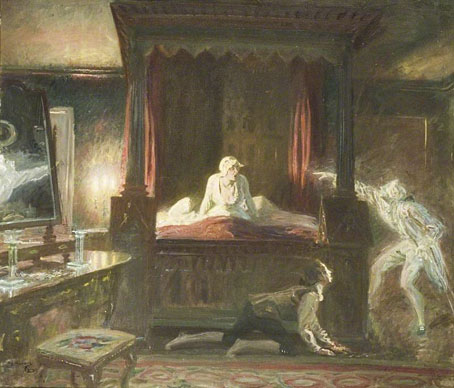
sosnowski.jpg

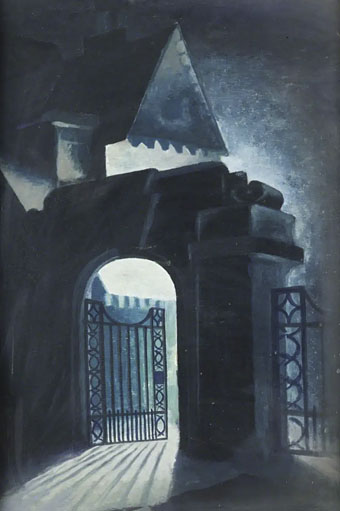
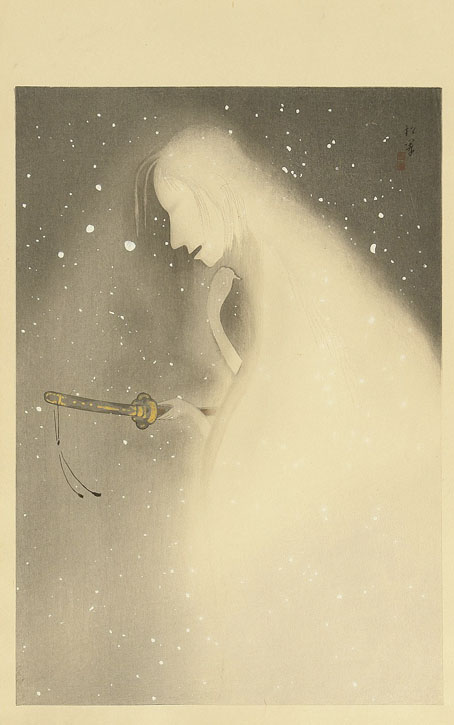
The Voice of St. Teresa (1928) by Oskar Sosnowski.

• The House is the Monster: Roger Corman’s Poe Cycle forms “a body of work not only deeply coherent but uniquely inspired,” says Geoffrey O’Brien.

• Steven Heller’s font of the month is Amberwood, while at The Daily Heller there’s a profile of Otto Bettmann, “an unsung visionary of commercial art”.

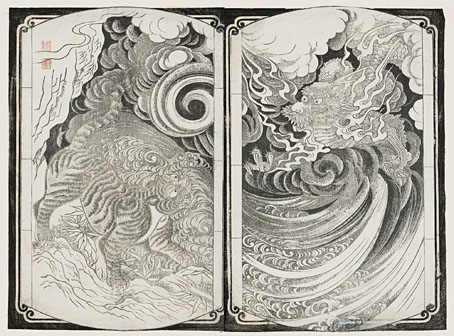
• At Public Domain review: The Works of Mars (1671), plans for military architecture by Allain Manesson Mallet.

The “underlying oneness of all things,” the conviction “that everything is connected” (Gravity’s Rainbow 703), is a thesis that appeals to many mystics and even to some scientists, but Fort complains that the latter too quickly dismiss unexplainable coincidences, or feebly explain them away. Scorning “scientific procedure” and inept police investigations, Fort turns for answers to denizens of the occult—poltergeists, invisible people, vampires, werewolves, miracle healers, fakirs, psychic criminals, dowsers—and to such notions as teleportation, human-animal metamorphoses, spontaneous combustion and pyrokinesis, “psychic bombardment,” telekinesis, animism, “secret rays,” telepathy, spirit-photography, clairvoyance, and modern instances of witchcraft.

Steven Moore in a perceptive essay about the overlooked connections between Thomas Pynchon, William Gaddis and Charles Fort. Having discussed Fort’s preoccupation with coincidences, the author notes that he shares a name with the late Steve Moore, former editor of Fortean Times magazine

• Pynchonesque headline of the week: The Paradox of the Radioactive Boars.

James Balmont’s guide to the masterworks of New Taiwanese Cinema.

• New music: Solo for Tamburium by Catherine Christer Hennix.

Winners of Bird Photographer of the Year 2023.

Idris Ackamoor’s favourite music.

Radio-Active (1984) by Steps Ahead | Radioactivity (William Orbit Remix) (1991) by Kraftwerk | Radioactivity (1998) by Hikasu

More Harry Clarke online

clarke1.jpg

A while back I put together a list of links to freely-available online copies of Harry Clarke’s illustrated books. The list didn’t have any notable omissions but was unsatisfying if you’re like I am and prefer to see scans of an entire book rather than collections of pictures or home-made creations. This illustration of Ligeia is from a 1936 US edition of Clarke’s illustrated Poe which is archived in the digital collection at Poland’s Biblioteka Narodowa. This is the edition for which Clarke created eight new full-page pieces in colour, all of which are happily intact in the Polish copy which may be downloaded as a PDF. A good test of the scanning (and print) quality of this book is the illustration for The Facts in the Case of M. Valdemar, a drawing where Clarke tested the limits of ink reproduction with his closely-hatched lines and speckle effects. I was hoping the Polish library might have more books like this but so far nothing has appeared.

clarke2.jpg

Following this discovery I tried another Clarke search at the Internet Archive where I found this recent upload of a Dutch edition of his illustrated Perrault. The same source has had an English edition of this title for some time but the copy is missing one of the colour plates, plate theft being a perennial problem for library books. Or even non-library books… I own a rather battered first-edition of Clarke’s illustrated Swinburne from which two of the full-page pictures have been carefully removed by a previous owner with a razor blade. And speaking of Swinburne, Clarke’s edition of the Selected Poems is the one I keep hoping to find as an online edition, together with his Faust, even though I own a reprint of the latter book. I suspect the contentious “obscene” drawings in these two volumes have kept copies away from library collections. You can at least find the illustrations for the books easily enough. Still unavailable unless you’re a collector of rare magazines is The Golden Hind, the short-lived arts magazine edited by Clifford Bax and Austin Osman Spare which contained unique contributions from Harry Clarke and many similar artists of the 1920s. That’s one I’ll continue to search for.

Elsewhere on { feuilleton }
The illustrators archive

Previously on { feuilleton }
Harry Clarke online
Harry Clarke record covers
Thomas Bodkin on Harry Clarke
Harry Clarke: His Graphic Art
Harry Clarke and others in The Studio
Harry Clarke’s Fairy Tales of Charles Perrault
Harry Clarke in colour
The Tinderbox
Harry Clarke and the Elixir of Life
Cardwell Higgins versus Harry Clarke
Modern book illustrators, 1914
Illustrating Poe #3: Harry Clarke
Strangest Genius: The Stained Glass of Harry Clarke
Harry Clarke’s stained glass
Harry Clarke’s The Year’s at the Spring
The art of Harry Clarke, 1889–1931

Ian Miller album covers

miller02.jpg

Stolen Life (1988) by Rattus.

Continuing an occasional series about artists or designers whose work has appeared on record sleeves. Ian Miller’s career, which dates back to the early 1970s, has encompassed book-cover illustration, art for magazines and role-playing games, also the occasional film design. His credits in the music world, however, are limited to this handful of covers plus a few interiors, most of them for punk bands or metal outfits of one type or another. I still prefer CDs for my music listening but the 12-inch vinyl sleeve has always been the best showcase for cover art, especially the hyper-detailed renderings that are Miller’s speciality.

miller04.jpg

Cosmovore (2018) by Ulthar.

Lovecraftian metal band Ulthar seem to have adopted Miller recently as their regular cover artist. Their Cosmovore album uses a third (?) version of Miller’s cover for the 1974 Panther Mountains of Madness paperback. (See The Art of Ian Miller for the second version.) The original is still one of my favourite Lovecraft illustrations of all, not least for the way he turns one of the relatively small and placid Elder Things into a towering kaiju—the scale can be gauged by the tiny human figures in the background—battling what appears to be an equally gigantic and frenzied shoggoth. Or maybe they’re both shoggoths since these are shape-shifting creatures? I’ve never been sure, but whatever they may be, they’re more than a match for the frenzy unleashed at the end of Lovecraft’s story.

miller03.jpg

Bound To Mutation (1991) by Dagon.

miller01.jpg

X-Rated Fairy Tales / Superior Catholic finger (1994) by Helios Creed.

A CD reissue of two Creed albums on Cleopatra Records. This one isn’t listed on Discogs because Miller receives no art credit.

miller05.jpg

Providence (2020) by Ulthar.

Continue reading “Ian Miller album covers”

HP Lovecraft: Tales of Horror

hpl.jpg

Cover design by Jo Obaroswki.

More Lovecraftiana (for a change). Today’s mail included the surprise delivery of these books, a very late arrival since the book was published over a year ago. Well better late than never, I was very pleased to be involved with this one which has been published by Fall River Press, an imprint of Barnes & Noble. The plan was to reprint a small number of Lovecraft stories on colour pages accompanied by my artwork. So the book is also a reprint of many of my earlier Lovecraftian drawings, from the comic strips to more recent illustrations, with the pictures carefully cropped and, in some places, reworked a little to match the stories.

The contents:
• Introduction by Stefan Dziemianowicz
The Call of Cthulhu
The Colour Out of Space
The Haunter of the Dark
The Whisperer in Darkness
The Dunwich Horror
The Thing on the Doorstep

hpl2.jpg

The end result is very impressive. The book is solidly bound in hard covers with the cover art featuring metallic silver ink and gloss highlights. The interior design is by Gavin Motnyk who chopped up and tinted my drawings (with my approval) in a very effective manner. Many of the panels at the end of my adaptation of The Call of Cthulhu were presented with this kind of fragmentation so I was happy to see this extended to other drawings. In addition to presenting the artwork in a new way it also helped compensate for some of the shortcomings in drawings that date back to 1986. Not everything is this old, however. I sent Gavin a copy of my redrawn R’lyeh panorama which has been printed across the endpapers.

For now this is the most substantial collection of my Lovecraft artwork in print. And since it’s being distributed by Barnes & Noble it’s also relatively easy to find (although that title, Tales of Horror, is very similar to other collections). Fall River Press will be publishing another classic horror volume featuring my illustrations towards the end of the year. More about this later.

Elsewhere on { feuilleton }
The Lovecraft archive


Necronomicon all’italiana

necro01.jpg

The 1978 edition of the Necronomicon edited by George Hay remains my favourite among the many fake Necronomica. It was the first one I bought, following a memorable “WTF?!” encounter with the Corgi paperback in WH Smiths, and as a book it’s always been better value than the much more popular “Simon” Necronomicon (1977) despite having a smaller page-count. Hay’s book is as much a general guide to Lovecraft’s fiction as an invented grimoire. In addition to the detailed occult fabulation crafted by Robert Turner and David Langford there’s a lengthy introductory essay by Colin Wilson, while the appendices comprise essays by L. Sprague de Camp (“Young Man Lovecraft”), Christopher Frayling (“Dreams of Dead Names: The Scholarship of Sleep”) and Angela Carter (“Lovecraft and Landscape”). The “Simon” book had little in the way of illustration beyond the few invented sigils which you now see reproduced endlessly in role-playing circles. The Hay book, on the other hand, featured a handful of illustrations by Gavin Stamp (all but one of them them credited to the fictitious “GM Sinclair”) which have been marooned with the essays in obscurity for far too long.

necro02.jpg

I posted some of Stamp’s illustrations several years ago but they’re worth visiting again now that an Italian translation of the Hay book has turned up at the Internet Archive. This edition, published in 1979 by Fanucci Editore, includes an additional appendix containing two more text pieces plus a portfolio section with further illustrations by Italian artists. The Italians seem to like Lovecraft’s fiction almost as much as the French do. The first substantial collection of Lovecraftian comic strips and illustrations was an Italian book, The Cosmical Horror of HP Lovecraft, published by Glittering Images in 1991. A more recent collection, Lovecraft Black and White from Dagon Press, featured a quantity of illustrations rather like those at the end of the Italian Necronomicon. The Dagon Press collection also reprinted one of my pieces but I don’t seem to have noted this until now.

necro03.jpg

The cover art for the Italian Necronomicon is worth mentioning since this isn’t a recent piece of art at all. The image is one of eleven woodcuts by Lorenz Stöer (c.1537–c.1621) which were published in book form as Geometria et Perspectiva in 1567. Happily, the 2009 BibliOdyssey post about Herr Stöer and his remarkable works is still available, so you can see the whole series and read about their history without my having to go searching for the details. Stöer’s creations are a good match for Lovecraft’s concept of deranged or non-human architecture. They remind me of Fred Chappell’s Remnants, one of the stories in Lovecraft’s Monsters, in which the Great Old Ones return to the Earth and begin to refashion the planet to their own designs.

necro04.jpg

necro05.jpg

Continue reading “Necronomicon all’italiana”