Heavy Metal, October 1979: the Lovecraft special

hm1.jpg

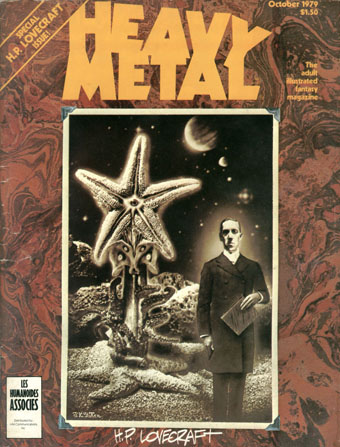
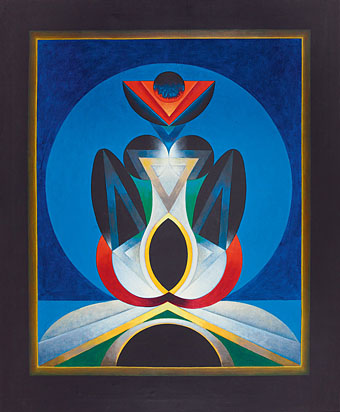
Mr Lovecraft by JK Potter.

HP Lovecraft died seventy-five years ago on 15th March, 1937. Twenty-five years ago I was halfway through drawing my comic strip adaptation of The Call of Cthulhu, conscious at the time that, yes, it was fifty years ago today… I mentioned at the weekend the special Lovecraft edition of Heavy Metal that was published in October 1979; of the many stimuli that led to the drawing of CoC, this magazine was by far the most important. Given the date, now seems as good a time as any to say something about it.

hm2.jpg

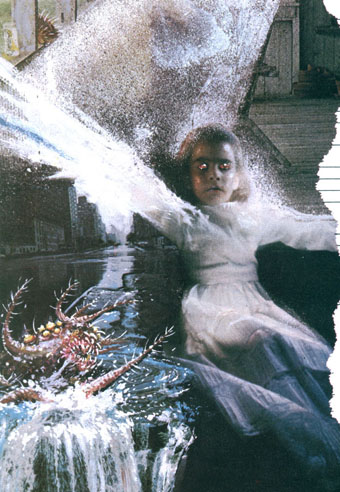
Illustration for the contents page by Stephen R. Bissette.

Heavy Metal was the US offshoot of Métal Hurlant, the sf/fantasy comics magazine founded by Jean Giraud (Moebius), Philippe Druillet and Jean-Pierre Dionnet in 1974. Copies of Métal Hurlant could be found in London but none ever made it further north. The advent of Heavy Metal provided an invaluable introduction to a generation of European artists whose work was otherwise difficult to find. Even better: their stories were being translated into English for the first time. The late 70s was a dizzying period for a Lovecraft reader: HR Giger appeared apparently out of nowhere in 1977 when Big O published the first UK collection of his art (which I couldn’t afford at the time), a book with Necronomicon in the title; a year later Thames & Hudson published Franz Rottensteiner‘s The Fantasy Book, an overview of the genre that devoted eight pages to Lovecraft and Arkham House, and which included many illustrations I’d never seen before; in 1979 Giger was all over the newspapers and magazines thanks to Alien; then in October the Lovecraft special dropped onto the shelves. I was stunned: this was that rare occasion when someone creates exactly the thing you want to see at precisely the right moment.

hm3.jpg

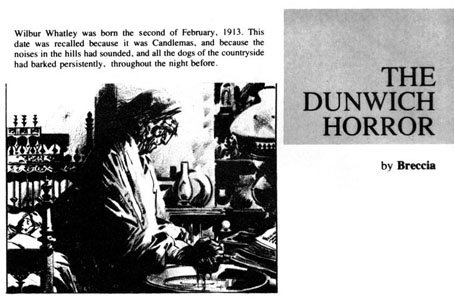
The Dunwich Horror by Alberto Breccia. A superb adaptation.

Looking back, the issue isn’t quite as good as it seemed at the time: many of the stories are slight, a couple have nothing whatever to do with Lovecraft, and, Breccia aside, none of the artists tackle the major works. What counted in the end was the idea of the issue, the implication that Lovecraft’s imagery was there to be seized and reworked in visual form. There were better issues of the magazine, before and after, but for the next six years this one remained for me a tantalising possibility. They hadn’t got it quite right…what if someone else did? After searching comic shop shelves in vain I eventually decided to have a go myself.

Continue reading “Heavy Metal, October 1979: the Lovecraft special”

Weekend links 93

favre.jpg

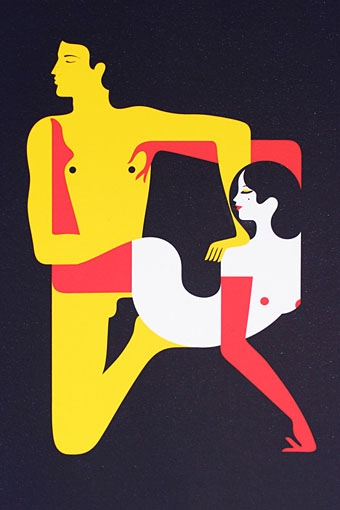
One of a series of tremendous designs by Malika Favre for a new Penguin edition of the Kama Sutra.

• New interviews: “…Americans — mired in individualism — prefer to think in terms of identity than in terms of roles and masks. An American would never have called a novel Confessions of a Mask.” Nicholas Currie, better known via his Momus mask. | “The horror in music comes from the silence,” says John Carpenter. | “It’s dangerous to be an artist. That’s what we talk about in Naked Lunch — and it’s dangerous on many different levels. Politically it can be dangerous, but psychologically it can be quite dangerous too. You make yourself very vulnerable. You put yourself out there and of course you open yourself up to criticism and attack.” David Cronenberg at the Los Angeles Review of Books.

• New books: Dotter of Her Father’s Eyes, a Joycean memoir by Mary M Talbot and Bryan Talbot. | A stack of new works from Strange Attractor including a collection of Savage Pencil‘s Trip or Squeek comic strips. | Robert Irwin’s Visions of the Jinn: Illustrators of the Arabian Nights. A shame about the high price on the latter but I’m sure it looks wonderful.

• The Blu-ray release of Wings (1927), William A. Wellman’s silent drama about air aces during the First World War, has prompted renewed attention for the passionate relationship between its two male leads, especially this deathbed scene which is tagged as the first same-sex kiss in cinema. That’s arguable, of course, but it’s certainly a touching moment.

• From 2009: Searching the Library of Babel, a list of all the stories in all 33 volumes of The Library of Babel, a 1979 Spanish language anthology of fantastic literature edited by Jorge Luis Borges.

• Lots of newpaper attention in the past week for the not-so-fresh news that magic mushrooms could help fight depression. Nature went into the detail of the latest studies.

French group Air have written the score for a rare colour print of Le voyage dans la lune (1902) by Georges Méliès. Air’s YouTube channel has extracts.

• From 1989: The Merchant of Shadows by Angela Carter.

Will Hunt on the Ghost River of Manhattan.

Selected Letters of William S. Burroughs

Sexy Boy (1998) by Air | Surfing On A Rocket (2003) by Air | Mer Du Japon (2007) by Air.

Weekend links 91

santosh.jpg

Untitled (1978) by GR Santosh at 50 Watts.

Evertype Publishing produces a range of Lewis Carroll special editions including Ailice’s Àventurs in Wunnerland (a translation in Scots), Alicia in Terra Mirabili (a Latin version), and an edition printed in the Nyctographic Square Alphabet devised by Carroll.

• This week’s bookshop animations: Type Books, Toronto presents The Joy of Books while at Shakespeare and Company, Paris, Spike Jonze and Simon Cahn explore the erotic life of book covers in Mourir Auprès de Toi.

• Invisible Girls and Phantom Ladies, a 1982 article on sexism in (US superhero) comics by Alan Moore. Thirty years on, things haven’t improved much at all.

I reread it now, 35 years later, and I am struck by its capacity to change like a magic mirror. Where I had originally seen it as a book about writing, about becoming a writer, I now see it as a book about reading, about taking one’s place in the chain. Where I once assumed it was a book about eternal youth, I now see it as a book about growing up, about learning to live.

Tilda Swinton on Virginia Woolf’s Orlando

Dark Water, Lovecraftian carpet designs (yes, carpets) by Kirill Rozhkov. Danish carpet manufacturer Ege has a catalogue showing the finished products.

Neil Gaiman ventures into the treacherous labyrinth of M. John Harrison’s Viriconium.

Nicholas Lezard reviews The White People and Other Weird Stories by Arthur Machen.

rousseau.jpg

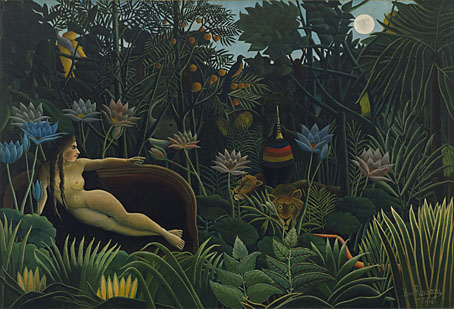
The Dream (1910) by Henri Rousseau at the Google Art Project.

• Reassessing the Saul Bass and Alfred Hitchcock Collaboration by Pat Kirkham.

• Getting There Too Quickly: Peter Bebergal on Aldous Huxley and Mescaline.

Hidden in the Open: A Photographic Essay of Afro-American Male Couples.

Filles En Aiguilles, a new musical work by Schütze+Hopkins.

RubiCANE’s Erotic Illustrations.

Laurie Anderson has a Godplex.

Alan Bennett on Smut.

The Jungle Line (1975) by Joni Mitchell | The Jungle Line (1981) by Low Noise (Kevin Armstrong, Thomas Dolby, JJ Johnson & Matthew Seligman) | The Jungle Line (2007) by Herbie Hancock with Leonard Cohen.

Cthulhoid and Artflakes

cthulhoid.jpg

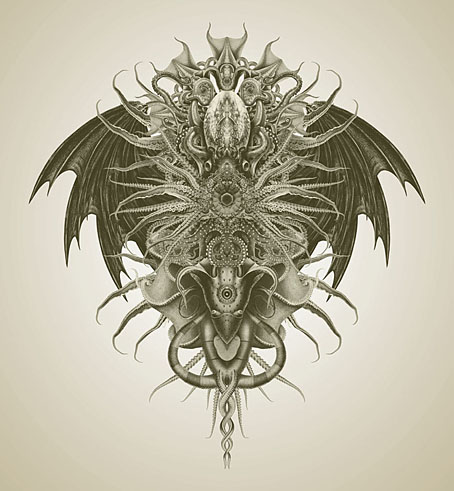
Cthulhoid (2012).

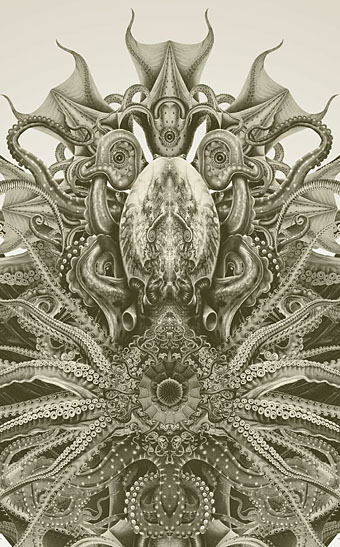
Hot on the scaly heels of my recent Cthulhu God comes a new collage work I was messing with over Christmas. This was done in part as a reaction to the earlier picture which I’m very happy with but which looks cleaner and flatter than I prefer for Lovecraft-related things. I’d also found some new books of copyright-free cephalopoda that I wanted to try playing with. There are trace elements here of Haeckel’s Kunstformen der Natur but I’ve plundered Haeckel so much in the past it’s better to search elsewhere for source material.

cthulhoid-detail.jpg

I’ve been selling reproductions of works such as this at CafePress but now have an additional outlet with a new print venture, Artflakes, who asked me late last year to contribute to their site. Artflakes is a German company operating as CafePress does: artists upload their pictures which can then be sold on a variety of products. The product range is smaller than their rivals but they do canvas prints which CafePress don’t. These are costly items but canvas prints tend to be expensive anyway, even at a high street copy shop. On the plus side, being based in Germany means the shipping costs will be slightly cheaper inside Europe. I’ve not uploaded much at the moment but this new piece is there together with six other works. More will be added in the next couple of months.

Elsewhere on { feuilleton }
The Lovecraft archive

Studies in the Horror Film: The Exorcist edited by Danel Olson

exorcist2.jpg

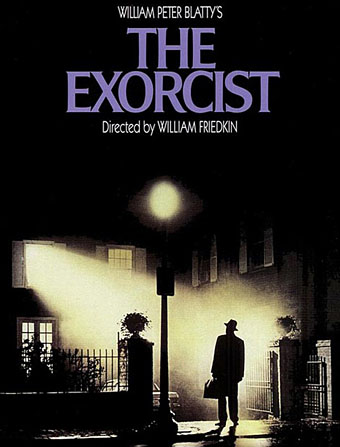
Growing up in the 1970s put cinema-going kids of my generation in a frustrating position: we knew that the censorship of decades past was over but we weren’t old enough to see any of the films benefiting from the relaxed strictures. Consequently some notorious releases grew larger in the imagination than they might have otherwise, especially when their cryptic titles—A Clockwork Orange, Straw Dogs—gave no clue as to their content. Looming larger and darker than all of these was William Friedkin’s The Exorcist whose content was at least clear despite that vague poster design. The film arrived in Britain in March 1974 bearing a ferocious reputation thanks to tabloid reports of a cursed production and hysteria at US screenings. The film’s power has been significantly reduced since its release, not least because of its enormous success which gave us two sequels, a prequel that went through three directors (and ended up as two separate films), a reworked version of the original in 2001, and all the endless parodyings of Linda Blair’s torment.
exorcist3.jpg

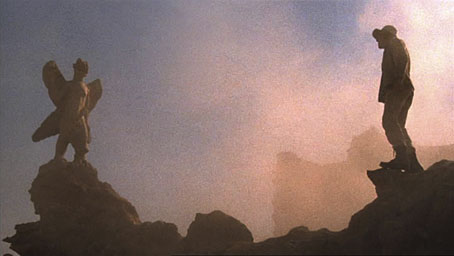
Pazuzu and Father Merrin face off in the desert.

The film and its sequels are explored in a new book from Centipede Press which turned up before Christmas but which has taken me a while to get round to since I wanted to re-watch the film first. I hadn’t seen The Exorcist for many years, the last viewing being a shoddy VHS copy so it was good to see it again in a decent DVD print. I still find the film more admirable on a technical level than as a work of cinematic art: the story has always been a piece of Catholic propaganda—something that author William Peter Blatty freely admits—and even if I set aside my lapsed-Catholic prejudices I have a hard time taking seriously Blatty’s religious narrative. Friedkin is a very good thriller director but the tension sags in the first half of the film when the possessed (or is she?) Regan is being hauled around various hospitals while Father Karras frets about his dying mother and his lapsed faith. A sub-plot with police detective Lee J. Cobb—a pared-down thread from the novel—is completely superfluous. On the plus side, the acting is first-class, the almost wordless sequence in Iraq makes a tremendous opening, and the exorcism itself still packs a considerable punch not least because of Dick Smith’s remarkable makeup effects.
exorcist1.jpg

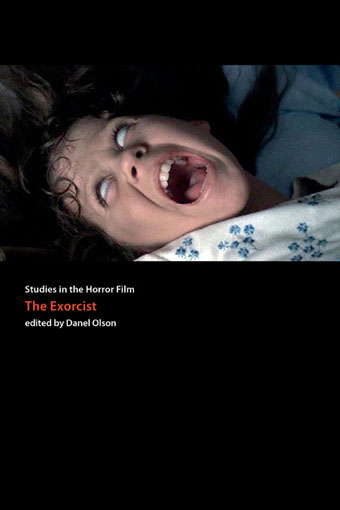
The Centipede volume is a substantial collection (516 pages) of interviews and essays edited by Danel Olson, part of the publisher’s Studies in the Horror Film series. The interviews are especially worthwhile being taken in part from back issues of Cinefantastique magazine: Friedkin and Blatty appear twice, there are talks with Dick Smith and Friedkin’s editor Bud Smith (no relation), and Paul Schrader discusses his troubled prequel, Dominion (2005).

Among the essay highlights Thomas Ligotti juxtaposes Blatty’s moral and theological universe with the amoral pessimism of HP Lovecraft while Blatty recounts the factual origin of his novel in a piece taken from The Exorcist: From Novel to Film (1974). Successful films that spawn sequels often present challenges for critics when the later installments begin to deviate from the premise of the original. Part of the interest in Olson’s collection is seeing how the writers delve into the imperatives of Hollywood sequelitis for moments of value. The critical essays are thought-provoking without wandering into the quicksands of jargon-ridden academicism: Kendall Phillips examines the influence of The Exorcist on The Texas Chainsaw Massacre (1974), there’s a spirited attempt by James Kloda to defend John Boorman’s much-vilified The Exorcist II: The Heretic (1977), and James Marriott points out that horror films are a continuing source (however debased) of metaphysical speculation.

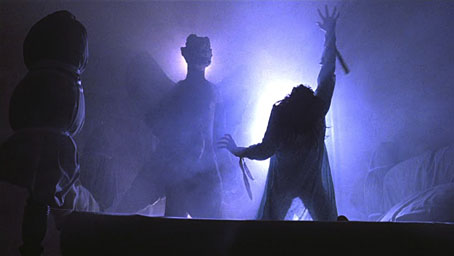
This last notion is an intriguing one: people always take The Exorcist at face value—God and Satan are real; it’s a spiritual battle—yet the demon we see in the film is the Assyro-Babylonian god Pazuzu, a spirit never mentioned by name in the Bible, or in the film for that matter. I’d suggest there’s an argument to be made that it’s only Pazuzu that actually exists as a supernatural force in the film’s world, and that the prayers of the priests confound it but temporarily.
exorcist4.jpg

Pazuzu has entered the building.

The aura of metaphysical threat may have diminished but The Exorcist still wasn’t allowed a UK TV screening until 2001. Something about the idea of people confronting supernatural evil continues to compel, however antiquated the scenario may seem. This isn’t too surprising when we have nominees for the US Presidential elections talking in hyperbolic terms about God and Satan without being widely ridiculed. Then there’s news stories like this recent one in the UK: “Boy ‘tortured and drowned’ over witchcraft claims, court told“. Blatty and Friedkin’s devil child was one of the most influential films of the 1970s, and may well be the most influential despite the continued popularity of the wretched Star Wars cycle. In the past couple of years alone we’ve had The Last Exorcism (2010) and The Rite (2011), with The Devil Inside due to appear on UK cinema screens in March; possessed girls appear in all three films. Danel Olson could easily fill another volume tracing this influence through the decades.

Studies in the Horror Film: The Exorcist isn’t published until March 2012 but can be pre-ordered at Amazon (US) and Barnes & Noble.

Previously on { feuilleton }
A playlist for Halloween: Orchestral and electro-acoustic
Dead on the Dancefloor
The monstrous tome