Weekend links 124

despont.jpg

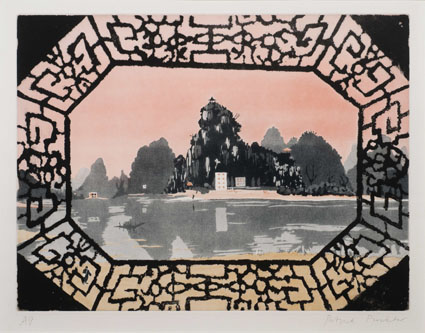
Couple with Clock Tower (2011) by Louise Despont.

Assuming such a thing doesn’t already exist, there’s a micro-thesis to be written about the associations between the musicians of Germany’s Krautrock/Kosmische music scene in the early 1970s and the directors of the New German Cinema. I’d not seen this clip before which shows the mighty Amon Düül II jamming briefly in Fassbinder’s The Niklashausen Journey, a bizarre agitprop TV movie made in 1970. More familiar is the low-budget short that Wim Wenders helped photograph a year earlier showing the Düül performing Phallus Dei. Wenders later commissioned Can to provide music for the final scene of Alice in the Cities. And this is before you get to Werner Herzog’s lengthy relationship with Popol Vuh which includes this memorable moment. Any others out there that I’ve missed?

Album sleeves in their original locations. And speaking of album sleeves, photo prints of some very famous cover designs by Storm Thorgerson will be on display at the Public Works Gallery, Chicago, throughout September and October.

Crazy for kittehs: the quest to find the purring heart of cat videos: Gideon Lewis-Kraus goes where few journalists dare to tread. Also at Wired, the same writer explores the Cat Cafés of Tokyo.

The City of Rotted Names, a “shamelessly Joycian cubist fantasy” by Hal Duncan, available to read in a variety of formats on a pay-as-thou-wilt basis until Monday only.

• Jailhouse rockers: How The Prisoner inspired artists from The Beatles to Richard Hawley.

How To Survive A Plague, a documentary about HIV/AIDS activism in the US.

• Deborah Harry: hippy girl in 1968, punk in 1976, and Giger-woman in 1981.

Alan Garner answers readers’ questions about his new novel, Boneland.

• For steampunk aficionados: ‘COG’nitive Dreams by Dana Mattocks.

• David Bowie, Iggy Pop, Madonna & Asparagus: Kraftwerk in 1976.

• New music videos: Goddess Eyes I by Julia Holter | Sulphurdew by Ufomammut | Warm Leatherette by Laibach.

Ted Shawn and His Men Dancers

shawn07.jpg

Poster on the left designed by Major Felten (1931).

In 1914, [Ruth] St Denis married a twenty-two-year-old gay man, the ambitious and sexually charismatic Ted Shawn (1891–1972), who became her dance partner. Shawn appeared at any opportunity in the scantiest of costumes. In 1915, they founded the Denishawn Dance School in Los Angeles, which became a significant artistic center from which many creative dancers emerged, most notably Martha Graham.

Burton Mumaw (b. 1912), a student of Shawn’s, first danced with the Denishawn company in 1931. Mumaw and Shawn soon became lovers and life companions. Shawn separated from St. Denis in 1933 and formed his Company of Male Dancers. Mumaw and Shawn were the leading soloists of the new company. (more)

I can’t vouch for the accuracy of GLBTQ’s claims about Ted Shawn’s sexuality before he married Ruth St Denis, but it’s impossible to see his all-male dance troupe as anything other than homoerotic, especially when they had a tendency to perform in the nude (see below). Shawn’s intention was to move the associations of male dance away from the perceived effeminacies of ballet towards something more assertive and muscular. Shawn and Ruth St Denis had gone to great lengths to import into American dance various exotic elements from Asia and the ancient world, a process they called “Oriental dance”. This was no doubt the kind of Orientalism which is repudiated today for its appropriations but in the 1910s and 20s these developments were significant moves away from the staid traditions of 19th-century ballet. Shawn continued this evolution with a robust choreography based on ethnic war dances and other masculine fare. This kind of all-male dance is now very common—and remains homoerotic, of course, often intentionally so—but in the 1930s the idea was a radical one.

YouTube has a short film of Shawn and company in action in 1935. At the Internet Archive there are the two volumes of Ted Shawn’s Ruth St. Denis, Pioneer & Prophet: Being a History of Her Cycle of Oriental Dances (1920).

shawn08.jpg

shawn09.jpg

Continue reading “Ted Shawn and His Men Dancers”

Weekend links 121

lambshead.jpg

Title spread for The Thackery T. Lambshead Cabinet of Curiosities (2011) edited by Ann & Jeff VanderMeer.

I was surprised this week to find myself nominated as Best Artist in the World Fantasy Awards. The results will be announced at the World Fantasy Convention in November. Among the books nominated for Best Anthology is the Thackery T. Lambshead Cabinet of Curiosities for which I provided title page designs and some illustrations. Editors Ann & Jeff are well-represented (and ought to win for their landmark The Weird anthology), and I’m pleased to see Mark Valentine receive a nod for his excellent Wormwood magazine. Mark and Roger Dobson published my first Lovecraft adaptation, The Haunter of the Dark, in a large-format edition under their Caermaen imprint in 1988.

I remember having a conversation with my father about it. I told him what I’d really have liked to find, in my exhaustive search of the canon, was a gay superhero. You know: fucking dudes, saving the world. Never mind the fact that superheroes, with their notoriously contour-hugging apparel, are usually assumed gay by default. I wanted something that had existed, something from history. My father considered my criteria.

“I think what you want is Gore Vidal.”

Henry Giardina on Gore Vidal’s Bully Republic at the Paris Review.

• Appreciations and memorials for the late Gore Vidal continue to surface: “He was punk rock with a traditional, smooth exterior. But there was nothing traditional about him, not really. He defied singular category,” says Aaron Tilford at Lambda Literary. “Jokes course through Vidal’s entropy-heavy commentaries like a warm, reviving current. They, more than the barbs to which they form a counterpoint, are what make his essays a continuing pleasure to read,” says “J.C.” at the TLS.

• “Winterson’s opposition to strict realism is less an artistic critique than a cultural one. She uses the term ‘realism’ to describe an entrenched way of viewing the world, which it is the writer’s duty to challenge.” Hannah Tennant-Moore on Jeanette Winterson at n+1.

The Ghosts of Bush by Robin The Fog: “A final hauntological perambulation around the hidden corners of Bush House, Aldwych, London, June 2012”.

• “For everything that is not shown, the filmmaker counts on the power of imagination of his viewers.” Lebbeus Woods on Chris Marker and La Jetée.

Joseph Burnett on “Rainbow Ambiguity: Defying conservatism in mainstream LGBT culture”.

• Leigh Brackett book and magazine covers at Golden Age Comic Book Stories.

BLDGBLOG visited the Whitechapel Bell Foundry in London.

Stilled Life: A collection of photography by Thom Ayres.

• Underground subversion: Stickers on the Central Line.

Andrei Codrescu on five favourite Fantastical Tales.

Vangelis performs an analogue synth freakout for Spanish TV in 1982 | Oro Opus Alter, a track from the forthcoming album by Ufomammut | New World, a track from the forthcoming album by The Irrepressibles. Can’t wait.

The art of Ismael Álvarez

alvarez1.jpg

Sangre Virgen.

Yeah, trust me to pick the gore-drenched teen out of a gallery of otherwise wholesome drawings… Ismael Álvarez is a Spanish artist with a nice clean line, a sense of humour and an imagination that can encompass comic imagery like the pictures below or run to full-on erotica. Of the latter there’s a separate gallery replete with the Enormous Cocks that now seem de rigueur for a certain kind of gay art in the same way that Enormous Breasts are a feature of much straight erotica. I’m not complaining—heaven forbid!—merely acknowledging a trend. In addition to his art, Señor Alvarez also maintains a blog and creates his own YouTube broadcasts, all of which are of course in Spanish.

alvarez2.jpg

My boy is a monster (cock).

alvarez3.jpg

Oh My Cock.

Elsewhere on { feuilleton }
The gay artists archive

Muto Manifesto, volume 7

muto7-1.jpg

In which Muto Manifesto, the photo-magazine created by ace French photographers Exterface, celebrates a year of publication with a new edition that’s available in two print editions (one of which is already sold out). The model is the splendid Matthieu Charneau who featured in the first issue. See page samples here and in the online version at Issuu. Via Homotography.

muto7-2.jpg

Elsewhere on { feuilleton }
The gay artists archive

Previously on { feuilleton }
Muto: The Exterface Manifesto
Exterface