The art of Guido Reni, 1575–1642

reni01.jpg

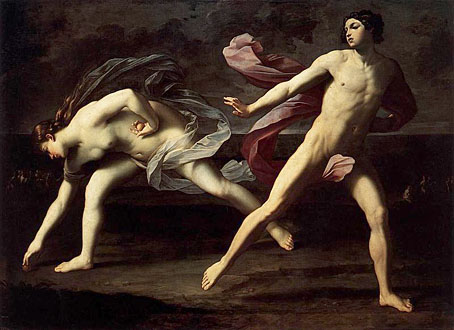
Atalanta and Hippomenes (c. 1612).

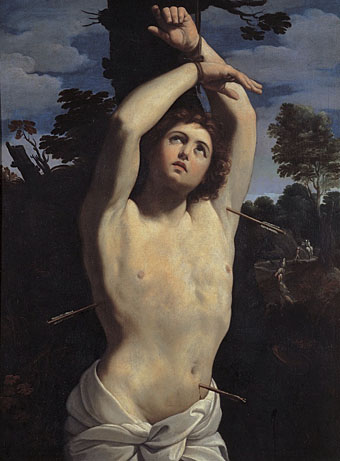
More golden apples appear in this painting by Guido Reni, not the most famous ones in art history—those would be all the Apples of Discord seen in the various Judgements of Paris—these are the fruit of the sacred tree in the Garden of the Hesperides which Hippomenes drops to prevent Atalanta from beating him in a race. The object of interest here isn’t the apples but the near-naked male, a favourite subject for Baroque artist Guido Reni whose work strikes viewers today as significantly homoerotic. This interpretation is by no means a recent one: Oscar Wilde was famously smitten with Reni’s depiction of Saint Sebastian (below) when he saw the painting in Genoa; in the 20th century the same painting (or one of Reni’s other Sebastians) excited the 12-year-old protagonist in Yukio Mishima’s novel Confessions of a Mask. Here’s what GLBTQ has to say about Reni:

Given the fierce homophobia prevailing in Europe during the Baroque era, historians seeking to reconstruct the lifestyles and works of queer artists often have to depend upon undocumented anecdotes and innuendoes.

Utilizing this type of evidence (including rumors about his supposed disdain of women, his possible romantic involvement with his long-time assistant, his interest in cross-dressing, and his “delicate” mannerisms), recent scholars interpret Guido Reni (1575–1642) as a gay artist.

The disdain of women is referred to in an earlier account, as are other pertinent details:

He was accustomed to paint with his mantle about him, gathered gracefully over his left arm. His pupils, of whom he had a great number—at one period no less than eighty, drawn from nearly every nation of Europe—vied with each other to serve him, esteeming themselves fortunate to have opportunities to clean his brushes or to prepare his palette. He had no dearth of models in the multitude of youths and disciples which surrounded him; but all that Guido cared of them was to refresh his memory by viewing their limbs and torsos, and after that he could adjust them and correct their imperfections.

In the same way any head sufficed him for a model. Being once besought by Count Aldovrandi to confide in him who the lady was of whom he availed himself in drawing his beautiful Madonnas and Magdalens, he made his color-grinder, a fellow of scoundrelly visage, sit down, and commanding him to look upward, drew from him such a marvelous head of a saint that it seemed as if it had been done by magic. Better than any other artist he understood how to portray upturned faces, and boasted that he knew a hundred ways of making heads with their eyes lifted to heaven. He often declared that his favorite, models were the ‘Venus of Medici’ and the wonderful heads in the Niobe group.

He was always in great fear of sorcery and poisoning, and for that reason could not endure women in his house, abhorring to have any dealings with them, and, when such were unavoidable, hurrying them through as rapidly as possible. Old women were his especial detestation, and he always fled from them, and lamented grievously if one of them should appear when he was about beginning or closing some commission.

From Guido Reni (1903)

That’s one way of either justifying your misogyny or explaining to the neighbours why your house is full of young men with no women.
reni10.jpg

Saint Sebastian (1615).

Speculation about the sexuality of artists from past centuries seldom leads anywhere but it can be a fun parlour game, provided you take accounts like the one above with a pinch of salt. In Reni’s case you’d have to point to the many paintings where a religious subject is used as the merest pretext for some shirtless male pulchritude. This was a common ploy in other areas of art: landscape painting evolved as a genre in its own right when post-Renaissance artists began to shrink the religious figures who were the ostensible subject of their commissions into the corner of a field or the shadows of a valley; the imagination could be given free rein by the expedient of painting an apocalypse or a Temptation of St Anthony.

Reni lets loose his temperament by returning to a range of religious subjects that happen to feature attractive youths. Even his picture of Sacred Love defeating Profane Love (below) shows a divine figure who seems to represent more of the libido than the subject should require. Elsewhere he follows Caravaggio with a youthful John the Baptist preaching in the wilderness in an almost total state of nature. Reni’s angels are some of the most androgynous figures you’ll find in Baroque painting; the model for his very girlish Archangel Gabriel also appears as Jesus in another painting, raising a somewhat scandalous implication as to the real paternity of Christ.
reni07.jpg

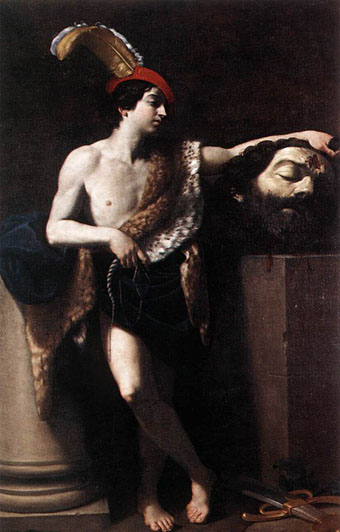
David with the Head of Goliath (1605).

The following selection of paintings is a prejudiced choice, of course. Some of these can be seen at a much larger size at the Google Art Project. Frivolous speculation aside, at his best Reni could be very good indeed as in this superb portrait of Saint Matthew with another androgynous angel. It’s no surprise to read that his work was in great demand throughout his life.

Continue reading “The art of Guido Reni, 1575–1642”

Weekend links 128

wrongeye.jpg

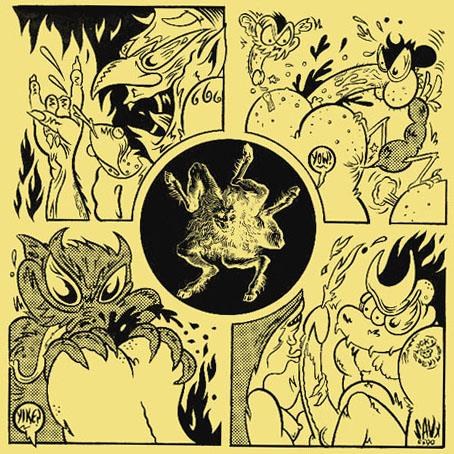
Seven-inch sleeve design by Savage Pencil for Wrong Eye (1990) by Coil.

• “Can you use sensory deprivation to explore ESP? And then make music from the process?” Drew Daniel and MC Schmidt of Matmos decided to find out for their new EP. Related: Occult Voices—Paranormal Music, Recordings of Unseen Intelligences, 1905–2007 at Ubuweb. Details of the original CD release can be found here.

Gorgeous Gallery: The Best in Gay Erotic Art is a new book by David Leddick featuring the work of contemporary gay artists. Howard G. Williams has a review at Lambda Literary.

Trip or Squeek by Savage Pencil, a book collection of the artist’s comic strips for The Wire magazine, forthcoming from Strange Attractor Press.

The novels of the middle period are Burgess’s most vital because it was in these that he forged what we might now recognize as the Burgessian – the antic puns and wordplay, the etymological digressions, the opacity, the glamorous pedantry, the tympanic repetitions, and an alliterative, assonantal musicality that makes every sentence seem vivid and extrovert: “Seafood salt with savour of seabrine thwacking throat with thriving wine-thirst”; “the lucent flawlessness of the skin, of the long fleshly languor that flowered into visibility”; “he was in a manner tricked, coney-caught, a court-dor to a cozening cotquean”. This is Burgess’s description of an Elizabethan brothel: “He entered darkness that smelled of musk and dust, the tang of sweating oxters, and, somehow, the ancient stale reek of egg after egg cracked in waste, the musty hold-smell of seamen’s garments, seamen’s semen spattered, a ghost procession of dead sailors lusting till the crack of doom”.

Ben Masters on A Clockwork Orange and its creator, fifty years on

• A streaming album for the beginning of autumn, the self-titled debut by Eraas, available in a range of formats at Bandcamp.

• “How Collecting Opium Antiques Turned Me Into an Opium Addict.”

Ted Hughes reads from Crow. Related: Raptors by Leonard Baskin.

• Janitors of Lunacy: Jonny Mugwump remembers Coil.

equus.jpg

Back in June I suggested Clive Hicks-Jenkins’ paintings as potential artwork for Penguin’s Modern Classics series. Last week Clive revealed that Penguin will be using one of his painted maquettes for a new edition of Equus next year.

150 Years of Lesbians and Other Lady-Loving-Ladies

Color Sound Oblivion: a Coil/TG/related Tumblr.

Tune in, psych out: the new black psychedelia.

The Hills Are Alive (1995) by Coil | QueenS (2012) by THEESatisfaction | Goldblum (2012) by Oddience.

Weekend links 126

dogo.jpg

Mala Reputación (1991) by Dogo Y Los Mercenarios. Cover art by Nazario Luque.

Artist Nazario Luque was Spain’s first gay comic artist who’s also known for the drawing which appeared (without permission) on the sleeve of Lou Reed Live – Take No Prisoners in 1978. On his website Nazario says he’s been described as “Exhibicionista, solidario, provocador, agitador moral, rompedor, arriesgado, polifacético, transgresor, canalla, pintiparado, morigerado o simplemente superviviente…” Via Música, maestros, a two-part post (second part is here) about album cover art by comic artists.

The BBC Radiophonic Workshop Returns. And quite conveniently, Ubuweb posts some original Radiophonic creations by electronic music genius Delia Derbyshire. Ms Derbyshire is profiled along with her other pioneering colleagues in an hour-long TV documentary, Alchemists of Sound.

• Tor.com celebrates the fiction of Shirley Jackson. Too Much Horror Fiction has a substantial collection of Shirley Jackson book covers.

Phantasmagorical and all but plotless, Nightwood flings itself madly upon the night, upon Wood, and upon the reader. Its sentences pomp along like palanquins and writhe like crucifixions. They puke, they sing. Their deliriums are frighteningly controlled. […] TS Eliot loved Nightwood so much that he shepherded its publication and wrote the introduction to the first edition. Dylan Thomas complimented it with his left hand by calling it “one of the three great prose books ever written by a woman” and with his right hand by stealing from it. […] Nightwood’s Dr. Matthew-Mighty-grain-of-salt-Dante O’Connor, florid monologist and transvestite, seems to have been a model (along with Captain Ahab) for Judge Holden in Blood Meridian. The difference is that Cormac McCarthy’s Judge is essentially Satan, whereas O’Connor is essentially Christ; they’re only just on opposite sides of the border of madness.

Austin Allen on The Life and Death of Djuna Barnes, Gonzo “Greta Garbo of American Letters”. There’s a lot more Djuna Barnes at Strange Flowers.

• Out at the end of the month, Extreme Metaphors, interviews with JG Ballard, 1967–2008, edited by Simon Sellars & Dan O’Hara.

• The favourite Polish posters of the Brothers Quay. Over at Cardboard Cutout Sundown there are more Quay book covers.

The Mancorialist: people on the streets of Manchester are given the Sartorialist treatment.

The Liverpool International Festival Of Psychedelia takes place on 29th September.

The Caves of Nottingham are explored in a detailed post at BLDGBLOG.

• In Remembrance: Bill Brent, Groundbreaking Queer Sex Publisher.

Confessions of a Bookplate Junkie

The Uranus Music Prize 2012

Fuck Yeah René Lalique

Dr Who: original theme (1963) by Ron Grainer with Delia Derbyshire | Falling (1964) by Delia Derbyshire | The Delian Mode (1968) by Delia Derbyshire | Blue Veils And Golden Sands (1968) by Delia Derbyshire.

Books of blood

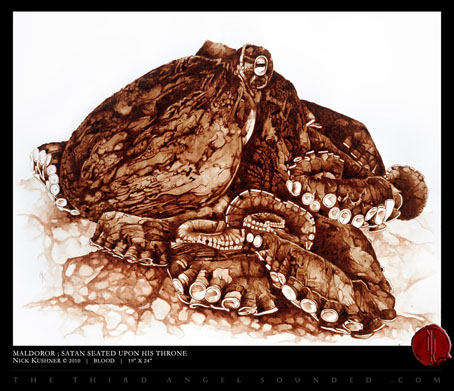
kushner1.jpg

Artist Nick Kushner writes to alert me that his 2010 painting Maldoror: Satan Seated Upon His Throne has been used on the cover of a recent Russian edition of Lautréamont’s novel. Kushner uses his own blood to create his paintings, and the cover below has been created using the same material. Maldoror himself would no doubt demand that proper homage be paid by binding the volume in human skin. That’s something publisher Provocateurs’ Club can maybe try for the special edition.

kushner2.jpg

This news has reminded me that I had a mail last month from another American artist, Robert Sherer, concerning a book collection of his own blood paintings. Sherer also uses the blood of friends both HIV-negative and HIV-positive. Blood Works: The Sanguineous Art of Robert Sherer is published by Kennesaw State University Press.

Previously on { feuilleton }
Magritte’s Maldoror
Frans De Geetere’s illustrated Maldoror
The art of Robert Sherer
Maldoror illustrated

Weekend links 125

cme.jpg

Coronal Mass Ejection from the surface of the Sun, August 31st, 2012.

• “Most of the main parts were recorded in a single day using Vangelis’s famous technique: try to play as many synths as possible at once.” Simon Drax on the prolific musical output of Zali Krishna. The new Krishna opus is Bremsstrahlung Sommerwind, free to download at the Internet Archive.

• The Northants International Comics Expo (N.I.C.E.) opens on September 22nd. Among the many attendees there will be Mr Alan Moore making his first convention appearance since 1987.

• “Isolated for one night in a boat overlooking the Thames, Geoff Dyer explores representations of reality through the lens of Joseph Conrad’s Heart of Darkness.”

Now seems the right time to revisit this secret archive of public broadcasting. It’s an antidote to the celebrity-led, format-driven nature of so many arts documentaries made today. It shows that it’s possible to produce TV that is both populist and experimental. And it also refutes the cliché that the 1970s was a decade only of crisis and downturn. “Feminism, political theatre, Ways of Seeing: I wasn’t thinking, ‘what a terrible time’. It was very dynamic, activist, political. Creatively it was very exciting. Yet all they show on those television retrospectives are episodes of Top of the Pops.”

Sukhdev Sandhu talks to Mike Dibb, the director of Ways of Seeing.

• From 1999: Colm Tóibín reviews A History of Gay Literature: The Male Tradition by Gregory Woods.

What We See: a song by Julia Holter & Nite Jewel with a film by Delaney Bishop & Jose Wolff.

Rick Poynor on The crash test dummy: from subcultural fringes to pop culture mainstream.

In his 1973 book on Joyce, Joysprick, Burgess made a provocative distinction between what he calls the “A” novelist and the “B” novelist: the A novelist is interested in plot, character and psychological insight, whereas the B novelist is interested, above all, in the play of words. The most famous B novel is Finnegans Wake, which Nabokov aptly described as “a cold pudding of a book, a persistent snore in the next room.” The B novel, as a genre, is now utterly defunct; and A Clockwork Orange may be its only long-term survivor.

Martin Amis on A Clockwork Orange, fifty years on. My old post about the film’s record shop scene continues to be one of the most popular pages here.

• Wild Boys: David Bowie and William Burroughs in 1974, hand-coloured by DB.

Alfred Kubin‘s illustrations for Haschisch (1902) by Oscar AH Schmitz.

• Revolution off: industrial ruins photographed by Thomas Jorion.

• Tetrahedra of Space: 22 pulp illustrations by Frank R. Paul.

The Blue Boy Studiolo: a Tumblr.

Marina Warner visits Hell.

• The art of Casey Weldon.

RainyMood.com

Third Stone From The Sun (1967) by The Jimi Hendrix Experience | Sunrise In The Third System (1971) by Tangerine Dream | 3rd From The Sun (1982) by Chrome.