The Mercenaries of the Stolen Moon

mercenaries.jpg

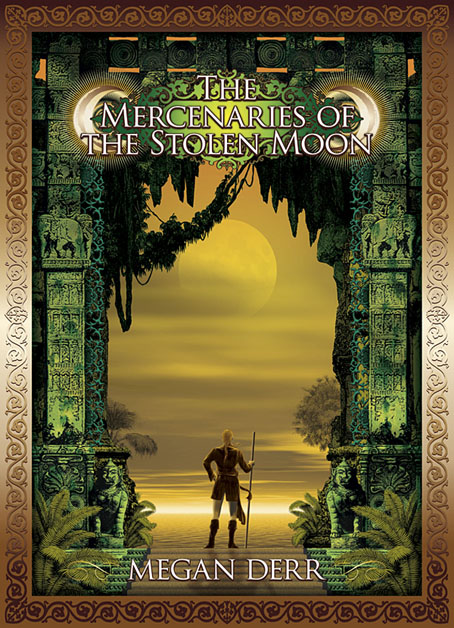
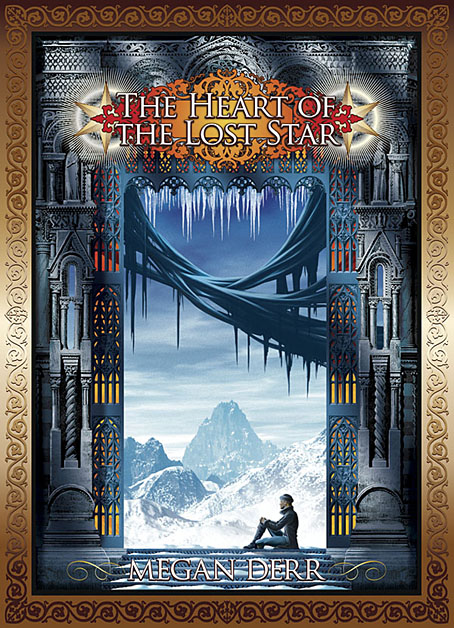
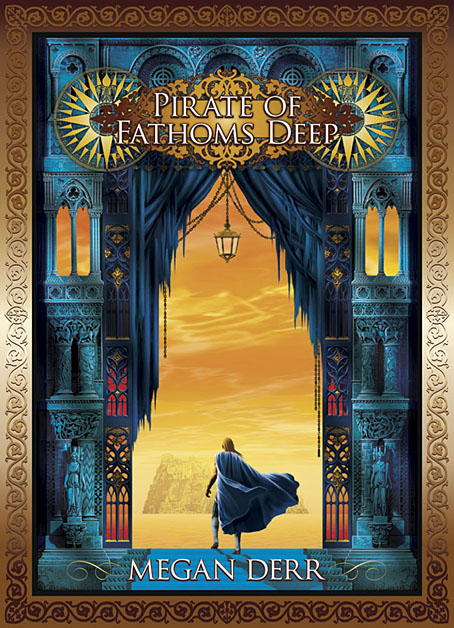
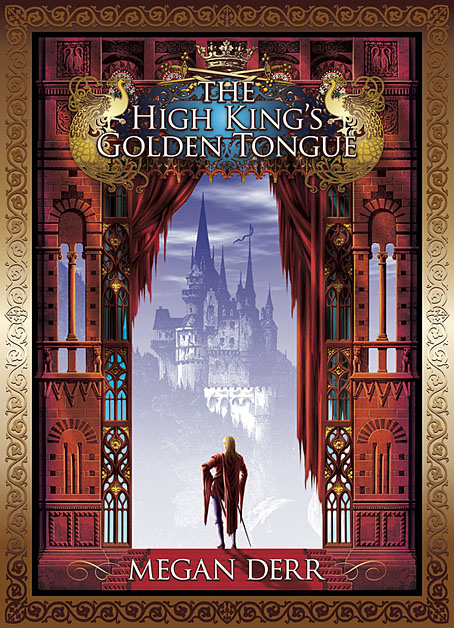
As promised last week, here’s my latest cover for Megan Derr’s gay fantasy series, Tales of the High Court. The first book wasn’t intended to have this many sequels so my initial cover design also wasn’t planned as something that might be a template for later volumes. The previous books (below) borrowed bits and pieces from a set of early Viollet-le-Duc illustrations, a decision that posed problems as the series evolved when I began to run out of usable material. The new book required a different setting so I was able to dispense with the medieval architecture in favour of a hybrid of Indian and Cambodian stonework. I’ve always enjoyed the ruined-jungle-temple aesthetic so this was fun to work on, and made a break from all the black-and-white illustration I’ve been producing for the past year or so. The Mercenaries of the Stolen Moon will be published by Less Than Three Press later this year.

loststar.jpg

derr2.jpg

derr1.jpg

Previously on { feuilleton }
The Heart of the Lost Star
Tales of the High Court

Weekend links 417

coil.jpg

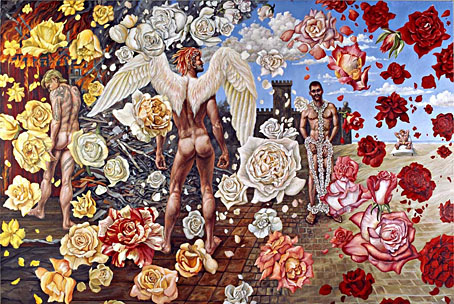
Cover of How To Destroy Angels (Remixes And Re-Recordings) (1992) by Coil. Artwork: Fine Balance (1986) by Derek Jarman.

• It’s that man again: “According to the late great short story writer Robert Aickman, the problem with our excessively modern world is not that it is strange, but that it is not strange enough.” Scott Bradfield on a writer who can no longer be described as neglected or overlooked.

• Coil may have expired over a decade ago after the death of John Balance but the posthumous releases persist. Latest of these is How To Destroy Angels, an album-length presentation of music (or audio) by Coil and Zos Kia (John Gosling) from 1983/84.

• “Two decades ago, a renowned professor promised to produce a flawless version of one of the 20th century’s most celebrated novels: Ulysses. Then he disappeared.” The Strange Case of the Missing Joyce Scholar.

• At Dangerous Minds: The Fool: The Dutch artists who worked for The Beatles (and made their own freak folk masterpiece). Previously here: The art of Marijke Koger.

• RIP Nick Knox. The Cramps were always best when playing live, as here in 1986 when they performed songs from A Date With Elvis on Channel 4’s The Tube.

• “The McKenzie Tapes is a collection of live audio recordings from some of New York City-area most prominent music venues of the 1980s and 1990s.”

• Beyond the veil: two extracts from Death by Anna Croissant-Rust, one of two new books from Rixdorf Editions.

• Impulse Responses: composer Deru on scoring with the Cristal Baschet.

Fleshback: Queer Raving in Manchester’s Twilight Zone Chapter 1–3.

• “Puzzler says he has cracked code to stolen Belgian masterpiece.”

• Mix of the week: FACT mix 657 by Beatrice Dillon.

Jenzeits

Death Have Mercy (1959) by Vera Hall | Oh Death (1964) by Dock Boggs | Oh Death (1967) by Kaleidoscope

Weekend links 415

varo.jpg

The Creation of the Birds (1957) by Remedios Varo.

• “I think my music is very modern and very old. Together.” Sandy Robertson interviewed Popol Vuh’s Florian Fricke for Sounds in 1981. The Fricke-directed Sei Still Wisse ICH BIN referred to in the feature may be viewed here. Further Vuh-ing: Popol Vuh on Beat Club, 1971; a news clip of the group from the same year; a filmed improvisation from around the same time (Florian still had his Moog); and the group miming to recorded music from a year or two later.

• More Rammellzee (see last week): Gothic Futurism, a video collage based on Rammellzee’s treatise of the same name. Probably the only place you’ll ever see Rammellzee, the late Glenn Branca and art historian Kenneth Clark thrown together.

• After releasing 5 albums, Disjointed Oddities And Other Such Things is the first EP of “odd strange electronics, psych, Radiophonics, drone and quirky folk” by Keith Seatman.

Alina Cohen on Remedios Varo, a Spanish Surrealist painter whose work has been receiving increased attention in recent years but whose life remains under-examined.

• More German music: “I grew up in total ruins”—Irmin Schmidt of Can on LSD, mourning and musical adventures.

• Mixes of the week: FACT mix 655 by Matthewdavid, and The Monday Is Okay mix by JQ.

Olivia Laing, Sarah Wood and Philip Hoare discuss Modern Nature by Derek Jarman.

National Geographic has digitized its collection of 6,000+ vintage maps.

• At Bandcamp: The Transcendental Sound of Moroccan Gnawa Music.

Joe Fletcher on the nightmarish dream logic of Bruno Schulz.

Levi Stahl on the mind of Donald E. Westlake.

Affenstunde (1970) by Popol Vuh | Toy Planet (1981) by Irmin Schmidt & Bruno Spoerri | Adithaim (2005) by The Cracow Klezmer Band

Weekend links 413

bester.jpg

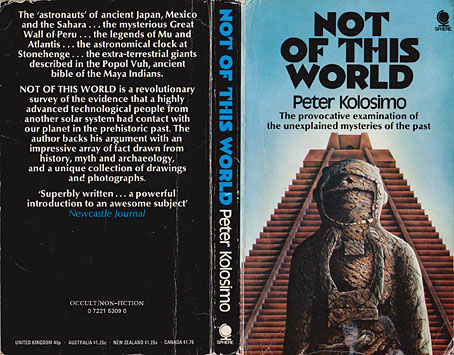
Cover art and design by David Pelham, 1974. The author’s name is set in Marvin (see below).

• Revelation of the week is a lengthy, career-spanning interview with Igor Wakhévitch, the French composer whose extraordinary run of albums from the 1970s are cult items in these parts. (Previously) Wakhévitch isn’t exactly reclusive but he lives in India, and hasn’t recorded anything since the 1980s, so in recent years he wasn’t visible or even known much at all outside France. The release in 1998 of a CD collection, Donc…, and a handful of vinyl reissues, brought him out of obscurity, although all the reissues to date have been in limited quantities. Work of this quality really warrants a wider release.

The Sky Torn Apart is a new album by Paul Schütze, his first for several years. Very good it is too, 56 minutes of growling and glittering atmospherics that could equally suit the enervating heights of summer (as in Wendy Carlos’s drone piece from Sonic Seasonings) as the depths of winter, the inspiration being the apocalyptic cycles of Norse mythology.

• At Lambda Literary: Cathy Camper talks to cartoonist Justin Hall about his planned film, No Straight Lines, about the history of queer comics. There’s a Kickstarter for the project, and more background detail at QueerClick (NSFW).

• Introducing Marvin Visions, a digital revival of Marvin, a photoset typeface first launched in 1969, and very popular during the 1970s on science-fiction cover designs. Marvin Visions is free for personal use.

• The second number of the relaunched Wyrd Daze—”The multimedia zine of speculative fiction + extra-ordinary music, art & writing”—has arrived.

• At New Noise: Dylan Carlson (again) talking about the influences on his solo album, Conquistador.

• Video Drone: Russell Cuzner talks to Rose Kallal about her audio-visual concerts.

• Mix of the week: a Dark Souls-inspired drone mix from Justin C. Meyers.

• RIP Glenn Branca

The Ascension (1981) by Glenn Branca | Ascension (1992) by O Yuki Conjugate | Ascension (2014) by The Bug

Weekend links 411

crowley.jpg

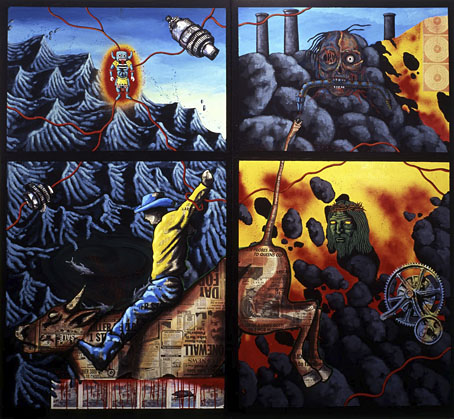
The Temple of Love (1911–24) by Herbert E. Crowley.

• My film viewing in the 1980s involved a considerable amount of backtracking: watching any film noir that turned up on the TV while chasing the early works of David Cronenberg, and various “New Hollywood” classics on television or at repertory cinemas (when such things were still plentiful). Contemporary fare by comparison was often a lot less attractive, although I’d be waiting for new work from David Lynch and Nicolas Roeg while pursuing obscurities (usually the banned or censored) on videotape. Popular films seldom generated actual loathing but throughout the decade I nurtured a persistent hatred for the works of John Hughes, an animus that can still return today when I read yet another nostalgic article about his oeuvre.

The monoculture of the 1980s was writ large on American cinema of the decade. From Arnold Schwarzenegger’s muscle-rippling actioners to John Hughes’s adolescent confections, bombastic, generally upbeat films characterised the decade of the yuppie.

Christina Newland offers a welcome riposte to the pastel-hued retrospectives in a piece entitled “Reagan’s bastard children: the lost teens of 1980s American indie films”. While not exclusively teen pictures, I’d have mentioned three low-budget films written by Eric Red: The Hitcher (1986), Near Dark (1987) and Cohen and Tate (1989).

The Temple of Silence: Forgotten Works & Worlds of Herbert Crowley is a lavish (and costly) study of the strange comic strips and incredibly detailed drawings of Herbert E. Crowley (1873–1937). Mark Newgarden interviewed Justin Duerr about rescuing Crowley’s art from undeserved neglect. I missed an earlier interview by Steven Heller with Temple of Silence publisher Josh O’Neill. There’s more: The Wiggle Much a Tumblr devoted to Crowley’s comic strips and other artwork. (Ta to Jay for the tip!)

Pandemic is an interactive film by John Bradburn for The Science Museum. “A pandemic is causing heart failure–how far will you go to create a pig/human hybrid to provide donor organs?” The multiple choice begins at YouTube; there’s also a behind the scenes feature at the Museum blog, and a trailer. Anyone who remembers a certain scene in Lindsay Anderson’s O Lucky Man! may hesitate before playing.

Given the plain palette of so much 1969–70 rock—jammed-out bluesy boogie in the Canned Heat and Allman Brothers mode, nasal pseudo-country harmony singing à la CSN&Y and their afterbirth—it is tempting to imagine an entirely alternative history for rock. It’s a parallel world where Fifty Foot Hose’s Cauldron, United States of America’s self-titled album and synthedelic oddities from Syrinx, Silver Apples, Beaver & Krause and Tonto’s Expanding Head Band were just the run-up to a giant leap into the electronic future.

Simon Reynolds in an excellent piece on one of my favourite musical sub-genres, electronic psychedelia

• The week in animated film: Emerald Rush, a video for an extract from Jon Hopkins’ new album, Singularity; Awaken Akira, a short homage to Katsuhiro Otomo’s graphic novel/film by Ash Thorp and Zaoeyo; Extra (1996), a video by one of the Akira animators, Koji Morimoto, for music by Ken Ishii.

Tenebrous Kate on The Powers of Darkness & The Powers of the Mind: The Legacy of Jacques Tourneur’s Night of the Demon. Related: a look at the film’s shooting script and pressbook.

• At Dangerous Minds: John Gray, the pre-Bosie lover of Oscar Wilde, and the man whose surname is memorialised in Wilde’s most famous creation, Dorian Gray.

• Skewing the Picture: China Miéville posts the full text of an essay from 2016 about the rural weird.

• Share a pastrami sandwich with TED Klein in Episode 65 of Eating the Fantastic.

• More Hodgsoniana: The Land of Lonesomeness, a short story by Sam Gafford.

• At The Quietus: Barry Miles on William Burroughs’ years in London.

• At Dennis Cooper’s: Curtis Harrington Day.

Night Of The Assassins (1977?) by Les Rallizes Dénudés | Night Of The Earth (1980) by Chrome | Night Of The Swallow (1982) by Kate Bush