Weekend links 82

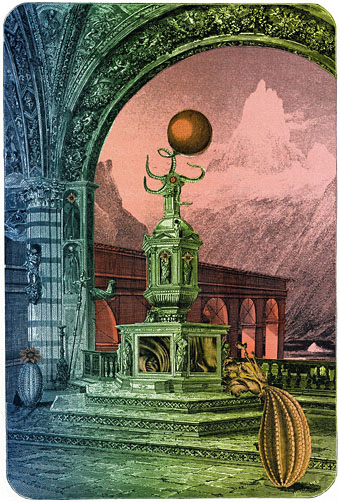
morris.jpg

At the Mountains of Madness (1979) from Halloween in Arkham by Harry O. Morris.

• Golden Age Comic Book Stories always pulls out the stops in the run up to Halloween. In addition to a wonderful collection of Harry O. Morris collages, Mr Door Tree has also been posting Virgil Finlay’s illustrations for Edgar Allan Poe, Lynd Ward’s tremendous illustrations for a collection of weird tales entitled The Haunted Omnibus, Barry Moser’s woodcuts for an edition of Frankenstein, and Virgil Finlay’s illustrations for stories and poems by HP Lovecraft.

• “Eugene Thacker suggests that we look to the genre of horror as offering a way of thinking about the unthinkable world. To confront this idea is to confront the limit of our ability to understand the world in which we live – a central motif of the horror genre. In the Dust of This Planet explores these relationships between philosophy and horror.”

• “…the reader […] becomes a conscious participant in the process of imposing a linear sequence, while at the same time remaining aware that all narrative is an act of memory, and that memory is necessarily random.” Jonathan Coe reviews Marc Saporta’s book-in-a-box, Composition No.1, recently republished by Visual Editions.

• Nearly fifty years after its first performance, Peter Weiss’s Marat/Sade is still disturbing playgoers. And nearly ninety years after its release, Alla Nazimova’s silent film production of Oscar Wilde’s Salomé is touring the UK with live musical accompaniment.

Tom of Sinland at Homotography, in which illustrator Bendix Bauer portrays some of the fashion world’s notable male designers as Tom of Finland-style characters for Horst magazine.

Neil Gaiman Presents is a new audiobook imprint which launches with works by Jonathan Carroll, Alina Simone, Keith Roberts, M. John Harrison and Steven Sherrill.

• The Weird Wild West: Paul Kirchner has put all his Dope Rider comic strips online.

Leonora Carrington prints at Viktor Wynd Fine Art, London, from November 5th.

The Fall to Earth: David Bowie, Cocaine and the Occult.

Photos of New York City, 1978–1985.

Kathy Acker recordings at Ubuweb.

The Occupied Times of London.

The Golden Age of Dirty Talk.

Pushkin silhouettes.

• This week I’ve been lost in the Velvet Goldmine (again): John, I’m Only Dancing (1972) by David Bowie | The Jean Genie (1972) by David Bowie | Drive-In Saturday (1973) by David Bowie.
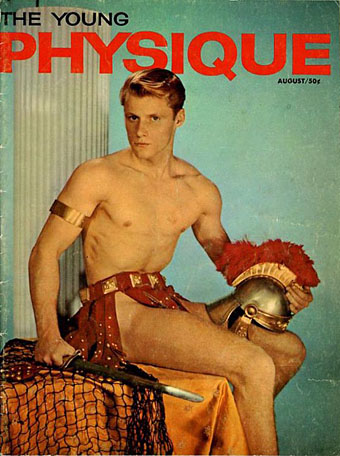
The Classical alibi in physique photography

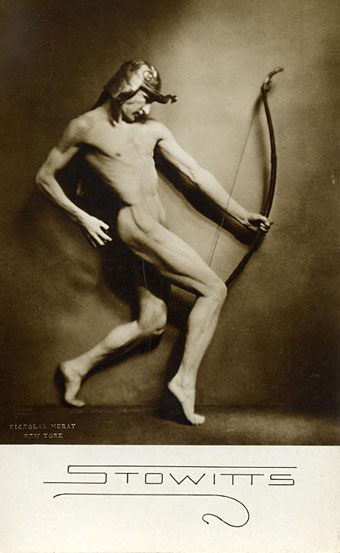
stowitts.jpg

Stowitts photographed by Nickolas Muray.

The title is from two gallery pages at the Queer Arts Resource which runs through a history of the old subterfuge whereby homoerotic pictures were decorated to look suitably Greek or Roman. This seldom fooled anyone, even in Oscar Wilde’s day, but it no doubt helped to keep the studios out of the law courts. Amid the plaster columns and antique props there’s a card I hadn’t seen before promoting dancer and artist Hubert Stowitts whose role as a satyr is one of the most memorable moments in Rex Ingram’s 1926 film of The Magician.

physique.jpg

Jim Galahad.

Also at Queer Arts is a copy of The Dying Gaul with a model who’s in the peak of health and a lot more well-hung than most Greek sculptures.

pose.jpg

This picture is something I found ages ago on a lost web page and now have a tenuous reason to post here. What looks like erotica is actually a fashion shoot (and he’s wearing swimming trunks) but it shows how the Classical mode persists. He looks like he wants to see more of Jim’s sword…

Elsewhere on { feuilleton }
The gay artists archive
The men with swords archive

Ed Wood’s Sleaze Paperbacks

wood.jpg

Yes, it’s that Ed Wood, Mr Plan 9 from Outer Space, who apparently supplemented his erratic film career by penning dubious porn novels and exposés of the erotic underworld. Most of what I know about him is culled from Tim Burton’s biopic so this was news to me. Ed Wood’s Sleaze Paperbacks is an exhibition at Boo-Hooray, New York, curated by Michael Daley and Johan Kugelberg:

The paperbacks are truly rare, even in an age of mass-searchable used book engines, and google ferocity. Ed Wood’s sleaze fiction is also as strange, idiosyncratic and out of step with his times and mores as his infamous movies. Wood would write porn inter-spliced with lengthy philosophical, sociological and psychological discourse, he’d write first person narratives of life as a transvestite in the buttoned up America of the 1950’s. He’d riff on psychosexual themes, and unleash his id, his ego and his superego in turn, sometimes in the same chapter. He’d write about sex and the human condition without veneer or filters, offering up the damaged and anguished voice of a desperately soul-searching drunk with a sense of self-worth that would stand in dichotomy to his self-pity.

Interesting to see Gay Black among the selected titles, a book I’d seen before in a Flickr collection of queer pulps. At the time I thought the credit must be coincidence, or some pseudonymous writer with a double-entendre name. The exhibition opens on November 2nd and runs to December 1st, 2011.

Elsewhere on { feuilleton }
The book covers archive

Looking for the Wild Boys

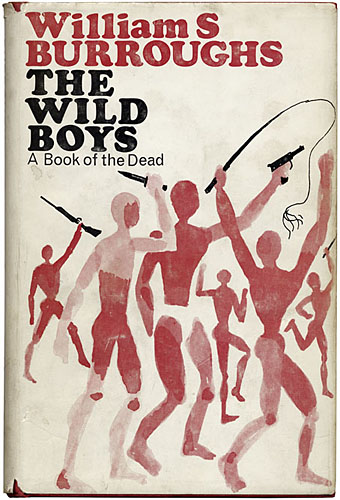
wildboys-calder.jpg

Calder & Boyars, 1972. Design by John Sewell.

This must be the first space novel, the first serious piece of science fiction—the others are entertainment.

Mary McCarthy defending The Naked Lunch in the New York Review of Books, June, 1963.

Mary McCarthy’s view—echoed a year later by Michael Moorcock and JG Ballard in the pages of New Worlds magazine—has never been popular or even particularly acceptable. William Burroughs gets touted as an sf writer by other writers, and John Clute gives him an entry in the Encyclopedia of Science Fiction, but Burroughs’ sf scenarios are guaranteed to offend those readers who prefer their narratives presented in a neat, linear form with detailed explanations of How The Future Would Actually Work, or the physics behind some piece of imaginary technology. The books which immediately follow The Naked LunchThe Soft Machine, The Ticket that Exploded, and Nova Express—all feature sf scenes or ideas. The latter was deemed sufficiently generic to prompt Panther Books in the UK to publish it three times as “Panther Science Fiction” although given the severe criticism that Moorcock sustained for trying to broaden the horizons of readers in the late 60s I don’t expect sales were encouraging.

The Wild Boys, published in 1971 (1972 in the UK), was Burroughs’ first novel after Nova Express, and his first book of fresh material after mining the stack of writing that birthed The Naked Lunch and the titles which followed. The novel is subtitled A Book of the Dead (as in the Egyptian or Tibetan Books of the Dead), and is certainly science fiction although I’ve never seen it marketed as such or noticed any sf reader include it in a list of notable genre novels of the period. My Calder & Boyers hardback offers a précis of the fractured narrative:

The year is 1988. The Wild Boys, adolescent guerilla armies of specialized humanoids, are destroying the armies of the civilized nations and ravaging the earth. The wild boys, who began in the pre-present past as petrol gangs, dousing their victims with petrol and setting them on fire for kicks, have grown to an army, dedicated to violence. One of them is used in a cigarette commercial. He becomes a new cult figure, a demi-god responsible for great destruction, and it is left to strong man Arachnid Ben Driss to exterminate the wild boys. He slaughters them, but the battle continues underground until all civilization collapses, revealing a future of horrifying dimensions. The originality of the theme and the very special Burroughs style together make this one of the most unusual science fiction novels ever, a prophetic exploration of the future, that should quickly establish itself as one of the classics of the present time.

That’s accurate, up to a point, although like many book blurbs it misrepresents the content somewhat. It also neglects to say how funny the book is. For anyone with a black sense of humour Burroughs has always been a great comic writer, and The Wild Boys has some prime examples, not least the opening chapter, Tío Mate Smiles, which is best appreciated in the author’s own reading.

Having gone through the novel in the past week, and going through its follow-up/appendix/remix Port of Saints at the moment, a couple of things occurred to me. The first was the way The Wild Boys strongly prefigures later works like Cities of the Red Night and The Place of Dead Roads. This is a fairly obvious point but it’s one that hadn’t fully clicked until now. The Wild Boys takes the problems of repressive control systems posed in the first few novels and offers a possible solution: a homoerotic utopia/dystopia where gangs of teenage boys hide out in depopulated regions, waging war against the rest of humanity with sex, magic and a mastery of weapons, including biological and viral varieties. While doing this they are steadily mutating so they can leave behind all human concerns with nation, family, laws and written language. Cities of the Red Night was Burroughs first novel after The Wild Boys and presents a less radical proposal, ranging through time with its anarchist pirate colonies and the six cities of the title. In The Place of Dead Roads Kim Carsons has his band of outlaw cowboys, The Wild Fruits, and the book gives us the conflict between the Johnsons—those who “mind their own business”—and the Shits: lawmen, politicians, tycoons, all the usual agents of Control.

Continue reading “Looking for the Wild Boys”

Weekend links 80

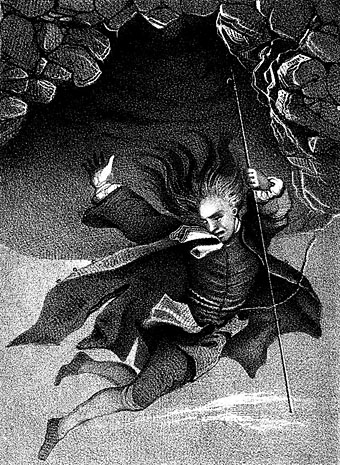
holberg.jpg

Niels Klim’s descent to the planet Nazar from the 1845 edition of Nicolai Klimii Iter Subterraneum (Niels Klim’s Underground Travels) (1741) by Ludvig Holberg.

BibliOdyssey posts illustrations from different editions of Ludvig Holberg’s satirical fantasy, appends the usual informative links and draws our attention Stories of a Hollow Earth at The Public Domain Review. I’d not come across the latter site before but it’s now bookmarked.

• While the economy of Europe continues to circle the toilet bowl it’s good to know that our Prime Minister is focusing on the important issues such as…limiting access to internet pornography. “Look at the implementation, and no matter where you stand on porn, I think you’ll see this plan is going to cause a lot of problems on its way to the eventual fail bin,” says Violet Blue. I was wondering how the four targeted ISPs would feel about a filtering plan that would drive many new customers elsewhere. The Register reports their response which comes down to offering guidelines rather than attempting the difficult and contentious task of filtering millions of websites.

• Related: Won’t you fuck off, Reg Bailey, in which the report by the small Christian pressure group that started all the fuss is eviscerated. | Elsewhere: Porn is good for society says Anna Arrowsmith, while Tristan Taormino asserts that “writing and publishing erotica, especially for minorities, is a political act.” Then there’s Pornsaints, “an artistic approach to porn, a pornographic approach to art, a pornartistic approach to religion.”

• In the music world: Richard H Kirk and Peter Care discuss Cabaret Voltaire and Johnny YesNo, Roy Harper talks to Alexis Petridis, and soundtrack composer Cliff Martinez is interviewed (and pictured playing a Cristal).

Witch’s Cradle at Strange Flowers (Maya Deren, Marcel Duchamp and Peggy Guggenheim), The Ghosts of Senate House, London, and Aleister Crowley’s Abbey of Thelema as it is today.

• RIP Frank Kameny, co-founder of the Mattachine Society, and a tireless gay rights advocate from the early 1960s on.

Bruce Weber photographs some of the dancers from Matthew Bourne’s Dance Company.

Terry Gilliam says “I used to think I could will things into existence. Not any more.”

• Charts at Business Insider: What the Wall Street protesters are so angry about.

Five From…: assorted wit and wisdom in the Tumblr labyrinth.

• Glass art by Jasmine Targett.

Ballard Geocoded.

Porno Base (1982) by 23 Skidoo | Kylie Minogue (2003) by Satanicpornocultshop | Tantric Porno (live) (2009) by Bardo Pond.