Golem, 2012

golem.jpg

“There are always more golems,” I wrote back in August, and here’s another. The artificial entity this time is a military computer that’s the subject of Golem XIV (1973), a science fiction story by Stanisław Lem that was later expanded into a novel:

The book is written from the perspective of a military AI computer who obtains consciousness and starts to increase his own intelligence, moving towards personal technological singularity. It pauses its own development for a while in order to be able to communicate with humans before ascending too far and losing any ability for intellectual contact with them. During this period, Golem XIV gives several lectures and indeed serves as a mouthpiece for Lem’s own research claims. The lectures focus on mankind’s place in the process of evolution and the possible biological and intellectual future of humanity. (more)

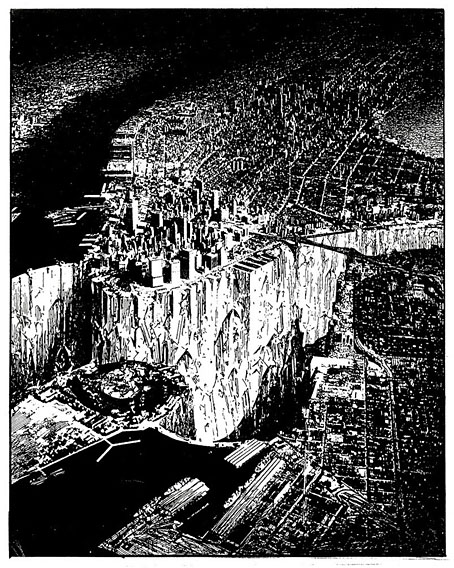
Golem (2012) is a seven-minute film by Patrick Mccue & Tobias Wiesner which uses elaborate and detailed CGI to illustrate Lem’s story. The music is an original piece by Cliff Martinez that in its final moments echoes his score for Steven Soderbergh’s Solaris (2002). Watch it here. (Via Coudal.)

Previously on { feuilleton }
More Golems
Das Haus zur letzten Latern
Hugo Steiner-Prag’s Golem
Barta’s Golem

Long Live the New Flesh: The Films of David Cronenberg

cronenberg.jpg

I used to have this documentary on tape but it vanished years ago so it’s good to find it again on YouTube. Long Live the New Flesh: The Films of David Cronenberg was directed by Laurens C. Postma and broadcast on British television in 1987 as a tie-in with the UK release of Cronenberg’s The Fly. The writer was Chris Rodley who subsequently directed some equally good documentaries of his own including the South Bank Show feature about the making of Naked Lunch (now present as an extra on the Naked Lunch DVD), A Very British Psycho about Michael Powell’s Peeping Tom (clips of which can be found in this film), and Donald Cammell: The Ultimate Performance.

Postma’s film captures Cronenberg when he was starting to gain visibility outside the science fiction and horror genres he’d mostly been working in up to this point. Among the interviewees are Martin Scorsese, an early champion, and Stephen King, whose The Dead Zone Cronenberg adapted in 1983. In the critical corner there’s the late film critic Robin Wood who the producers possibly chose on account of his being the voice of dissent in Piers Handling’s 1983 study of Cronenberg’s films The Shape of Rage. Wood isn’t as tiresomely ideological here as he is in Handling’s book (where you can play a drinking game if you count the times he uses the phrase “bourgeois patriarchal capitalism”) but he still seemed to find something reactionary and “unprogressive” (in a political sense) about Cronenberg’s work. Elsewhere there are clips of the films from Shivers on, and I’d forgotten about the comparisons Rodley and Postma make between Cronenberg’s work and Michael Powell’s still astonishing Peeping Tom.

Long Live the New Flesh is 67 minutes long and unfortunately chopped into chunks on the YouTube copy. Watch it here:

Part 1 | part 2 | part 3 | part 4 | part 5 | part 6 | part 7

Weekend links 130

teraoka.jpg

Sarah and Writhing Octopus (New Wave Series, 1992) by Masami Teraoka.

Strange Flowers continues to push all my buttons. For a while now I’d been intent on writing something about the strange (unbuilt) temples designed by German artist/obsessive naturist Fidus (Hugo Höppener) but I reckon James has done a better job than I would have managed. Also last week he wrote about Schloss Schleißheim, a palatial estate outside Munich with connections to Last Year in Marienbad and another eccentric, pseudonymous German artist: Alastair (Hans Henning Voigt).

• The circus poster that inspired John Lennon’s Sgt. Pepper song Being For The Benefit Of Mr. Kite! has been reproduced as a limited edition letterpress print. Related: Wikipedia’s page about Pablo Fanque (1796–1871), “the first black circus proprietor in Britain”.

• The first two volumes of The Graphic Canon, both edited by Russ Kick, are reviewed at Literary Kicks. I’ve not seen either of these yet but volume 2 contains my interpretation of The Picture of Dorian Gray. Related: the second book previewed at Brain Pickings.

You only have to read [Alan Bennett’s] diaries to see that, underneath the wit and humour and sandwich-filled pottering around old churches, there is a deep resentment at what has happened to England in his lifetime and an instinctive distrust, sometimes amounting to deep loathing, of most politicians. Listening, for instance, to Alan Clark and Kenneth Clarke talking on the radio about the arrest of General Pinochet in 1998, he writes: “Both have that built-in shrug characteristic of 80s Conservatism, electrodes on the testicles a small price to pay when economic recovery’s at stake.”

Michael Billington on Alan Bennett: a quiet radical

Hauntologists mine the past for music’s future: Mark Pilkington draws a Venn diagram encompassing Coil, Broadcast, the Ghost Box label, Arthur Machen, MR James, Nigel Kneale, Iain Sinclair and others.

Hell Is a City: the making of a cult classic – in pictures. The mean streets of Manchester given the thriller treatment by Hammer Films in 1959. The film is released on DVD this month.

The Function Room: The Kollection, Matt Leyshon’s debut volume of horror stories, has just been published. The cover painting is one of my pieces from the 1990s.

New Worlds magazine (now apparently known as “Michael Moorcock’s New Worlds“) has been relaunched online.

konahin.jpg

A drawing from Anatomy (part 1), a series by Alex Konahin.

• The forthcoming Scott Walker album, Bish Bosch, will be released on December 3rd. 4AD has a trailer.

Cormac McCarthy Cuts to the Bone: Noah Gallagher Shannon on the early drafts of Blood Meridian.

• The Velvet Underground of English Letters: Simon Sellars Discusses JG Ballard.

• Michelle Dean on The Comfort of Bad Books.

The typewriter repairers of Los Angeles

Cats With Famous People

Marienbad (1987) by Sonoko | Komm Nach Marienbad (2011) by Marienbad | Marienbad (2012) by Julia Holter.

(Thanks to Ian and Pedro for this week’s picture links!)

Petulia film posters

petulia1.jpg

Illustration by Bob Peak.

Further examples of those things you find when you’re searching for something else, these posters for Richard Lester’s Petulia (1968) are a good example of just how differently the same film can be presented by its advertising materials. Petulia (“the uncommon movie”) is a fascinating, unjustly neglected gem, a serious adult drama quite unlike the comedies (or comic dramas) Lester was making before and after. Nicolas Roeg photographed Petulia shortly before embarking on his own directing career, capturing San Francisco just after the Summer of Love in a more documentary fashion than the exploitation films of the period. There are nods to the psychedelic scene with party appearances by Big Brother and the Holding Company, and the Grateful Dead, but the narrative concerns the flipside of hippiedom with a group of middle-class professionals ensnared in adultery and marital failure.

A commonly remarked feature of Petulia is Antony Gibbs’ fragmented editing style which flashes backwards and forwards throughout, even showing events that never happen. The technique is usually taken to be derived from Alain Resnais although Gibbs had earlier edited The Knack…and How to Get It for Lester which is often as fragmented, albeit for a more comic effect. What’s notable about the technique is that Gibbs went on to edit Nicolas Roeg’s first two features, Performance (co-directed with Donald Cammell) and Walkabout, both of which take the fragmentation even further, creating the style which Roeg made his own.

petulia4.jpg

The poster that caught my attention was the marvellous one by Bob Peak who manages to depict the awkward relationship between the two leads—holding hands yet facing away from each other—whilst alluding to the psychedelic backdrop in the details. It’s difficult to tell at a small size but the sheet music design above shows that Peak’s drawing is a complex arrangement of blended faces, the reflected figure of a woman and a pattern of Bridget Riley swirls. If I was still collecting film posters I’d be sorely tempted to buy one of these.

petulia2.jpg

Illustration by Jean Fourastié.

Compared to which this pair of French designs veer off in opposite and unsatisfying directions. Jean Fourastié seems to have been under the impression that the story concerned a San Francisco flower child not a bored housewife, while Jean Mascii’s painting isn’t inaccurate but is more suited to a romance paperback. Big heads were apparently Mascii’s métier even if there were no people in the film.

petulia3.jpg

Illustration by Jean Mascii.

Petulia has been available on DVD for a while now, it’s well worth seeking out. Watch the trailer here.

Previously on { feuilleton }
Lucifer Rising posters
Wild Salomés
Druillet’s vampires
Bob Peak revisited
Alice in Acidland
Salomé posters
Polish posters: Freedom on the Fence
Kaleidoscope: the switched-on thriller
The Robing of The Birds
Franciszek Starowieyski, 1930–2009
Dallamano’s Dorian Gray
Czech film posters
The poster art of Richard Amsel
Bollywood posters
Lussuria, Invidia, Superbia
The poster art of Bob Peak
A premonition of Premonition
Metropolis posters
Film noir posters

Salomé by Upside Down House

salome1985.jpg

Big thanks to Mr. Kenneth at Radio Shirley for drawing my attention to this 1985 music video by Australian group Upside Down House. From their brief listing at Discogs the group don’t seem to have lasted long or released a great deal, Salomé being their second and final single. Given the quality of the music that’s not too surprising, you need someone like Jarboe to do justice to this theme. But the video is remarkably good for a low-budget imitation of silent cinema. The verisimilitude is no doubt a result of director Bob Eagle having used a hand-cranked camera which gives that distinctive flickering effect, a common feature of silent films which sound cameras and digital filters seldom replicate with any accuracy. The wildly emoting femme fatale is Kathleen Stewart, now better known as a novelist.

Elsewhere on { feuilleton }
The Salomé archive