Moorcock: Faith, Hope and Anxiety

moorcock.jpg

Photo of the author by Linda Moorcock.

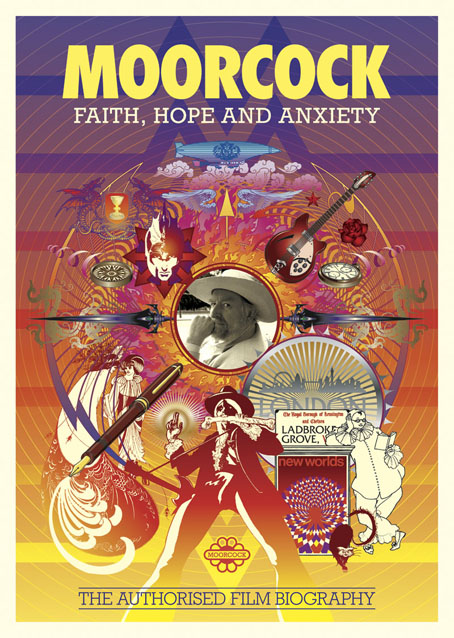
I mentioned a few days ago that I had another new piece of work to reveal, and this is it, a poster/promotional piece for Russell Wall’s forthcoming documentary about Michael Moorcock. The main challenge with one was to create something that would give a sense of Moorcock’s extensive career and the genre-spanning content of his many books.

mm1.jpg

I took the 1970s as the starting point, since this was the period when his reputation as a writer was established worldwide. The decade began with Britain’s bookshelves being colonised by Moorcock’s SF and fantasy novels published by Mayflower with vivid covers; it saw a cult feature film—The Final Programme—made from his first Jerry Cornelius novel, and it ended with the fourth Jerry Cornelius novel, The Condition of Muzak, winning a serious literary award, the Guardian Fiction Prize.

mm2.jpg

So the general appearance of the design, the headline typography, and the colour scheme are a nod to the Mayflower covers and especially to Bob Haberfield’s artwork which often used a similar style of Tibetan flames and clouds. The rest of the type is set in Rockwell, a preferred typeface of the Hipgnosis design team for much of the 1970s. Early on I had the idea of filling the design with stylised graphics like those used by some of the Hipgnosis illustrators, chiefly George Hardie, but that idea receded once the composition began to arrange itself. The fountain pen is the main hangover from this, a hard-edged graphic tilted at an angle like many of Hardie’s illustrations. The pen is a little inappropriate given that Moorcock is famous for knocking out novels at speed on a typewriter but it made a good visual rhyme with the guitar, a Rickenbacker like the one the author played in his Deep Fix band.
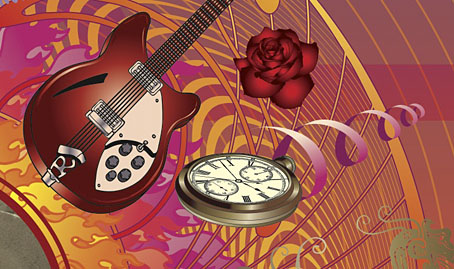
mm3.jpg

Elsewhere there are many specific references competing for attention: the Elric head is Jim Cawthorn’s illustration from the first edition of Stormbringer (1965); the Jerry Cornelius figure (straddling a repurposed Mayflower logo) is one of Mal Dean’s best, as seen on the cover of issue 191 of New Worlds magazine; the sorcerous blades are my own designs from 1985 as seen on the sleeve of Hawkwind’s Chronicle of the Black Sword album; the Beardsley figures from Salomé were a vague gesture to the 1890s but the Pierrot figure happens to be one Moorcock used for a while as a bookplate, something I didn’t know until I’d placed it in the design; the cat at Pierrot’s feet is another Beardsley from one of the Bon-Mots books; the London skyline is a contemporary one, London past and present having been a continual feature of Moorcock’s writing throughout his career. Lastly, all these details are contained by a graphic based on Abram Games’ BBC TV ident from the 1950s. When Russell and I began talking about this project the words “television biography” were being used so this would have connected to that idea, and to the decade when Moorcock’s career began.
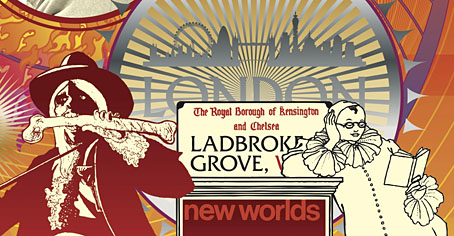
mm4.jpg

I don’t know when the documentary will be released but any news will be posted here in due course. There’s also talk of making copies of the poster available for purchase but nothing concrete has been decided yet.

Previously on { feuilleton }
Eduardo Paolozzi at New Worlds
Elric 1: Le trône de rubis
Into the Media Web by Michael Moorcock
The Best of Michael Moorcock
Revenant volumes: Bob Haberfield, New Worlds and others

Weekend links 238

hinrichsen.jpg

We Are The Water – Snow Drawings Project, Colorado (2014) by Sonja Hinrichsen with 50 volunteers.

• I don’t do end-of-year lists but Dennis Cooper does. My thanks to Dennis once more for including this blog among his selections. Also there is Jonathan Glazer’s film of Under the Skin, an adaptation of Michel Faber’s novel that impressed me as the most insidiously disturbing thing I’ve seen since Mulholland Drive. The Guardian‘s film critics agreed, making it their film of the year. I’d add to Peter Bradshaw’s appraisal by noting the superb score by Mica Levi, the refusal to spoon-feed the audience with explanations, and a refreshing absence of Hollywood gloss. Glazer’s film, like Kill List before it, shows that mundane British streets and interiors can still be a setting for serious horror.

• Related to the above: “I like Caravan, Coil—it’s very sad that they’re both dead now. In fact, Peter Christopherson, who was leader of Coil, contributed a song to a CD which I made for my wife for what we believed would be her last birthday.” Michel Faber talks to Hope Whitmore about Under the Skin and his new novel, The Book of Strange New Things. M. John Harrison recommends the latter on his own end-of-year list. In January Black Mass Rising will release a recording of The Art of Mirrors, Peter Christopherson’s homage to Derek Jarman from 2004.

David Bowie and band live on Musikladen in 1978: 40 minutes with Adrian Belew on squealing lead guitar, some Kurt Weill and an outstanding performance of “Heroes”.

• “Realism is a literary convention – no more, no less – and is therefore as laden with artifice as any other literary convention.” Tom McCarthy on realism and the real.

• Mixes of the week: The Best of the Best of the Best by TheCuriosityPipe, and Secret Thirteen Mix 138, a medley of post punk from Psyche.

• “We spent two weeks making the penises.” Livin’ Thing: An Oral History of Boogie Nights by Alex French and Howie Kahn.

• At Dangerous Minds: Seeing The Man Who Fell to Earth was one of the greatest experiences of Philip K. Dick’s life.

• Giving Voice to Our Pagan Past and Present: Pam Grossman on Witches, Women and Pop Occulture.

• Neglected last week (and linked everywhere but still a good one): The typography of Alien.

William Mortensen, the photographer who Ansel Adams called the Anti-Christ.

• Hear a track from analogue synthesizer virtuoso Kaitlyn Aurelia Smith.

Rick Poynor on illustrations by Bohumil Stepan for Crazy Fairy Tales.

12 excellent features from directors who never made another feature.

Werner Herzog Inspirationals

The Devil in the Hedgerow

New Warm Skin (1980) by Simple Minds | Rapture Of The Skin (1996) by Paul Schütze | Take Me Into Your Skin (2007) by Trentemøller

Weekend links 237

trouille.jpg

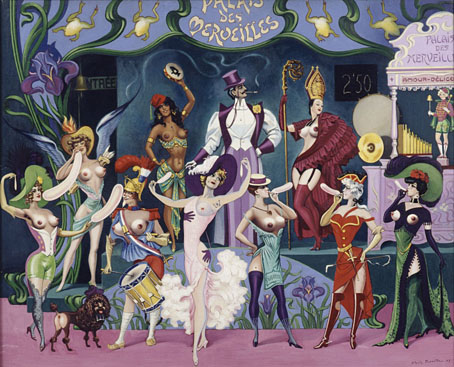
Le Palais des Merveilles, 1907 – 1927 – 1960 by Clovis Trouille.

• “Why is it OK to show a male ejaculation but not a female one? What are the qualifications of those who cobble together these rules?” Suzanne Moore on the latest batch of discriminatory restrictions against porn production in the UK. Porn laws in Britain have long been like the drug laws, sprouting fresh Hydra-heads of unwarranted bans and crackdowns after the previous bans and crackdowns have been discredited. Last month Zoe Williams talked to women who make niche porn for other women. This week she discovered that some of those she interviewed now find their work is illegal under the latest restrictions.

• “[Derek Jarman] considered In the Shadow of the Sun to be just as important as any of the feature films that he made in the 1970s.” Film producer and archivist James Mackay talking to Beatrix Rux about Derek Jarman’s Super-8 films. Related: Tilda Swinton is GQ’s Woman of the Year.

The Art of Big O by Michael Fishel (author) and Nigel Suckling (editor), a collection of the fantastic and psychedelic poster art published by Peter Ledeboer’s company in the 1970s. Good to see but at $67 (really?) I’d expect a better cover design.

• New electronica: More “confusing English electronic music” from Moon Wiring Club; Shut-Eyed Stories, an album by Jim Cheff; and Shapwick by Jon Brooks, previously vinyl-only and out-of-print, now has a digital edition.

JK Potter Mutates the Story: Christopher Burke & David Davis talk to the horror illustrator about his photographic work.

• Beth Maiden on The Fascinating Life of Pamela Colman Smith, artist of the Rider-Waite-Smith Tarot deck.

• Under the Influence: The Sexy, Sordid Surrealism of Clovis Trouille by Kirsten Anderson.

Geoff Manaugh on The Fiery Underground Oil Pit Eating LA.

• Mix of the week: Secret Thirteen Mix 137 by Teste.

The Wild Horny Goat

The Young People (2010) by Belbury Poly & Moon Wiring Club | Goat Foot (2012) by Belbury Poly | Walking Through Me (2014) by Moon Wiring Club

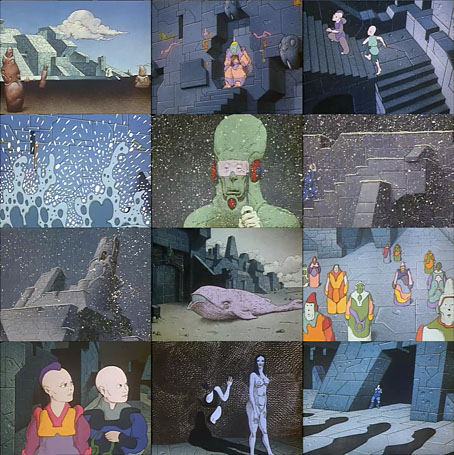
The Captive, a film by René Laloux

captive.jpg

The feature films of French animator René Laloux are the closest thing to cinematic equivalents of comics magazine Métal Hurlant. Laloux’s collaboration with Roland Topor, Fantastic Planet (1973), is familiar to Anglophone audiences but fewer people are aware of Time Masters (1982) and Gandahar (1988), two more science fiction films made with Moebius and Philippe Caza respectively. Time Masters looks marvellous but the story (based on a novel by Stefan Wul) lacks the strangeness of Fantastic Planet. Gandahar,  based on a novel by Jean-Pierre Andrevon, I’ve yet to see but anyone searching for it should be aware that the version dubbed into English (and retitled The Light Years) dumped Gabriel Yared’s score, and had a sexual encounter censored by the usual rabble of prudish American producers.

The Captive (1988) continues the collaboration with Philippe Caza being a 7-minute adaptation of Caza’s comic story Equinoxe (1982). The music for this one is also by Gabriel Yared, and this copy at YouTube includes English subtitles. For comparison, the comic story is here. Of the two I prefer the comic but then I’ve always enjoyed Caza’s work.

Previously on { feuilleton }
Les Temps Morts by René Laloux

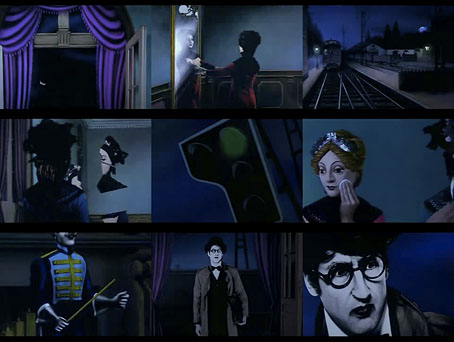
Papillons de Nuit, a film by Raoul Servais

papillons.jpg

From Homosurrealism to Belgio-surrealism. Papillons de Nuit (1997) is a short homage to the Surrealist painter Paul Delvaux featuring a handful of familiar Delvaux motifs including nocturnal tramcars and large-eyed, bare-breasted women. Raoul Servais had already borrowed some of Delvaux’s imagery for his feature-length fantasy, Taxandria (1994), but that film doesn’t sustain itself over its running time despite the involvement of Alain Robbe-Grillet and François Schuiten. Servais’s blend of live action and animation seems to work better in concentrated doses.

Previously on { feuilleton }
Sirene by Raoul Servais
Paul Delvaux: The Sleepwalker of Saint-Idesbald
Harpya by Raoul Servais
Taxandria, or Raoul Servais meets Paul Delvaux