Robert Anning Bell’s Tempest

bell1.jpg

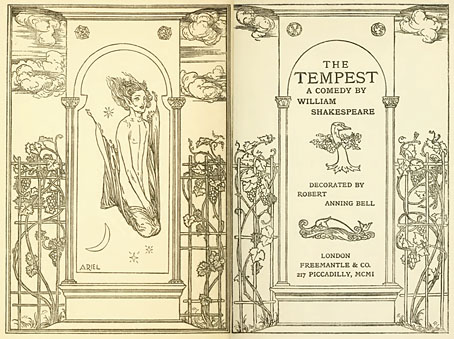
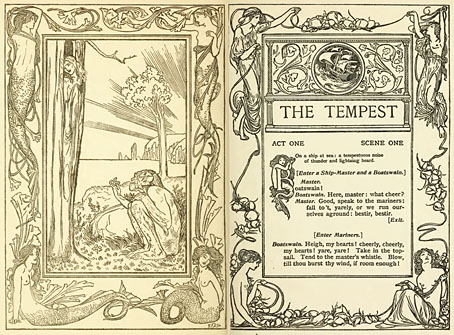
British artist and designer Robert Anning Bell (1863–1933) illustrates Shakespeare in this 1901 edition at the Internet Archive and the work seemed to give him an excuse to embellish many of the pages with writhing mer-folk. His adaptation isn’t as striking as William Heath Robinson’s Midsummer Night’s Dream from 1914 but then few books are. In style Bell is closer to his contemporary Charles Ricketts with very open line work and no heavy black areas. Ricketts produced his own version of Ariel’s Song to Ferdinand for The Magazine of Art in 1895 but doesn’t seem to have illustrated much more of The Tempest as far as I’m aware, although his Vale Press did issue an edition of Shakespeare’s complete works. It hadn’t occurred to me before how few illustrated editions there are of The Tempest; this seems surprising given the fantastic nature of the story. It might be that illustrated plays have never sold so well despite there having been a number of illustrated Midsummer Night’s Dreams. I’d love to have seen Harry Clarke tackling Ariel and Caliban.
bell2.jpg

bell4.jpg

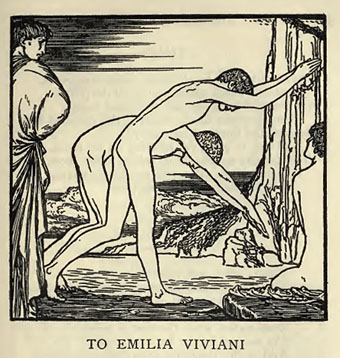
Also at the Internet Archive is a 1902 edition of Shelley’s poems illustrated by Bell (above) and an 1897 edition of Keats in the same series (below). Great poetry doesn’t necessarily lend itself to illustration so it’s no surprise that these books are less interesting than the Shakespeare.
bell3.jpg

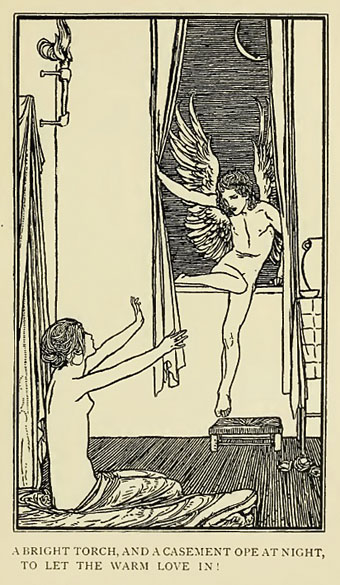
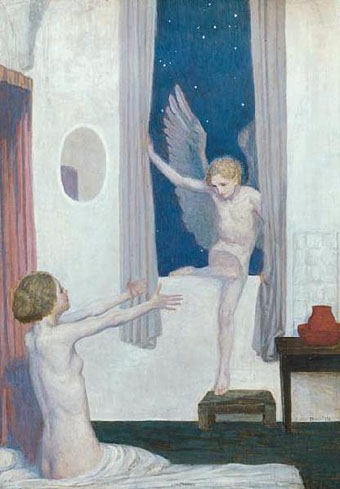
Bell later reworked his illustration for Keats’s Ode to Psyche as a painting which he called Cupid’s Visit. I much prefer the drawing to the painting.
bell5.jpg

Cupid’s Visit (1912).

Elsewhere on { feuilleton }
The illustrators archive

Previously on { feuilleton }
Charles Ricketts’ Hero and Leander
Another Midsummer Night
Arthur Rackham’s Midsummer Night’s Dream
The art of Charles Robinson, 1870–1937
William Heath Robinson’s Midsummer Night’s Dream
Weekend links #7

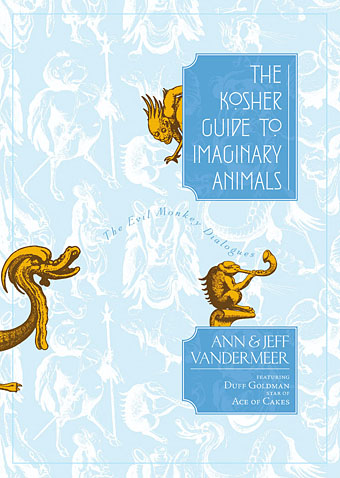
The Kosher Guide to Imaginary Animals by Ann and Jeff VanderMeer (and sporting my design inside and out) is now in print. The grotesque creatures on the jacket and inside are from a celebrated set of prints by Arent van Bolten.

• More VanderMeeria: my cover for Jeff’s novel Finch continues to garner attention. Artist John Picacio selected it as part of his contribution to this discussion of genre cover designs (thanks John) and io9 followed up by choosing it from SF Signal’s selection.

• Graphic design: the Ballets Russes at BibliOdyssey; Julian Montague’s “books from an invented intellectual history” at A Journey Round My Skull; Women, Snakes and Stalkers, book covers from the PK (Indo-Iranian languages and literatures) section of the University of Chicago’s Regenstein library (also here); I want this book: Arabesque – Graphic Design from the Arab World and Persia.

• Photography: Richard Davies’ documenting of Russia’s wooden churches; Dave Walsh’s fata morgana mirages in the Arctic.

• Illustration: Jacob Escobedo at Sci-Fi-O-Rama; Mahlon Blaine reprinted.

• The gays: Oliver Frey (aka Zack) has originals of his erotic art for sale; 100 is the third book of erotic portraits from photographer Dylan Rosser.

Silent Porn Star is back. Related: Susie Bright praises sexual expression.

• The Libel Reform Campaign is trying to reform England’s egregious libel laws. Sign their petition here.

• RIP: Victor Arwas, art collector, writer and scholar; Alex Chilton, musician and record producer.

• The record sleeve that’s also the record player.

• Song of the week: Guess I Was Dreaming by The Fairytale (1967).

The art of Jim Leon, 1938–2002

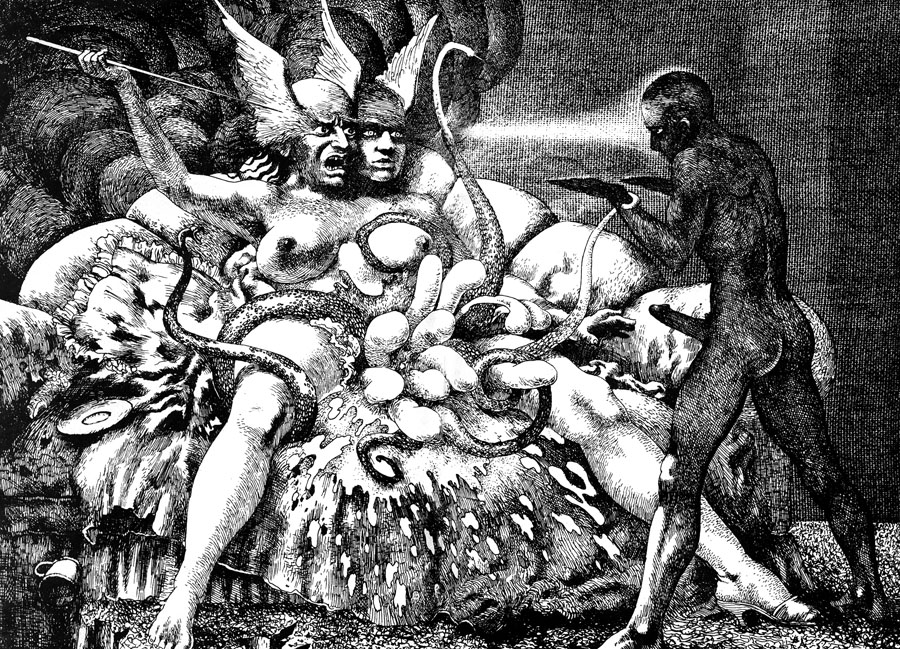
leon1.jpg

Psychopathia Sexualis (1967).

This, dear friends, is what the art of the fantastic could give us but rarely does, something which combines the metaphysical intensity of the Symbolists with a post-Freudian sensibility to create what Philip José Farmer once called “the pornography of the weird”. Jim Leon was a British artist whose work gained prominence via the underground magazines of the 1960s, especially Oz, although he was never really a psychedelic artist as such. Many of his earliest paintings show the influence of the Pop artists, it was only later in the decade that a distinctly original and surreal imagination came to the fore. Oz was always pretty scurrilous and had no qualms about challenging the authorities with bizarre sexual imagery which other magazines would never dare to print. Leon and other artists were fortunate to have such a public forum for outré work, a few years earlier or later and they might not have found an outlet at all.

leon2.jpg

Untitled (1979).

His early work blended influences from Francis Bacon, surrealism and the baroque. Lurking there is also the English visionary William Blake, together with the obsessive Romanticism of the pre-Raphaelites. A number of his early paintings and drawings refer to William Burroughs’s Naked Lunch (first published in Paris in 1959). These were just some of the ingredients of an amazing, semi-abstract, spatially complex, ritualistic, orgiastic flesh-painting, expressing highly wrought morbidity, eroticism, transcendence and ecstasy; astonishing explorations of the murkier depths of the human mind. (More.)

A Very English Visionary by Simon Wilson.

I first encountered Leon’s work thanks to David Britton’s curating of a portfolio feature in Wordworks magazine which was republished in the Savoy Books anthology, The Savoy Book in 1980. Having seen a Leon painting in a back issue of Oz I was surprised that an artist with such a powerful imagination was so little-known. It turns out that he’d been working all along, albeit far from the public gaze, having moved to Lyons in France where he spent the 1970s and 80s painting many canvases of mystical scenes similar to those produced by the California artists featured in the Visions book. None of his later work explores the darker realms of his earlier Psychopathia Sexualis drawings, and since it’s the early work that I prefer, that’s what’s featured here. These drawings and paintings bear comparison with the art of Raymond Bertrand but where Bertrand has had his work published in lavish book collections, we have to rake through back issues of magazines for Leon’s endeavours. Leon’s later paintings at least have a website which is maintained by his family.

Continue reading “The art of Jim Leon, 1938–2002”

Weekend links 6

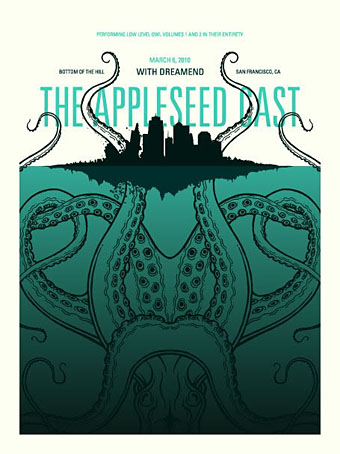
dkng.jpg

Shades of Toho: the city of San Francisco encounters its octopoid nemesis on this gig poster from DKNG. Via OMG Posters!

• Related to the above: Godzilla Haiku.

View from Another Shore: a fantastic (so to speak) and overdue interview with Franz Rottensteiner, writer and editor of landmark studies of fantasy and science fiction.

Ronald Searle: a life in pictures: an appreciation by Guardian cartoonist Steve Bell.

• 832 masks: The Maskatorium at Flickr.

The Cult of the Theremin: lots of theremin links including this page of scans from a beautiful Art Deco theremin brochure. (Thanks to Kara for the tip!) Related: the DIY IKEA lamp theremin.

Music & Science Fiction, an exhibition at Maison d’Ailleurs.

• Nathalie found a stoned angel in Rome.

• EVB’s Boy of the Week is a Spanish guy in his underwear drawn by Jacobo Labella.

• Film of the month: Sally Potter’s Orlando on DVD, featuring the luminous enigma of Tilda Swinton.