Cthulhu under glass

bl-exhibition.jpg

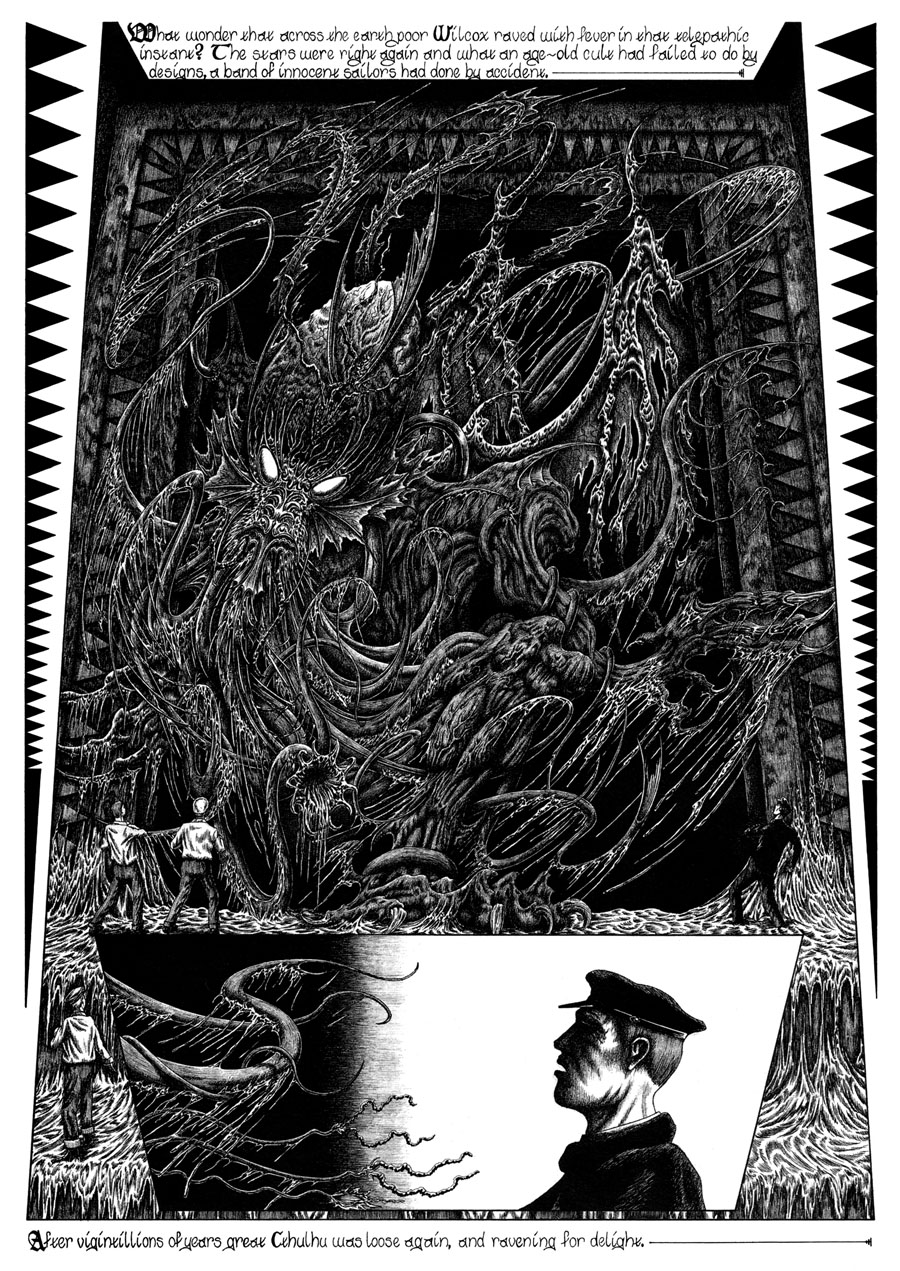
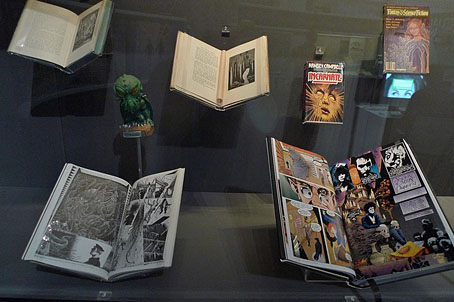
Having had two separate visitors to the British Library’s Out of this World exhibition tell me that some of my work was featured there, it’s been a good to finally discover what was on display. Many thanks to John Keogh for notifying me of his exhibition photo set which includes the above shot of the relevant display case. This is an odd collection for what’s been widely advertised as a science fiction event. Pages from my 1988 adaptation of The Call of Cthulhu are in there along with other fantasy and horror titles including Neil Gaiman’s Sandman, Incarnate by Ramsey Campbell, an edition of Fantasy & Science Fiction with Robert Holdstock’s Mythago Wood on the cover, and a Sidney Sime illustration for Lord Dunsany’s Gods of Pergana. Cthulhu originates out of this world, of course, and that phrase is general enough to encompass other genres.

coulthart-cthulhu.jpg

This page from the climax of Lovecraft’s story was the first drawing I made of the living Cthulhu, all earlier representations following Lovecraft’s scheme of the creature manifesting throughout history in different human artworks and religious icons. Since most of those representations are highly stylised I wanted to make the awful reality seem a lot more visceral and even incoherent, hence the mass of flailing tentacles and ropes of slime. This is also the only full view you receive, everything else is fragmentary and allusive so there’s space for the reader’s imagination. I think the book in the library display is the Lovecraft anthology The Starry Wisdom but The Call of Cthulhu is also present in my Haunter of the Dark collection which includes a couple more portraits of “the green, sticky spawn of the stars”.

Out of this World is a free exhibition which will run to September 25th, 2011.

Elsewhere on { feuilleton }
The Lovecraft archive

Sibylle Ruppert revisited

ruppert1-1.jpg

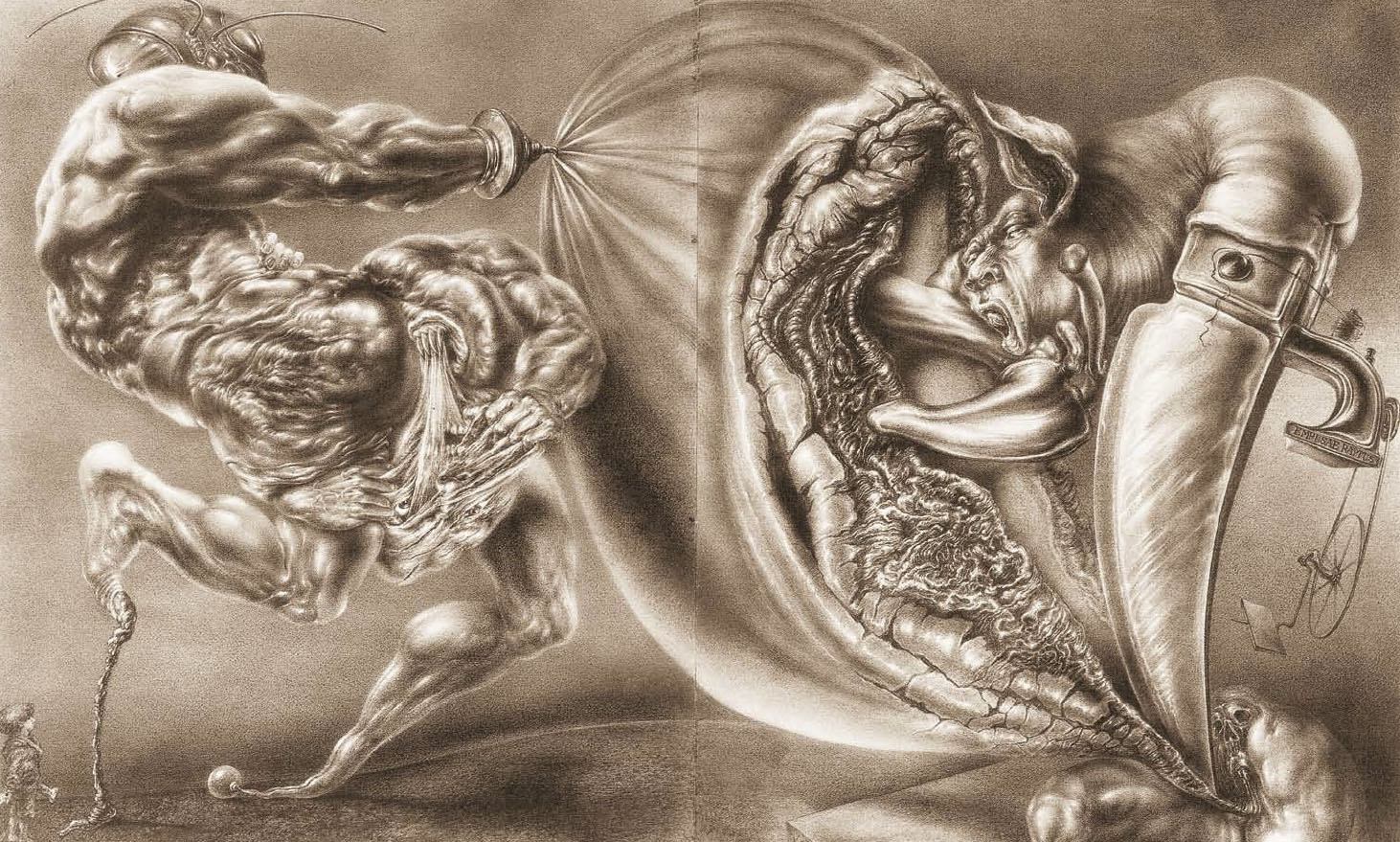
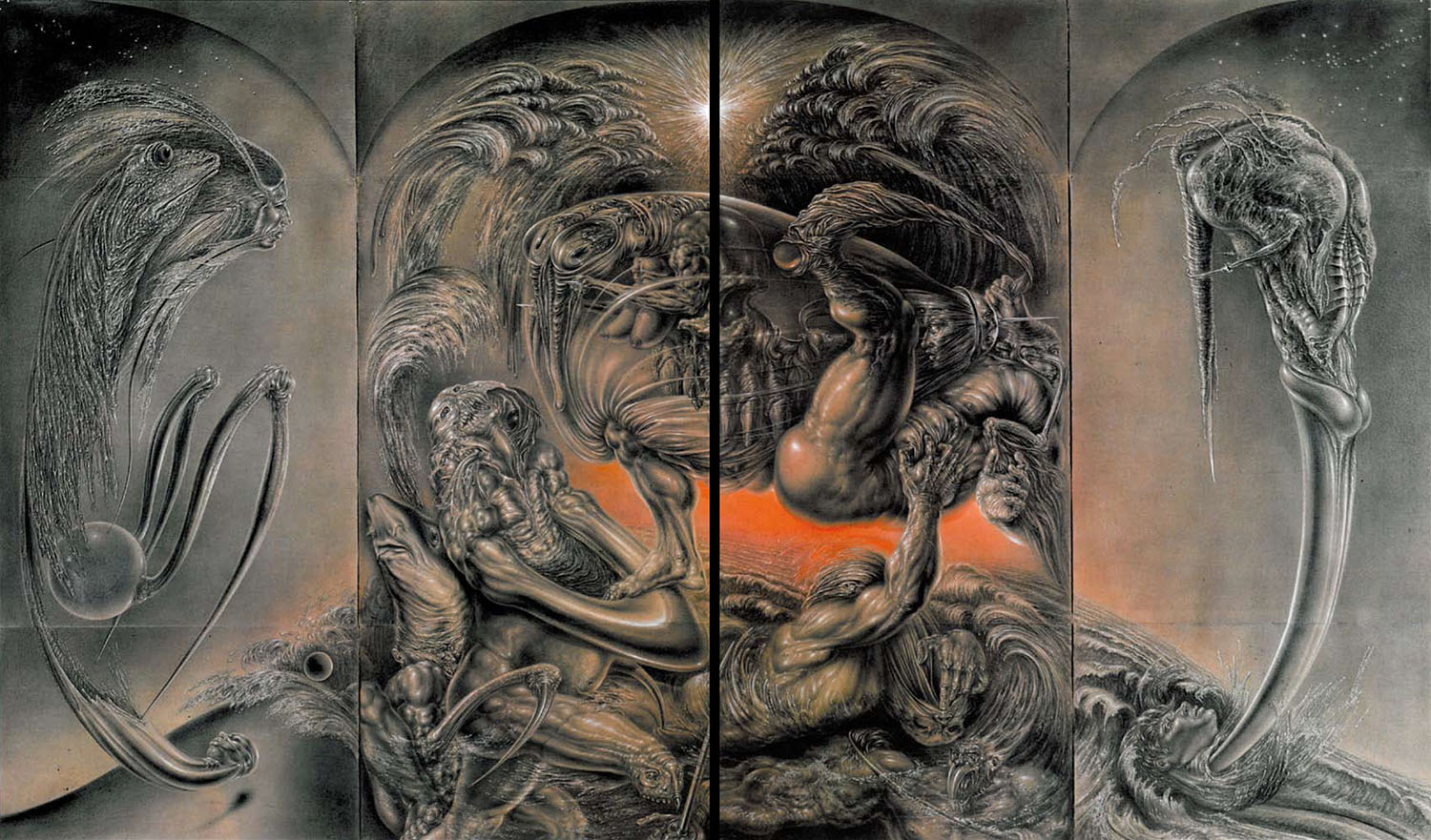
Empusae Raptus (1977).

Another post about this astonishing artist (I’ll keep talking about her if no one else does…). The pictures here are taken from the catalogue for the 2010 Sibylle Ruppert exhibition at the HR Giger Museum, Gruyères, Switzerland. Leslie Barany was good enough to send me a copy of this, and the pictures are posted courtesy of the museum. To purchase a copy of the catalogue contact marcowitzig@gigerworkcatalog.com

ruppert2-1.jpg

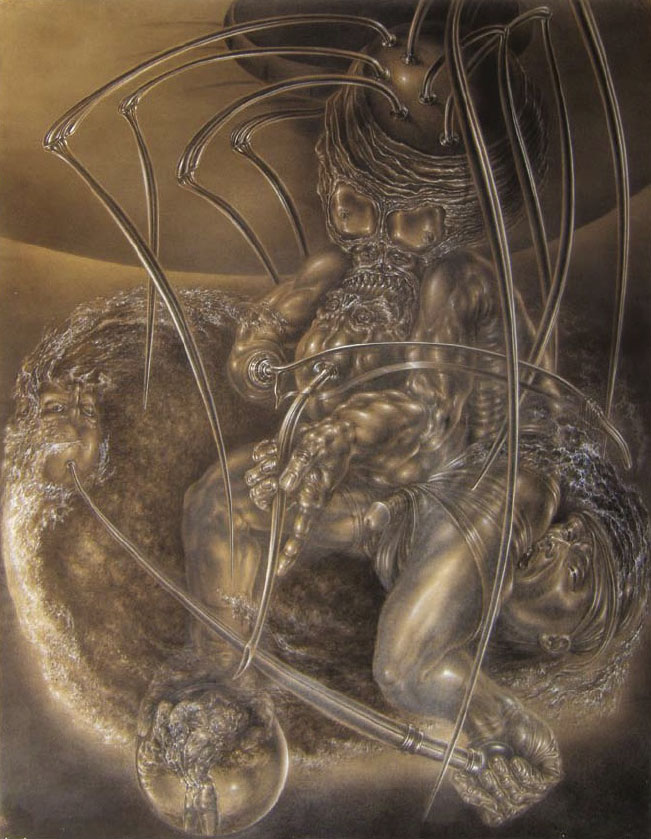
Le Chant de Maldoror (1978).

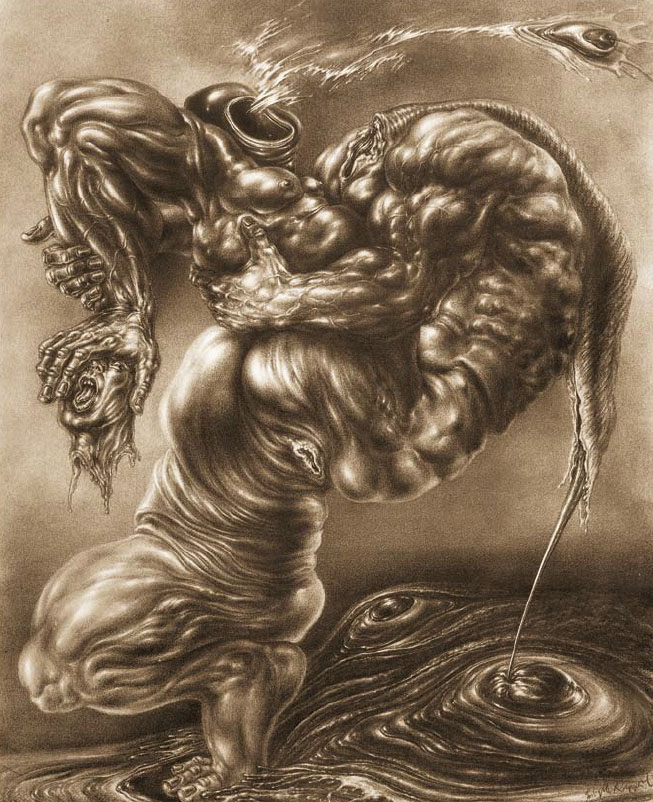
Looking over Sibylle Ruppert’s work this week I’ve been pondering why she wasn’t better known. She was working throughout the 1970s and could easily have been swept up in the vogue for fantastic art when it was being popularised by Omni magazine. Giger, Mati Klarwein, Robert Venosa, De Es Schwertberger and others all benefited from Bob Guccione’s publication, and to a lesser degree from appearances in Heavy Metal magazine. Ruppert’s lack of visibility may have been a result of the usual situation whereby women artists were overlooked or marginalised. But I think it’s far more likely that her work was simply too intense and visceral for the newsstands. Giger could get by with paintings like the semi-abstract NY City series which were attached to science fiction stories without causing a stir. It’s difficult to imagine Ruppert’s work gaining such a popular acceptance, especially in the United States where, lest we forget, Giger’s Penis Landscape did cause a stir in 1985. One of the great benefits of the web is the way so much previously buried culture is surfacing and finding new and enthusiastic audiences. Sibylle Ruppert’s greatest audience has yet to find her but they’re surely out there, you can’t keep work of this quality buried forever.

For a few more Ruppert works see that haven of all things grotesque, Monster Brains.

ruppert3-1.jpg

Le Spectacle de l’Univers (1977).

Continue reading “Sibylle Ruppert revisited”

Sibylle Ruppert, 1942–2011

ruppert1.jpg

La Bible du mal (1978).

Another painter gone, and a really extraordinary one at that. I wrote something about German artist Sibylle Ruppert two years ago, and only heard about her death this week following an email from Leslie Barany of Barany Artists. Leslie also sent copies of recent exhibition material from a Ruppert show last year at the HR Giger Museum in Gruyeres, Switzerland, from which these pictures have been taken. The picture above gives some idea of the intensely visceral nature of her paintings and drawings. Giger owns (or owned) the picture below as he reproduces it in one of his books, along with other works from his personal collection.

ruppert2.jpg

Hit Something (1977).

There was an official site for Sibylle Ruppert’s work but, as is often the case with artist sites, it appears to now be defunct. This is frustrating since her work isn’t very visible on the web at all. Anyone interested could start with this set of Flickr views of the Giger Museum exhibition. She was a fantastic artist in all senses of the word.

The following is a note credited to Alain Robbe-Grillet and some biographical details taken from the gallery materials. They’re presented here as printed:

Je m’avance avec un croissant malaise, apprehension peut-etre, avec lenteur en tout cas, dans une sorte de souterrain tres encombre (engorge, meme, en depit de ses dimensions sans doute considerables), que j’imagine bourre de pieges. (J’allais dire pourri…) La lumiere est vive par endroit, sans que l’on puisse deviner d’Oll elle tombe, laissant tout a cote des plages d’ombre dense, et comme visqueuse. Cependant, meme dans les zones bien eclairees, la precision des lignes est suspecte, car on aurait du mal a rattacher ces fragments trop nets, trop dessines (le trace sans bavure d’une pointe aigue), a quelque figure d’ensemble nommement identifiable. L’impression qui domine, au milieu de cette dangereuse incertitude, est qu’il doit y avoir la une grande quantite de chevaux eventres, des etalons a musculatures massives, avec des herses, et des crocs de boucher, et des socs de charrues, avec aussi des femmes nues aux formes splendides, melees au carnage. Je pense a la mort de Sardanapale, evidemment, mais la scene qui m’entoure se situerait plusieurs minutes apres l’instant fragile immobilise par Delacroix, Oll toutes les courbes du desir sont encore rangees aleurs places diurnes. Tandis qu’icl, devant moi, derriere moi, sur ma droite ou sur ma gauche, et presque sous mes pas, ce qui s’offre aux sens revulses ce sont les hontes secretes de l’anatomie : les orifices ecarteles, les entrailles repandues, les secretions, les pertes. Une pointe aigue, ai-je ditQ Oui, le gluant et l’acere semblent, maintenant, s’engendrer en cercle l’un l’autre, le fin couteau du supplice appartenir au meme monstre que la chair ignominieuse qui s’ entaille (se debonde), les sexes s’invertir, insidieusement, et s’invaginer l’arme du crime. Parvenant non sans peine a vaincre mon horreur, ou bien au contraire enfin vaincu par elle, je me decide a toucher… J’approche une paume tendue, doigts ecartes, vers cette substance innomable… Ma surprise est immense : tout cela est en metal poli, sec, luisant mais dur, et froid comme de la glace. Non, je ne suis pas surpris : je le savais deja, bien entendu.

—Alain Robbe-Grillet

ruppert3.jpg

Sibylle Ruppert was born during an air raid on September 8th, 1942. It was the night of the first massive bombing of Frankfurt during World War II. With a numbered tag around her neck, Sibylle was, immediately whisked from the maternity ward down to the bomb shelter in the basement, while her mother was moved to safety under a supporting column of the hospital staircase.

She spent her infancy between the nursery and an improvised bomb shelter in which plaster fell from the ceiling whenever the bombs hit the neighborhood. In spring 1944 her parents decided to flee Frankfurt for the countryside. Sibylle’s first memories were of the shoving and screaming crowds on the platform of the train station desperately trying to climb into the overcrowded wagons.

Although the family spent the remainder of the war in relative security, they were subjected to mistreatment and greed at the hands of the farmers who gave them shelter. After the war they were taken in by an aristocratic family who owned a castle and Sibylle spent her early childhood years as if in a dream world. Her father was a graphic designer and young Sibylle spent hours upon hours near his desk watching as he drew. One day she seized his hand and promised him that she would paint nice colourful pictures just like him. Her first drawing surprised everyone, it was a brutal illustration of a fist stricking the middle of a face – she was 6 years old.

At age of 10 she had a religious enlightment and she insisted on becoming a nun. Only the great efforts of her parents managed to dissuade her from taking up a novitiate. In school she was not the best, except in her art classes where she far surpassed all the other students to such an extent that her instructors could not believe that she painted the pictures by herself. Secretly she took the entrance examination of the Städel Akkademie and passed brilliantly.With the support of Prof.Battke she worked relentlessly and created up to 20 drawings a day.

Sitting immobile, continuously, behind the drawing board caused her to gain quite some weight, so her mother enrolled her in the neighborhood ballet school. Sibylle tackled her new activity with the same energy and will-power as she did drawing which prompted the school authorities to give her a choice: either art or dance, but not both at the same time. As soon as she turned 18 she solved the problem her own way by escaping to Paris, the city of her dreams, where she enrolled in a dance school in Clichy. During the day she followed the strict regimen of dance classes, but at night she roamed the notorious streets of Pigalle and Montmartre, fascinated by the ambiguous characters in these neighborhoods.

As she was too tall for classical ballet she joined the famous dance ensemble of Georges Rech. This was the beginning of an adventurous life as a revue dancer touring all over Europe and the Middle East. But while her colleagues relaxed Sibylle visited all the local museums and galleries and continued drawing her every free minute. Then all of a sudden, in New York, she decided to give up on her dancing career. She returned to her family in Frankfurt and started working as a drawing instructor at the art school founded by her father.

In addition to her teaching, at night she pursued her own personal work, inspired by the „divine“ Marquis de Sade and his frightful universe. Encouraged by notable German intellectuals like Peter Gorsen, Theodor Adorno and Horst Glaser whom she later married her drawings start to become well known. The exhibitions organised by the Sydow – Zirkwitz Gallery in Frankfurt consternated as much the traditional art audience as they produced raised eye brows among the intellectuals.

In 1976 she moves to Paris and exhibits her large format charcoal drawings, inspired by the writings of de Sade, Lautréamont and Georges Bataille, her collages and paintings at the Gallery Bijan Aalam. French intellectuals and great thinkers like Alain Robbe-Grillet, Pierre Restany, Henri Michaux and Gert Schiff show interest and are fascinated by and try to interpret her infernal work. When the gallery closes in 1982 she returns to teaching drawing and painting. She starts giving art classes in prisons, psychiatric institutions and drug rehabilitation centers. Today, Sibylle Ruppert lives a cloistered life, withdrawn from the public, in Paris.

• See also this later post for more artwork: Sibylle Ruppert revisited

Elsewhere on { feuilleton }
The fantastic art archive

Previously on { feuilleton }
The art of Sibylle Ruppert

Weekend links 61

knaus.jpg

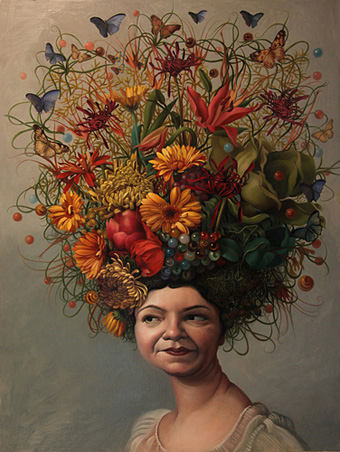
Marbles and Butterflies (2011) by Jennifer Knaus.

• “Cutter’s Way is a cinematic masterpiece” says John Patterson. Yes, it is, and it’s often been difficult to see (although it’s now on DVD) being one of those cult films that rarely surfaced on TV or video. Another cult film surfacing at last is Jerzy Skolimowski’s Deep End (yes, again…) which will be out on DVD & Blu-ray next month. I missed this Telegraph piece about the film. You want more? Lint: The Movie is showing at the Kino Club, Brighton, later this month.

• This week’s Eno haul: Developing Your Creative Practice: Tips from Brian Eno; Eric Tamm’s 1995 study Brian Eno: His Music and the Vertical Color of Sound is now available for free at the author’s website; Imagine New Times is an outtake from Eno’s forthcoming Drums Between the Bells which can be downloaded here.

• Mixtapes of the week: Demdike Stare with a suitably sinister and eclectic mix are out-curated by Current 93’s David Tibet who mashes together a unique blend of folk, prog, riffs, choral works and glam rock.

I began to realize the hypocrisy about sexual freedom in the feminist establishment was as bad as it is in the religious right. They do whatever they want. They look at whatever they want, they masturbate to whatever they want, they fuck whoever and however they like. I couldn’t even say everything I know in the book because it would just be too cruel and personally invasive. But I’ve had it with their lying. I spent so long trying to have these earnest conversations and now I’m like, “Fuck you — you’re as bad as the Vatican!”

Susie Bright interviewed by Tracy Clark-Flory at Salon sounding as happy and positive as she always does.

The Gnostic #4 is out this month featuring Alan Moore’s essay on magic and related matters, Fossil Angels, and a piece examining the Gnostic influences on Cormac McCarthy’s Blood Meridian.

• “Nobody should be sent to prison for taking drugs,” says Richard Branson. Many politicians agree with him but they’re all too cowardly to do anything about it.

eng.jpg

Untitled work by Kilian Eng.

The Adventures of Jerry Cornelius, The English Assassin (1969–70). A comic strip written by Michael Moorcock & M John Harrison with art by Mal Dean & Richard Glyn Jones.

The Lavender Scare: The Cold War Persecution of Gays and Lesbians in the Federal Government by David K Johnson is available as a free ebook here.

• “If I was to try to write a mainstream book I would be constantly bumping my elbows up against the restrictions.” Tim Powers is interviewed by Alison Flood.

HOMO Online, Adventures in Homosexuality: Fiction, Fact, Art and Porn.

Your Rainbow Panorama, a new work by Olafur Eliasson.

Self Suck, a poem by Angelo Nikolopoulos.

Map Of Dusk (1987) by Jon Hassell | Lam Lam (1998) by Baaba Maal (with Jon Hassell & Brian Eno) | All Is Full Of Love (1999) by Björk (Guy Sigsworth mix featuring Jon Hassell).

Miwa Yanagi’s fairy tales

yanagi.jpg

Rapunzel (2004).

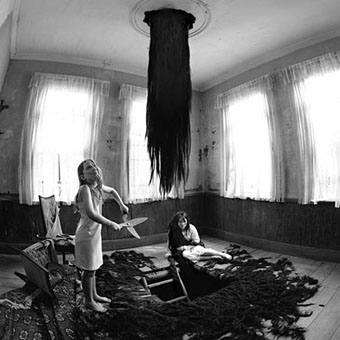
Emphasising the “grim” in the Brothers Grimm is what Japanese artist Miwa Yanagi achieves with Fairy Tale, a series of staged photos. It’s a familiar approach, of course, mining childhood for a darker subtext, and the effect is reminiscent in places of earlier explorers of this disturbing territory such as David Lynch and Jan Švankmajer. But Yanagi adds some twists of her own, not least the alarming figures of young girls masked to resemble old women. Despite being based on tales from the West, there’s a distinctly Eastern flavour to some of these scenes: in Rapunzel the usual golden locks have become a black torrent which can’t help but seem sinister when one recalls the legacy of supernatural hair in ghost stories like Yotsuya Kaidan.

fairytale.jpg

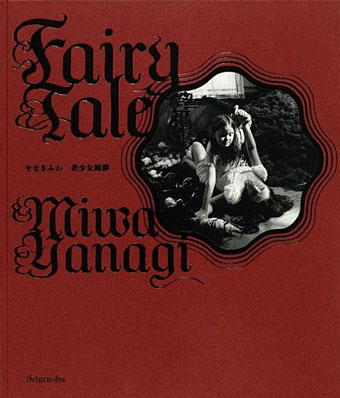
There’s a catalogue of these works available although the text may well be Japanese-only. And speaking of Švankmajer, it’s worth noting again that Alice is now available on DVD. David Moats enthuses about the film here.

Thanks to Gabriel for the Yanagi tip!

Previously on { feuilleton }
Kwaidan
The art of Maleonn Ma