Owls and flowers

1: The pattern

pattern.jpg

A plate design by Christopher Dresser.


2: A novel by Alan Garner

garner.jpg

The Owl Service (1967). Cover design by Kenneth Farnhill.


3: A Granada TV serial

granada.jpg

The Owl Service (1969). Eight episodes, written by Alan Garner, directed by Peter Plummer.


4: A diversion

clockwork.jpg

Chapter 8 of The Owl Service.

hills.jpg

Gillian Hills as Alison in The Owl Service.

aco.jpg

Gillian Hills (left) as Sonietta in A Clockwork Orange (1971).


5: A single by Pram

pram.jpg

The Owl Service (2000) by Pram. Cover art by Mary Jo Bole.


6: Ghost Box

belbury.jpg

The Owl’s Map (2006) by Belbury Poly. Design by Julian House.

Track 1: Owls And Flowers

advisory.jpg

As The Crow Flies (2011) by The Advisory Circle. Design by Julian House.

Track 11: Learning Owl Reappears


7: A group

owlservice.jpg

The Owl Service.


8: A Folio Society edition

hopes.jpg

The Owl Service (2013) by Alan Garner, illustrated by Darren Hopes.


9: Twelve audiological pathways

ayitc.jpg

In Every Mind: Transmission Resonances, Volume 1 (2015) by A Year In The Country.

Transmission Resonances: Volume 1 takes as its wellhead the continuing reverberations of the 1969 cathode ray version of Alan Garner’s The Owl Service.

It pushes open the attic door from whence the scratching descends and travels to places that surprised, intrigued and even delighted our good selves when it was being shaped on our own particular audiological potters wheels.

Previously on { feuilleton }
To Kill a King by Alan Garner
Red Shift by Alan Garner

Laurence Housman’s End of Elfintown

elfin01.jpg

More Laurence Housman, and a book I’d not seen before. Jane Barlow’s The End of Elfintown (1894) is a typical piece of Victorian fairy poetry—her “elves” are also flower-dwelling “Fays”, and Oberon is mentioned—but Housman’s renderings give a very different impression. In place of the usual delicate creatures he shows a very sensual company, all satyr ears and enormous Pre-Raphaelite manes. The frontispiece is very Beardsley-like, especially those entwined roses.

elfin02.jpg

elfin03.jpg

Continue reading “Laurence Housman’s End of Elfintown”

La Ronde du Sabbat

hugo1.jpg

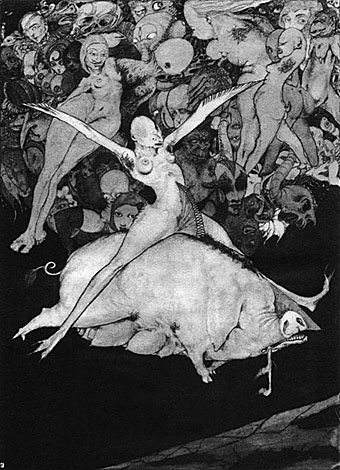
This is too late for Walpurgisnacht (although it’s still night at this moment) but the 1st May is Beltane, and this is a very pagan drawing. The artist is Louis Boulanger, a friend of Victor Hugo’s here illustrating one of the author’s poems for Cent Dessins: Extraits des Oeuvres de Victor Hugo, illustrations for Hugo’s poetry, fiction and drama. Much of the work is mediocre or dull but this surprisingly excessive picture would have stood out even among better company. Many of the illustrations are engravings from paintings—one is an adaptation of Delacroix’s Liberty Leading the People—but the copy of Boulanger’s painting wanders freely from the original which is a much more typical piece of Romantic art. The engraver was Fortuné-Louis Méaulle who really ought to share a credit with the original artist.

hugo2.jpg

A few of the more notable illustrations follow, one of which is yet another artwork on the perennial theme of man versus cephalopod.

hugo3.jpg

Continue reading “La Ronde du Sabbat”

Symbolist Temptations

khnopff.jpg

The Temptation of St Anthony (1883) by Fernand Khnopff.

This should really be more Symbolist Temptations since Odilon Redon belongs among these artists. Redon may have devoted more of his time than anyone else to the saint’s travails but other artists also took up the theme. Fernand Khnopff seldom depicted religious subjects but his painting—an early work—is remarkable for the way it reduces the phantasmagoric pageants of previous centuries to a simple face-to-face confrontation.

rops.jpg

The Temptation of St Anthony (1878) by Félicien Rops.

Félicien Rops, on the other hand, can always be relied upon to be vulgar and blasphemous in equal measure. The Devil lurking behind the cross was probably added to balance the composition but that silly expression makes the picture seem more comical than shocking. Similar skull-faced cherubs may be found in other Rops prints.

Continue reading “Symbolist Temptations”

Odilon Redon’s Temptations

redon09.jpg

Saint-Antoine: Au secours, mon Dieu! (Saint Anthony: Help me, O my God!)

St. Anthony and his temptations provide another connection between the Surrealists and the Symbolists via Gustave Flaubert and his phantasmagoric drama. Flaubert’s The Temptation of St Anthony (1874) doesn’t quite stand in relation to the art of the time as does Oscar Wilde’s Salomé but, with its predominant themes of sex, death and spiritual transcendence, it both suited and pre-empted the concerns of the Decadence. Odilon Redon was particularly taken with the book, and from 1888 to 1896 produced three sets of lithograph illustrations. The examples here are from the final set of 24 images. A few of these are the ones you see most often in Symbolist studies, often in poor reproductions, but the other sets have some memorable moments. What’s most notable about all the drawings is how little the saint appears in them, Redon choosing to depict either the visions or the subjects of Flaubert’s philosophical discussions. See the complete set here.

redon10.jpg

Et partout ce sont des Colonnes de basalte, … la lumière tombe des voûtes (And on every side are columns of basalt, … the light falls from the vaulted roof)

redon11.jpg

Mes baisers ont le gout d’un fruit qui se fondrait dans ton cœur! … Tu me dédaignes! Adieu! (My kisses have the taste of fruit which would melt in your heart! … You distain me! Farewell!)

redon12.jpg

Des fleurs tombent, et la tête d’un python paraît (Flowers fall and the head of a python appears)

Continue reading “Odilon Redon’s Temptations”