Tentacles #5: Art Nouveau

watch.jpg

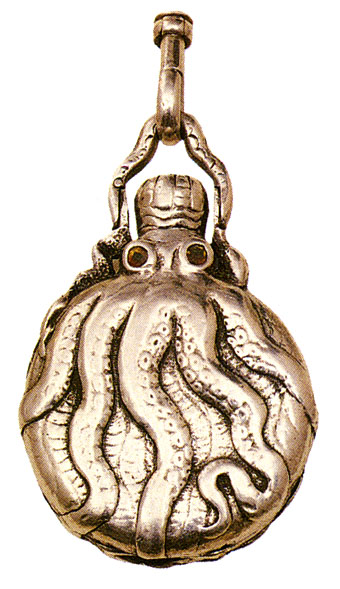
Fob watch (c. 1890) made by Gorham for Tiffany.

Concluding a week of tentacular posts. I was tempted to do something about tentacle porn but that subject has already been covered here, and besides, there’s rather a lot of it around these days. Given the writhing nature of octopus limbs you’d expect there to be far more octopoid Art Nouveau design than there is. The Art Nouveau style was exceptional in allowing the octopus to become a design motif, probably the first time in Western Europe the animal had been given its decorative due since the Ancient Greeks, Minoans and other Mediterranean civilisations used it to pattern dishes and vases. The remoteness of the animal is no doubt one reason it was shunned for so long in northern countries: British sailors used to refer to octopuses as “devil-fishes”, a term that appears in William Hope Hodgson’s fiction. Octopuses in Europe weren’t part of the general culture the way they are in Japan. It took the appearance of Ernst Haeckel’s Kunst-Formen der Natur, published from 1899 to 1904, to bring the aesthetic attractions of the stranger varieties of marine life to a wide audience.

ledru.jpg

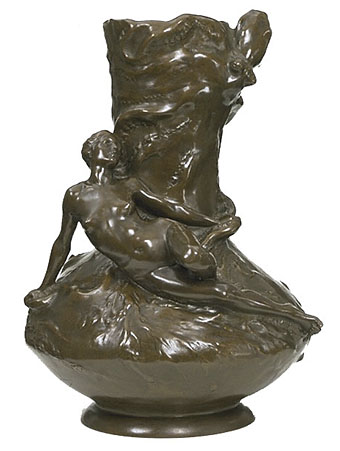
The Prey (1895), bronze by Auguste Ledru.

vignette.jpg

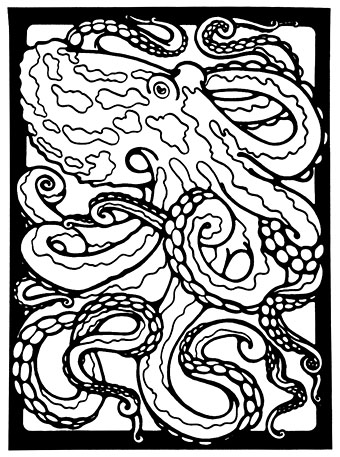
From Animal Vignettes (c. 1900)

rothmuller1.jpg

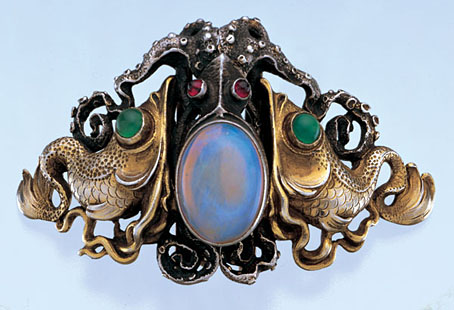
Buckle in silver, gilt, opal, garnet, chalcedony (c. 1900) by Karl Rothmüller.

Continue reading “Tentacles #5: Art Nouveau”

Weekend links 126

dogo.jpg

Mala Reputación (1991) by Dogo Y Los Mercenarios. Cover art by Nazario Luque.

Artist Nazario Luque was Spain’s first gay comic artist who’s also known for the drawing which appeared (without permission) on the sleeve of Lou Reed Live – Take No Prisoners in 1978. On his website Nazario says he’s been described as “Exhibicionista, solidario, provocador, agitador moral, rompedor, arriesgado, polifacético, transgresor, canalla, pintiparado, morigerado o simplemente superviviente…” Via Música, maestros, a two-part post (second part is here) about album cover art by comic artists.

• The BBC Radiophonic Workshop Returns. And quite conveniently, Ubuweb posts some original Radiophonic creations by electronic music genius Delia Derbyshire. Ms Derbyshire is profiled along with her other pioneering colleagues in an hour-long TV documentary, Alchemists of Sound.

• Tor.com celebrates the fiction of Shirley Jackson. Too Much Horror Fiction has a substantial collection of Shirley Jackson book covers.

Phantasmagorical and all but plotless, Nightwood flings itself madly upon the night, upon Wood, and upon the reader. Its sentences pomp along like palanquins and writhe like crucifixions. They puke, they sing. Their deliriums are frighteningly controlled. […] TS Eliot loved Nightwood so much that he shepherded its publication and wrote the introduction to the first edition. Dylan Thomas complimented it with his left hand by calling it “one of the three great prose books ever written by a woman” and with his right hand by stealing from it. […] Nightwood’s Dr. Matthew-Mighty-grain-of-salt-Dante O’Connor, florid monologist and transvestite, seems to have been a model (along with Captain Ahab) for Judge Holden in Blood Meridian. The difference is that Cormac McCarthy’s Judge is essentially Satan, whereas O’Connor is essentially Christ; they’re only just on opposite sides of the border of madness.

Austin Allen on The Life and Death of Djuna Barnes, Gonzo “Greta Garbo of American Letters”. There’s a lot more Djuna Barnes at Strange Flowers.

• Out at the end of the month, Extreme Metaphors, interviews with JG Ballard, 1967–2008, edited by Simon Sellars & Dan O’Hara.

• The favourite Polish posters of the Brothers Quay. Over at Cardboard Cutout Sundown there are more Quay book covers.

• The Mancorialist: people on the streets of Manchester are given the Sartorialist treatment.

• The Liverpool International Festival Of Psychedelia takes place on 29th September.

• The Caves of Nottingham are explored in a detailed post at BLDGBLOG.

• In Remembrance: Bill Brent, Groundbreaking Queer Sex Publisher.

• Confessions of a Bookplate Junkie

• The Uranus Music Prize 2012

• Fuck Yeah René Lalique

• Dr Who: original theme (1963) by Ron Grainer with Delia Derbyshire | Falling (1964) by Delia Derbyshire | The Delian Mode (1968) by Delia Derbyshire | Blue Veils And Golden Sands (1968) by Delia Derbyshire.
Rue St. Augustin, then and now

augustin1.jpg

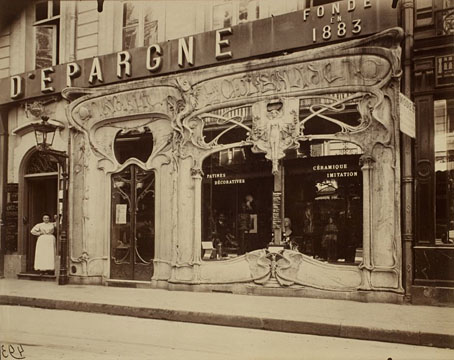
Boutique art nouveau, 45 rue st. Augustin (2e arr, 1904–05).

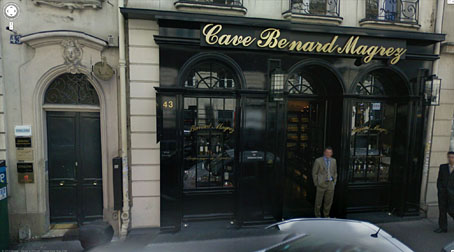
Despite being reasonably familiar with Eugène Atget’s celebrated photos of Paris, this picture of a very elaborate Art Nouveau façade is something I’d not seen until now. The photo is part of the George Eastman House collection of Atget prints, and is unusual for showing a very contemporary shopfront. Atget generally preferred premises redolent of an older, pre-Haussmann Paris, like the window full of barometers at Au Griffon, 39 Quai de l’Horloge. The Rue St. Augustin façade is an especially baroque example of Art Nouveau excess with a flying fish, a large butterfly (or moth) supporting the window, and the ubiquitous fin de siècle female floating above it. Naturally I had to know if the decor had survived but a quick look at Google Maps revealed the mundane scene below. The apartment entrance next door is pretty much unchanged but the wine shop that’s there now shows no traces of its delirious past.

augustin2.jpg

Previously on { feuilleton }
• Hector Guimard elevations
• Infernal entrances
• Hector Guimard sketches
• Temples for Future Religions by François Garas
• Elizabetes Iela 10b, Riga
• Atelier Elvira
• Louis Bonnier’s exposition dreams
• The Maison Lavirotte
• The House with Chimaeras

Hector Guimard elevations

guimard1.jpg

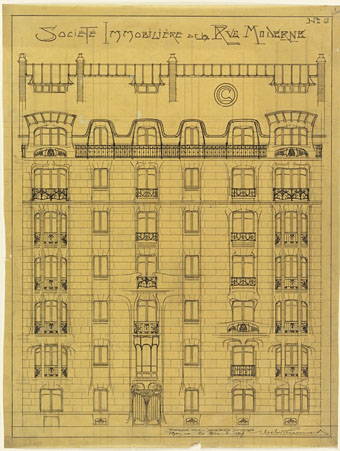
Design for the Facade of Societé Immobilière de la Rue Modern, No. 6 (1909).

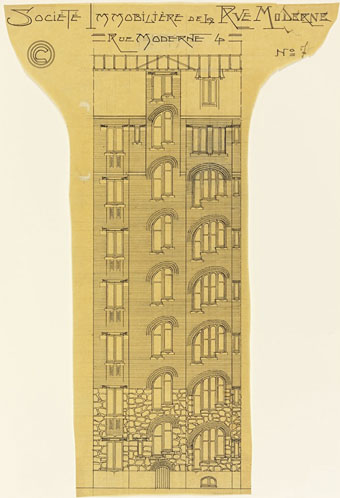
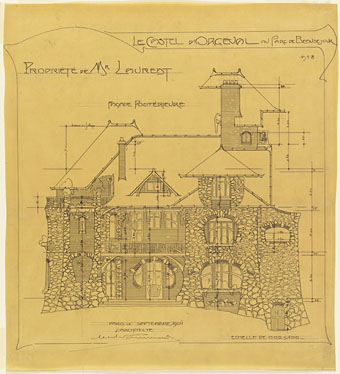
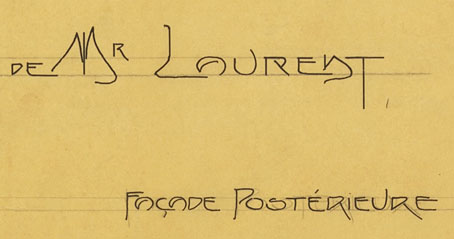
Drawings by French architect and designer Hector Guimard (1867–1942), the man who gave Paris those plant-like entrances to the Metro stations. The examples here can be seen in greater detail at the Google Art Project where there’s a few more of his works including his typically organic smoking bench. One thing I like about the architectural drawings is seeing the way he stylised his lettering. Frank Lloyd Wright used to do the same on his plans but I doubt there are any architects today who do the same.

guimard2.jpg

Elevation of an Apartment Building, Société Immobilière, rue Moderne (now rue Agar) (1909–11).

guimard3.jpg

Rear Facade, Castel d’Orgeval, Parc Beauséjour, near Paris: Elevation (1904).

guimard4.jpg

Previously on { feuilleton }
• Hector Guimard sketches
• Temples for Future Religions by François Garas
• Elizabetes Iela 10b, Riga
• Atelier Elvira
• Louis Bonnier’s exposition dreams
• The Maison Lavirotte
• The House with Chimaeras

Weekend links 124

despont.jpg

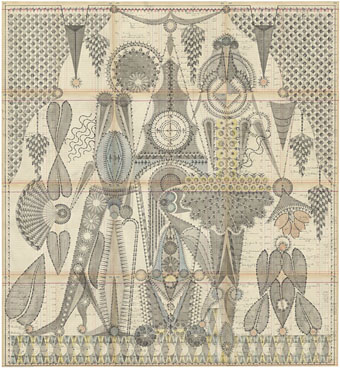
Couple with Clock Tower (2011) by Louise Despont.

Assuming such a thing doesn’t already exist, there’s a micro-thesis to be written about the associations between the musicians of Germany’s Krautrock/Kosmische music scene in the early 1970s and the directors of the New German Cinema. I’d not seen this clip before which shows the mighty Amon Düül II jamming briefly in Fassbinder’s The Niklashausen Journey, a bizarre agitprop TV movie made in 1970. More familiar is the low-budget short that Wim Wenders helped photograph a year earlier showing the Düül performing Phallus Dei. Wenders later commissioned Can to provide music for the final scene of Alice in the Cities. And this is before you get to Werner Herzog’s lengthy relationship with Popol Vuh which includes this memorable moment. Any others out there that I’ve missed?

• Album sleeves in their original locations. And speaking of album sleeves, photo prints of some very famous cover designs by Storm Thorgerson will be on display at the Public Works Gallery, Chicago, throughout September and October.

• Crazy for kittehs: the quest to find the purring heart of cat videos: Gideon Lewis-Kraus goes where few journalists dare to tread. Also at Wired, the same writer explores the Cat Cafés of Tokyo.

• The City of Rotted Names, a “shamelessly Joycian cubist fantasy” by Hal Duncan, available to read in a variety of formats on a pay-as-thou-wilt basis until Monday only.

• Jailhouse rockers: How The Prisoner inspired artists from The Beatles to Richard Hawley.

• How To Survive A Plague, a documentary about HIV/AIDS activism in the US.

• Deborah Harry: hippy girl in 1968, punk in 1976, and Giger-woman in 1981.

• Alan Garner answers readers’ questions about his new novel, Boneland.

• For steampunk aficionados: ‘COG’nitive Dreams by Dana Mattocks.

• David Bowie, Iggy Pop, Madonna & Asparagus: Kraftwerk in 1976.

• New music videos: Goddess Eyes I by Julia Holter | Sulphurdew by Ufomammut | Warm Leatherette by Laibach.